Introduction
On 15 August 1947, while the rest of India was celebrating its hard-won independence, the princely state of Hyderabad was engulfed in violence, uncertainty, and turmoil. The Nizam of Hyderabad, Mir Osman Ali Khan, sought to keep his state independent rather than accede to India. Backed by his private militia, the Razakars, led by Qasim Razvi, Hyderabad became a hotspot of communal violence, repression, and political intrigue.
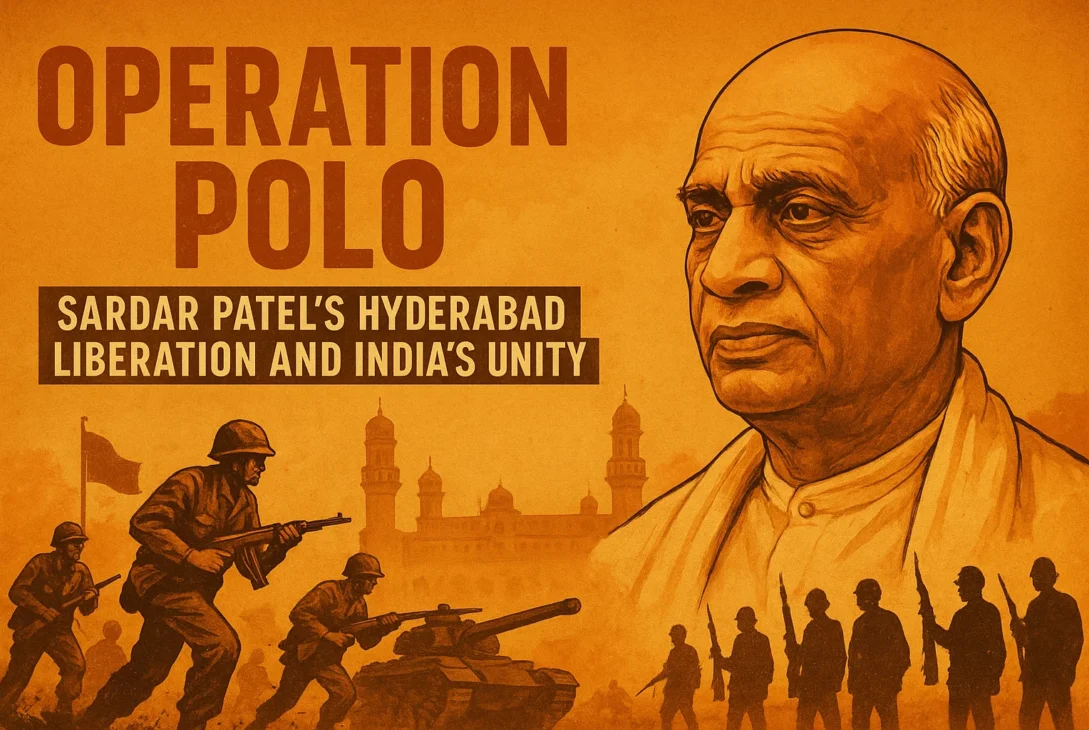
It was Sardar Vallabhbhai Patel‘s decisive leadership and the Indian Army’s swift action through Operation Polo in September 1948 that finally ended the crisis and ensured Hyderabad’s integration into the Indian Union.
Hyderabad’s Troubled State After Independence
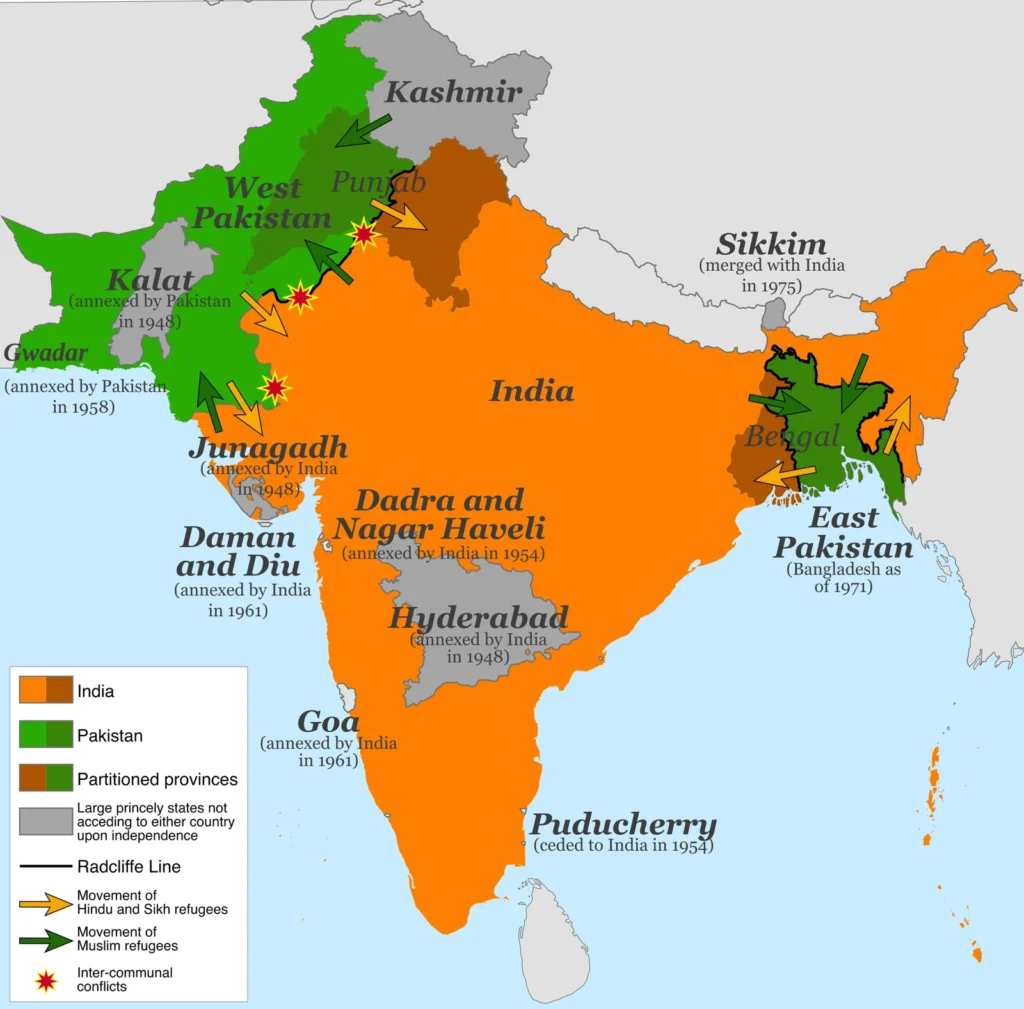
When the British left India in 1947, they allowed princely states the option to join India, Pakistan, or remain independent. While most rulers agreed to merge with India, Hyderabad’s ruler, the Nizam Osman Ali Khan, chose independence.
Hyderabad was the largest princely state in terms of population and the second-largest in area, covering present-day Telangana along with parts of Karnataka and Maharashtra. Despite having an over 80% Hindu majority, the Nizam insisted on maintaining an independent Islamic state.
The Nizam’s immense wealth gave him confidence—he was once the richest man in the world, with his own army, railway, and even a separate currency called the Osmania Sicca, which was valued higher than the British pound.
But beneath this royal pride, Hyderabad’s people, especially its Hindu majority, suffered under the violent oppression of the Razakars. Trains were looted, villages burned, and innocent civilians tortured and killed.
source: wikimedia
The Rise of Qasim Razvi and the Razakars
Qasim Razvi, leader of the Razakars and president of the Majlis-e-Ittehadul Muslimeen, spearheaded the movement to turn Hyderabad into an Islamic state. He openly incited hatred and violence against Hindus, vowing to resist India at any cost.
The Razakars, numbering in the thousands, terrorized Hyderabad’s Hindu population and violently suppressed voices calling for integration with India. Alongside them, the Communist-led Telangana rebellion also created unrest, adding to the chaos.
India’s Dilemma and the Standstill Agreement
The Indian government, led by Prime Minister Jawaharlal Nehru and Governor-General Lord Mountbatten, initially preferred a peaceful solution. On 29 November 1947, a Standstill Agreement was signed, allowing Hyderabad to retain control over its internal affairs, while defense, foreign policy, and communications remained under India’s oversight.
However, the Nizam violated the agreement, secretly stockpiling arms and seeking international support. He reached out to Pakistan, Britain, and European nations, attempting to procure modern weapons. With Pakistan’s encouragement, he even extended a loan of ₹100 crore to them.
British arms dealer Sidney Cotton smuggled weapons from Pakistan into Hyderabad, using secret air routes. Meanwhile, Razvi’s atrocities continued unchecked.
Patel’s Patience and the Final Decision
Unlike Nehru’s cautious approach, Sardar Vallabhbhai Patel was convinced that Hyderabad could not be allowed to remain independent. He famously called it a “cancer in the belly of India” that threatened the nation’s unity and security.
By mid-1948, circumstances changed in India’s favor:
- Lord Mountbatten had resigned and left India in June.
- Pakistan’s founder, Muhammad Ali Jinnah, died on 11 September 1948, leaving Pakistan politically unstable.
Patel saw this as the right moment to act. On 13 September 1948, India launched Operation Polo, a military offensive described diplomatically as a “police action” to avoid international criticism.
Operation Polo: The Military Action
The Indian Army deployed 36,000 soldiers under Major General J.N. Chaudhuri. They entered Hyderabad from multiple directions:
- From the West: Solapur to Secunderabad route led by Major General Chaudhuri.
- From the East: Vijayawada sector commanded by Major General Ajit Rudra.
- Other smaller groups advanced from different borders, swiftly overwhelming the Nizam’s forces.
Despite having nearly 24,000 state troops and over 200,000 Razakars, Hyderabad’s defense collapsed against the disciplined Indian Army. Key battles were fought at Naldurg Fort and other strategic points, where Indian forces quickly gained ground.
By 17 September 1948, just five days after the operation began, the Nizam surrendered unconditionally. Hyderabad was officially integrated into India.
Aftermath and Legacy
The results of Operation Polo were decisive:
- Over 1,300 Razakars and 800 Hyderabad State troops were killed.
- 66 Indian soldiers attained martyrdom.
- Qasim Razvi and about 18,000 Razakars were imprisoned.
Razvi was later released in 1957 and exiled to Pakistan, where he handed over his political party, the Majlis-e-Ittehadul Muslimeen, to Abdul Wahid Owaisi. Today, that party survives as the All India Majlis-e-Ittehadul Muslimeen (AIMIM), led by Asaduddin Owaisi.
The operation’s name, Operation Polo, was chosen as a symbolic gesture—Hyderabad had the largest number of polo grounds in the world at the time, a reflection of the Nizam’s luxury and detachment from his people’s plight.
Conclusion
Operation Polo was not merely a military campaign; it was a decisive moment in India’s history that preserved the nation’s unity and integrity. Sardar Vallabhbhai Patel’s foresight and determination ensured that Hyderabad did not become a second Pakistan in the heart of India.
Every year, 17 September is observed as Hyderabad Liberation Day, commemorating the courage of those who fought against oppression and the vision of leaders who united India.