Introduction
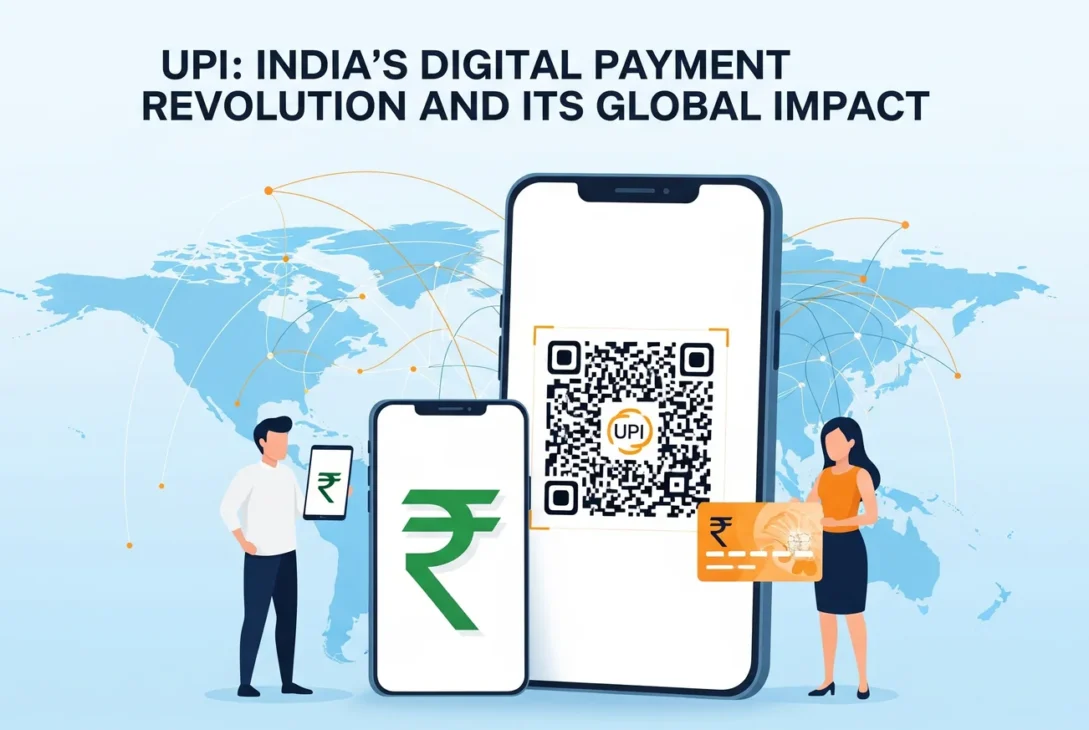
Digital payments in India have witnessed one of the most dramatic transformations in global financial history. While the world often associates technological breakthroughs with the United States or China, India quietly built a payment system that outperformed them both in speed, scale, and inclusivity. That system is the Unified Payments Interface, commonly known as UPI.
In less than a decade, UPI moved India from cash-heavy transactions to instant, mobile-first payments. It eliminated friction, removed fees, empowered small merchants, and challenged global payment giants like Visa and Mastercard. More importantly, it brought millions of Indians into the formal financial system.
This article explores how digital payments in India evolved before UPI, why UPI succeeded where others failed, how the UPI payment system works, its impact on fintech in India, and what the future holds for this globally admired innovation.
History of Digital Payments in India Before UPI
The history of digital payments in India did not begin with smartphones. Long before QR codes and UPI IDs, banking systems relied on paperwork, manual verification, and long settlement cycles.
Early Payment Systems Introduced by RBI
The Reserve Bank of India introduced several electronic systems to modernise banking:
- ECS (1990): Designed for bulk payments like salaries and pensions. It lacked flexibility.
- RTGS (2004): Enabled real-time transfers above ₹2 lakh but required heavy infrastructure.
- NEFT (2005): Allowed smaller transfers but worked in time batches.
- IMPS (2010): Enabled instant mobile transfers but remained complex for users.
Despite these systems, digital payments in India remained inaccessible for ordinary citizens. Adding beneficiaries, remembering IFSC codes, and waiting hours for settlement discouraged adoption.
Birth of the Unified Payments Interface
Why UPI Was Different
In 2016, NPCI launched the Unified Payments Interface to solve usability, cost, and accessibility problems. Built on the IMPS backbone, UPI introduced a revolutionary idea: abstracting banking complexity from users.
Instead of account numbers, users could pay using:
- UPI IDs
- QR codes
- Mobile numbers
Transactions became instant, free, and available 24/7.
This shift marked the true beginning of cashless payments in India.
How the UPI Payment System Works
Architecture Behind UPI
The UPI payment system acts as a real-time messaging layer between banks. It does not store money. Instead, it routes payment instructions securely.
Key components include:
- NPCI switch
- Issuer bank
- Acquirer bank
- Third-party apps like PhonePe, Google Pay, and BHIM
Each transaction uses two-factor authentication and real-time settlement.
Why This Architecture Scaled So Fast
Unlike card networks, UPI:
- Has zero MDR
- Uses lightweight infrastructure
- Allows interoperability across banks and apps
This design explains how UPI works in India at massive scale.
Difference Between UPI and IMPS
Many users ask about the difference between UPI and IMPS.
IMPS:
- Requires bank details
- Has per-transaction limits
- Less intuitive user experience
UPI:
- Uses virtual IDs
- Supports pull & push payments
- Works seamlessly across apps
UPI did not replace IMPS. It simplified it.
How UPI Disrupted Fintech India
UPI reshaped fintech in India in three ways:
Impact on Small Businesses
Street vendors, kirana stores, and tea stalls adopted QR codes instantly. No POS machines. No fees.
Decline of Card Networks
Visa and Mastercard depend on MDR. UPI eliminated it, forcing global players to rethink pricing.
Inspiration for Global Systems
The US launched FedNow in 2023. Experts openly acknowledged UPI as an inspiration.
Global Expansion of UPI
NPCI created NPCI International Payments Limited (NIPL) to export UPI.
UPI is now accepted in:
- Singapore
- UAE
- Bhutan
The long-term goal is to reduce reliance on SWIFT, whose geopolitical risks were exposed during the Russia-Ukraine war.
Challenges Facing UPI
Despite success, challenges remain:
- Infrastructure stress
- Zero revenue model
- Transaction failures
- Global resistance
To solve disputes, RBI is building UDIRS, a centralised resolution system.
Future of UPI in India
The future of UPI in India includes:
- Credit card integration
- Offline UPI
- Cross-border remittances
- Financial data monetisation
If adopted globally, UPI could redefine international payments.
Conclusion
The rise of digital payments in India is not just a technology story. It is a governance success, a policy triumph, and a people-driven revolution. From cash queues to QR scans, UPI changed how India pays.
As UPI expands globally, it positions India not just as a user of fintech, but as its architect.
UPI is no longer just a payment system. It is India’s blueprint for an inclusive digital economy.