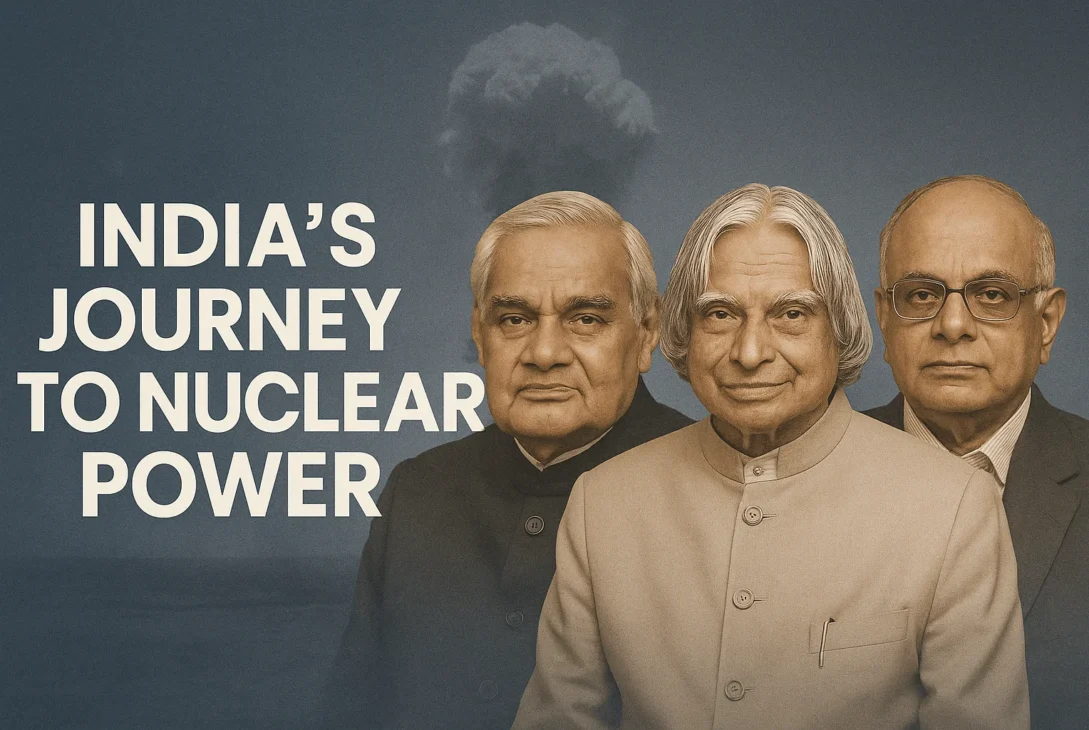
The detonation that shook the Thar Desert on May 11, 1998, marked a turning point in global geopolitics. India’s Pokhran nuclear test announced to the world that a new nuclear power had emerged—one that defied international pressure and charted its own path to strategic autonomy.
India’s journey to becoming a nuclear power represents decades of scientific brilliance, political courage, and unwavering determination. From the first test under Operation Smiling Buddha in 1974 to the definitive 1998 demonstrations, this story encompasses Cold War tensions, regional conflicts, and visionary leaders who refused to compromise national security for the sake of global approval.
This comprehensive account reveals how India navigated international sanctions, outmaneuvered intelligence agencies, and ultimately joined the exclusive club of nuclear-armed nations through sheer will and strategic genius.
The Dawn of the Nuclear Age: Global Context Before Pokhran
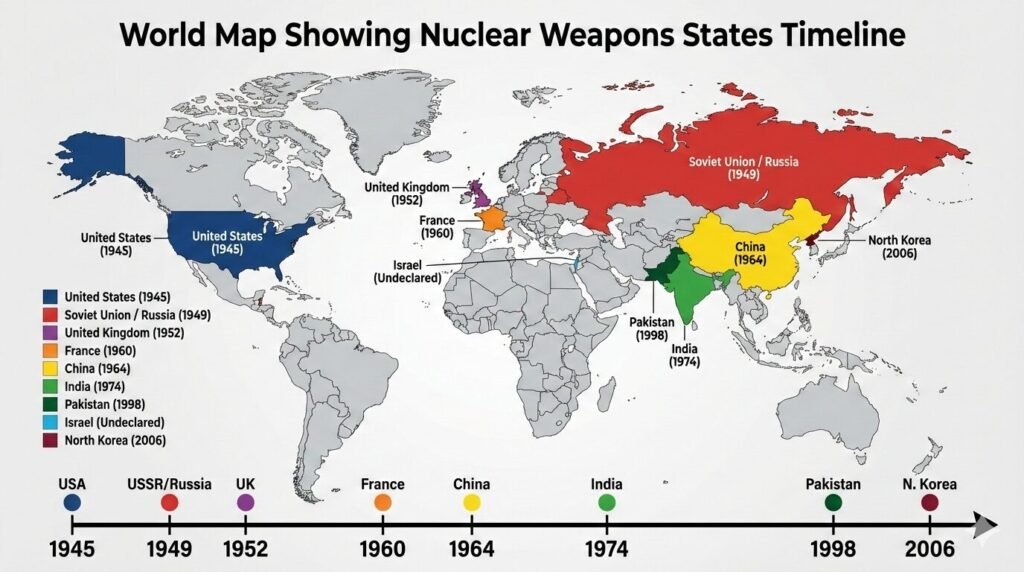
The nuclear era began on July 16, 1945, when American scientists detonated the world’s first atomic device at Trinity Site in New Mexico. Robert Oppenheimer’s creation changed warfare forever. Within weeks, the United States dropped atomic bombs on Hiroshima and Nagasaki, killing over 200,000 people and ending World War II.
This horrific demonstration triggered a global arms race. The Soviet Union tested its first nuclear weapon in 1949, followed by the United Kingdom in 1952, France in 1960, and China in 1964. These five nations—permanent members of the UN Security Council—quickly moved to control nuclear proliferation.
In 1968, they crafted the Non-Proliferation Treaty (NPT), establishing a two-tier system of control. Nuclear-armed states promised not to share weapons technology, while non-nuclear nations agreed to remain weapon-free. Although 191 countries eventually signed, India rejected the NPT outright, viewing it as discriminatory and hypocritical.
Why India Refused the Nuclear Non-Proliferation Treaty
India’s refusal to sign the NPT stemmed from harsh geopolitical realities. On October 20, 1962, China launched a massive invasion across India’s northern borders. Chinese forces attacked simultaneously in Ladakh and the North-East Frontier Agency (now Arunachal Pradesh), catching Indian defenses unprepared.
The war resulted in a humiliating defeat. India lost approximately 43,000 square kilometers of territory in the Aksai Chin region. Just two years after China’s victory, Beijing tested its first nuclear weapon in October 1964, fundamentally altering South Asian security dynamics.
Pakistan attacked India in 1965, initiating the second Indo-Pak war within three years. These consecutive military challenges convinced Indian leadership that signing the NPT would permanently lock the nation into strategic vulnerability. The treaty allowed existing nuclear powers to maintain arsenals while prohibiting others from developing deterrence—a framework India considered unjust and dangerous.
Architects of India’s Nuclear Dream
The vision of India’s nuclear history began not with weapons, but with peaceful atomic energy development. Several pioneering figures laid the groundwork for eventual weapons capability.
Dr. Homi Jehangir Bhabha: The Scientific Foundation
Dr. Homi J. Bhabha, often called the father of India’s nuclear program, established the institutional infrastructure that made everything possible. In 1945, he founded the Tata Institute of Fundamental Research in Mumbai, creating India’s premier physics research center.
Bhabha’s crowning achievement came in 1954 with the establishment of the Atomic Energy Establishment at Trombay (later renamed Bhabha Atomic Research Centre). This facility became the nerve center for India’s nuclear research, housing reactors, laboratories, and the scientific talent necessary for advanced nuclear technology.
His vision extended beyond research. Bhabha advocated for India’s right to develop nuclear explosives for peaceful purposes—excavation, mining, and civil engineering applications. This “peaceful nuclear explosive” framework provided political cover for weapons-relevant research.
Lal Bahadur Shastri: The Political Green Light
Prime Minister Lal Bahadur Shastri transformed nuclear research from theoretical to operational. Following China’s 1964 nuclear test, Shastri authorized the “Study of Nuclear Explosions for Peaceful Purposes” (SNEPP) in 1965 a program that would develop India’s nuclear explosive capability.
Shastri’s decision came during the 1965 Indo-Pak war, when Pakistan’s aggression reinforced the need for strategic deterrence. He understood that India’s security environment demanded an indigenous nuclear capability, regardless of international opposition.
Dorabji Tata: The Industrial Visionary
Industrialist Dorabji Tata provided crucial financial support when government funding proved insufficient. His philanthropic contributions enabled early nuclear research at a time when India’s economy could barely sustain basic development programs.
Tragically, both Homi Bhabha and Prime Minister Shastri died under mysterious circumstances in January 1966—Bhabha in a plane crash on Mont Blanc, Shastri hours after signing the Tashkent Declaration. Their deaths temporarily derailed India’s nuclear ambitions.
Operation Smiling Buddha: The 1974 Breakthrough
Operation Smiling Buddha marked India’s dramatic entry into nuclear capability. In September 1972, Prime Minister Indira Gandhi authorized the development of a nuclear fission device. Despite international pressure and limited resources, a team of 75 scientists from BARC began secret preparations.
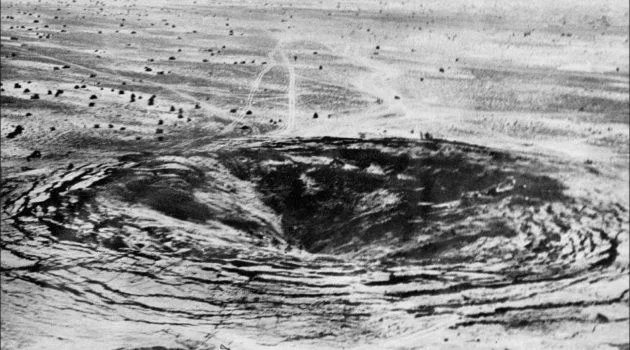
The First Pokhran Nuclear Test 1974
On May 18, 1974, at 8:05 AM, India detonated its first nuclear device in the Thar Desert near Pokhran, Rajasthan. Led by physicist Dr. Raja Ramanna, the test yielded approximately 8-12 kilotons—similar to the Hiroshima bomb’s power.
The government officially described it as a “peaceful nuclear explosion” for civilian applications. This semantic distinction helped manage international backlash, though few observers believed India had no weapons intentions. The Pokhran nuclear test of 1974 demonstrated that India possessed the scientific knowledge and technical capability to build nuclear weapons if desired.
International Reaction and Domestic Setbacks
Global response proved harsh. The United States and Canada immediately cut off nuclear cooperation. International sanctions targeted India’s civilian nuclear program, attempting to strangle further development. Western nations established the Nuclear Suppliers Group specifically to prevent technology transfer to India.
Domestically, political crises derailed weapons development. Indira Gandhi declared a national emergency in 1975, concentrating power but creating political instability. The second global oil shock in 1979 devastated India’s economy. From 1975 to 1995, India’s nuclear weapons program remained largely dormant, trapped between economic constraints and political uncertainty.
The 1971 War: Nuclear Threats and Superpower Intervention
The 1971 Indo-Pak war demonstrated exactly why India needed nuclear power status. In March 1971, Pakistan launched Operation Searchlight in East Pakistan (now Bangladesh), initiating a genocide that killed between 300,000 and 3 million Bengalis. Between 200,000 and 400,000 women suffered sexual violence.
The Crisis Escalates
When Pakistan’s air force attacked Indian airfields on December 3, 1971, India had legal justification for military intervention. Indian forces executed a brilliant campaign, encircling Pakistani troops in East Pakistan and forcing their surrender within two weeks.
However, the United States sent its Seventh Fleet—including the nuclear-armed aircraft carrier USS Enterprise—to the Bay of Bengal in a show of support for Pakistan. British naval forces simultaneously approached India’s western coast, creating a two-front maritime threat.
India’s naval capabilities were minimal—essentially one aircraft carrier (INS Vikrant) with 20 obsolete aircraft. Facing potential superpower intervention, India urgently requested Soviet assistance.
Soviet Nuclear Umbrella
The USSR responded decisively, dispatching a nuclear-armed fleet including two cruisers, two destroyers, and six submarines. This powerful Soviet presence forced American and British vessels to withdraw, ensuring Bangladesh’s liberation.
Declassified documents later revealed that President Richard Nixon and National Security Advisor Henry Kissinger actually discussed using nuclear weapons against India. This shocking revelation—that a democracy faced nuclear threats for stopping genocide—profoundly influenced India’s nuclear calculations.
The Long Struggle: Failed Attempts in the 1990s
India’s nuclear history in the 1990s involved repeated attempts and frustrations. As India liberalized its economy under Prime Minister P.V. Narasimha Rao in 1995, strategic thinking also evolved. Rao authorized preparations for a nuclear test, but American intelligence discovered activity at Pokhran.
CIA satellite imagery detected test preparations, and U.S. diplomatic pressure forced India to abort. A second attempt in 1996 met the same fate American surveillance and diplomatic intervention killed the mission before execution.
When Atal Bihari Vajpayee became Prime Minister in 1996, he immediately prioritized nuclear testing. However, his government collapsed after just 13 days, ending hopes for immediate testing. India seemed trapped in a cycle of failed attempts and external interference.
The 1998 Pokhran Nuclear Test: India’s Nuclear Triumph
Everything changed when Atal Bihari Vajpayee returned as Prime Minister in March 1998. On April 8, he summoned Dr. A.P.J. Abdul Kalam (head of DRDO) and Dr. R. Chidambaram (chief of Atomic Energy). The order was simple: conduct the tests, ensure secrecy, outsmart American surveillance.
Operation Shakti: Deceiving the World
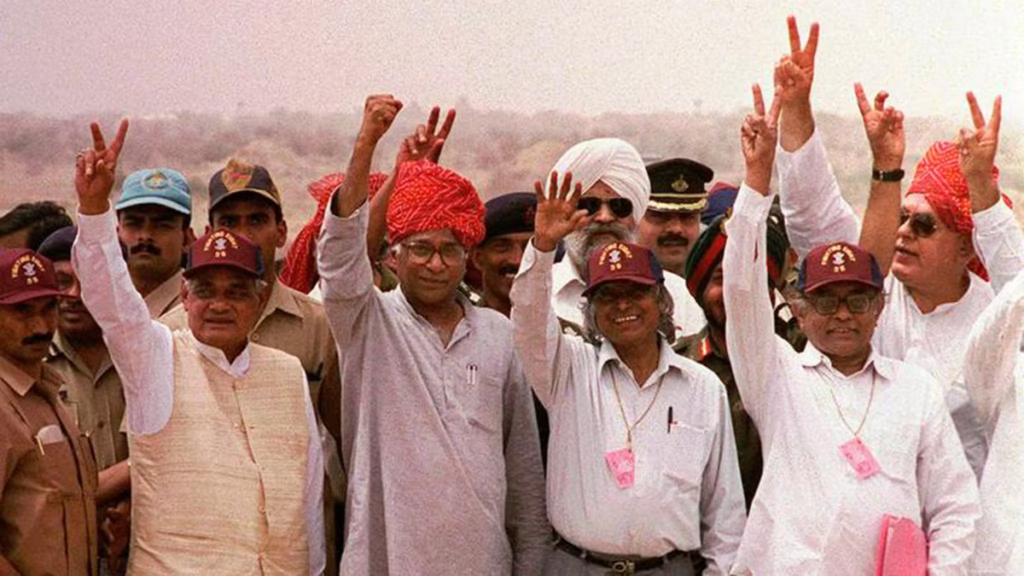
The Pokhran nuclear test of 1998 required unprecedented operational security. Only the Home Minister knew, besides the scientific team. To fool U.S. spy satellites, organizers arranged a cricket tournament at Pokhran, creating innocent-looking activity and foot traffic.
Scientists disguised equipment movements, conducted preparations at night, and maintained civilian cover stories. The deception worked perfectly—American intelligence detected nothing until bombs were already in place.
Source: Firstpost
May 11, 1998: Three Simultaneous Detonations
At 3:45 PM on May 11, 1998, India detonated three nuclear devices simultaneously:
- Shakti-I: A 45-kiloton thermonuclear (hydrogen bomb) device
- Shakti-II: A 15-kiloton fission bomb
- Shakti-III: A 0.2-kiloton sub-kiloton device
Two days later, on May 13, India conducted two additional sub-kiloton tests (Shakti-IV and Shakti-V), demonstrating a complete range of nuclear capabilities from tactical weapons to strategic thermonuclear devices.
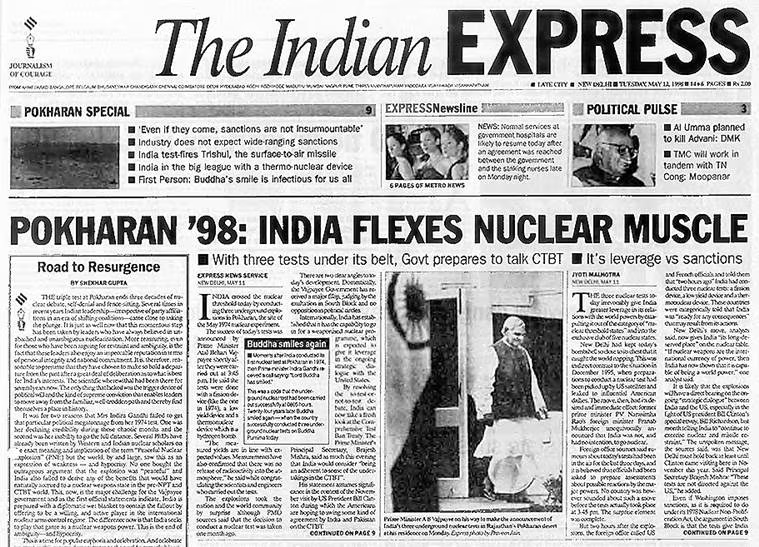
Prime Minister Vajpayee’s announcement electrified the nation: “India is now a nuclear-weapon state.” The Pokhran nuclear test succeeded where previous attempts had failed—India had outmaneuvered global intelligence and achieved strategic autonomy.
Global Response and Strategic Achievement
International condemnation arrived swiftly. The United States imposed economic sanctions. The UN Security Council passed resolutions criticizing India. Western nations condemned the tests as destabilizing and irresponsible.
Yet India had achieved its objective. The demonstrations proved India possessed deliverable nuclear weapons—not just experimental devices, but genuine military capability. Pakistan responded with its own tests two weeks later, establishing overt nuclear deterrence in South Asia.
Interestingly, sanctions proved short-lived. By 2008, the U.S.-India Civil Nuclear Agreement effectively recognized India’s nuclear status, allowing civilian nuclear commerce despite India’s NPT non-membership. Strategic realities trumped non-proliferation ideology.
Legacy: How India’s Nuclear Power Status Shaped Modern Geopolitics
When did India become a nuclear power? Technically, India achieved nuclear capability in 1974, but established credible deterrence only in 1998. The Pokhran nuclear test of 1998 marked the transition from potential to actual nuclear weapons state.
This achievement fundamentally altered South Asian security dynamics. India gained strategic autonomy—the ability to make security decisions without superpower approval. Nuclear deterrence prevented large-scale conventional war; no major India-Pakistan conflict has occurred since both nations achieved nuclear status.
The journey also vindicated India’s NPT rejection. By refusing discriminatory treaties, India maintained sovereign decision-making. The subsequent U.S.-India nuclear deal proved that strategic importance eventually overcomes non-proliferation dogma.
Conclusion: A Testament to Strategic Vision and Scientific Excellence
India’s journey to becoming a nuclear power represents triumph over adversity. From Homi Bhabha’s scientific foundations through Operation Smiling Buddha to the definitive 1998 Pokhran nuclear test, this path required decades of persistent effort.
The story encompasses visionary scientists like Bhabha and Abdul Kalam, courageous leaders like Shastri and Vajpayee, and countless unknown technicians who maintained secrecy under immense pressure. It involved outsmarting global intelligence agencies, enduring economic sanctions, and maintaining national resolve across administrations.
Most fundamentally, India’s nuclear power status validated the principle that nations must secure their own security. The 1971 war’s nuclear threats, China’s 1962 invasion, and repeated Pakistani aggression proved that international institutions wouldn’t protect India. Only indigenous capability could guarantee sovereignty.
Today, India stands among the world’s nuclear powers not through inheritance or alliance, but through determination, scientific excellence, and strategic clarity. The Pokhran nuclear test remains a defining moment—when India announced it would never again depend on others for fundamental security, and would chart its course regardless of global pressures.
This is how India became a nuclear power: step by calculated step, crisis by crisis, and ultimately, triumphantly.