Introduction: The Map That Rewrites Indian Naval History
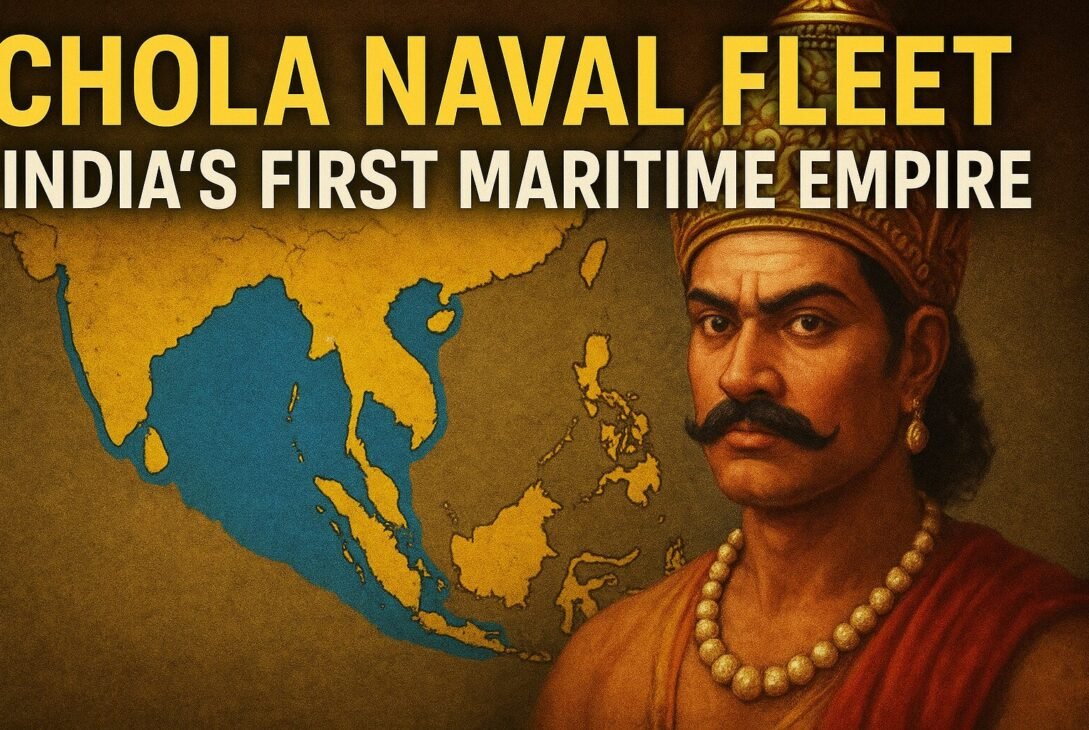
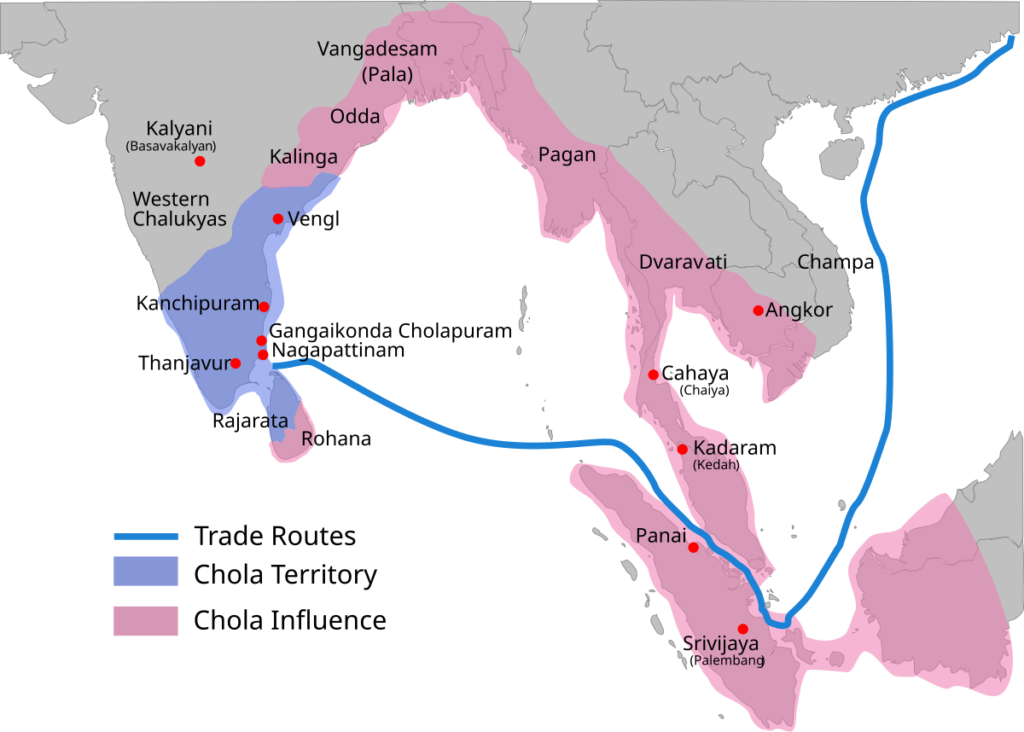
Picture a map that most Indians have never seen. It stretches across southern India, extends to Sumatra in Indonesia, reaches Malaysia’s shores, and touches Myanmar’s coast. This wasn’t a fantasy—this was the Chola naval fleet’s domain in the 9th century.
The Chola Empire brought the golden age to the Tamil kingdoms. However, their most extraordinary achievement remains largely forgotten. They created India’s first navy and dominated the Indian Ocean like no power before them. But how did these kings conquer lands across vast oceans? How did they defeat kingdoms in Indonesia and Malaysia?
The answer lies in their revolutionary naval power. The Chola empire’s maritime power was unmatched in the Indian Ocean for centuries. This is the untold story of India’s forgotten seafarers.
Source: Wikimedia Commons
The Chola Empire: A Dynasty That Ruled for Centuries
Ancient Origins and Longevity
The Chola dynasty’s roots run deep into Indian history. According to historical records, they ruled for a longer period than any other empire. The first mention dates back to the third century CE. Emperor Ashoka’s edicts reference the Cholas as friendly neighbours.
However, their true golden age began much later. The 10th century marked the Chola renaissance. This period transformed them from regional rulers into maritime superpowers.
The Golden Age Begins
By the 10th century, the Cholas controlled the entire Indian Peninsula’s coastline. This geographic advantage proved crucial. Trade flourished naturally along these extensive shores.
Chola exports commanded high demand worldwide. Spices, cotton cloth, and ivory filled merchant ships. The wealth generated was staggering. Consequently, the Cholas became extraordinarily prosperous.
This money funded their golden age brilliantly. The Chola kings generously supported poetry and the arts. They constructed massive temples like the magnificent structure in Thanjavur. Furthermore, they designed efficient water management systems. A sophisticated civil service emerged to govern their expanding territories.
Yet their biggest strength lay elsewhere—in the sea itself.
Trade, Temples & Treasury: Why the Cholas Turned to the Sea
Economic Powerhouse
The Chola economy thrived on maritime trade. Their long coastline provided natural ports and harbours. Ships carried goods to distant lands regularly. Arab traders, Chinese merchants, and Southeast Asian kingdoms all sought Chola products.
This international trade created immense wealth. The royal treasury overflowed with gold and precious stones. Meanwhile, the merchant class prospered alongside the monarchy.
Naval Philosophy: No Standing Navy
Interestingly, the Cholas never maintained a standing navy. They had no permanent warships or gunboats. Instead, they relied on merchant vessels. When war came, these trade ships transformed into battleships.
This strategy was both economical and effective. Merchant ships served dual purposes during peacetime and war. Moreover, sailors were already experienced in long-distance voyages.
Shipbuilding Mastery: Woods, Ropes & Navigation Secrets
The Art of Wooden Warships
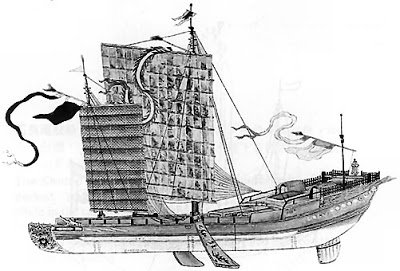
Modern ships are metal monsters built in massive shipyards. However, Chola vessels were entirely wooden. The Chola shipbuilding techniques represented advanced engineering for their era.
The Cholas knew exactly which woods to use. The jackfruit tree provided excellent timber. Jamun, rosewood, and mawa also worked well. These woods were strong yet flexible enough for ocean voyages.
Ships were constructed using rope and wood exclusively. Unfortunately, this knowledge is now lost. Today, neither interest nor demand exists for wooden ships. The ancient techniques died with the empire.
Navigation Genius
Building ships wasn’t enough, though. Navigation requires completely different skills. The Cholas proved to be quick learners in this domain.
They understood exactly what provisions to carry. Dried meat, fish, and rice flakes sustained sailors during long voyages. Food preservation was crucial for month-long journeys.
The Bird Navigation Trick
The Cholas developed a brilliant land-detection method. Sailors would carry land-based birds aboard ships. These birds naturally preferred land over open water.
Periodically, sailors would release these birds. If the birds returned, bad news—no land existed nearby. However, if they kept flying away, excellent news followed. Land lay somewhere in that direction. This ingenious technique demonstrated remarkable maritime innovation.
Celestial Navigation
For direction-finding, Cholas used staple navigational methods. They followed stars diligently during night voyages. Sailors aligned their course with specific constellations. This celestial navigation proved reliable across the Indian Ocean.
As a result, the Chola naval fleet flourished spectacularly. They explored new lands systematically. Diplomats were stationed in foreign territories. Even distant China hosted a Chola embassy.
The Kings Who Commanded the Seas: Raja Raja Chola & Rajendra Chola
Raja Raja Chola: The Empire Builder (985-1014 CE)
The Cholas possessed impressive naval capabilities. However, they needed the right leadership to unleash this potential. Fortunately, they had two extraordinary kings.
Raja Raja Chola ascended the throne in 985 CE. He reigned for nearly 30 years of continuous expansion. Under his leadership, the kingdom grew dramatically.
Most present-day southern states fell under Chola control. Nevertheless, Raja Raja set his sights beyond mainland India.
The Sri Lankan Campaign Begins
He invaded the Sinhalese kingdom in Sri Lanka. The Chola forces even razed their capital. However, Raja Raja couldn’t complete the conquest. As his armies moved south, they faced fierce resistance.
Only northern Sri Lanka fell under Chola control. Still, this represented a good start. More importantly, Raja Raja set his empire on an expansion path.
By his reign’s end, he controlled the Maldives and Lakshadweep. The foundation for maritime dominance was firmly established.
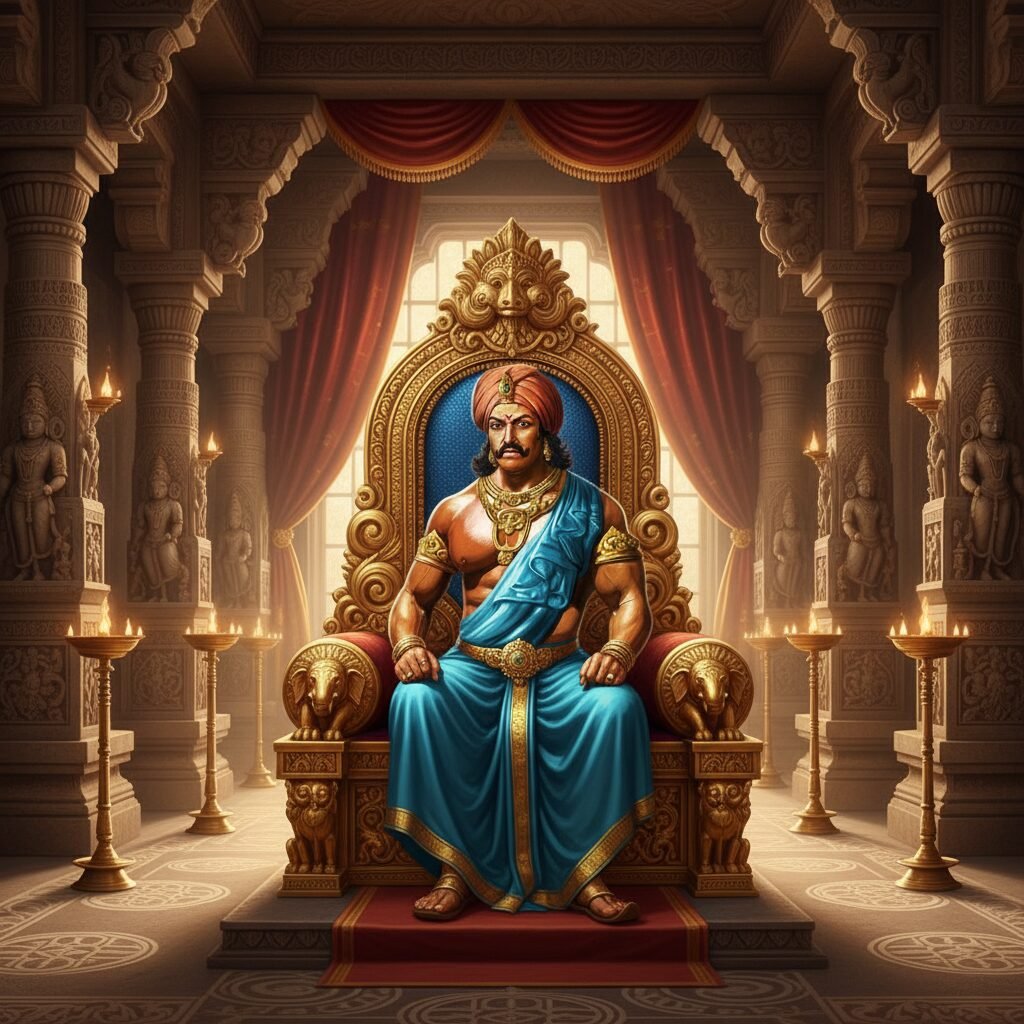
Rajendra Chola: The Naval Conqueror (1014-1044 CE)
If Raja Raja was good, his son proved even better. Rajendra Chola expanded territories north, south, and east. He came to power in 1014 CE with ambitious plans.
Completing His Father’s Mission
Rajendra’s first priority was completing the Sri Lankan campaign. He accomplished this with remarkable speed and force. Entire cities and religious centres were systematically destroyed. The Sinhalese barely saw the assault coming.
Yet Sri Lanka was merely a warm-up exercise. Rajendra Chola’s invasion plans extended far beyond the island.
Southeast Asian Ambitions
Rajendra established settlements throughout Southeast Asia. Thailand, Malaysia, and Indonesia witnessed Chola influence. Furthermore, he wasn’t afraid to demonstrate his naval superiority.
The greatest opportunity arrived in 1025 CE. Most of Southeast Asia was ruled by the powerful Sri Vijaya Empire. They were based on the island. This empire controlled vital trade routes to China.
The stage was set for the most spectacular naval campaign in Indian history.
The Great Invasion: Naval Blitzkrieg on Sri Vijaya (1025 CE)
The Journey
The Rajendra Chola invasion of Sri Vijaya was extraordinary. The journey covered approximately 2,300 kilometres. Calculating travel time, the voyage took roughly 30 days.
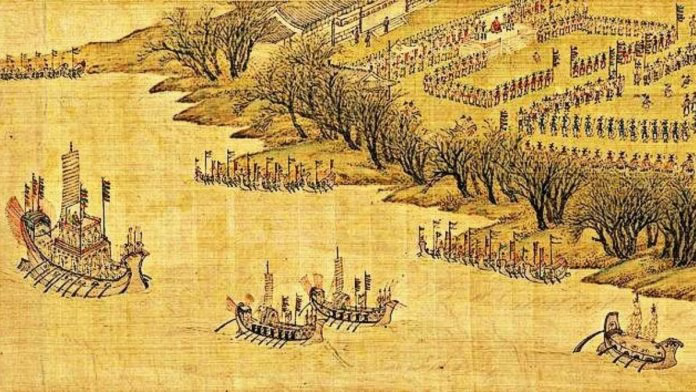
The Chola fleet sailed from Nagapattinam to Malaysia. This represented a massive logistical undertaking. Hundreds of ships, thousands of soldiers, and countless supplies were mobilised.
The Attack Strategy
Sri Vijaya had no warning about what awaited them. The Cholas executed a perfect naval blitzkrieg. They brilliantly used monsoon winds for rapid movement.
Their strategy followed a consistent pattern: attack, plunder, leave. The Cholas had no interest in permanent occupation. They weren’t trying to rule these territories.
The fleet sailed from city to city systematically. Each coastal settlement faced the same devastating assault. Sri Vijaya’s defences crumbled before this organised onslaught.
Naval Tactics and Warfare
Understanding how this war unfolded challenges imagination. Chola ships lacked catapults or traditional siege weapons. However, they could transport soldiers, elephants, and horses effectively.
Most likely, the ships landed near target cities. Then, ground forces would attack from the beaches. Elephants provided shock value in battle. Cavalry offered mobility and speed.
The combination proved devastatingly effective against unprepared defenders.
The Spoils of Victory
Rajendra returned home with untold riches. Gold, precious stones, and rare artefacts filled Chola treasuries. Additionally, he captured Sri Vijaya’s prized war elephant.
Any military historian would admire this invasion’s execution. It demonstrated superior planning, logistics, and tactical skill. The campaign left Sri Vijaya and Southeast Asia broken politically and economically.
The monopoly over the Indian Ocean trade routes was shattered permanently.
Why Did Rajendra Chola Invade? The Three Theories
Historians cannot definitively answer this crucial question even today. However, three main theories exist explaining Rajendra Chola’s motivations.
Theory One: Territorial Ambition
Rajendra resembled any other ambitious ruler fundamentally. He desired expansion for expansion’s sake. Conquering foreign lands brought prestige and glory. Perhaps the invasion was simply about power projection.
Theory Two: Trade Route Control
This theory focuses on economics rather than politics. Apparently, the Sri Vijaya rulers were interfering with Chola merchant ships. They were intimidating traders and disrupting commerce.
The sea route to China held enormous economic importance. Perhaps Rajendra decided to eliminate this commercial obstacle permanently. A military lesson would ensure free passage for Chola merchants.
Theory Three: Medieval Geopolitics
The third theory involves complex regional alliances. The Khmer King Suryavarman had approached Rajendra seeking help. He faced trouble from another regional kingdom.
Suryavarman’s rival discovered this alliance. Consequently, he requested help from the Sri Vijaya Empire. This extended rivalry possibly forced Rajendra’s hand.
Supporting an ally meant confronting their enemy’s supporters. Medieval geopolitics created chain reactions of conflicts.
The Spectacular Result
Whatever motivated the invasion, the result remained spectacular. The Chola empire’s maritime power reached its absolute zenith. The Indian Ocean became a Chola lake.
Chola influence throughout the region persists even today. Temples bearing Chola architectural styles dot Southeast Asia. Poetry and artwork reflect Tamil cultural impact. The golden age left permanent marks across continents.
Legacy & Collapse: Why the Chola Navy Faded
The Price of Expansion
The Cholas indeed heralded a remarkable golden age. Their economy was unmatched across South Asia. Their navy remained unrivalled in the Indian Ocean. Their rulers demonstrated extraordinary ambition and capability.
However, a harsh reality awaited every great empire. The bigger you grow, the more enemies you accumulate. The Cholas had plenty of adversaries.
Rising Enemies
The Pandyas constantly challenged Chola supremacy. The Deccan kingdoms resented Chola expansion northward. The Sinhalese never forgot their humiliation in Sri Lanka. Managing multiple fronts simultaneously proved overwhelming.
Resources stretched thin across vast territories. The Navy required constant maintenance and funding. Land armies needed support for multiple campaigns. The treasury couldn’t sustain everything indefinitely.
The Final Chapter
In 1279 CE, the Chola Dynasty ended. Centuries of dominance concluded with their defeat. The Chola naval fleet that once ruled the Indian Ocean disappeared.
Their maritime knowledge vanished with the empire. Shipbuilding techniques were lost forever. Navigation secrets died with the last sailors. India’s first navy became a distant memory.
Relevance Today: India’s Naval Ambitions & Chola Inspiration
A Forgotten Legacy
The Chola seafarers’ story deserves greater recognition. Unfortunately, they don’t find enough chapters in history textbooks. Their Southeast Asian invasion barely receives mention. This oversight is both unfortunate and unjust.
The maritime achievements remain largely unknown to modern Indians. Few people realize India once dominated the Indian Ocean. Even fewer know about India’s first navy and its spectacular conquests.
Modern Naval Ambitions
Today, this story gains new relevance. India has ambitious naval plans for the 21st century. The Indian Navy aims to dominate the Indian Ocean once again.
Interestingly, this is the same ocean that Rajendra Chola once ruled. The parallels are striking and intentional. India is rediscovering its maritime heritage systematically.
Building on Historical Foundations
The Chola naval fleet legacy provides inspiration for modern India. Their achievements prove that Indian civilisation mastered naval warfare centuries ago. This isn’t a new ambition but rather a rediscovery.
Modern shipbuilding uses steel and advanced technology. However, the strategic principles remain similar. Control sea lanes, project power overseas, protect trade routes.
The Cholas understood these concepts perfectly. They executed them brilliantly across the Indian Ocean. Their success story offers valuable lessons for contemporary naval strategists.
Conclusion: Remembering India’s Maritime Masters
The Chola Empire created India’s first navy and dominated the Indian Ocean for centuries. Under Raja Raja Chola and Rajendra Chola, they achieved extraordinary maritime conquests. Their 1025 CE invasion of Sri Vijaya represents one of history’s most successful naval campaigns.
They mastered shipbuilding using indigenous woods and techniques. Navigation skills allowed them to cross vast oceans confidently. Their trade networks stretched from China to Arabia. Wealth and power flowed from maritime dominance.
Yet this glorious legacy remains largely forgotten. The Chola naval fleet deserves recognition alongside history’s greatest maritime powers. Their achievements rival those of the Vikings, Phoenicians, or Venetians.
As India rebuilds its naval capabilities today, the Chola legacy offers inspiration. These ancient Tamil kings proved that Indian civilisation could master the seas. They demonstrated that naval power secured prosperity and prestige.
The story of the Cholas isn’t just history—it’s a blueprint. A legacy that India must rediscover. A foundation that modern India must build upon.
What aspect of Chola naval history inspires you most? Share your thoughts in the comments below.