Introduction: The Next Digital Revolution After UPI
India’s digital payment revolution started with UPI. Now, get ready for the next big transformation. ONDC simply means the Open Network for Digital Commerce—an ambitious government initiative poised to revolutionize how Indians shop online.
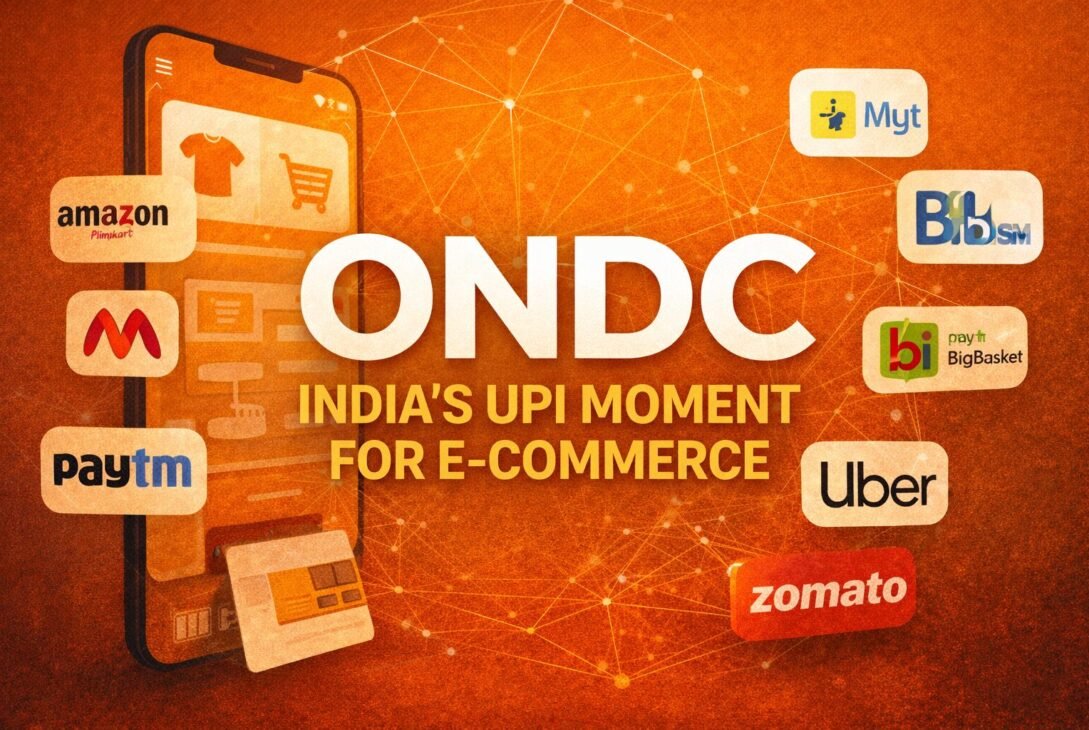
Imagine seeing Amazon, Flipkart, Myntra, BigBasket, Zomato, Paytm, and even Uber all on one platform. That’s ONDC’s bold vision. The Government of India’s most ambitious project after UPI could do to e-commerce what UPI did to digital payments.
What is ONDC? It’s an open network connecting any buyer with any seller who signs up. Food, fashion, groceries, travel all in one app. This isn’t just convenient shopping. It’s a fundamental restructuring of India’s digital commerce landscape.
The “One App for All Apps” Vision
Shopping Without Boundaries
ONDC creates one meta-store—one everything store for all shopping needs. The platform allows buyers to access multiple e-commerce sites simultaneously. You can buy an Apple phone and the fruit in the same place.
The revolutionary aspect? You do this at the best deals and best prices automatically. More choices mean more power in consumers’ hands.
Price Comparison on Steroids
When you compare Amazon and Flipkart prices on one page, magic happens. Zomato and Swiggy appear side-by-side. Uber and Ola compete directly. This automatically forces platforms to compete for the best price.
Consequently, their pricing power gets curbed. Hidden charges disappear. Inflated delivery rates vanish. ONDC benefits both consumers and the entire ecosystem.
The Trivago Analogy
Remember Trivago showing hotel prices across booking sites? ONDC is essentially Trivago for all things online shopping. However, it goes much further than simple price comparison.
This open network digital commerce approach truly has the potential to democratize the entire digital commerce space in India.
Also Read: Understanding UPI’s Success Story – Lessons for ONDC
Why India Needs ONDC – The Problem of Closed Networks
The Duopoly Problem
India has thousands of e-commerce websites. Yet two companies—Flipkart and Amazon—control over 60% of India’s e-commerce market. The government expects this market to grow to $350 billion by the decade’s end.
Why is market concentration problematic? Currently, your favorite apps operate as closed networks. They keep out several small players—retailers, delivery firms, and kirana stores. These small businesses form the backbone of India’s retail system.
Restaurant Owners Fight Back
Last year, India’s restaurant owners’ body filed a complaint against food aggregators. They accused Zomato and Swiggy of monopolizing the market. The complaint alleged these platforms imposed their price terms on partner restaurants.
Are these allegations true? Understanding how platforms make money reveals the answer.
Two Business Models Explained
E-commerce platforms in India follow two basic models:
Marketplace Model:
The website acts only as a platform connecting buyers and sellers. They take a percentage cut when products sell. This model allows foreign companies like Amazon and Walmart-owned Flipkart to operate in India.
Inventory Model:
The platform buys directly from sellers in bulk. Using bargaining power, they buy cheap and sell at higher prices. This increases their profit margins significantly.
India doesn’t allow foreign direct investment in inventory-driven models. However, platforms still maximize profits through search manipulation.
How Platforms Game the System
E-commerce sites limit search results to brands with platform tie-ups. They throw favored sellers to the top of search results. Maximum visibility goes to sellers where platforms get maximum margins.
Additionally, these platforms control pricing power and logistics, such as delivery. Small sellers can’t compete on this uneven playing field.
How ONDC Works & Its Revolutionary Benefits
For Consumers: Power Returns to Your Hands
1. Genuine Price Comparison
With an open network showing results across e-commerce platforms, you gain multiple advantages immediately. Real-time comparison happens across all participating platforms automatically.
2. Discover Local Sellers
You end up discovering a local store near you. This store could bring what you need faster and cheaper than giant warehouses far away.
3. Choose Your Delivery Partner
This feature is revolutionary. If a seller app can’t deliver to your address, you choose another delivery partner from the ONDC pool. Suppose Zomato charges too heavily for deliveries—order food from Zomato but use Dunzo to deliver it.
4. Lower Prices, Zero Hidden Charges
Competition automatically drives prices down. Platforms can’t hide delivery fees or inflate charges when alternatives appear side-by-side.
For Sellers & Kirana Stores: A Level Playing Field
1. Direct Discoverability
Small sellers and retailers finally get a level playing field. No platform biases favor big brands over local shops. Your neighborhood kirana store appears alongside mega-retailers.
2. Access to Logistics Networks
Small sellers gain access to multiple delivery partners. They’re no longer locked into expensive platform-specific logistics. This dramatically reduces their operational costs.
3. No Commission Exploitation
ONDC for small sellers means freedom from exploitative commission structures. Platforms can’t arbitrarily increase fees since alternatives exist immediately.
4. Compete on Quality, Not Marketing Budgets
Without algorithm manipulation, products compete on actual merit. Quality and price matter more than advertising spend on platform search results.
The Mastermind & The Pilot Phase
Nandan Nilekani’s Vision
Tech pioneer Nandan Nilekani’s ONDC involvement adds significant credibility. The Infosys co-founder famously created Aadhaar, India’s biometric identity system. He’s the mastermind behind this initiative as well.
Nilekani describes ONDC as “an idea whose time has truly come.” His track record with large-scale digital infrastructure projects inspires confidence.
Current Implementation Status
This isn’t just a concept for the future. ONDC is already here. Pilots have started in five cities currently. The ambitious goal? Cover 100 cities and towns by August 2022.
Early adopters are testing the platform. Feedback loops are improving the system. The network grows stronger with each participating seller and buyer.
Who’s Joining?
Several big tech companies are in talks to join the ONDC network. Retail majors are considering participation. Even banks are exploring integration possibilities. However, final commitments remain to be seen.
ONDC vs Amazon Flipkart: Understanding the Paradigm Shift
Not Competition, But Transformation
ONDC vs Amazon Flipkart isn’t a direct competition story. ONDC doesn’t compete with these platforms. Instead, it creates an ecosystem where these platforms participate differently.
Amazon and Flipkart become participants in a larger network rather than walled gardens. Their products appear alongside competitors and small sellers. Consumers choose based on actual value, not platform lock-in.
What Changes for Major Platforms
Major platforms must adapt their business models. Algorithm manipulation becomes impossible when results aggregate across networks. Commission structures face competitive pressure immediately.
Customer loyalty depends on service quality, not convenience monopoly. Platforms must genuinely compete on price, delivery speed, and customer service.
The Choice Factor
For now, how many companies sign up for ONDC remains uncertain. Participation is voluntary after all. Major platforms might resist joining a system, reducing their market power.
However, consumer demand could force their hand. If ONDC gains traction, staying outside means losing customers to the network.
The Road Ahead: Challenges & Potential
Challenge One: Platform Participation
The biggest question mark? Which companies will actually sign up? Major e-commerce players currently enjoy monopolistic advantages. Why would they voluntarily join a system reducing those advantages?
Consumer pressure provides one answer. Government policy incentives offer another. The network effect itself becomes compelling—the more participants join, the more valuable ONDC becomes.
Challenge Two: Technology Robustness
Will the technology be good enough to compete with current e-commerce majors? Current giants ensure trusted goods, reliable delivery partners, and timely return policies.
ONDC must match this standard. The platform needs seamless integration across diverse sellers. Real-time inventory management across thousands of shops requires sophisticated systems.
Challenge Three: User Experience
Consumers are accustomed to polished apps with intuitive interfaces. Amazon and Flipkart invest billions in user experience optimization. ONDC-powered apps must compete on this front.
However, some of the country’s best minds are working on it. The same teams that built UPI’s seamless experience are contributing to ONDC.
The Potential Payoff
If successful, democratizing e-commerce in India becomes a reality rather than a slogan. Small businesses access national markets without prohibitive costs. Consumers save money through genuine competition.
The entire digital economy benefits. Innovation accelerates when thousands of sellers can experiment freely. Local businesses thrive alongside national chains.
Real-World Impact: What Changes for You
As a Consumer
Your shopping experience transforms fundamentally. One app replaces juggling multiple platforms. Price comparison happens automatically. Local options appear alongside national brands.
Delivery charges become transparent and competitive. Return policies standardize across sellers. Customer service improves through competition rather than monopoly inertia.
As a Small Business Owner
Your kirana store or small business suddenly competes nationally. No expensive platform commissions eat your profits. Algorithm manipulation doesn’t hide your products.
Investment in quality products matters more than advertising budgets. Your loyal customers find you easily. New customers discover you through the open network.
As a Delivery Partner
Gig workers gain more opportunities. Multiple platforms need delivery services. Competition for delivery partners means better compensation and working conditions.
Flexibility increases. Work for multiple platforms simultaneously through one interface. Geographic limitations reduce—deliver for any seller on the network.
Addressing Concerns: Is ONDC Too Good to Be True?
The Honest Assessment
Sounds revolutionary, right? It might be. However, there’s a catch. Implementation challenges are real and significant.
Major platforms have no incentive to reduce their market power voluntarily. Technology integration across thousands of sellers isn’t simple. User experience must match current standards.
Why It Might Succeed Anyway
Several factors favor ONDC’s success. First, government backing provides legitimacy and resources. Second, UPI’s success proves India can build a transformative digital infrastructure.
Third, consumer demand for better prices and choices is overwhelming. Fourth, small sellers desperately need alternatives to exploitative platforms.
Finally, international interest in open commerce networks is growing. India could lead a global movement toward democratized digital commerce.
Conclusion: A Transformative Idea Whose Time Has Come
ONDC explained reveals more than just a new shopping app. It’s a fundamental restructuring of India’s digital commerce ecosystem. The vision democratizes access, competition, and opportunity.
For consumers, it means better prices, more choices, and transparent pricing. For small sellers, it offers a level playing field and national market access. For India’s economy, it could unlock hundreds of billions in value.
Challenges remain significant. Major platforms must choose participation. Technology must prove robust. User experience must satisfy demanding consumers.
However, as Nandan Nilekani says, this is “an idea whose time has truly come.” India transformed digital payments through UPI. The same innovative spirit could revolutionize e-commerce through ONDC.
The pilot phase is underway. Early results will determine the network’s future. One thing is certain—if ONDC succeeds, Indian e-commerce will never be the same.
Would you use an ONDC-powered app that shows Amazon, Flipkart, and local stores on one platform? Share your thoughts in the comments below. If you found this explanation helpful, share this article with fellow shoppers and small business owners.