Introduction
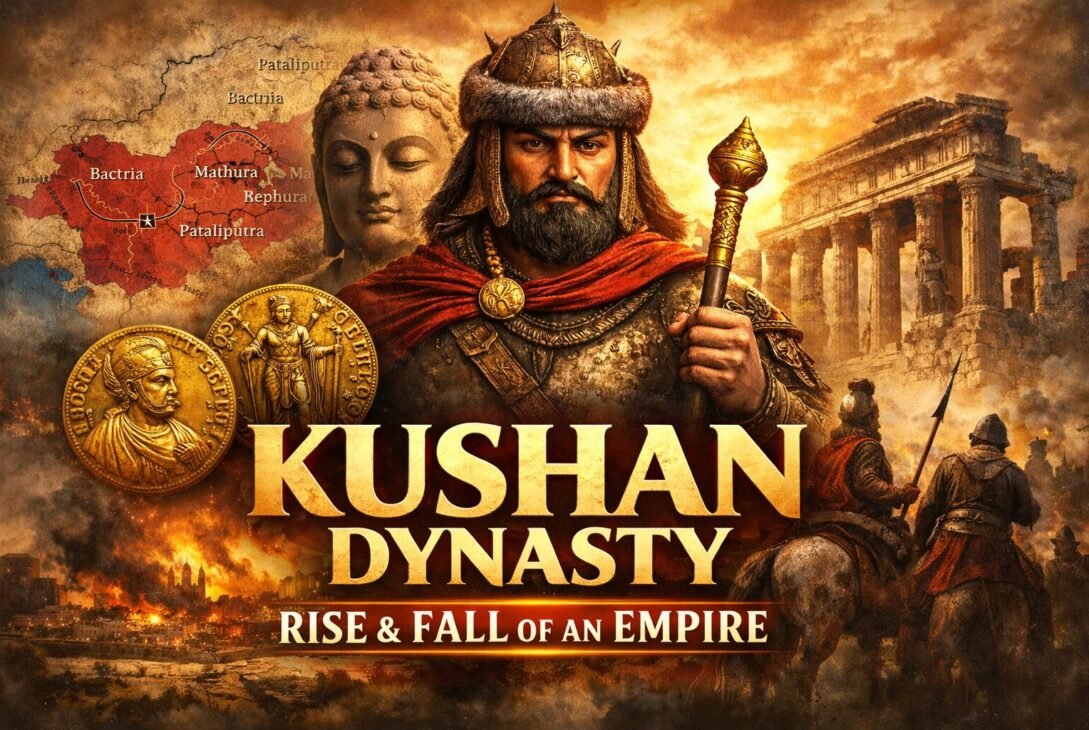
The Kushan Dynasty emerged as one of ancient India’s most influential empires during the 1st century AD. While the Satavahana Empire dominated the Deccan region, foreign invaders like Indo-Greeks, Sakas, and Parthians controlled northern and northwestern India.
Eventually, the Kushans crossed the Hindu Kush mountains and replaced these earlier powers. They conquered the Gangetic Valley and established themselves as a major dynasty that would shape Indian history for centuries.
The Kushan rulers not only built a vast empire but also promoted trade, patronized art, and embraced Indian culture in ways that distinguished them from typical foreign invaders.
Origins of the Kushans
The Kushans, also known as the Kuei-Shang dynasty, were descendants of the Yuezhi tribe from Central Asia. These nomadic people migrated from their original homeland and eventually reached the Indian borderlands.
The Yuezhi tribe was initially divided into five separate branches. These groups operated independently until a strong leader emerged to unite them under a single banner.
This Central Asian origin gave the Kushans unique advantages. They understood both the cultures of their homeland and the regions they would soon conquer, positioning them as effective rulers of a diverse empire.
Source: Wikipedia
Rise of the Kushan Dynasty
Kujula Kadphises: The Founder
Kujula was the first Yuezhi chief to lay the foundation of the Kushan Empire in India. His leadership marked a turning point for the scattered Yuezhi tribes.
He successfully united all five branches of the Yuezhi people under his rule. This consolidation created a powerful force capable of challenging established kingdoms in the region.
After unification, Kujula attacked the Indo-Parthians who controlled Northwest India. He drove them out and became the sole overlord of the Indian borderland.
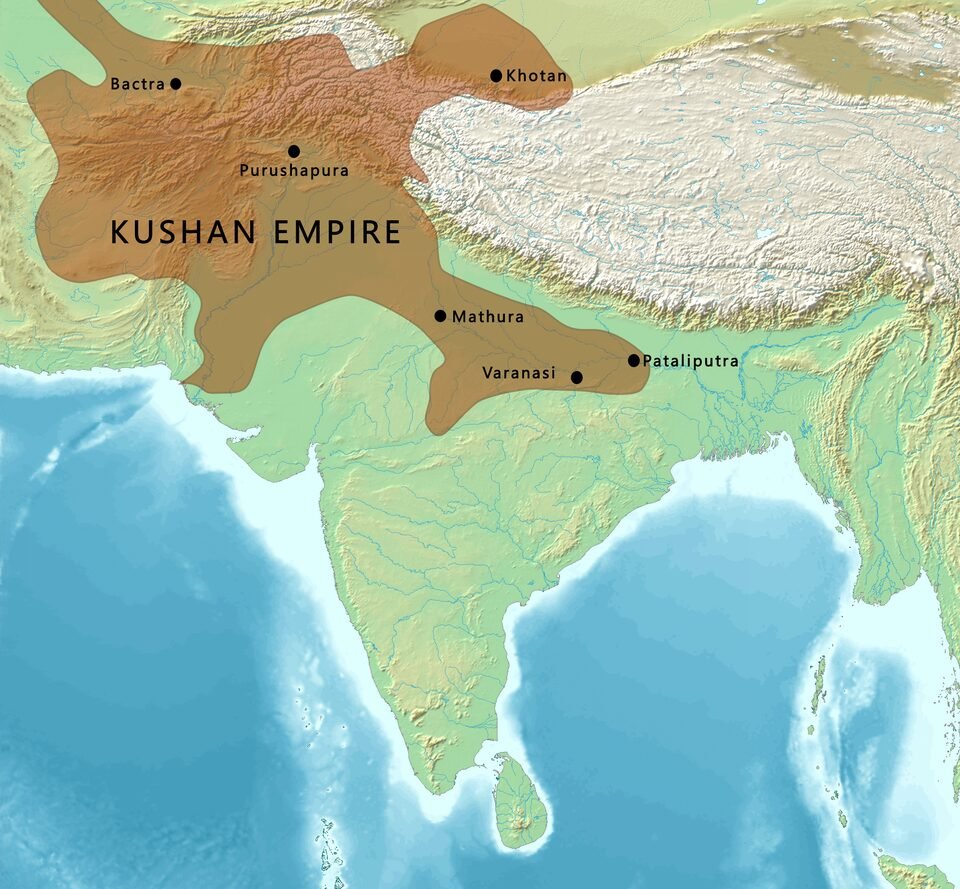
His empire stretched impressively from the borders of Persia to the banks of the Jhelum River. Kabul served as the capital of this emerging power.
Vima Kadphises: The Expansionist
Following Kujula’s reign, it is believed that his grandson Vima Kadphises succeeded him. Vima inherited a strong foundation and worked to expand it significantly.
He conquered major territories, including Punjab, Mathura, and Banaras. Through these conquests, Vima also secured control of the strategically important Gangetic Valley.
However, Vima’s contributions went beyond military expansion. He focused equally on economic development and promoted trade throughout his kingdom.
Notably, Vima pioneered the use of gold coinage in India. This innovation revolutionized commerce, demonstrating the dynasty’s economic sophistication.
Kanishka: The Greatest Kushan Emperor
Succession and Consolidation
After Vima Kadphises died, a power struggle erupted among his governors. Different factions competed for control of the empire during this uncertain period.
Finally, in 78 AD, Kanishka ascended the throne and ended the succession crisis. His rise marked the beginning of the Kushan Dynasty’s golden age.
Under Kanishka’s rule, the Kushans reached their peak of power and influence. His reign is considered the most powerful period in Kushan history.
Military Campaigns
Kanishka pursued an aggressive expansion policy to secure his borders and increase his territory. He defeated the Saka ruler Chatsana to gain control over the Malwa region.
His military campaigns extended the empire eastward to Patliputra and Gaya. These conquests gave the Kushans control over some of India’s most important cities.
Kanishka also attempted to improve relations with neighboring China. He even sent a marriage alliance proposal involving a Chinese princess.
When the Chinese Emperor refused this proposal, Kanishka invaded China. Unfortunately, he was defeated in this battle and had to pay a hefty tribute to the Chinese Emperor.
Administrative Innovations
Managing a vast empire required effective administrative strategies. Kanishka understood this challenge and implemented practical solutions.
For easier administration of his large territory, he established two capitals. One was located in Peshawar in the northwest, and the other in Mathura in the heartland.
This dual-capital system allowed better governance of distant regions. It also demonstrated Kanishka’s understanding of administrative efficiency and regional needs.
Administration, Economy, and Trade
The Kushan Empire’s economic prosperity was one of its defining features. The rulers understood that trade generated wealth and stability for their realm.
The Kushans controlled the Global Silk Route, which connected India with Central Asia, Persia, and beyond. This strategic position brought immense commercial benefits to the empire.
Trade with the Roman Empire proved particularly profitable during the Kushan era. Both regions exchanged goods, ideas, and diplomatic envoys regularly.
Several embassies were established between Rome and India for political relations, trade contacts, and commercial transactions. These diplomatic ties strengthened both economic and cultural exchanges.
The introduction of gold coinage by Vima Kadphises facilitated more complex commercial transactions. It standardized trade and made the Kushan economy more sophisticated than many contemporary kingdoms.
Religion, Art, and Culture
Cultural Integration
The Kushans, Greeks, and Sakas were foreign invaders who developed a unique relationship with India. Unlike typical conquerors, they became deeply attached to Indian culture.
Eventually, these groups left their original identities behind and embraced Indian customs, religions, and social practices. This cultural assimilation made them part of India’s civilizational fabric.
The Kushans particularly adopted Indian religions. Some Kushan kings embraced Shaivism, while others became followers of Buddhism.
Kanishka and Buddhism
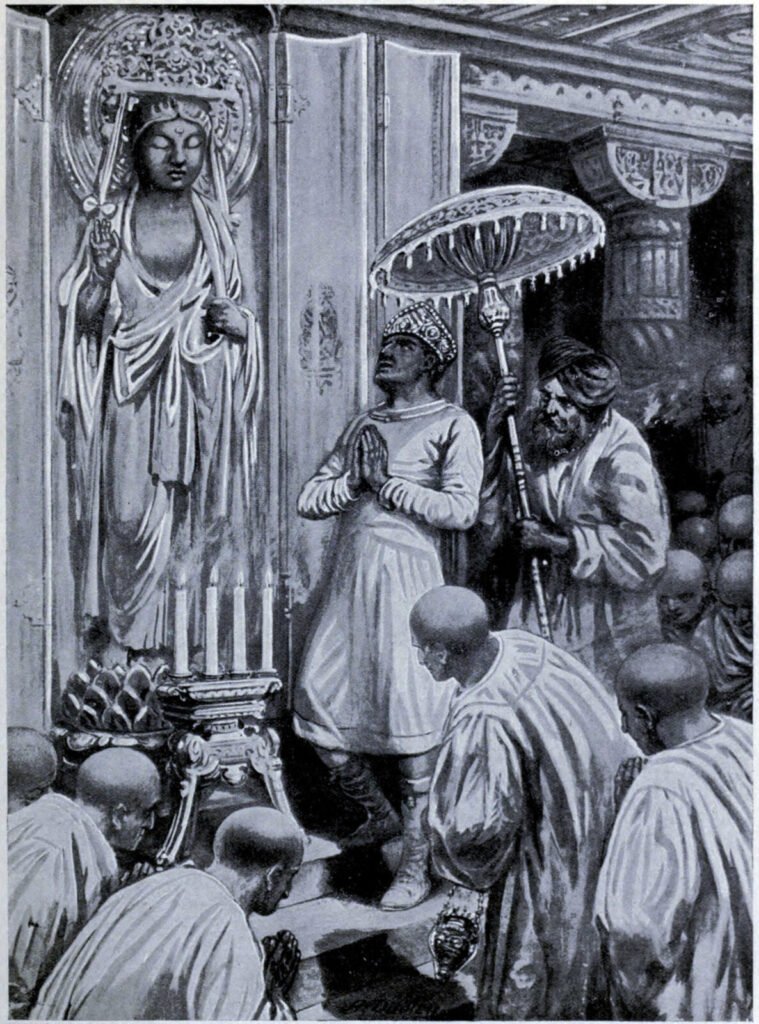
Kanishka was a devoted follower of Buddhism. His patronage significantly influenced the religion’s development and spread across Asia.
During his reign, the 4th Buddhist Council took place in Kashmir. This gathering of Buddhist scholars and monks had far-reaching consequences for the religion.
At this council, Buddhism was officially divided into two sects Mahayana and Hinayana. This split shaped Buddhist philosophy and practice for centuries to come.
Source: Wikimedia
The Gandhara School of Art
One of the Kushan Dynasty’s most enduring cultural contributions was the Gandhara School of Art. This artistic tradition emerged during Kanishka’s reign.
Gandhara art represented a unique fusion. It combined Indian artistic traditions with Central Asian, Roman, and Greek influences.
This synthesis is also known as Greco-Buddhist art. It produced distinctive sculptures and artistic styles that depicted Buddhist themes using Hellenistic techniques.
The Gandhara School influenced Buddhist art across Asia. Its impact can be seen in artistic traditions from Afghanistan to Japan.
Decline of the Kushan Dynasty
End of Kanishka’s Reign
Despite his achievements, Kanishka’s constant military campaigns took a toll on his health. The continuous warfare exhausted both the emperor and his army.
Remarkably, not a single revolt occurred during Kanishka’s time, suggesting effective governance. However, his soldiers grew tired of endless wars.
Eventually, while Kanishka was ill and weakened, his own soldiers assassinated him. This tragic end came from the very military that had secured his empire.
Final Rulers and Disintegration
After Kanishka’s death, the empire continued under new leadership. The last notable king of the Kushan Dynasty was Vasudeva.
Vasudeva maintained the empire’s unity during his reign. However, after his death, the centralized control that had held the kingdom together collapsed.
The empire split into two separate halves. Neither portion could maintain the strength and influence of the unified Kushan Dynasty.
The western half was taken over by the Persians and Huns. These invaders capitalized on the weakened state to establish their own control.
Meanwhile, the eastern half was conquered by the rising Gupta Dynasty. The Guptas would go on to create what historians call the Golden Age of India.
Historical Significance and Legacy
The Kushan Dynasty played a crucial role in shaping ancient India’s political, economic, and cultural landscape. Their empire bridged Central Asia and the Indian subcontinent, facilitating unprecedented exchanges.
Economically, the Kushans’ control of the Silk Route transformed India into a major commercial hub. Trade connections with Rome brought prosperity and cosmopolitan influences to Indian cities.
Culturally, their patronage of Buddhism helped the religion spread beyond India’s borders. The 4th Buddhist Council during Kanishka’s reign influenced Buddhist philosophy for generations.
The Gandhara School of Art remains one of history’s finest examples of cultural synthesis. It demonstrated how different civilizations could blend their artistic traditions to create something entirely new.
Perhaps most significantly, the Kushans showed that foreign rulers could successfully integrate into Indian society. Their embrace of Indian religions and customs set them apart from other invaders.
The dynasty’s decline paved the way for the Gupta Empire. However, the Kushan legacy—in art, religion, and trade continued to influence Indian civilization long after their political power ended.
Conclusion
The Kushan Dynasty stands as a testament to the dynamic nature of ancient Indian history. From their Central Asian origins to their rule over vast territories, the Kushans transformed themselves from foreign invaders into Indian rulers.
Their contributions to trade, art, and religion left lasting impacts that extended far beyond their political reign. The dynasty’s embrace of Indian culture while maintaining international connections created a unique cosmopolitan empire.
Today, the Kushan Dynasty is remembered not just for its military conquests but for its role in cultural exchange, artistic innovation, and the spread of Buddhism across Asia.