The Mughal Empire conquered almost every land it tried to take. From Babur’s arrival in 1526 to the reign of Aurangzeb, one princely state after another folded under the force of Mughal cavalry, cannons, and strict administration. Almost everything.
One kingdom said no. Seventeen times.
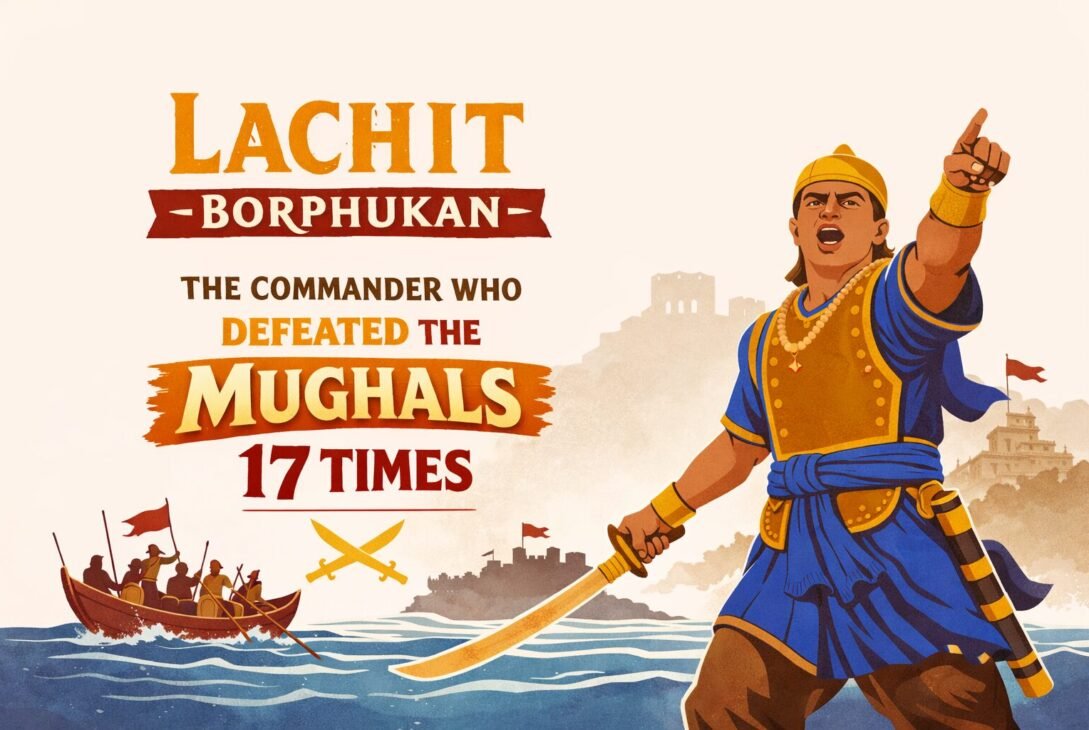
The Ahom dynasty ruled Assam from the Brahmaputra Valley for approximately 600 years, and for the better part of a century, they successfully resisted the mightiest empire in India without ever fully capitulating. The man most responsible for the most decisive of those victories was Lachit Borphukan — a general who led his army into battle from a sickbed, executed his own uncle for cowardice, and delivered the Mughals their most humiliating naval defeat in the northeast. His birthday is now celebrated as Lachit Day across Assam. The best graduating cadet at India’s National Defence Academy receives the Lachit Gold Medal in his name.
Yet outside Assam and a handful of history books, most Indians couldn’t tell you who he was. Here’s the full story.
How the Ahom Kingdom Began: A Thai Prince and a 13-Year March
The story of the Ahom dynasty doesn’t begin in India. It begins in Yunnan, in the prosperous frontier kingdom of Mong Mao, around the year 1215 CE.
A Thai prince, Sukapha, was passed over for the throne. His uncle, King Poong, had promised him succession. At the last moment, however, the king fathered his own son, handing the kingdom to his biological heir. Sukapha’s grandmother gave counsel that lasted centuries: no two tigers live in one jungle, just as no two kings share a throne. So Sukapha looked elsewhere.
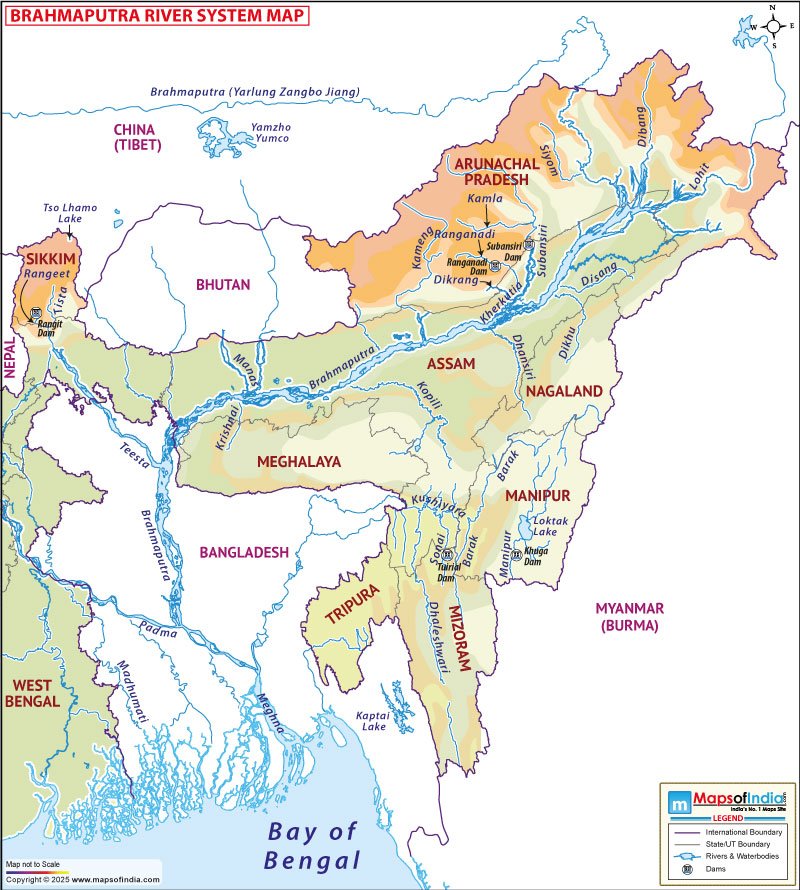
Word had reached Mong Mao that the once-powerful Kamarupa empire had lost its grip over the Brahmaputra Valley in northeast India — a fertile, naturally protected region connected to vibrant trade networks. Sukapha gathered five loyal Ahom lords, their warriors, priests, merchants, and peasants — more than nine thousand people in total — and set off. The journey took 13 years, through Burma and over the Patkai mountains, before the group finally entered the Brahmaputra Valley in 1228 CE.
What happened next is a masterclass in statecraft. Sukapha didn’t fight the local tribes for land. He settled between them, learned their languages, married the daughters of the Barahi and Maran chiefs, and encouraged intermingling. He farmed alongside common people. Over the following decades, the Ahom gradually absorbed local groups through what later came to be called ‘Ahomization’ — political alliances, intermarriage, and cultural exchange. Conquered nobles were given high-ranking positions. Local kinship groups were accorded the same respect as Ahom noble houses. It worked.
The Paik System: How the Ahom Kept an Army Without a Standing Budget
The Ahom Kingdom’s staying power over six centuries owed a great deal to an institution called the paik system — a compulsory labour obligation applied to all able-bodied men between the ages of 15 and 50, with exceptions for nobles, priests, and artisans. Every four paiks formed a got. Each man rotated through work assignments across the kingdom — military service, construction, farming state lands — for roughly three months per year, while the other three members of their family tended to his land in his absence.
In exchange, paiks were granted a plot of land to cultivate. The system gave the state a cheap, reliable, and constantly renewable workforce. It built roads and bridges, raised fortifications, constructed temples and reservoirs, and kept a large pool of trained soldiers available without the cost of a permanent standing army. One way to read the Ahom military success against the Mughals: they weren’t just fighting with better tactics. They were fighting for a more sustainable system.
The Mughal Invasions: Why Assam Was Worth Fighting For
By the time Babur established the Mughal Empire in 1526, the Ahom had already been ruling Assam for over 300 years. Their hold was deep, their administrative structures were mature, and their military had been hardened against Turkish and Afghan incursions from the northwest.
The Mughals, having swept through most of India, turned their attention northeast. The Brahmaputra Valley offered extraordinarily fertile land — described in the sources as among the most productive in India — and access to natural resources the Mughals coveted. By the time of Jahangir, Mughal power in Bengal had grown strong enough to make Assam the logical next step.
The first major flashpoint came in 1613, when the newly appointed Bengal Governor Qasim Khan Chishti began encroaching on Ahom territory through illegal trade. When the Ahoms seized boats carrying smuggled Mughal goods, war followed. In 1615, Qasim Khan declared war and marched a large force — 10,000 cavalry, 200 gunners, 400 large warships — toward Ahom territory.
The Battle of Samdhara: The First Lesson the Mughals Ignored
The Mughals won the first engagement. They crossed into Ahom territory, established military camps, and started feeling confident. Then the Ahoms waited for the right moment. It came in January 1616 at the Battle of Samdhara, near the confluence of the Bharali and Brahmaputra rivers. The Ahoms attacked on a cold night, with the element of complete surprise, killing Mughal commander Syed Abu Bakr and capturing the entire naval fleet. Some 5,000 Mughal soldiers died. Another 9,000 were seriously wounded. Around 3,000 fled.
Jahangir was furious but didn’t dare to make another major assault. Peace held for roughly 20 years. But it didn’t hold forever.
The Humiliating Treaty of Asurar Ali, 1639
In 1636, the Mughals launched another major attack. The resulting conflict — the Battle of Swal Kuchi — ran for two years before ending in Ahom victory. The Ahoms recaptured Swalakchi and Hajo from Mughal control. But both sides were exhausted, and in February 1639, Ahom general Momai Tamoli Bor Barua and Mughal commander Ala Yarar Khan signed the Treaty of Asurar Ali. Under it, the Mughals recognized Ahom sovereignty east of the Bardi River — but the Ahoms had to hand over Guwahati. It was a painful concession, and both sides knew it wouldn’t last.
It didn’t. When Mughal Emperor Shah Jahan fell seriously ill, and his sons began fighting over succession, the Ahom king Jayadhwaj Singha seized the moment, launched a fierce attack on Mughal-held areas, and drove them back to Dhaka. The Mughals responded by sending their most capable general.
Mir Jumla and the Low Point
Aurangzeb, now on the throne, dispatched Mir Jumla II — Viceroy of Bengal — with a powerful force that included Portuguese, Dutch, and English sailors alongside a substantial Mughal naval fleet. He pushed up the Brahmaputra, took Guwahati, swept past garrison after garrison, and captured the Ahom capital Gargaon in 1662. King Jayadhwaj Singh fled into the hills.
The monsoon saved the Ahoms. Mir Jumla found himself isolated, cut off from his supply base in Dhaka by the un navigable rains. The Ahoms launched relentless hit-and-run raids. An epidemic broke out in the Mughal camps. Still, Mir Jumla held on, and eventually Jayadhwaj Singh was forced to sue for peace, signing a treaty that required him to hand over Western Assam, pay a staggering war indemnity, send 90 war elephants annually, and give his 7-year-old daughter Ramani Ghabru to the Mughal emperor as a hostage. She grew up to marry Aurangzeb’s third son, Muhammad Azam Shah.
Before he died, Jayadhwaj called his successor Chakradhwaj Singh and said: You will have to remove this thorn of insult from our country’s chest. Chakradhwaj took that charge seriously. He refused to pay the remaining war indemnity, and then he appointed Lachit Borphukan.
Who Was Lachit Borphukan — And Why Chakradhwaj Chose Him
Lachit was the youngest son of former general Momai Tamuli Barbarua, who had himself fought Mughal forces across multiple campaigns. He wasn’t an untested young warrior. Before becoming Borphukan — supreme commander of the Ahom military, leader of 6,000 soldiers — he had served as head of the royal stables, chief of tax collection, and chief of police. Each post taught him something different about how the kingdom functioned and how its people could be organized.
The Ahom military hierarchy was precise: a leader of 10 was a Deka, of 100 a Sainy, of 1,000 a Hazarika, of 3,000 a Raj Khoba, of 6,000 a Phukan. Above all of them: the Borphukan. Chakradhwaj didn’t find anyone better suited to that role than Lachit.
His first act as Borphukan was to strengthen the Ahom naval force on the Brahmaputra — recognizing, correctly, that the river would be the decisive arena. He equipped his army with cannons. Then, in 1667, he launched his first major campaign to retake Guwahati.
Retaking Guwahati: The Night the Cannons Went Silent
The Itakhuli Fort stood between Lachit and Guwahati. A direct assault without cavalry was suicidal. So Lachit chose a different approach. He sent a soldier named Ismail Siddiqui — known as Baghika — with a small team to scale the fort walls under the cover of darkness. Their mission: fill the mouths of the Mughal cannons with water, rendering them useless. They succeeded. The next morning, when the Ahom army attacked, and the Mughal cannons failed to fire, the fort fell quickly. Guwahati was back in Ahom hands.
When Aurangzeb heard, he was furious. He assigned the campaign to Ram Singh, son of Raja Jai Singh — a Rajput commander with something to prove after a string of personal failures at the Mughal court. Ram Singh arrived in Assam with 30,000 infantry, 18,000 cavalry, 21 Rajput chieftains, hundreds of cannons, and a substantial naval fleet. Estimates put the total force at 75,000 to 80,000 soldiers.
The Battle of Saraighat: Lachit Borphukan’s Greatest Hour
Lachit knew exactly what he was facing. A direct confrontation in an open field would be suicide — his forces were massively outnumbered and outgunned. So he chose terrain that neutralized those advantages: the Brahmaputra at Saraighat, where the river narrowed, where dense forests flanked both banks, and where the only viable approach was through the water itself.
For months, the Ahoms fought only at night. They attacked Mughal camps at midnight and vanished into the forests before dawn. One night, Ahom soldiers crept into the tents of Mughal commanders and walked off with their silverware. Ram Singh sent a letter to Lachit requesting, genuinely, that the night fighting stop. Lachit’s reply became legendary: lions hunt only at night, and we are lions.
When the Ahom soldiers learned that Mughal troops feared them as demons, Lachit sent men disguised as demons to deepen the terror. Ram Singh, frustrated, planted a forged letter suggesting Lachit had taken a bribe from the Mughal camp. It reached the Ahom court. King Chakradhwaj, suspicious, ordered Lachit to fight in the open field. The result was the Battle of Alaboi in August 1669 — a disaster. The Ahoms lost 10,000 soldiers fighting in conditions that stripped away every tactical advantage they had.
Fighting Sick: The Moment That Defined a Legend
Chakradhwaj died. A new king took the throne. Ram Singh, sensing an opportunity, sent a peace proposal. Lachit opposed it furiously — he knew the Mughals wouldn’t honour it. He was right. Aurangzeb sent additional naval commanders Munawar Khan and Shahista Khan with reinforcements. The Mughal fleet mounted cannons on their boats and began shelling Ahom positions. The Ahom army started retreating.
Lachit Borphukan was seriously ill. He could barely stand. But when news reached him that his soldiers were falling back, he overruled his advisors, left his sickbed, and joined the battle personally. His message to the demoralized troops was unambiguous: if any of you tries to retreat, I will kill you with my own hands. The honour of this land is more precious than anyone’s life. Then, to demonstrate he meant it, he killed his own maternal uncle with a sword when the man showed cowardice.
He took personal command of a fleet of six boats, positioning them in a triangular formation between Kamakhya, Itakhuli, and Ashwakranta to trap the Mughal ships. Ahom soldiers leaped from boat to boat, boarding Mughal vessels in fierce hand-to-hand combat. The Ahoms also used fire arrows to set Mughal ships ablaze and — according to Ahom chronicles — released trained crocodiles into the river to create chaos among Mughal ranks.
Mughal naval commander Munawar Khan, supremely confident in his larger fleet and cannons, was smoking a hookah during the battle when a bullet struck him. His death broke Mughal morale. Approximately 4,000 Mughal soldiers died in the Battle of Saraighat. Dozens of warships sank in the Brahmaputra. Ram Singh retreated to Rangamati in March 1671, and in a remarkable tribute from an enemy commander, he wrote that he had never in all his campaigns seen such an all-round army, skilled equally in boatmanship, archery, trench digging, and handling guns and cannons. He could find no weakness.
Why Did the Mughals Never Conquer Assam? The Real Answer
The popular answer is: Lachit Borphukan. That’s not wrong. But it’s only part of the story.
Consider what the Mughals were actually up against. The Ahom guerrilla warfare tactics were built into the kingdom’s DNA from the very beginning — Sukapha’s original military thinking centred on using the Brahmaputra as both a defensive line and a strategic weapon. The river’s strong and unpredictable currents were a home advantage the Ahoms spent generations learning to exploit. The Mughal fleet, designed for open-water naval combat, was useless on a narrow, fast-moving river against small, manoeuvrable boats with local pilots who knew every bend.
Geography was a co-conspirator. Dense forests, seasonal monsoon floods, and mountain barriers made sustained Mughal occupation logistically impossible. Even when Mir Jumla captured the Ahom capital, he couldn’t hold it through the rains — his supply lines simply collapsed. The Ahoms understood this and used it deliberately, retreating, raiding, and waiting.
There’s also a structural point worth making. The Ahom paik system meant the kingdom could mobilize large numbers of trained fighters quickly and sustain a long resistance without the financial strain that would cripple a more centralized army. The core administrative system proved remarkably resilient even when political leadership faltered.
The Ahoms defeated the Mughals approximately 17 times across the conflict period from 1615 to 1682. The final decisive engagement, the Battle of Itakhuli in 1682, saw the Ahoms use mock forts built from bamboo and mud to lure Mughal forces into constant ambushes, bleeding them with hit-and-run attacks until they withdrew permanently. After that, the Mughals did not look toward Assam again.
Lachit Borphukan’s Legacy — And Why It Took So Long to Be Recognised
Lachit Borphukan died in April 1672, just months after the Battle of Saraighat. His health had never recovered from fighting while seriously ill. The Ahom Kingdom continued without him, ruled Assam for roughly another 150 years, and finally fell — not to the Mughals, but to the British in 1826.
For a long time, Lachit’s story stayed within Assam. Historians, including S.L. Barwa, eventually brought his heroism to wider attention, drawing explicit comparisons to Chhatrapati Shivaji Maharaj, Maharana Pratap, and Rani Durgavati — warriors who resisted Mughal power with similar tenacity. The comparison to Shivaji is particularly apt: both used terrain and unconventional tactics to repeatedly outmanoeuvre a far larger imperial force; both understood that a smaller army fighting on familiar ground could defeat a bigger one fighting blind.
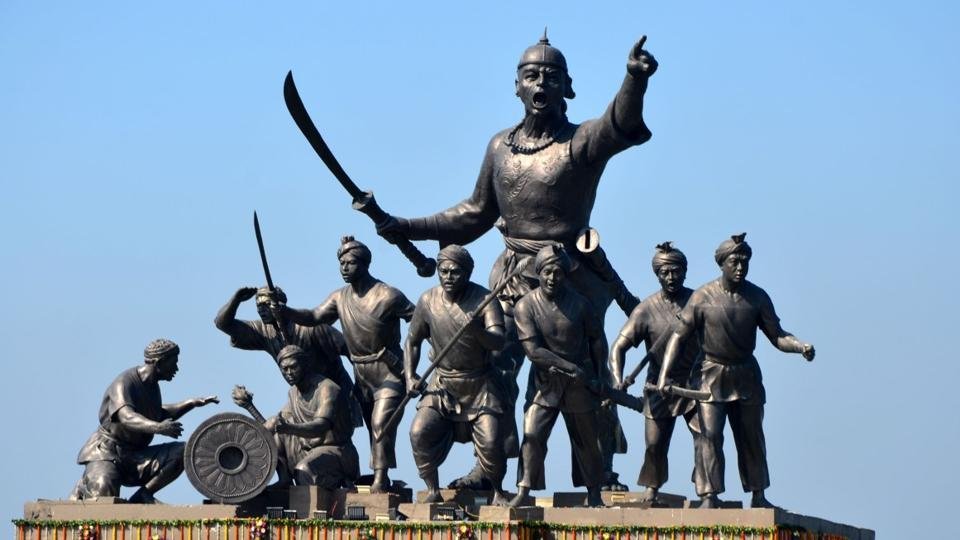
The Government of India installed a 125-foot statue of Lachit in Jorhat, Assam, in March 2024. His birthday, November 24, is celebrated as Lachit Day across the state. And the Lachit Gold Medal — awarded annually to the best NDA cadet — ensures his name is known to every officer entering India’s armed forces.
The Ahom dynasty held off the Mughal Empire for over seven decades of active conflict. Lachit Borphukan won its most critical battle while dying. The history of northeast India is not a footnote to the history of Delhi. It’s a different story entirely — and it’s one worth knowing.