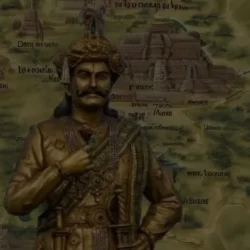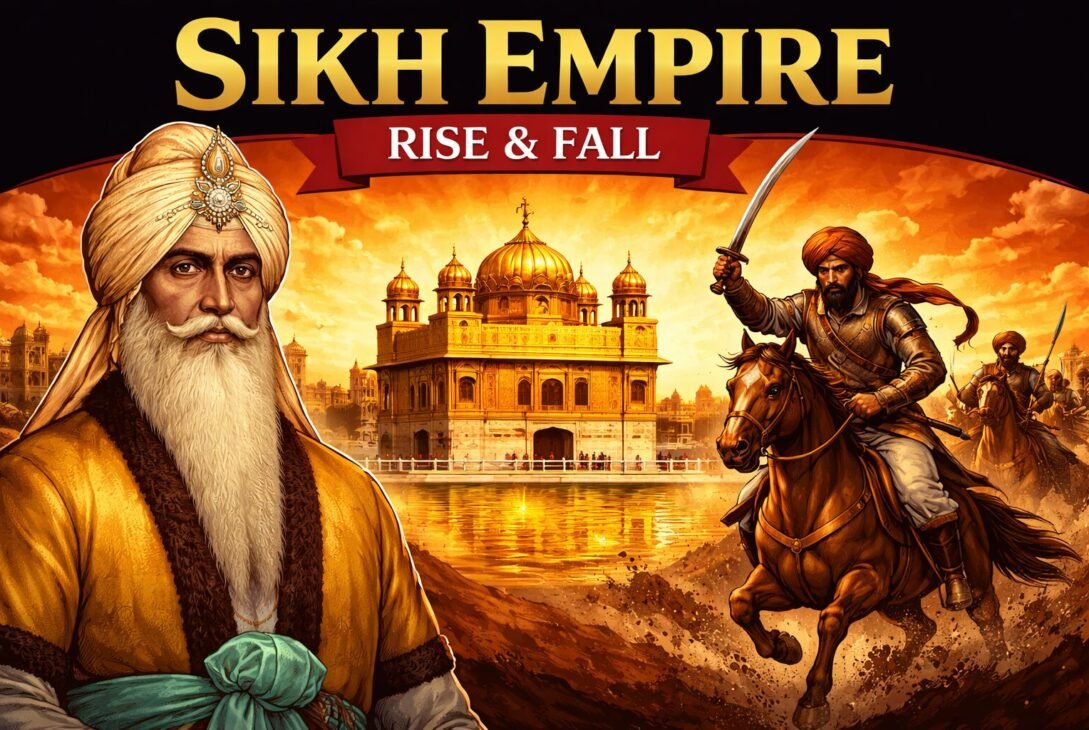
The Sikh Empire was one of the last major powers in northern India before British rule. Founded by Maharaja Ranjit Singh in 1801, it brought political stability to Punjab after decades of conflict, invasions, and fragmented authority. Within a few decades, it extended control over Lahore, Multan, Kashmir, and Peshawar, built a modern army, and consolidated power in a region long shaped by competing empires.
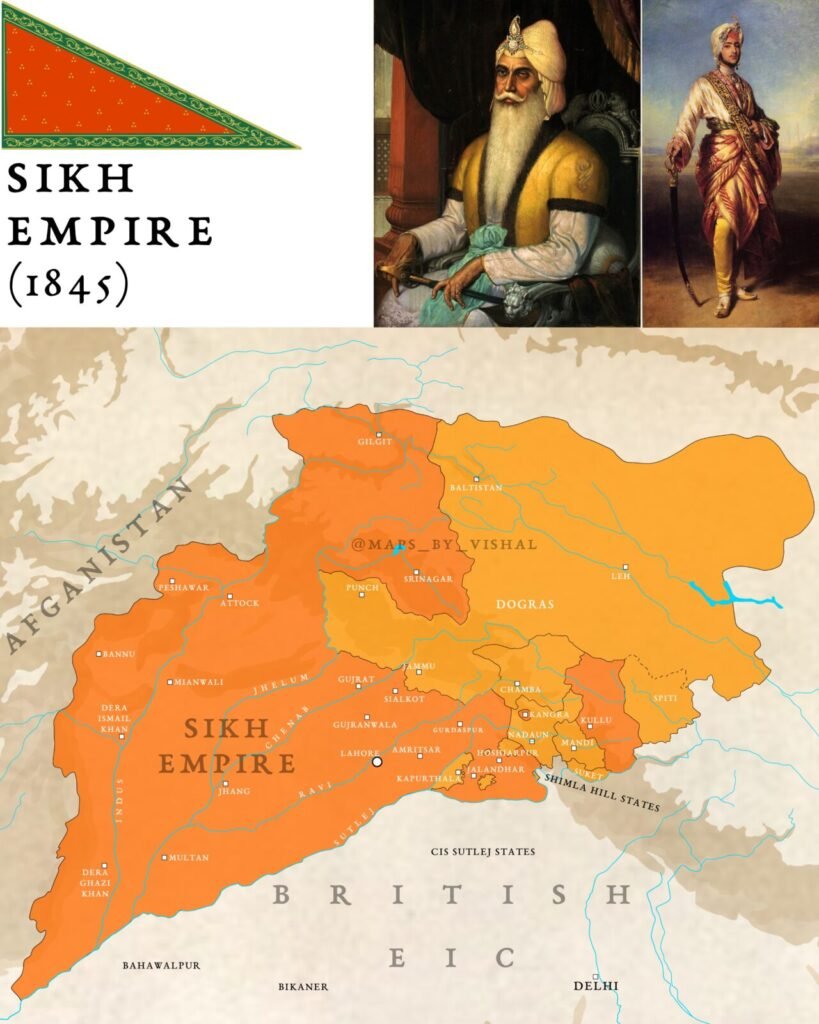
Source: Wikimedia Commons
Its importance lies not only in its expansion but in how it emerged. The empire evolved from a loose confederacy of Sikh groups that had survived persecution, adapted militarily, and gradually gained control of territory.
Origins: From Sikh Gurus to the Khalsa
The roots of the Sikh Empire can be traced to the movement founded by Guru Nanak in the 15th century, which developed into a distinct community in Punjab under the later Gurus.
Relations with the Mughal authority became increasingly tense over time. The execution of Sikh Gurus and political pressures pushed the community toward militarisation. This shift became decisive under Guru Gobind Singh, who established the Khalsa in 1699—a disciplined order committed to both faith and defence.
Banda Singh Bahadur and the First Sikh State
After Guru Gobind Singh’s death in 1708, leadership passed to the Khalsa. Banda Singh Bahadur led a major uprising against the Mughals and established what is often described as the first Sikh state in Punjab.
His rule briefly extended across eastern Punjab. But internal divisions weakened his position. After losing support within the Sikh community, he was defeated and executed by Mughal forces in 1716.
This episode demonstrated that political power was attainable; however, it was difficult to maintain without internal cohesion.
Persecution, Survival, and the Rise of Jathas
After Banda Singh’s defeat, Mughal authorities intensified efforts to suppress the Sikh community. Many Sikhs went into hiding, while others blended into civilian society.
Those who resisted regrouped in the Shivalik hills, forming small, mobile bands known as jathas. These groups avoided direct battles and relied on speed, local knowledge, and surprise.
Over time, coordination improved through the Sarbat Khalsa, a collective assembly held at Amritsar. This helped transform scattered bands into a more organised force.
Dal Khalsa and the Formation of Misls
By the 18th century, Sikh forces were reorganised under leaders such as Kapur Singh. The jathas were structured into two main divisions—the Taruna Dal and the Budha Dal—together forming the Dal Khalsa.
Later, these were reorganised into twelve misls, each led by a chieftain and controlling defined territories. While largely independent, they acknowledged a loose collective leadership.
This arrangement became known as the Sikh Confederacy—a network of regional powers rather than a centralized state. As external threats persisted, the confederacy adapted, laying the groundwork for future unification.
A Region in Flux: Afghans, Mughals, and Marathas
In the 18th century, Punjab was contested by multiple powers. The Mughal Empire was weakening, Ahmed Shah Abdali launched repeated invasions, and the Maratha Confederacy expanded northward.
Sikh groups avoided large, decisive battles. Instead, they relied on hit-and-run tactics, targeting supply lines and retreating quickly. Over time, this allowed them to outlast larger forces.
By the late 18th century, the misls were collecting tribute and exercising territorial control, even without a single central authority.
Rise of Maharaja Ranjit Singh and the Sikh Empire
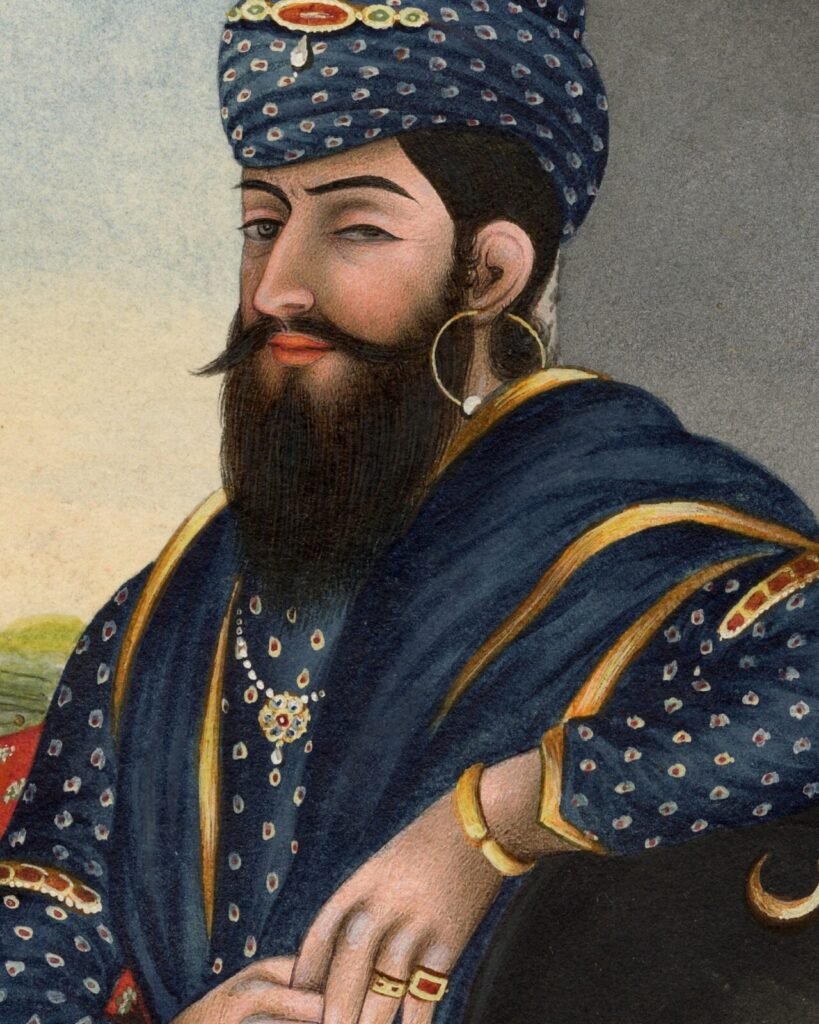
The shift from confederacy to empire came under Ranjit Singh, leader of the Sukerchakia Misl.
By the late 1790s, he had emerged as the most powerful misl leader. In 1799, he captured Lahore, the political centre of Punjab. In 1801, he declared himself Maharaja, marking the formal beginning of the Sikh Empire.
His rise reflected a broader need for central authority as the confederacy became increasingly unstable.
Expansion of the Sikh Empire
Under Ranjit Singh, the empire expanded into key regions:
- Multan (1818)
- Kashmir (1819)
- Peshawar (1823)
These campaigns extended control to strategic frontiers, including access to the Khyber Pass.
At its height, the Sikh Empire dominated much of Punjab and the surrounding regions.
Military and Administrative Reforms
Ranjit Singh moved away from the confederacy’s guerrilla-style warfare and built a standing army suited to holding territory.
- European officers were recruited to modernise training and artillery.
- Military organisation combined local practices with European techniques.
His administration included Hindus, Muslims, and others in key roles. Local customs and laws were generally respected, which helped maintain stability.
Society and Governance
Sikhs remained a minority in the empire, with most of the population being Hindu or Muslim.
Governance combined central authority with local autonomy. Different communities followed their own legal and social practices.
Ranjit Singh also focused on economic recovery. Agriculture was encouraged, and urban industries such as textiles and metalwork revived.
Decline of the Sikh Empire
The empire’s stability depended heavily on Ranjit Singh’s leadership. After his death in 1839, succession disputes and internal struggles weakened the state.
At the same time, the British East India Company had already expanded across much of India.
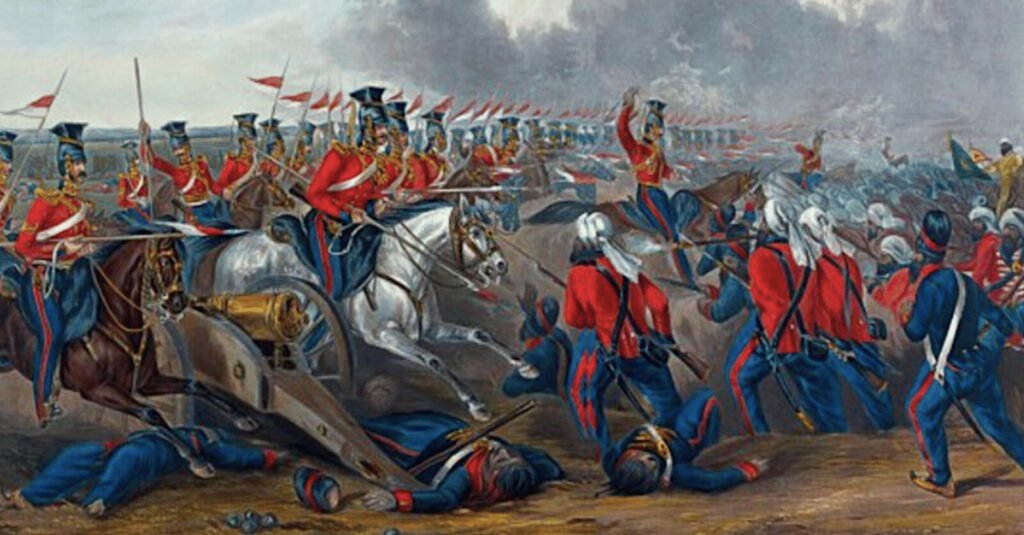
The Anglo-Sikh Wars (1845–1849) ended with the annexation of Punjab, bringing the Sikh Empire to an end.
Conclusion: What the Sikh Empire Represents
The Sikh Empire emerged from a long process of adaptation—religious organisation, military restructuring, and political consolidation.
It shows how a fragmented community, operating through confederacies and mobile warfare, eventually built a centralized state that held its ground in a contested region. Its rise and fall remain closely tied to the conditions of 18th and early 19th-century northern India.
FAQ
Who founded the Sikh Empire?
The Sikh Empire was founded by Maharaja Ranjit Singh in 1801 after he unified the Sikh misls of Punjab.
What were the Sikh misls?
The misls were semi-independent Sikh political and military units that controlled different parts of Punjab before the formation of the empire.
Why did the Sikh Empire decline?
After Ranjit Singh’s death in 1839, internal conflicts and weak leadership weakened the empire, leading to defeat in the Anglo-Sikh Wars.
What territories were part of the Sikh Empire?
At its height, the empire included Punjab, Multan, Kashmir, and Peshawar.
How was the Sikh Empire different from the Sikh Confederacy?
The Sikh Confederacy was a loose alliance of misls, while the Sikh Empire was a centralized state under Ranjit Singh.