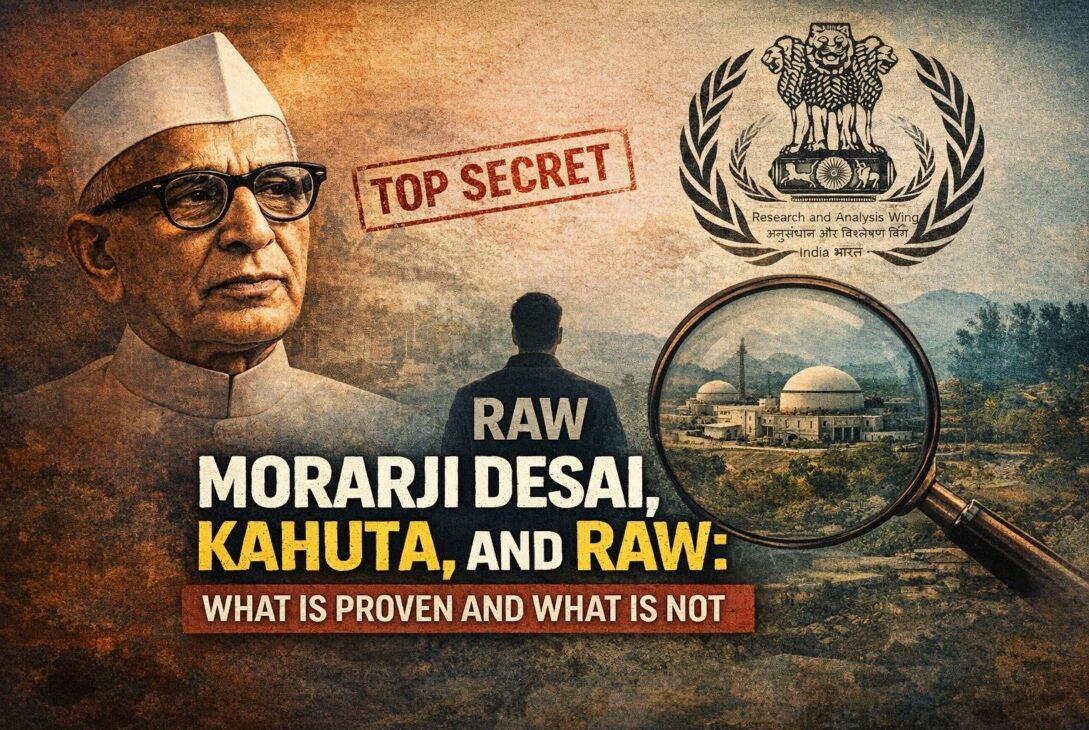
The claim that Morarji Desai helped Pakistan’s nuclear program has endured because it is dramatic and politically convenient. It is also often stretched beyond the record. The strongest version says Desai revealed India’s knowledge of Kahuta to General Zia-ul-Haq. Pakistan rolled up RAW’s network, and Islamabad moved ahead toward the bomb. The available record supports a narrower conclusion. Morarji Desai, Kahuta, and RAW are linked by a real controversy, but evidence points first to institutional weakening inside R&AW, not a proven chain leading to the killing of specific Kahuta-monitoring agents. Pakistan’s nuclear rise was also driven by forces that predated and outlasted Desai’s tenure.
That makes the subject harder to write about than it first appears. It sits at the intersection of intelligence history, India-Pakistan rivalry, and a long-running political accusation. A useful account has to separate what can be shown from what has simply been repeated.
Why Morarji Desai is linked to Kahuta
The public allegation usually follows a simple sequence. India knew about Pakistan’s uranium-enrichment work at Kahuta. Desai allegedly let Zia-ul-Haq know that India was aware of it. Pakistan then moved against Indian intelligence assets, and the program continued toward the nuclear threshold. That is the version most readers will recognize. Some parts of this chain are better supported than others.
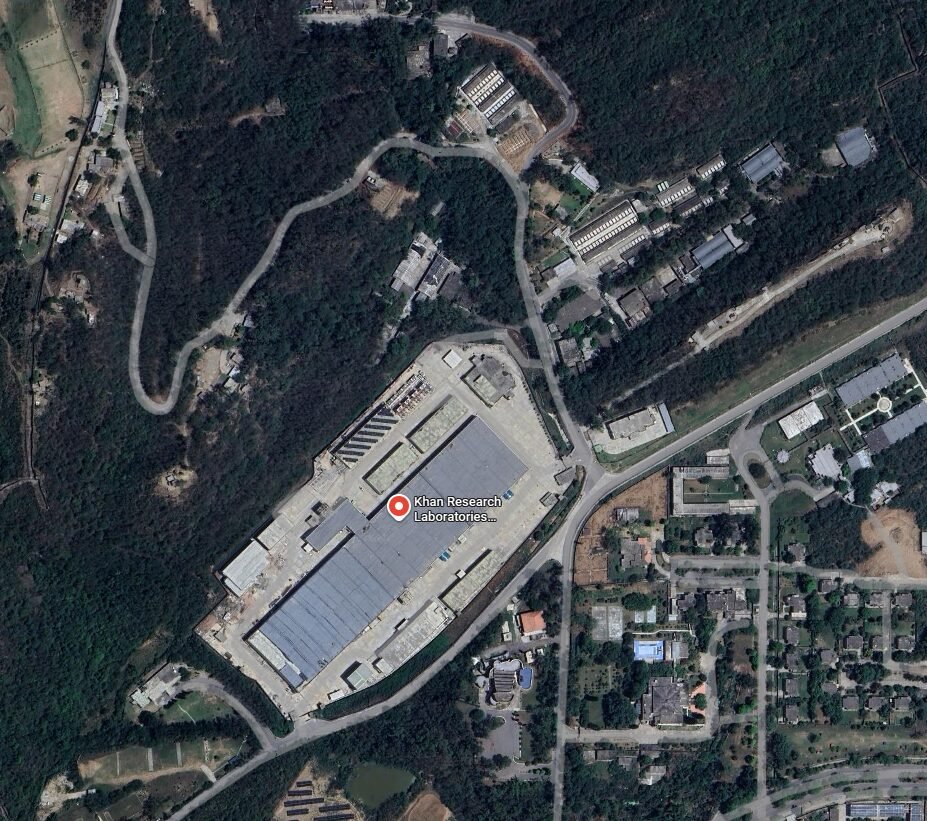
Kahuta mattered because it was central to Pakistan’s enrichment effort. The site is closely associated with Khan Research Laboratories, and with the wider weapons drive linked to A.Q. Khan. Any Indian monitoring of it would have carried obvious strategic value. The controversy around Morarji Desai, then, is not just about an alleged disclosure. It is also about what happened to India’s intelligence system during his tenure.
What is documented about RAW under Morarji Desai
The strongest part of the record is institutional.
A widely cited intelligence-history account says that after Desai became prime minister in 1977, R&AW was reduced to roughly two-thirds of its strength under a new chief, and that the cuts affected field officers and technical specialists, severely hurting Indian intelligence. That matters because it points to a concrete mechanism by which intelligence collection could have weakened. Cuts of that scale affect networks, continuity, technical work, and the ability to sustain sensitive overseas monitoring.
A second institutional detail is also important. Desai is said to have abolished the “Secretary ®” designation and redesignated the post as “Director, R&AW.” This change has been linked to K. Sankaran Nair’s resignation in protest. Status inside the Indian state is not a ceremonial matter. It shapes access, authority, and the ability of an intelligence chief to work across ministries and agencies.
The firmest conclusion is this: changes made during Desai’s tenure plausibly weakened India’s external intelligence capability.
The claim that requires careful wording
The most repeated version of the story is also the least secure.
The allegation about Desai’s reported disclosure is widely discussed, but official documentation is scarce. Recent reporting on the controversy has also pointed out that a frequently cited 2007 book does not itself describe the more dramatic outcome often attached to the story — that several RAW agents were captured, executed, or vanished because of Desai’s action.
That distinction matters. It is one thing to say that Morarji Desai is accused of compromising Indian awareness of Kahuta. It is another to present, as settled fact, that specific Indian agents were killed as a direct result. The available material does not support that stronger claim with named victims, declassified Indian inquiry records, Pakistani court proceedings, or contemporaneous reporting that clearly ties such outcomes to Kahuta monitoring. The careful formulation is that some commentators assert Indian assets were compromised, but the casualty claim remains unverified in accessible primary sources.
That is the difference between a cautious historical judgment and a repeated allegation.
Why Pakistan’s nuclear trajectory began before the Desai years
The phrase Morarji Desai Pakistan nuclear program invites a neat answer: one Indian leader made one mistake, and Pakistan became nuclear. The historical record is broader than that.
Pakistan’s nuclear trajectory had deeper roots. The program’s long arc is tied to the shocks of 1965 and 1971, to the role of Zulfikar Ali Bhutto, and to India’s 1974 nuclear test. It also depended on procurement networks, centrifuge technology, and long-term institutional persistence, including the network associated with A.Q. Khan. By the late 1970s and early 1980s, outside intelligence assessments already treated Pakistan’s program as advancing and resilient. Even a serious Indian intelligence setback in 1977–79 would still have been only one part of a larger story.
A decades-long nuclear history cannot be reduced to one anecdote about one conversation.
Why timing still mattered
The issue makes more sense when Morarji Desai is placed within a longer sequence rather than at its centre.
Pakistan’s nuclear pursuit moved from an early civil nuclear phase into sharper strategic urgency after the 1965 and 1971 wars, then accelerated after India’s 1974 test, with Kahuta becoming central in the later 1970s and the broader weapons trajectory continuing into the 1980s before culminating in the 1998 tests. Desai’s tenure, from 1977 to 1979, falls at a sensitive point in that sequence — but not at its beginning and not as its sole driver.
That timeline also clarifies why the institutional weakening of R&AW matters. If India’s external intelligence capability was weakened when Pakistan’s enrichment effort was consolidating, the damage could have been real even without a single provable “smoking gun” leak.
Did Morarji Desai weaken RAW?
The claim that he weakened R&AW is better supported than the claim that he directly enabled Pakistan’s nuclear success. The case rests on reported reductions in manpower, losses among field and technical staff, leadership disruption, and the lowering of the chief’s status.
For most readers, the real issue is not Morarji Desai’s full political career but whether his government weakened India’s visibility into Kahuta at a critical moment. On that narrower question, the article has firmer ground.
What this controversy does and does not prove
It does not let us say, with confidence, that Morarji Desai directly caused the deaths of named Indian agents near Kahuta.
It does not let us say that one conversation, if it happened in the way often described, explains Pakistan’s path to the bomb.
It does not let us turn a contested intelligence controversy into a settled historical verdict.
Two conclusions can be held together. First, Desai-era decisions appear to have imposed real structural constraints on India’s intelligence apparatus. Second, Pakistan’s nuclear rise cannot be reduced to one Indian lapse, and the strongest casualty claims tied to Kahuta remain unverified in the open record.
Conclusion
The Morarji Desai Kahuta controversy is more limited and more specific than its loudest retellings suggest. The record supports the view that Desai-era decisions weakened R&AW through leadership disruption, status downgrading, and manpower cuts. It does not firmly support the stronger claim that his actions directly led to the killing of specific agents monitoring Kahuta. Nor does it justify treating Pakistan’s nuclear success as the result of one Indian political mistake. Pakistan’s nuclear program was driven by wars, strategic resolve, institutional persistence, and external procurement over many years.
FAQ
Did Morarji Desai reveal Indian knowledge of Kahuta to Zia-ul-Haq?
The allegation is widely repeated, but official documentation is sparse. The stronger public claims about its consequences need careful wording.
Did Morarji Desai weaken RAW?
The available material supports that claim more strongly than the broader “he made Pakistan nuclear” allegation, especially through reported manpower cuts, leadership churn, and the lowering of the R&AW chief’s status.
Did Desai’s actions directly cause the deaths of RAW agents monitoring Kahuta?
There is not enough accessible primary evidence to state that confidently. The casualty component remains unverified in open sources.
Why can Pakistan’s nuclear program not be explained by Desai alone?
Because the program’s roots go back to earlier wars, India’s 1974 test, the leadership decisions of Zulfikar Ali Bhutto, and Pakistan’s long-term procurement and institutional efforts. Those structural factors were larger than any single Indian decision.