Seventy-three words. That is all it takes for India’s Constitution to declare what kind of nation it intends to be. The Preamble of the Indian Constitution is the document’s opening statement — a carefully worded declaration of the republic’s foundational ideals and governing structure. It begins with three of the most consequential words in Indian constitutional law: “We, the People.”
Those words do something specific. They establish that the Constitution’s authority does not flow from a colonial grant, a royal decree, or a religious mandate — it flows from the citizens of India themselves. Everything that follows in the Preamble builds on that claim: a sovereign state, committed to justice, liberty, equality, and fraternity, structured as a democratic republic.
For UPSC aspirants and students of Indian polity, the Preamble is among the first topics covered — and often misunderstood. Is it legally enforceable? Can it be amended? Were “Socialist” and “Secular” always in it? Each of these questions has a precise, documented answer grounded in Constituent Assembly debates and Supreme Court rulings. This article covers all of it.
Quick Reference: Key Facts at a Glance
| Detail | Information |
| Adopted by Constituent Assembly | 26 November 1949 |
| Constitution came into force | 26 January 1950 |
| Preamble debated in Assembly | 17 October 1949 |
| Objectives Resolution moved | 13 December 1946 (adopted 22 January 1947) |
| Only amendment to Preamble | 42nd Amendment Act, 1976 |
| Words added in 1976 | “Socialist”, “Secular”, “Integrity” |
| Drafting Committee Chair | Dr. B.R. Ambedkar |
| Constituent Assembly President | Dr. Rajendra Prasad |
| Length of Preamble | 73 words |
| Legally enforceable? | No — interpretive guide only |
| Part of basic structure? | Yes, per Supreme Court |
[SOURCE: Ministry of Law & Justice / People’s Archive of Rural India — official constitutional text; Dr. Balram Singh v. Union of India, Supreme Court of India, 2024]
The Full Text of the Preamble
Before examining what it means, it helps to read it as it stands today — amended and in force:
WE, THE PEOPLE OF INDIA, having solemnly resolved to constitute India into a SOVEREIGN SOCIALIST SECULAR DEMOCRATIC REPUBLIC and to secure to all its citizens:
JUSTICE, social, economic, and political;
LIBERTY of thought, expression, belief, faith, and worship;
EQUALITY of status and of opportunity; and to promote among them all
FRATERNITY assuring the dignity of the individual and the unity and integrity of the Nation;
IN OUR CONSTITUENT ASSEMBLY, this twenty-sixth day of November, 1949, we do hereby ADOPT, ENACT, and GIVE TO OURSELVES THIS CONSTITUTION.
[SOURCE: Government of India / Ministry of Law & Justice — official Preamble text; constitutionofindia.net]
The words in bold capitals are printed that way in the original document — a deliberate typographic choice that signals their constitutional weight.
Where the Preamble Came From: The Objectives Resolution
The Preamble did not emerge fully formed in November 1949. Its intellectual roots lie in a document moved three years earlier.
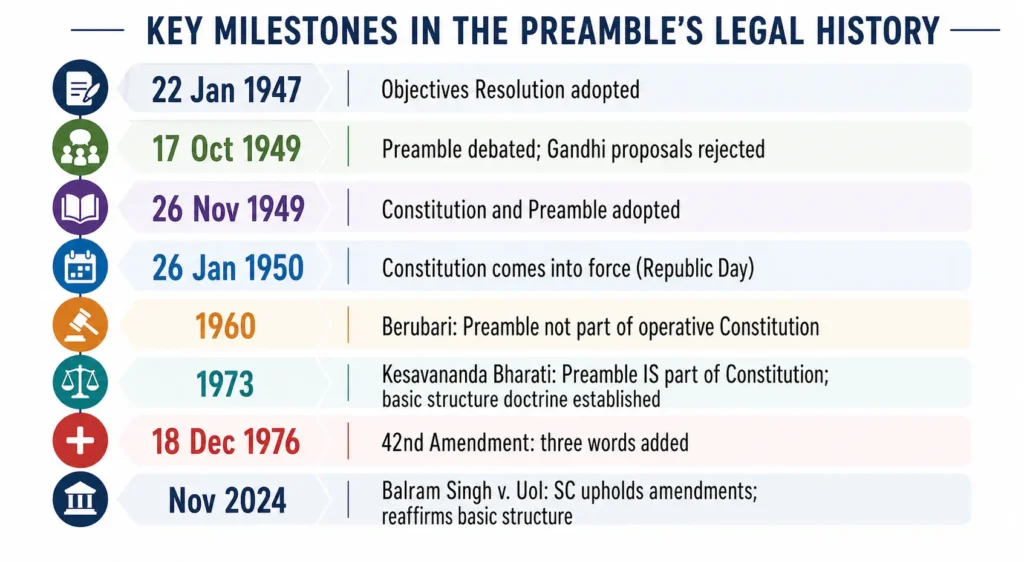
On 13 December 1946, Jawaharlal Nehru placed before the newly convened Constituent Assembly what he called the Objectives Resolution. It declared India to be an “Independent Sovereign Republic” and pledged to secure justice, equality, and fundamental rights for all citizens — language that would directly shape the Preamble’s final text. The Assembly adopted the Objectives Resolution on 22 January 1947.
[SOURCE: Indian Express Explained — “How ‘socialist’ and ‘secular’ were inserted in the Preamble”]
This is a distinction that matters for UPSC: the Preamble is not the same as the Objectives Resolution. The resolution was a statement of intent; the Preamble is the enacted constitutional text. The two share DNA but are separate documents with different legal status.
The key difference in the examiners’ test is that the Objectives Resolution referred to India as an “Independent Sovereign Republic.” The Preamble, as adopted, used “Sovereign Democratic Republic” — and later “Sovereign Socialist Secular Democratic Republic” after the 1976 amendment.
The Constituent Assembly Debate: What Almost Made It In
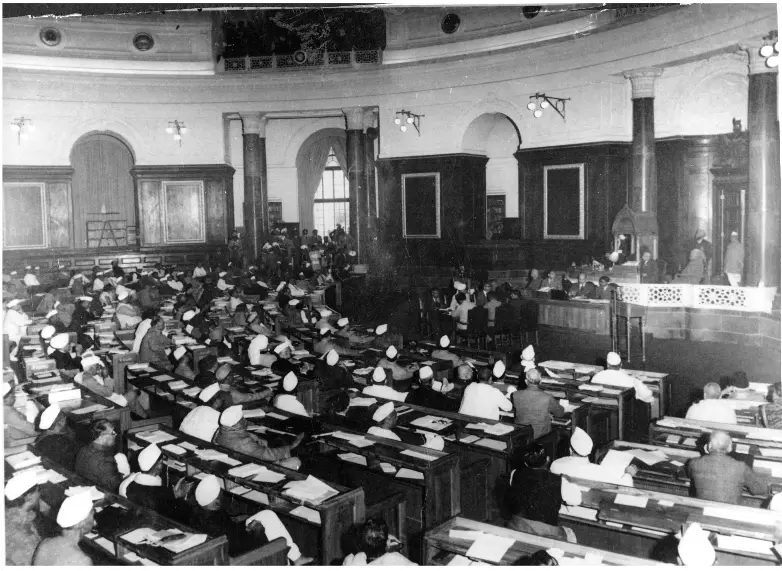
Image Source: Apna Gyaan
The Constituent Assembly debated the Preamble on 17 October 1949 — notably, it was the last major subject debated before the Constitution was adopted. Several amendments were proposed and rejected, and knowing them reveals how deliberate the final text actually is.
The proposal to invoke God: H.V. Kamath moved an amendment to prefix the Preamble with “In the name of God.” The Assembly voted on it. The result: 41 in favour, 68 against. The proposal was defeated. [SOURCE: constitutionofindia.net — Constituent Assembly Debates summary]
The proposal to rename India: Maulana Hasrat Mohani urged the Assembly to rename India the “Union of Indian Socialist Republics” — an explicit reference to the Soviet model. The Assembly rejected this as incompatible with the constitutional scheme already adopted. [SOURCE: constitutionofindia.net — Constituent Assembly Debates summary]
The proposal to include Gandhi’s name: Another member moved to include a reference to Mahatma Gandhi. This, too, was rejected. The framers were building a constitutional republic, not a hagiography.
Ultimately, the Assembly adopted the Preamble as presented by the Drafting Committee. [SOURCE: constitutionofindia.net]
What emerges from these debates is a picture of a founding generation that was deeply conscious of the choices they were making. The rejection of “God” was not anti-religion; it was a decision that the state would not privilege any faith. The rejection of “Gandhi” was not ingratitude; it was a commitment to a constitutional text that stood on principle, not personality.
What Each Word in the Preamble Actually Means
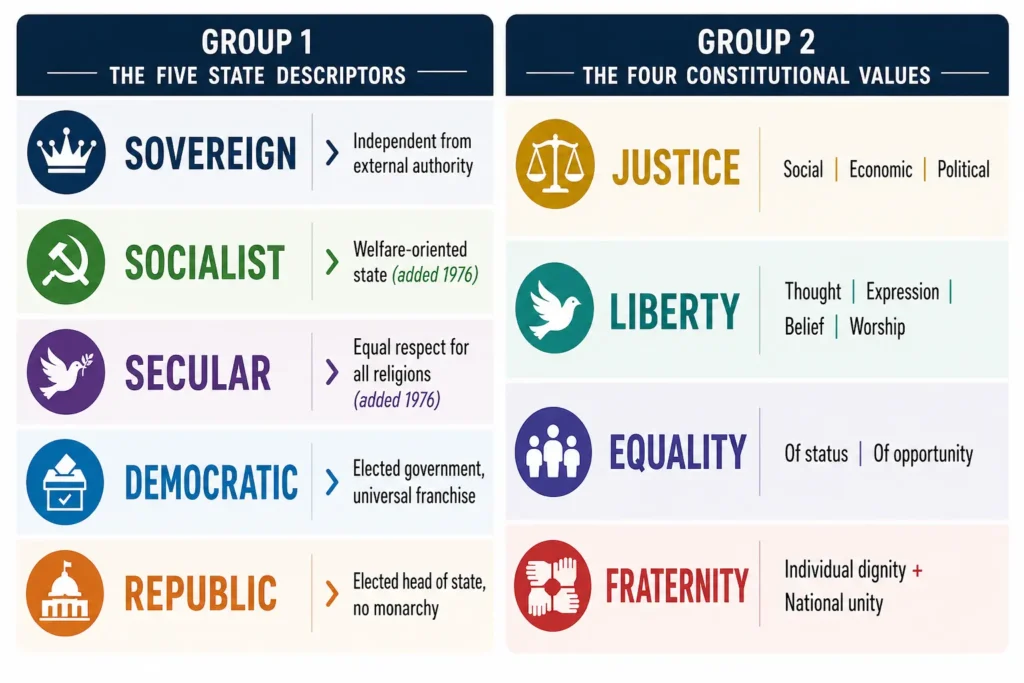
The five descriptors of the Indian state — Sovereign, Socialist, Secular, Democratic, Republic — are not decorative. Each has a defined legal meaning.
Sovereign means India is fully independent. It governs itself without being subject to any external authority. [SOURCE: Indian Express Explained — “The Preamble: what does it say, and what does it mean to India and its Constitution?”]
Socialist, added in 1976, signals the state’s commitment to social welfare and reducing economic inequality. The Supreme Court, in Dr. Balram Singh v. Union of India (2024), clarified that socialism in the Indian constitutional context means the state is welfare-oriented — committed to ensuring equality of opportunity — rather than implying rigid state ownership of all means of production.
Secular, also added in 1976, means the state maintains no official religion and treats all faiths equally. India’s secularism is not the strict separation of religion from public life (as in France) but a model of equal respect and non-discrimination. The Supreme Court in Balram Singh (2024) defined Indian secularism as the state neither upholding nor denigrating any religion. [SOURCE: Dr. Balram Singh v. Union of India, Supreme Court of India, 2024]
Democracy reflects that India’s government derives its authority from the people, exercised through elected representatives under universal adult franchise.
Republic means the head of state — the President of India — is elected, not hereditary. There is no monarchy.
The four values that follow — Justice, Liberty, Equality, Fraternity — are equally specific:
Justice is tripartite: social (dismantling caste and class privilege), economic (fair distribution of resources), and political (equal political rights for all citizens).
Liberty covers thought, expression, belief, faith, and worship — a formulation that maps directly onto the Fundamental Rights in Part III of the Constitution.
Equality of status and opportunity — this phrase runs through Articles 14 to 18 of the Constitution, which prohibit discrimination and untouchability.
Fraternity is the most underappreciated of the four. It ties individual dignity to national unity — the idea that the republic only holds together when its citizens treat each other as equals.
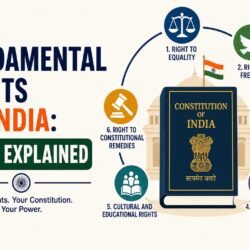
These ideals are not just words — they are actually enforced through the Fundamental Rights in Part III of the Constitution.
The 42nd Amendment: What Changed in 1976
The Preamble has been amended exactly once.
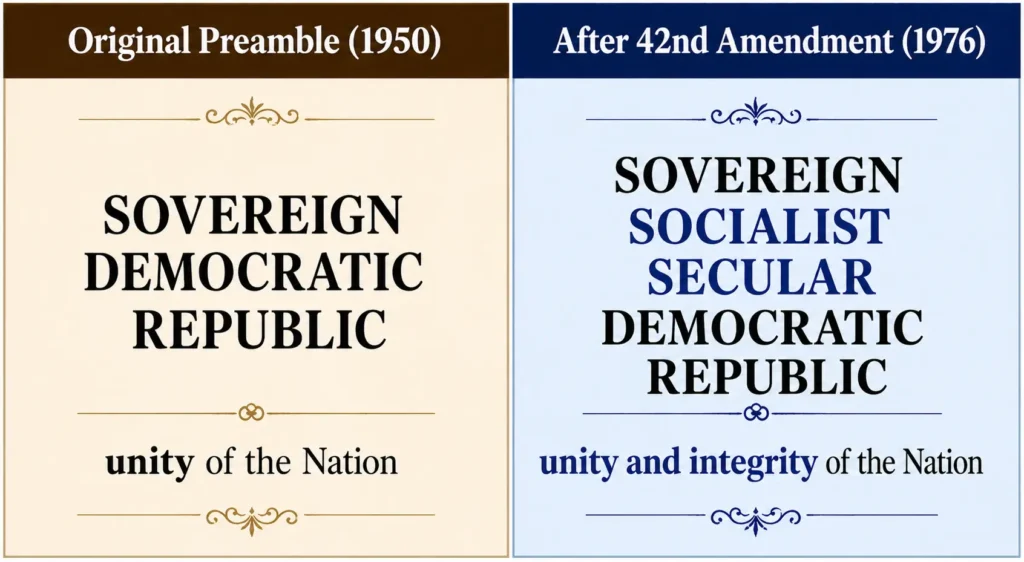
The Constitution (Forty-second Amendment) Act, 1976 — passed during the Emergency under Prime Minister Indira Gandhi — inserted three words and changed a phrase:
- “Socialist” was inserted before “Democratic Republic.”
- “Secular” was inserted alongside “Socialist.”
- “Integrity” was added, changing “unity of the Nation” to “unity and integrity of the Nation.”
[SOURCE: Dr. Balram Singh v. Union of India, Supreme Court, 2024; Ministry of Law & Justice — official constitutional text]
So the original 1950 Preamble described India as a “SOVEREIGN DEMOCRATIC REPUBLIC.” The post-1976 Preamble describes India as a “SOVEREIGN SOCIALIST SECULAR DEMOCRATIC REPUBLIC.”
This change goes beyond terminology. “Socialist” and “Secular” were not in the original 1950 text, as the debate record shows. They were inserted in 1976 during suspended democratic norms and later challenged.
In November 2024, the Supreme Court of India addressed petitions questioning whether these words could remain in the Preamble, given their circumstances of insertion. In Dr. Balram Singh v. Union of India, the Court confirmed that Parliament’s Article 368 power to amend the Constitution extends to the Preamble and that, as understood in the Indian constitutional context, secularism and socialism are part of the Constitution’s basic structure and cannot be removed by amendment.
The Legal Status of the Preamble: Part of the Constitution, Not a Law
This is the most consistently misunderstood aspect of the Preamble, and it is tested directly in UPSC.
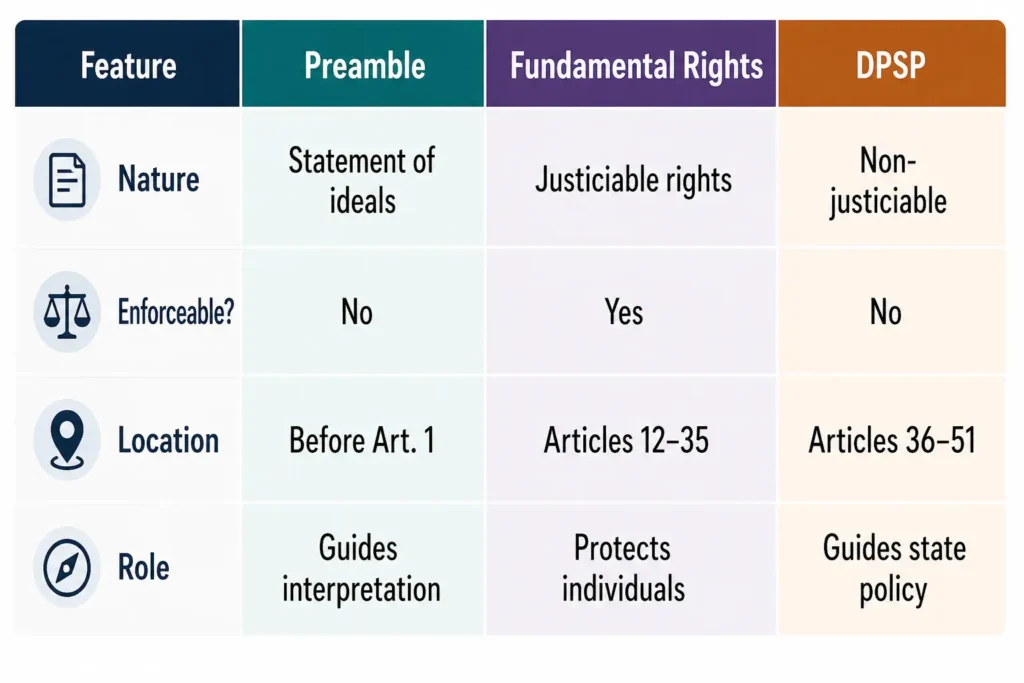
The Preamble is not a source of enforceable rights. You cannot file a writ petition in the Supreme Court on the basis of the Preamble alone. It does not confer rights or impose obligations by itself. [SOURCE: Indian Express Explained — “The Preamble: what does it say, and what does it mean to India and its Constitution?”]
What it does is guide interpretation. When a constitutional provision is ambiguous, courts look to the Preamble to understand the framers’ intent. It is a navigational tool for judges, not a standalone legal instrument.
On whether it is part of the Constitution at all, earlier judicial opinion was divided. The 1960 Berubari judgment suggested the Preamble was not part of the Constitution’s operative provisions. But Kesavananda Bharati v. State of Kerala (1973) decisively shifted this — the Supreme Court held that the Preamble is part of the Constitution and, crucially, that the core ideals it embodies (democracy, secularism, the rule of law) constitute the basic structure of the Constitution. The basic structure cannot be abrogated even by a constitutional amendment.
The Balram Singh (2024) judgment reaffirmed this framework: the Preamble can be amended under Article 368, but not in a way that destroys its basic structure. Parliament amended it in 1976 to add values; it could not amend it to remove democracy or sovereignty.
Who Drafted the Preamble?
The Preamble was drafted by the Constituent Assembly’s Drafting Committee, which was chaired by Dr. B.R. Ambedkar. Dr. Rajendra Prasad presided over the Constituent Assembly as a whole. The Constituent Assembly formally adopted the Constitution — including the Preamble — on 26 November 1949.
A note of historical nuance: some accounts attribute the original draft of the Preamble’s language to other figures, including V.K. Krishna Menon, who reportedly worked on an early draft. [SOURCE: The Hindu — “Krishna Menon drafted Constitution’s Preamble”] However, the constitutionally authoritative position is that the Drafting Committee under Ambedkar produced the final text adopted by the Assembly.
Common Misconceptions About the Preamble
“The Preamble gives me constitutional rights.”
It does not. Rights are in Part III (Fundamental Rights, Articles 12–35). The Preamble states the goals of the Constitution; it is not itself a source of justiciable entitlements.
“India was always secular and socialist from 1950.”
No. The original 1950 Preamble did not contain either word. They were added by the 42nd Amendment in 1976.
“The Preamble cannot be amended.”
Incorrect. Parliament amended it in 1976, and the Supreme Court upheld that power in 2024. The Preamble can be amended under Article 368, subject to the basic structure doctrine.
“The Preamble was adopted on 26 January 1950.”
The Constitution came into force on 26 January 1950 (hence Republic Day). But the Preamble — along with the rest of the Constitution — was adopted by the Constituent Assembly on 26 November 1949 (hence Constitution Day, also called National Law Day).
Frequently Asked Questions
What is the Preamble of the Indian Constitution?
The Preamble is the Constitution’s introductory statement. It declares India to be a Sovereign Socialist Secular Democratic Republic and commits the state to securing justice, liberty, equality, and fraternity for all citizens. It was adopted on 26 November 1949.
Can the Preamble be amended?
Yes. Parliament amended it once, via the 42nd Amendment Act, 1976. The Supreme Court confirmed in Dr. Balram Singh v. Union of India (2024) that Parliament’s power under Article 368 extends to the Preamble, subject to the basic structure doctrine.
What does “We, the People of India” mean?
It establishes popular sovereignty — the principle that the Constitution’s authority derives from the citizens of India, not from any external power or hereditary authority.
Which words were added by the 42nd Amendment?
“Socialist”, “Secular”, and “Integrity” (the last changing “unity of the Nation” to “unity and integrity of the Nation”).
Is the Preamble legally enforceable?
No. The Preamble is not a justiciable law. It guides constitutional interpretation but does not independently confer rights or impose obligations.
What is the difference between the Objectives Resolution and the Preamble?
The Objectives Resolution (adopted 22 January 1947) was a statement of intent that guided the Constitution’s drafting. The Preamble is the enacted constitutional text — it is part of the Constitution itself and carries legal significance as an interpretive tool.
Key Takeaways
- The Preamble of the Indian Constitution is a 73-word declaration of national ideals, adopted on 26 November 1949 and in force from 26 January 1950.
- “We, the People of India” establishes popular sovereignty as the foundation of the entire constitutional order.
- The five descriptors — Sovereign, Socialist, Secular, Democratic, Republic — each carry a specific legal meaning, the last two added only in 1976.
- The Preamble has been amended exactly once, by the 42nd Amendment Act, 1976. The Supreme Court upheld those amendments and confirmed Parliament’s power to amend the Preamble in Balram Singh v. Union of India (2024).
- The Preamble is part of the Constitution but is not enforceable law. It functions as a guide to interpreting ambiguous constitutional provisions and embodies the basic structure of the republic.