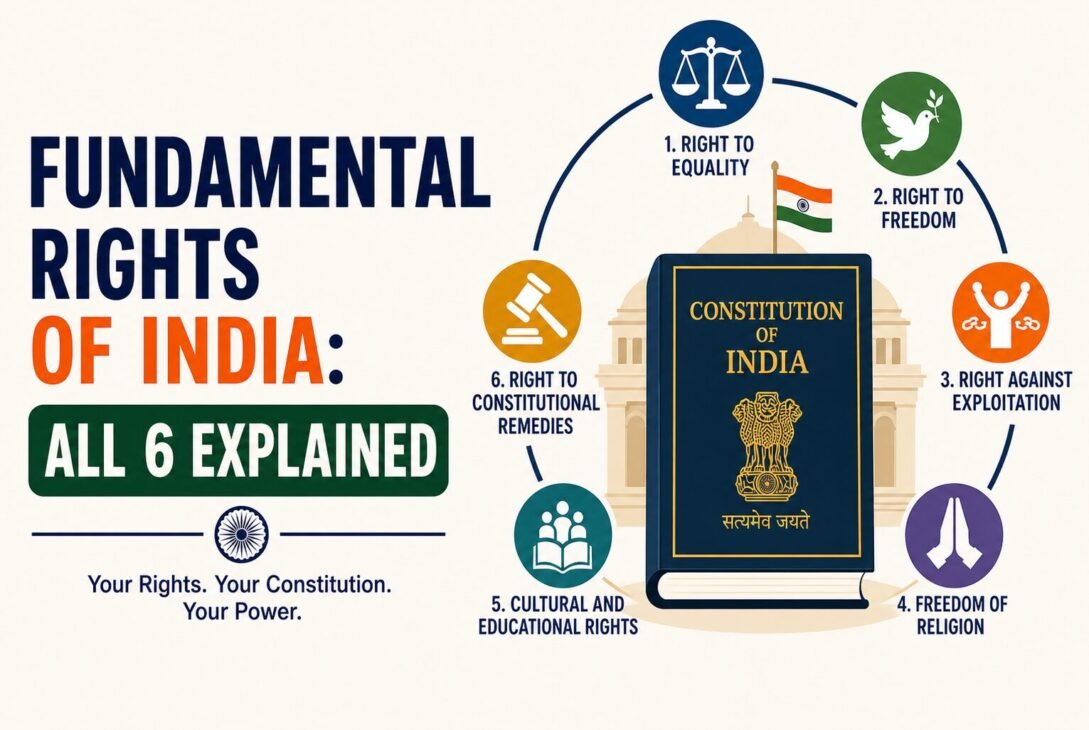
Every democracy makes promises. India’s Constitution went a step further — it made those promises legally enforceable from the very first day. When the Constitution came into effect on 26 January 1950, it embedded a set of Fundamental Rights in Part III (Articles 12–35) that no legislature could casually override and no government could simply ignore. These are not aspirational goals. They are justiciable guarantees: enforceable in court, with the Supreme Court as the last line of defence.
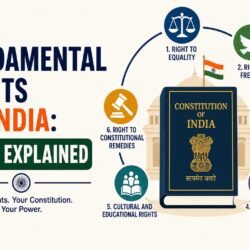
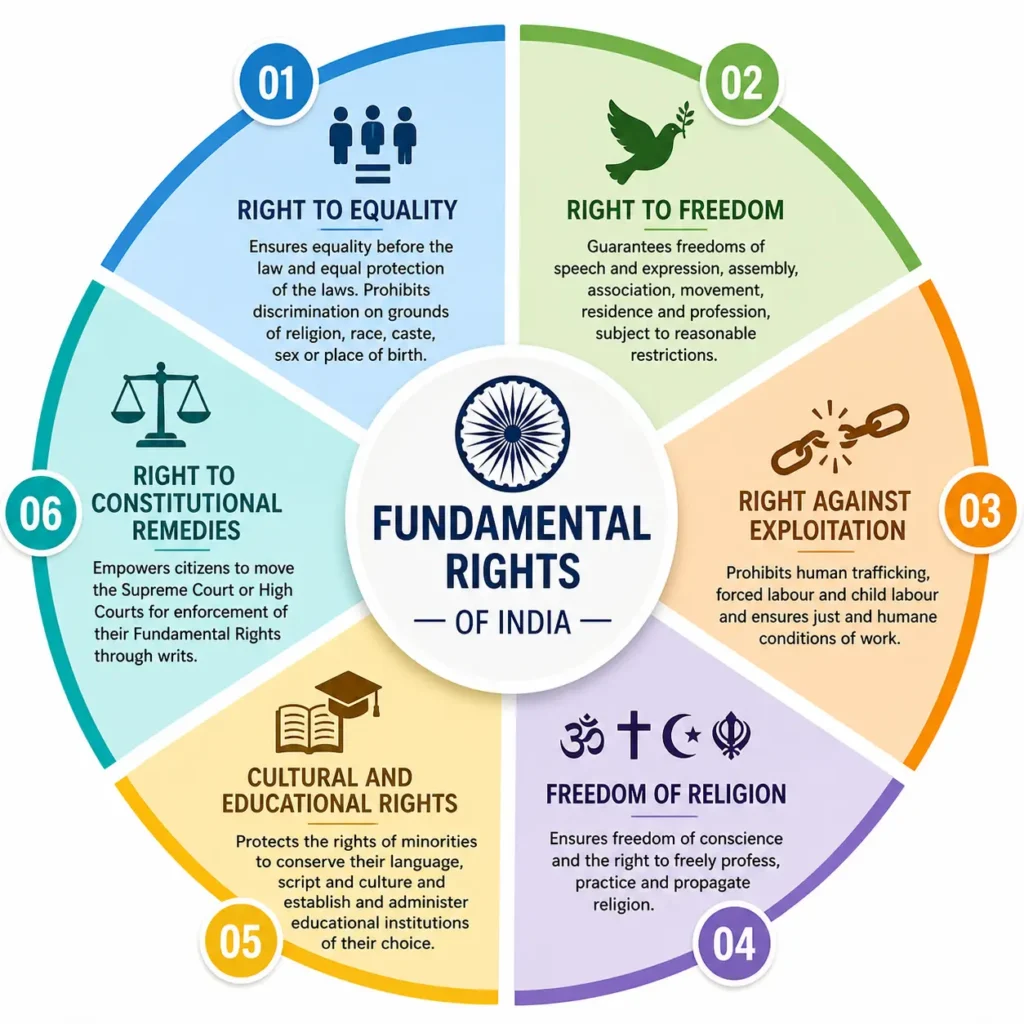
There are six categories of Fundamental Rights in the Indian Constitution today: Right to Equality, Right to Freedom, Right against Exploitation, Freedom of Religion, Cultural and Educational Rights, and the Right to Constitutional Remedies. Understanding them is essential not just for UPSC preparation but for any Indian who wants to know what the Constitution actually promises. This article walks through all six categories, the key Articles, landmark Supreme Court cases, and the amendments that have shaped these rights over seven decades.
Quick Reference: Fundamental Rights at a Glance
| Category | Articles | Core Guarantee |
| Right to Equality | 14–18 | Equality before law; no discrimination; abolition of untouchability |
| Right to Freedom | 19–22 | Six freedoms of citizens; right to life; legal safeguards on arrest |
| Right against Exploitation | 23–24 | Ban on human trafficking, forced labour, child labour |
| Freedom of Religion | 25–28 | Freedom of conscience; secular state; no religious taxes |
| Cultural and Educational Rights | 29–30 | Minority rights to culture, language, and educational institutions |
| Right to Constitutional Remedies | 32 | Right to approach Supreme Court; power to issue writs |
Source: Constitution of India, Part III (Articles 12–35) — [SOURCE: indiacode.nic.in / National Portal of India, knowindia.india.gov.in]
What Are Fundamental Rights? Meaning and Scope
Fundamental Rights are the basic, enforceable rights that the Indian Constitution guarantees to protect individuals against arbitrary state action. They differ from ordinary legal rights because Fundamental Rights override ordinary legislation, while ordinary legal rights do not. Article 13 makes this explicit — any law that is “inconsistent with or in derogation of” the Fundamental Rights is void to the extent of that inconsistency. [SOURCE: Constitution of India, Article 13 — indiacode.nic.in]. These rights are based on the values of justice, liberty, equality, and fraternity mentioned in the Preamble of the Constitution.
This gives courts — especially the Supreme Court — the power of judicial review: the authority to strike down any parliamentary law or executive action that violates these rights. It is a foundational check on state power.
Who is protected? Most Fundamental Rights apply to citizens of India. But Articles 14 (equality before law), 20, 21 (life and personal liberty), and 22 (protection against arbitrary arrest) extend to any person, citizen or not. [SOURCE: Constitution of India, Articles 14, 21 — indiacode.nic.in; mea.gov.in Part III PDF]
Who must respect them? Article 12 defines “the State” broadly — it includes the Central Government and state governments, Parliament and state legislatures, local authorities, and all other bodies or authorities under government control or performing public functions. [SOURCE: Constitution of India, Article 12 — indiacode.nic.This breadth matters: Fundamental Rights constrain every arm of the state, not merely elected legislators.
A note on private actors: Fundamental Rights are primarily enforceable against the state. They do not directly bind private individuals, though several provisions — like the ban on untouchability under Article 17 — explicitly extend to all persons in all circumstances.
According to PRS Legislative Research’s analysis of the Constituent Assembly Debates, Fundamental Rights occupied 14 percent of the Assembly’s entire clause-by-clause debate — reflecting just how seriously the framers took this part of the Constitution. [SOURCE: PRS Legislative Research, Vital Stats — prsindia.org]
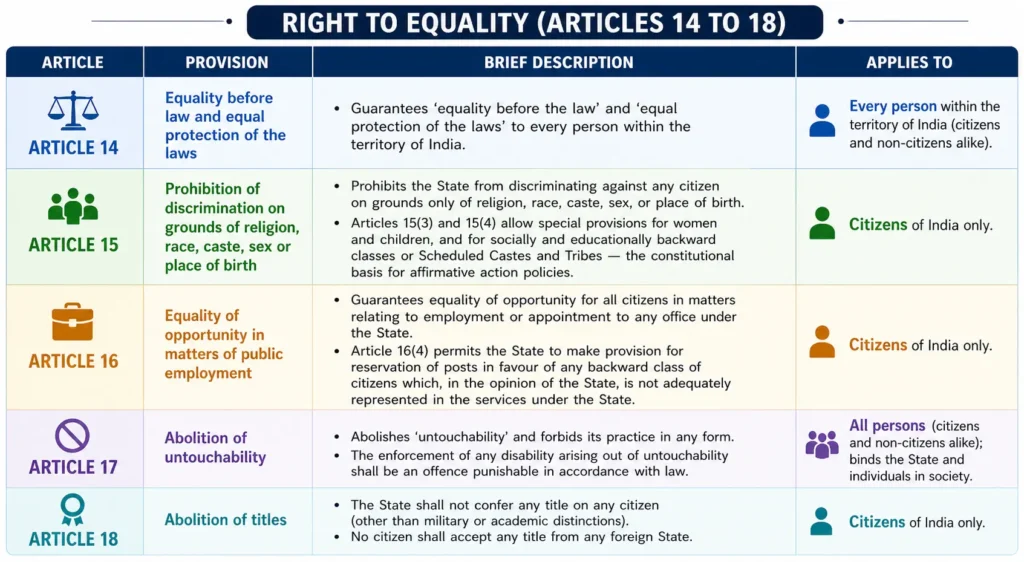
Right to Equality (Articles 14–18)
The Right to Equality is the most foundational of all six categories. It sits at the intersection of individual dignity and democratic governance.
Article 14 lays down two guarantees—“equality before the law” and “equal protection of the laws”—for everyone within the territory of India. [SOURCE: Constitution of India, Article 14 — indiacode.nic.The distinction is key: “equality before the law” (from British common law) means no special privileges for anyone; “equal protection of the laws” (from the US Constitution’s 14th Amendment) mandates the state to treat like cases alike, and to justify any different treatment by a clear and reasonable distinction.
Article 15 prohibits the state from discriminating against any citizen on grounds only of religion, race, caste, sex, or place of birth in access to public spaces, shops, hotels, wells, bathing ghats, roads, and places of public resort. Importantly, Article 15(3) and (4) carve out exceptions allowing the state to make special provisions for women and children, and for socially and educationally backward classes or Scheduled Castes and Scheduled Tribes. This is the constitutional basis for affirmative action policies.
Article 16 guarantees equality of opportunity in public employment and prohibits discrimination on the same grounds as Article 15. It also includes an exception (Article 16(4)) permitting the reservation of posts for backward classes that are not adequately represented in services.
Article 17 abolishes untouchability and makes its enforcement a punishable offence. Unusually for a constitutional provision, it binds not just the state but all persons in society, making it one of the few Fundamental Rights with horizontal application.
Article 18 abolishes titles. The state cannot confer any title (other than military or academic) on any citizen, and no citizen can accept a title from a foreign state.
Common misconception: Article 14 does not require that all persons be treated identically. The Supreme Court has long held that the Constitution allows — and sometimes requires — classification, as long as it is based on an intelligible differentia with a rational relation to the object sought to be achieved.
Right to Freedom (Articles 19–22)
The Right to Freedom is the largest category, spanning four Articles and covering everything from free speech to the rights of arrested persons.
Article 19: The Six Freedoms
Article 19 guarantees six fundamental freedoms exclusively to citizens:
- Freedom of speech and expression
- Right to assemble peaceably and without arms.
- Right to form associations or unions.
- Right to move freely throughout the territory of India.
- Right to reside and settle in any part of India.
- Right to practise any profession, or to carry on any occupation, trade, or business.
None of these freedoms is absolute. Articles 19(2) through 19(6) permit the state to impose “reasonable restrictions” on each freedom in the interests of specific state objectives — sovereignty and integrity of India, security of the state, friendly relations with foreign states, public order, decency, morality, contempt of court, defamation, and incitement to an offence. The test of reasonableness is ultimately for the courts, not the government, to determine.
Article 20: Protection Against Conviction for Ex Post Facto Laws
Article 20 provides three protections: no person can be convicted of an offence that was not an offence when the act was committed; no person can be sentenced to a greater penalty than what was applicable at the time of the offence; and no person can be compelled to be a witness against himself. The last clause (protection against self-incrimination) is significant in criminal procedure.
Article 21: The Right to Life — The Most Expansive Provision
Article 21 states simply: “No person shall be deprived of his life or personal liberty except according to procedure established by law.” [SOURCE: Constitution of India, Article 21 — mea.gov.in Part III PDF]
In seven decades of interpretation, the Supreme Court has turned this short sentence into the most expansive provision in the entire Constitution. Over time, courts have held that the “right to life” includes not merely physical existence but the right to live with dignity, the right to livelihood, the right to health and medical care, the right to education (before it had its own Article), the right to a clean environment, and much more.
The 1978 decision in Maneka Gandhi v. Union of India was a turning point: the Supreme Court ruled that “procedure established by law” under Article 21 must be fair, just, and reasonable — not merely any procedure the legislature might devise. This aligned India’s standard more closely with the American concept of “due process.”
In 2017, the Supreme Court in Justice K.S. Puttaswamy v. Union of India unanimously held that the right to privacy is protected as an intrinsic part of Article 21 and constitutes a fundamental right under Part III of the Constitution. [SOURCE: Center for Global Law and Justice, cglj.org, summarising the Puttaswamy judgment, 2017] This ruling settled a long-running debate and has since shaped policy debates on data protection, surveillance, and digital rights.
Article 21A: The Right to Education
Added by the 86th Constitutional Amendment in 2002, Article 21A provides that the state shall provide free and compulsory education to all children between the ages of six and fourteen years. [SOURCE: Constitution of India, Article 21A — indiacode.nic.This made the Right to Education a Fundamental Right — operationalised through the Right of Children to Free and Compulsory Education Act, 2009 (the RTE Act).
Article 22: Safeguards on Arrest and Detention
Article 22 provides procedural protections to persons arrested or detained. A person cannot be detained without being informed of the grounds of arrest, cannot be denied the right to consult a lawyer of their choice, and must be produced before a magistrate within 24 hours of arrest. These protections apply to all persons, citizens and non-citizens alike.
Article 22 also contains provisions governing preventive detention — detention without trial for security reasons — subject to limits on maximum duration and requirements for advisory boards.
Right against Exploitation (Articles 23–24)
Article 23 prohibits traffic in human beings, begar (forced or unpaid labour), and other similar forms of forced labour, making any violation a punishable offence. [SOURCE: Constitution of India, Article 23 — indiacode.nic.The practical importance of this provision has grown with modern jurisprudence: the Supreme Court has interpreted “forced labour” broadly to include situations where a person is compelled to work for less than the minimum wage.
Article 24 prohibits the employment of children below the age of 14 in any factory, mine, or other hazardous employment. This was among the most socially progressive provisions in the original Constitution and has been reinforced and expanded by parliamentary legislation over the decades.
Together, Articles 23 and 24 reflect the framers’ determination that the Constitution would not merely protect political and civil liberties but also address economic exploitation — particularly the exploitation that many Indians, especially Dalits and the rural poor, historically faced.
Freedom of Religion (Articles 25–28)
India is constitutionally secular, meaning the state does not have an official religion and must treat all religions equally. Articles 25 to 28 give this principle its operational content.
Article 25 guarantees every person freedom of conscience and the right to freely profess, practise, and propagate religion. These freedoms are subject to public order, morality, and health — and, importantly, to laws regulating or restricting associated economic, financial, political, or other secular activities.
Article 26 grants every religious denomination the right to establish and maintain institutions for religious and charitable purposes, to manage its own affairs in matters of religion, and to own and administer property in accordance with law.
Article 27 provides that no person can be compelled to pay any tax whose proceeds are specifically appropriated for the promotion or maintenance of any particular religion. This prevents state funds from being used to favour any single faith.
Article 28 prohibits religious instruction in state-funded educational institutions and restricts it even in state-recognised institutions that do not receive state funding.
Sensitivity note: Debates around the scope of religious freedom — particularly around practices claimed as religious versus secular activities regulated by the state — are ongoing and contested in Indian courts. This article states the constitutional text and does not adjudicate specific contemporary controversies.
Cultural and Educational Rights (Articles 29–30)
These provisions protect the cultural and educational interests of minorities — both religious and linguistic.
Article 29 guarantees that any section of citizens having a distinct language, script, or culture has the right to conserve it. It also prohibits denial of admission to any educational institution maintained by the state or receiving state aid on grounds only of religion, race, caste, or language.
Article 30 grants all minorities (religious or linguistic) the right to establish and administer educational institutions of their choice. The state cannot discriminate against such minority institutions while granting aid.
These Articles are particularly significant because India’s diversity — of language, script, religion, and culture — is not treated as a problem to be homogenised but as a plurality to be protected by the Constitution itself.
Right to Constitutional Remedies (Article 32) — The Heart and Soul
Of all the Fundamental Rights, Article 32 is arguably the most important — not because it grants any particular substantive right, but because it guarantees that all the others can actually be enforced.
Article 32 guarantees every citizen the right to approach the Supreme Court of India for the enforcement of the Fundamental Rights in Part III. [SOURCE: Constitution of India, Article 32 — indiacode.nic.The Supreme Court is empowered under Article 32 to issue writs — including habeas corpus, mandamus, prohibition, certiorari, and quo warranto — whichever is appropriate to enforce the right in question.
Dr. B.R. Ambedkar, the principal architect of the Constitution, famously described Article 32 as “the very soul of the Constitution and the very heart of it.” [SOURCE: Indian Express, citing Constituent Assembly Debates — indianexpress.com; The Print — theprint.His reasoning was straightforward: without a remedy, a right is merely a word on paper. It is Article 32 that transforms constitutional text into lived legal protection.
The five writs under Article 32 serve distinct purposes:
- Habeas corpus (“you shall have the body”) — commands that a person unlawfully detained be brought before the court.
- Mandamus (“we command”) — orders a public authority to perform a public duty it is legally obliged to perform.
- Prohibition — stops a lower court or tribunal from exceeding its jurisdiction.
- Certiorari — quashes the order of a lower court or tribunal that has acted beyond its jurisdiction.
- Quo warranto (“by what authority”) — questions a person’s right to hold a public office.
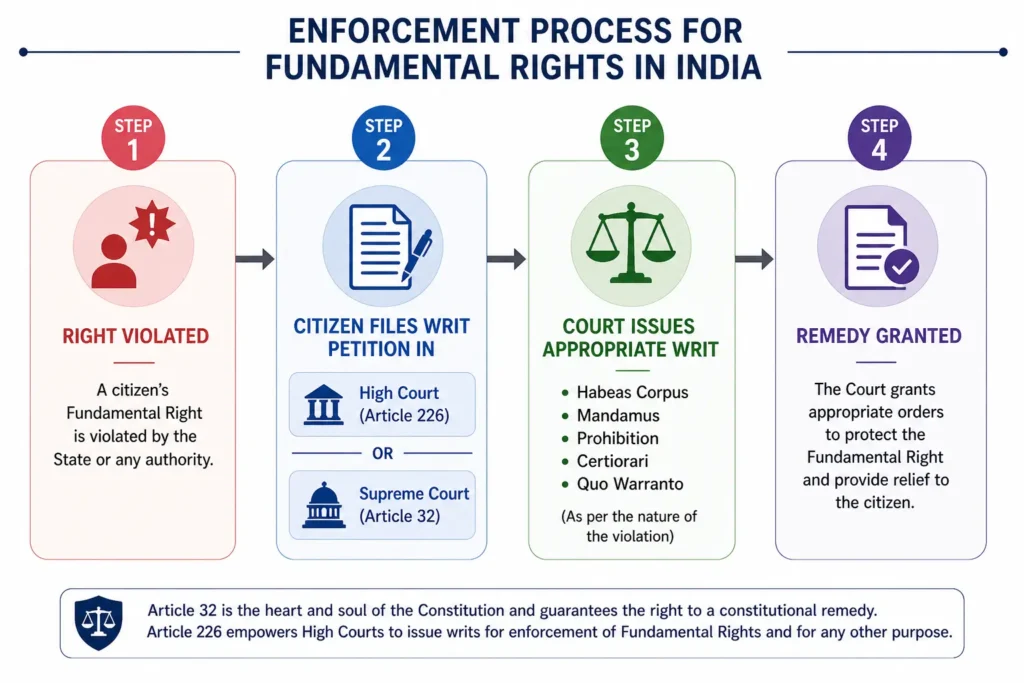
Note: Article 226 of the Constitution gives the High Courts similar writ jurisdiction. The difference is that Article 32 is itself a Fundamental Right — it cannot be denied to a citizen. Article 226 is a constitutional power of the High Court, but approaching the High Court is not in itself a Fundamental Right. In practice, most litigants approach the High Court under Article 226 first, and the Supreme Court under Article 32 when those remedies are exhausted or when the matter is of national importance.
Restrictions, Amendments, and the Evolution of Fundamental Rights
Rights Are Not Absolute
No Fundamental Right is unlimited. Article 19, as discussed, explicitly permits “reasonable restrictions.” Other rights carry their own qualifications — Article 25 on religion is subject to public order, morality, and health. The underlying principle is that individual rights must coexist with the legitimate needs of an ordered society.
Key Constitutional Amendments
The Right to Property — Originally a Fundamental Right, Now Removed
The original Constitution included a Right to Property under Article 31. This proved contentious from the beginning, creating friction between property rights and the state’s land reform and nationalisation programmes. A series of amendments chipped away at it, and ultimately, the 44th Amendment Act, 1978 (effective 1979), deleted Article 31 from Part III entirely. [SOURCE: Constitution of India, Article 31 note on omission — indiacode.nic.In The right to property now exists as a constitutional right under Article 300A — the state cannot deprive a person of property except by authority of law — but it is no longer a Fundamental Right enforceable under Article 32.
This is one of the most common misconceptions about India’s Fundamental Rights: many people still believe there are seven rights, including property. There are six.
The Right to Education — Added in 2002
The 86th Constitutional Amendment (2002) inserted Article 21A, making free and compulsory education for children aged 6–14 a Fundamental Right. [SOURCE: Constitution of India, Article 21A — indiacode.nic.Before this amendment, education appeared as a Directive Principle (Article 45) — aspirational but not enforceable. The amendment converted it into a justiciable right. The Right of Children to Free and Compulsory Education Act (RTE Act) was passed in 2009 to give legislative effect to this constitutional mandate.
Fundamental Rights During a National Emergency
When a national emergency is declared under Article 352, the Constitution permits serious curtailment of Fundamental Rights. Under Article 359, the President can, by order, suspend the right to move any court for enforcement of Part III rights (other than Articles 20 and 21) for the duration of the emergency. [SOURCE: Constitution of India, Article 359 — indiacode.nic.in]
The 44th Amendment (1978) made Articles 20 and 21 — the right against ex post facto conviction and the right to life and liberty — permanently immune from emergency suspension. No presidential order can touch them, even during the gravest national emergency. This was a direct legislative response to the Emergency of 1975–77, during which the Supreme Court controversially held (in the ADM Jabalpur case) that even Article 21 could be suspended. Parliament corrected this by constitutional amendment.
The Basic Structure Doctrine
Parliament can amend the Constitution under Article 368, but the Supreme Court’s landmark ruling in Kesavananda Bharati v. State of Kerala (1973) held that Parliament cannot use this power to destroy the “basic structure” of the Constitution. Fundamental Rights — particularly those that are integral to human dignity and liberty — are part of this basic structure. This means even constitutional amendments that seek to abrogate core Fundamental Rights can be struck down by the Supreme Court.
Landmark Supreme Court Cases
A handful of judgments have defined the scope of Fundamental Rights as much as the constitutional text itself.
Kesavananda Bharati v. State of Kerala (1973): Established the Basic Structure doctrine. Parliament’s amending power cannot be used to destroy the fundamental framework of the Constitution, of which Fundamental Rights form an essential part.
Maneka Gandhi v. Union of India (1978): Transformed Article 21 by ruling that “procedure established by law” must be just, fair, and reasonable. Expanded the right to life beyond mere physical existence.
Justice K.S. Puttaswamy v. Union of India (2017): A nine-judge bench unanimously held that privacy is a fundamental right protected under Article 21. [SOURCE: Center for Global Law and Justice — cglj.org, summarising the judgment] The ruling has since become foundational in debates on data protection legislation, surveillance, and digital rights.
Fundamental Rights vs Directive Principles vs Fundamental Duties
| Feature | Fundamental Rights (Part III) | Directive Principles (Part IV) | Fundamental Duties (Part IV-A) |
| Enforceable in court? | Yes — justiciable | No — non-justiciable | No — non-justiciable |
| Who they bind | The State | The State (as guidelines) | Citizens |
| Purpose | Protect individual liberty | Guide state policy for social welfare | Remind citizens of civic obligations |
| Added by | Original Constitution (1950) | Original Constitution (1950) | 42nd Amendment (1976) |
| Key articles | Art. 12–35 | Art. 36–51 | Art. 51A |
The distinction between Fundamental Rights and Directive Principles of State Policy (DPSP) is essential for any student of Indian constitutional law. While Fundamental Rights protect individuals from the state, DPSPs guide the state in formulating policies for economic and social welfare. The Constitution does not allow DPSPs to override Fundamental Rights — though Parliament has at various times attempted, through amendments, to expand the scope of DPSPs at the expense of property and other rights.
Frequently Asked Questions
How many Fundamental Rights are there in India?
There are six categories of Fundamental Rights in the Indian Constitution today. Originally, the Constitution included a seventh — the Right to Property (Article 31) —, but it was removed by the 44th Amendment in 1978. So the current count stands at six.
Which Article is the “heart and soul” of the Indian Constitution?
Article 32 — The Right to Constitutional Remedies. Dr. B.R. Ambedkar described it in the Constituent Assembly as “the very soul of the Constitution and the very heart of it,” because without the ability to enforce rights in court, the rights themselves would be meaningless. [SOURCE: Indian Express — indianexpress.com; The Print — theprint.in]
Is the Right to Education a Fundamental Right in India?
Yes. The 86th Constitutional Amendment (2002) added Article 21A, making free and compulsory education a Fundamental Right for all children between the ages of 6 and 14. This was given legislative form through the RTE Act, 2009. [SOURCE: Constitution of India, Article 21A — indiacode.nic.in]
Is the Right to Privacy a Fundamental Right?
Yes, since 2017. The Supreme Court’s nine-judge bench in Justice K.S. Puttaswamy v. Union of India unanimously held that privacy is protected as an intrinsic part of the right to life and personal liberty under Article 21. [SOURCE: CGLJ summary of Puttaswamy judgment — cglj.org]
Can Fundamental Rights be suspended?
During a national emergency under Article 352, most Fundamental Rights can be suspended by presidential order under Article 359 for the duration of the emergency. However, Articles 20 and 21 — protection against arbitrary conviction and the right to life — cannot be suspended under any circumstances, even during a national emergency. [SOURCE: Constitution of India, Article 359 — indiacode.nic.in]
What is the difference between Article 32 and Article 226?
Both empower courts to issue writs for the enforcement of rights. Article 32 is a Fundamental Right itself — the right to approach the Supreme Court — and cannot be denied. Article 226 gives the High Courts similar writ jurisdiction, but approaching the High Court is a constitutional power, not a Fundamental Right. In practice, most citizens approach the High Court first under Article 226.
Key Takeaways
- Fundamental Rights are enshrined in Part III (Articles 12–35) of the Indian Constitution and are enforceable in courts.
- There are six categories today: Equality, Freedom, against Exploitation, Religion, Cultural/Educational, and Constitutional Remedies. Right to Property was the seventh, but was removed in 1978.
- Article 21 (right to life and personal liberty) is the most expansive provision — the Supreme Court has interpreted it to include privacy, dignity, health, and more.
- Article 32 — the right to approach the Supreme Court — is what makes all other rights real. Ambedkar called it the soul of the Constitution.
- Most rights apply to citizens; Articles 14, 20, 21, and 22 extend to all persons in India.
- Only Articles 20 and 21 remain in force even during a national emergency — all other Fundamental Rights can be suspended by presidential order.