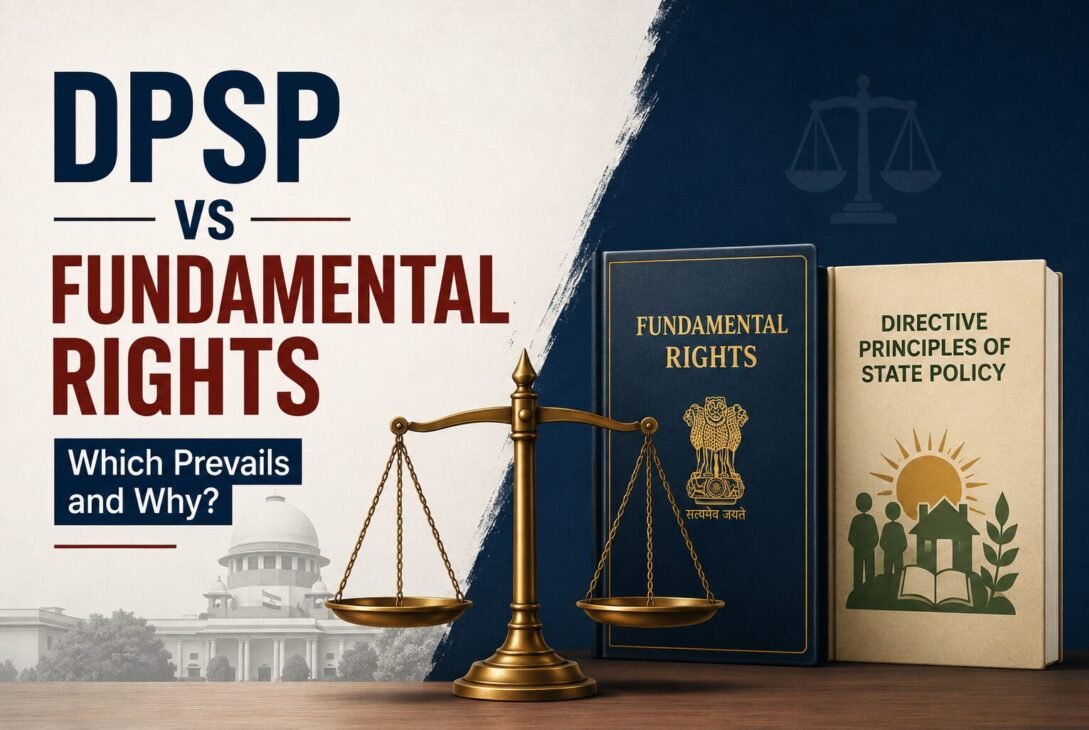
Many UPSC aspirants struggle with the relationship between the Directive Principles of State Policy (DPSP) and Fundamental Rights. Both are core to the Constitution, but when they clash, which takes precedence?
In short, Fundamental Rights usually prevail. But landmark Supreme Court rulings, a constitutional amendment struck down by the courts, and a key exception shape how welfare laws are tested today. Grasping DPSP vs Fundamental Rights is crucial—it’s about how India balances liberty and the State’s mandate to build a just society.
What Are Fundamental Rights and Directive Principles? A Quick Distinction
Before examining the conflict, it helps to understand what each actually is.
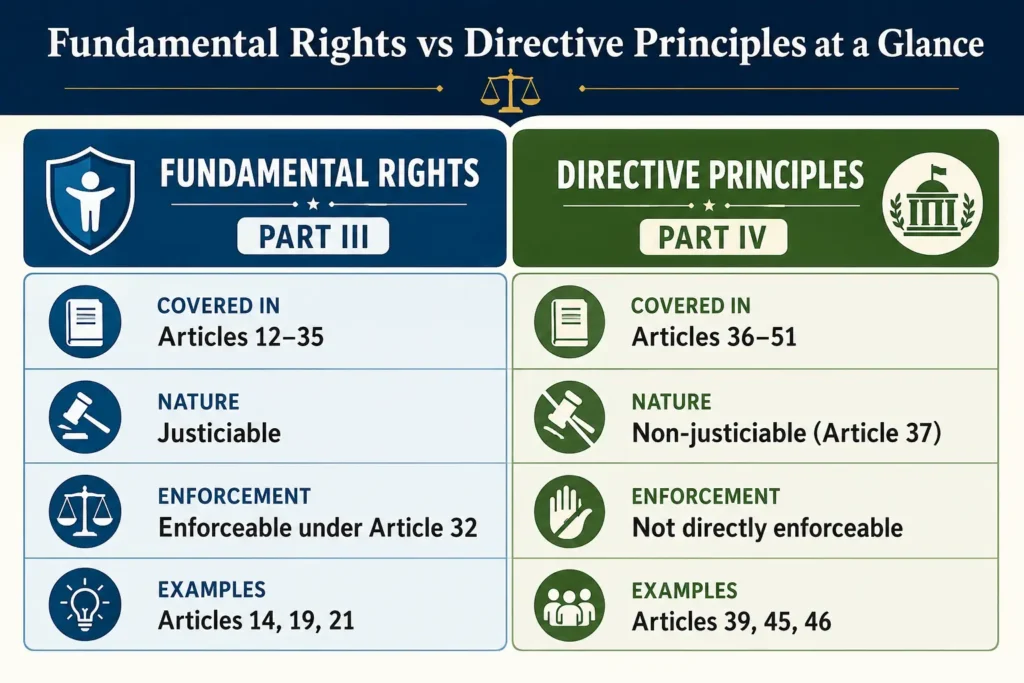
Fundamental Rights are set out in Part III of the Constitution (Articles 12 to 35). They include the rights to equality (Article 14), freedom of speech and expression (Article 19), and life and personal liberty (Article 21), among others. The defining feature of Fundamental Rights is that they are justiciable — meaning any citizen can approach the Supreme Court or a High Court to enforce them. Article 32 itself is a Fundamental Right: the right to constitutional remedies.
Directive Principles of State Policy are set out in Part IV (Articles 36 to 51). They direct the State to pursue goals such as the equitable distribution of resources (Article 39), free and compulsory education (Article 45), and the promotion of equal justice (Article 39A). The defining feature of Directive Principles is that they are non-justiciable. Article 37 of the Constitution states explicitly that the provisions in Part IV “shall not be enforceable by any court.” No citizen can file a writ petition demanding that the government implement a DPSP.
This single difference — justiciable vs. non-justiciable — is the foundation of the entire DPSP vs Fundamental Rights debate.
[SOURCE: Constitution of India, Article 37 — constitutionofindia.net (Centre for Law and Policy Research)]
The First Major Clash: Champakam Dorairajan (1951)
India had barely begun operating under its new Constitution when the first serious conflict between DPSP and Fundamental Rights reached the Supreme Court.
In 1951, the State of Madras had a Communal Government Order in place that reserved seats in state medical and engineering colleges for different religious and caste communities. The stated purpose was to fulfil the policy of promoting educational opportunities for backward classes — a goal aligned with Article 46 of the Constitution, which is a Directive Principle.
Srimathi Champakam Dorairajan challenged this order. She argued that the quota system violated her Fundamental Right under Article 29(2), which prohibits the denial of admission to state-aided educational institutions on grounds of religion, race, caste, language, or any of them.
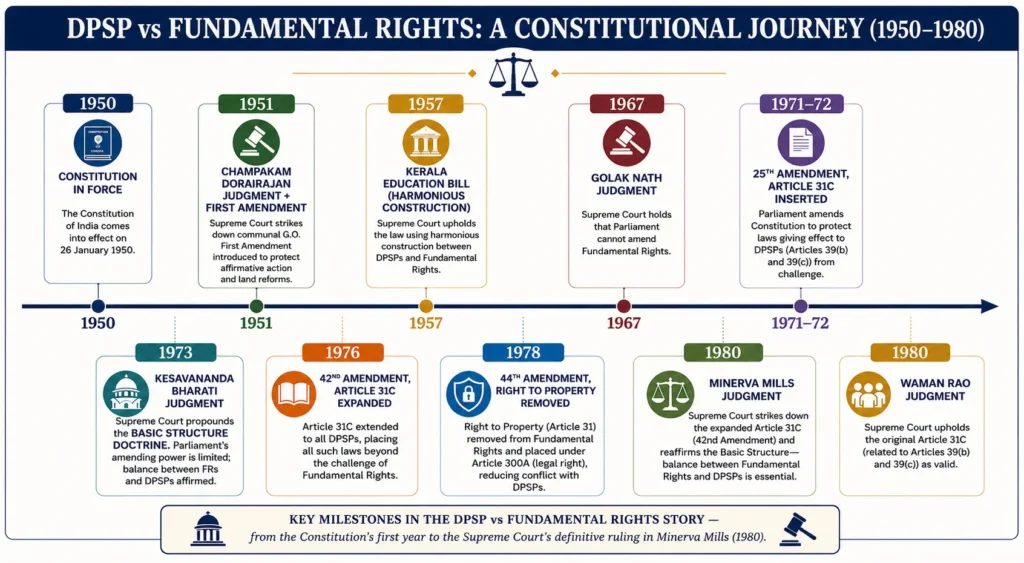
The Supreme Court agreed with her. In its ruling in State of Madras v. Srimathi Champakam Dorairajan (1951), the Court held that Fundamental Rights are “sacrosanct” and that Directive Principles “cannot override the provisions of Part III.” When the two conflict, the enforceable Fundamental Rights must prevail.
[SOURCE: State of Madras v. Srimathi Champakam Dorairajan, Supreme Court of India, 9 April 1951 — Legitquest]
This judgment was a watershed moment. It established the primacy of Fundamental Rights in clear, unambiguous terms. It also had an immediate political consequence: Parliament responded by passing the First Amendment to the Constitution in 1951, inserting Articles 15(4) and 16(4) to expressly permit special provisions for socially and educationally backward classes — thereby creating a constitutional basis for reservations that could not be challenged under Article 29.
The pattern would repeat itself several times: courts applying Fundamental Rights strictly, Parliament amending the Constitution to carve out space for policy goals. This back-and-forth defines the evolution of the DPSP vs Fundamental Rights relationship.
The Judicial Approach: Harmony Before Conflict
The Supreme Court has never been purely mechanical about this hierarchy. Where possible, it has attempted to read Fundamental Rights and Directive Principles together so that both can operate.
The clearest articulation of this came in the Supreme Court’s advisory opinion in In Re: Kerala Education Bill (1957). The Kerala government had proposed a law that would have required private minority schools to follow certain State-mandated conditions. The question before the Court involved a potential tension between Article 30(1) — the Fundamental Right of minorities to establish and administer educational institutions — and Article 45, the Directive Principle calling for free and compulsory education.
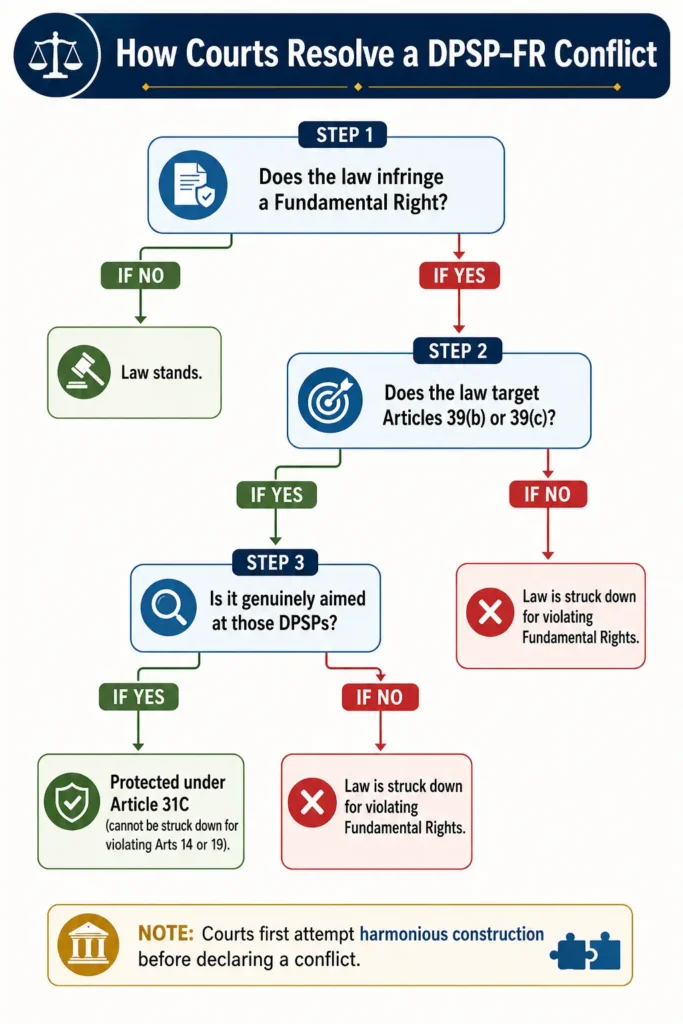
The Court held that there was no genuine conflict in the facts before it, and applied a doctrine now known as harmonious construction: wherever the language of both Parts can be read in a way that gives effect to both, courts must do so. A conflict is only treated as real when the two provisions are irreconcilable. Only then do Fundamental Rights take precedence.
[SOURCE: In Re: Kerala Education Bill (1957), Supreme Court of India — SCObserver, scobserver.in]
This doctrine matters in practice. It means that the State is not automatically blocked from pursuing DPSP-driven legislation simply because someone invokes a Fundamental Right. The legislation must actually, materially infringe a right to be struck down. Courts examine substance, not just surface tension.
Article 31C: When Parliament Gave DPSPs an Advantage
By the late 1960s, tensions between Fundamental Rights and the government’s welfare agenda had become politically acute. The Supreme Court, in Golak Nath v. State of Punjab (1967), went so far as to hold that Parliament could not amend Fundamental Rights at all — a ruling that alarmed the government, which was pursuing land reform and bank nationalisation policies.
Parliament responded with a series of constitutional amendments. The most consequential for the DPSP vs Fundamental Rights question was Article 31C, inserted by the Constitution (Twenty-Fifth Amendment) Act, 1971.
Article 31C created a shield for a specific category of laws. In its original form, it stated that laws made to secure the principles of Article 39(b) (that the ownership and control of material resources of the community are distributed so as to best serve the common good) and Article 39© (that the operation of the economic system does not result in the concentration of wealth to the common detriment) would not be void merely because they are inconsistent with Articles 14 or 19.
In plain terms, welfare laws genuinely aimed at wealth distribution and prevention of monopoly concentration could not be struck down for violating the right to equality or the right to freedom. Those two Directive Principles were, in a narrow but real sense, given precedence over two Fundamental Rights.
[SOURCE: Constitution of India, Article 31C — constitutionofindia.net (CLPR); Constitution (Twenty-Fifth Amendment) Act, 1971 — constitutionofindia.net/blog/desk-brief-the-25th-amendment/]
Kesavananda Bharati (1973): Partial Validation and the Basic Structure
When Article 31C was challenged, a thirteen-judge bench of the Supreme Court examined it in the landmark Kesavananda Bharati v. State of Kerala (1973) case. The Court upheld the original Article 31C — protecting laws genuinely implementing Articles 39(b) and © from challenge under Articles 14 and 19 — as constitutionally valid.
However, the Court struck down the second part of Article 31C as originally enacted, which had attempted to bar judicial review of such laws entirely. The ability to scrutinise whether a law actually served the stated DPSP goal had to remain with the courts.
More importantly, Kesavananda Bharati established the Basic Structure doctrine — the principle that Parliament, even with its amending power under Article 368, cannot alter the fundamental identity of the Constitution. The harmony between Fundamental Rights and Directive Principles was itself identified as part of this basic structure. This would prove decisive six years later.
[SOURCE: SCObserver analysis, “The effect of striking down a substitution: The Article 31C story” — scobserver.in]
The 42nd Amendment (1976): Overreach and Its Reversal
The Constitution (Forty-Second Amendment) Act, 1976, passed during the Emergency, made a far more sweeping change. It amended Article 31C to extend its protection not just to laws implementing Articles 39(b) and ©, but to all Directive Principles. Under the 42nd Amendment, any law stated to be in furtherance of any DPSP would be immune from challenge under any Fundamental Right.
If it had stood, this would have effectively inverted the constitutional hierarchy established in Champakam Dorairajan. Directive Principles would have achieved blanket superiority over Fundamental Rights.
It did not stand. In Minerva Mills Ltd. v. Union of India (1980), a Constitution Bench of the Supreme Court struck down the 42nd Amendment’s expansion of Article 31C. The Court’s reasoning was grounded in the Basic Structure doctrine from Kesavananda Bharati: to give all Directive Principles precedence over all Fundamental Rights would destroy the harmony between Parts III and IV of the Constitution, and that harmony is itself part of the basic structure that Parliament cannot abolish.
[SOURCE: Minerva Mills Ltd. v. Union of India (1980), Supreme Court of India — SCObserver analysis, scobserver.in]
The consequence was direct: Article 31C reverted to its pre-42nd Amendment scope. Only laws genuinely implementing Articles 39(b) and © retained the shield against Articles 14 and 19. Every other Directive Principle remained non-justiciable and subordinate to enforceable Fundamental Rights.
Waman Rao (1980): The Current Position Confirmed
In Waman Rao v. Union of India (1980), a five-judge bench of the Supreme Court addressed the residual question: was the original, pre-42nd Amendment version of Article 31C still valid law?
The Court answered yes. The unamended Article 31C remained in force. Its effect, as confirmed by the bench, is that laws genuinely enacted to secure the objectives of Articles 39(b) and © “cannot at all violate Article 14 or 19.” This is a narrow but real exception to the general principle that Fundamental Rights prevail.
[SOURCE: Waman Rao & Ors. v. Union of India, 9 May 1980, Supreme Court of India — indiankanoon.org/doc/799151/]
The Current Legal Position: A Clear Answer with One Exception
After Minerva Mills and Waman Rao, the law on DPSP vs Fundamental Rights is settled:
As a general rule, Fundamental Rights prevail over Directive Principles. If any law — central or state — infringes a Fundamental Right, it can be challenged and struck down by the courts. The fact that the law was enacted to further a Directive Principle does not insulate it from such a challenge.
The one exception is Article 31C. Laws genuinely aimed at implementing Articles 39(b) and © — concerning equitable distribution of material resources and prevention of concentration of wealth — cannot be struck down on the ground that they violate Articles 14 (right to equality) or 19 (right to freedoms). This is the only area where a Directive Principle has legal precedence over Fundamental Rights.
No other Directive Principle enjoys this status. A law enacted to implement Article 44 (Uniform Civil Code), Article 45 (free education), Article 46 (welfare of weaker sections), or any other DPSP outside Articles 39(b) and © remains open to challenge if it infringes a Fundamental Right.
Frequently Asked Questions
Are Directive Principles of State Policy justiciable?
No. Article 37 of the Constitution explicitly states that the provisions in Part IV “shall not be enforceable by any court.” Citizens cannot approach a court to compel the State to implement a Directive Principle. This is the fundamental distinction between DPSPs and Fundamental Rights, which are directly enforceable under Article 32.
[SOURCE: Constitution of India, Article 37 — constitutionofindia.net]
If a DPSP and a Fundamental Right conflict, which one wins?
In general, the Fundamental Right wins. The Supreme Court established this in State of Madras v. Champakam Dorairajan (1951), holding that Directive Principles are subordinate to the enforceable rights in Part III. The only exception is Article 31C — but it applies only to laws implementing Articles 39(b) and ©, not to all DPSPs.
What does Article 31C actually do?
Article 31C, inserted by the 25th Amendment in 1971-72, provides that laws made to secure the principles of Articles 39(b) and © — equitable distribution of material resources and prevention of economic concentration — cannot be declared void merely because they are inconsistent with Articles 14 or 19. It gives those two Directive Principles a constitutionally protected edge over the two Fundamental Rights.
[SOURCE: Constitution (Twenty-Fifth Amendment) Act, 1971 — constitutionofindia.net/blog/desk-brief-the-25th-amendment/]
What was the Minerva Mills case, and why does it matter?
In Minerva Mills Ltd. v. Union of India (1980), the Supreme Court struck down the 42nd Amendment’s attempt to extend Article 31C’s protection to all Directive Principles. The Court held this destroyed the constitutional balance between Parts III and IV — a balance that is part of the Constitution’s basic structure. After Minerva Mills, only Articles 39(b) and © retain legal priority over Fundamental Rights.
[SOURCE: Minerva Mills Ltd. v. Union of India (1980) — SCObserver analysis, scobserver.in]
Are DPSP and Fundamental Duties the same thing?
No. Directive Principles (Part IV, Articles 36–51) are obligations on the State to pursue certain policy goals. Fundamental Duties (Part IVA, Article 51A) are moral obligations on citizens, added by the 42nd Amendment in 1976. The two are related concepts — both reflect the Constitution’s vision of a responsible society — but they are distinct in nature, scope, and constitutional location.
Can Parliament amend Fundamental Rights to give DPSPs more power?
Parliament has the power to amend Fundamental Rights under Article 368, but it cannot do so in a way that destroys the basic structure of the Constitution. The Kesavananda Bharati judgment established this. Specifically, the harmony between Part III and Part IV is itself a basic structure feature, which is why the Supreme Court reversed the 42nd Amendment’s overreach in Minerva Mills.
Key Takeaways
- Directive Principles are non-justiciable — Article 37 makes this explicit. No court can order their enforcement.
- Fundamental Rights are justiciable and generally superior — courts can and do strike down laws that infringe them.
- Courts’ first attempt at harmonious construction — a genuine, irreconcilable conflict is needed before Fundamental Rights are applied to override a DPSP-driven law.
- Article 31C creates a narrow exception — laws genuinely implementing Articles 39(b) and © cannot be voided for violating Articles 14 or 19.
- The 42nd Amendment’s attempt to extend this protection to all DPSPs was struck down in Minerva Mills (1980) as a violation of the basic structure doctrine.
- The current legal position is clear: Fundamental Rights prevail, with one narrow statutory exception.