Introduction: The Power That Changed India Forever
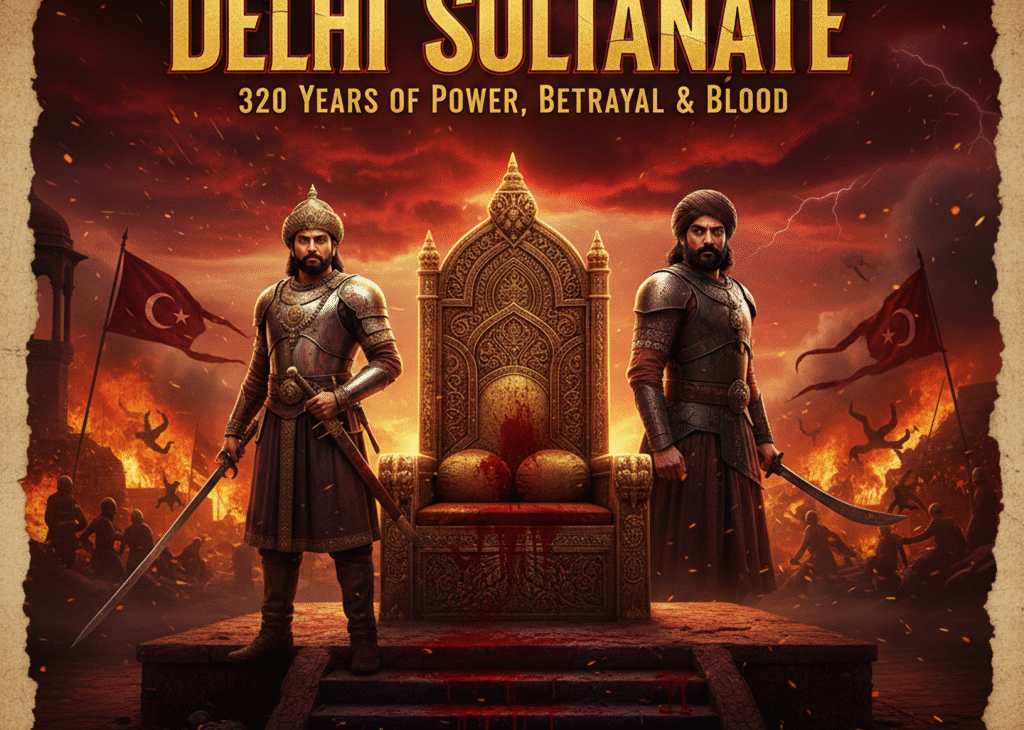
The Delhi Sultanate’s history began in 1206 CE when a slave became a king. This remarkable period lasted 320 years. Five dynasties ruled from Delhi’s throne during this era.
The Sultanate transformed India’s political landscape completely. Turkish and Afghan rulers brought new administration systems. They introduced Persian culture and Islamic architecture.
Over 50 rulers sat on Delhi’s throne during these centuries. Some died in battle. Others were murdered by their own sons. The throne was never safe.
This article explores each dynasty in detail. You’ll discover the bloodshed, brilliance, and legacy of medieval India’s most turbulent period.
Why Delhi Became the Prize Everyone Wanted
Strategic Importance
Delhi held unmatched strategic value in medieval times. The city served as India’s primary commercial center. Merchants from across the country traded here.
All currency was minted in Delhi during the Rajput rule. This made the city incredibly wealthy. Controlling Delhi meant controlling India’s economy.
Military Advantage
Delhi’s location offered military benefits too. The city connected northern and central India perfectly. Any ruler controlling Delhi could easily manage the surrounding territories.
The coordination center theory explains Delhi’s importance. Capturing Delhi meant indirect control over connected provinces. This made it India’s most coveted throne.
The First Attack: Muhammad Ghori’s Obsession
Initial Defeat in 1191
Muhammad Ghori first attacked Delhi in 1191 CE. Rajput king Prithviraj Chauhan defeated him decisively. The invader retreated with heavy losses.
However, Ghori couldn’t accept defeat. He returned the following year with renewed determination.
The Battle That Changed Everything
The Second Battle of Tarain occurred in 1192 CE. This time, Ghori emerged victorious. Prithviraj Chauhan fell in battle.
Delhi’s 500-year Rajput rule ended abruptly. A new era was about to begin. The Delhi Sultanate’s history would now unfold.
Slave Dynasty (1206-1290): Born from Bondage
Qutub-ud-din Aibak: The Generous Slave King
Qutub-ud-din Aibak became Delhi’s first Sultan in 1206. He was Ghori’s most loyal slave and lieutenant general. After Ghori’s death, his successors appointed Aibak as ruler.
Despite being a slave, Aibak ruled with remarkable generosity. He distributed war spoils among his subjects freely. People lovingly called him “Lakh Baksh” (giver of lakhs).
Aibak’s architectural legacy remains stunning today. He built the world-famous Qutub Minar. The Quwwat-ul-Islam mosque still stands magnificent. Adhai Din Ka Jhopra mosque showcases its vision.
His reign lasted only five years. In 1210, Aibak died falling from his horse during polo.
Iltutmish: The True Founder
Aibak’s son-in-law, Shamsuddin Iltutmish, took the throne in 1211. Historians consider him the Delhi Sultanate’s real founder. He made crucial administrative changes.
Iltutmish shifted the capital from Lahore to Delhi. This decision proved historically significant. Delhi became the Sultanate’s permanent seat of power.
Administrative Innovations
He created the “Chalisa” system brilliantly. This council of 40 ministers advised the Sultan. They resembled modern cabinet ministers in function.
Iltutmish also established the Iqta system. Soldiers received salaries based on their ranks. This military payment structure brought order.
His greatest achievement was stopping Genghis Khan. The Mongol conqueror never invaded India during Iltutmish’s reign. This saved countless lives.
Razia Sultana: India’s First Woman Ruler
Iltutmish’s daughter, Razia, became Sultan after his death. She was Delhi’s first and last female ruler. Her capability was extraordinary.
However, medieval society couldn’t accept a woman’s authority. Many nobles opposed her appointment openly. Jealousy and prejudice surrounded her reign.
Razia ruled for only four years. In 1240, her brother Muizuddin Bahram murdered her publicly. Her death ended hopes for gender equality in medieval India.
Ghiyasuddin Balban: The Iron Fist
After several weak rulers, Balban seized power in 1266. He ruled with absolute authority for 20 years. His methods were brutal but effective.
Balban dismantled Iltutmish’s Chalisa system immediately. He planted spies across all territories. His army became extraordinarily powerful.
The Sultan called himself “Zill-e-Ilahi” (Shadow of God). Anyone opposing him faced certain death. Fear became his primary governance tool.
Despite his strength, Balban couldn’t stop the Mongol invasions in 1287. The Mongols, whom previous rulers had blocked, finally penetrated the Indian borders.
The Dynasty’s Collapse
Balban’s 17-year-old grandson Kaikubad became Sultan after his death. The young ruler proved weak and cowardly. His uncle Jalaluddin Firuz Khalji saw an opportunity.
In 1290, Khalji murdered Kaikubad ruthlessly. Kaikubad’s three-year-old son couldn’t inherit. The Slave Dynasty ended after 84 years.
Khalji Dynasty (1290-1320): Terror and Expansion
Jalaluddin Khalji: The Mild Beginning
Jalaluddin Khalji started his dynasty in 1290. He ruled as a compassionate and humble Sultan. His age—nearly 70 years—brought wisdom.
However, age also brought vulnerability. In 1296, his son-in-law Alauddin Khalji murdered him treacherously. The throne passed to a monster.
Alauddin Khalji: The Conqueror
Alauddin Khalji exemplified ruthless ambition perfectly. Historians debate whether he was a Sultan or a professional looter. His conquests were spectacular but savage.
Military Campaigns
Alauddin conquered vast territories systematically. Gujarat, Ranthambore, Chittor, Devagiri, Warangal, and Madurai fell before him. His general Malik Kafur led southern campaigns.
In 1308, Malik Kafur looted the famous Kohinoor diamond from Warangal. This legendary gem entered Indian history through theft.
Religious Persecution
Alauddin forcibly converted lakhs to Islam during his 20-year reign. Those refusing faced brutal execution. Religious tolerance didn’t exist under his rule.
Economic Reforms
Surprisingly, Alauddin showed administrative genius, too. He implemented strict market controls effectively. Prices of daily commodities dropped significantly.
The Sultan developed markets systematically. He kept the Mongols outside India’s borders successfully. The Alai Darwaza in Rajasthan remains his architectural legacy.
Personal Life Controversies
Historical records confirm Alauddin’s bisexuality. He maintained a deep attachment to General Malik Kafur. Their relationship was widely known.
Alauddin maintained a massive harem, too. It housed over 70,000 men, women, and children. He exercised complete control over them.
The Dynasty’s End
Alauddin died mysteriously in 1316. Some historians blame Malik Kafur’s poisoning. Others cite natural illness as the cause.
His six-year-old son, Shihabuddin Umar, became nominal Sultan. Real power stayed with Malik Kafur. However, Alauddin’s son Qutbuddin Mubarak Shah resented this arrangement.
Mubarak Shah and ministers conspired successfully. They killed Malik Kafur brutally. Mubarak Shah removed his young brother and seized power.
Mubarak Shah’s Madness
Mubarak Shah exceeded his father’s depravity. He spent days drunk or drugged constantly. Sometimes he dressed as a woman. Other times, he roamed the palace naked.
Everyone recognized his unsuitability for the rule. In 1320, his general Khusrau Khan murdered him. This ended the Khalji Dynasty after 30 years.
Tughlaq Dynasty (1320-1414): Confusion and Contradiction
Ghiyasuddin Tughlaq: The Foundation
Khusrau Khan killed Mubarak Shah but couldn’t hold power. Ghazi Malik, the governor of Punjab, eliminated Khusrau quickly. He became Ghiyasuddin Tughlaq in 1320.
This dynasty ruled Delhi for 94 years—the longest period. It produced history’s most confusing Sultan, too.
Muhammad bin Tughlaq: The Mad Genius
Ghiyasuddin couldn’t rule long. In 1325, his son Muhammad bin Tughlaq murdered him. Thus began the reign of history’s most eccentric ruler.
Muhammad earned the title “wise fool” deservedly. He made impulsive decisions constantly. Then he regretted them immediately afterward.
The Capital Shift Disaster
Muhammad made his most famous blunder in 1327. He shifted Delhi’s capital to Daulatabad (Devagiri). His reasoning seemed logical initially.
Mongols attacked Delhi repeatedly. Moving further south would provide safety. Mongols wouldn’t reach Daulatabad easily.
Muhammad ordered everyone—ministers and citizens—to migrate immediately. The entire population trudged to Daulatabad reluctantly.
However, problems emerged quickly. With no Sultan in Delhi, the Mongols nearly captured the city. Muhammad recognized his error belatedly.
The Sultan ordered everyone back to Delhi immediately. This double migration caused immense suffering. Many died during these forced journeys.
Delhi, once prosperous and wealthy, became impoverished. The city took decades to recover fully.
The Token Currency Fiasco
Muhammad created another disaster with currency. He introduced brass and copper coins instead of gold and silver. This aimed to reduce expenses.
However, brass was cheap and easily available. People started manufacturing counterfeit coins massively. The economy collapsed under fake currency.
Muhammad hastily reverted to gold and silver coins. The damage was already done, though.
The Wise Side
Despite madness, Muhammad showed intelligence occasionally. He maintained religious tolerance unusually. His administrative vision was actually progressive.
On his deathbed, Muhammad smiled and told his subjects: “The Sultan got freedom from his people, and people got freedom from the Sultan.”
Firoz Shah Tughlaq: The Builder Sultan
After Muhammad died in 1351, Delhi found a capable ruler. Firoz Shah Tughlaq brought stability and development.
He built numerous cities across his kingdom. Firozpur, Firozabad, Hissar, Jaunpur, and Firozshah Kotla emerged during his reign. Delhi’s Darulshifa hospital provided free treatment.
Social Welfare Initiatives
Firoz Shah introduced progressive social reforms. The Diwan-e-Khairat funded marriages for poor girls. Diwan-e-Bundagan employed needy people.
He created Diwan-e-Istihqaq for elderly pensions. These welfare systems were revolutionary for medieval times.
After 37 years of stable rule, Firoz Shah died in 1388. No capable successor existed afterward.
Timur’s Invasion: The Beginning of the End
The weakened Tughlaq dynasty faced catastrophe in 1398. Mongol chieftain Timur (Tamerlane) invaded Delhi ruthlessly. The reigning Sultan fled in terror.
Timur captured Delhi within five days. His army created unprecedented horror. Two lakh people were brutally massacred.
Women and children faced public abuse and exploitation. Countless people were enslaved and taken away. Delhi needed a century to recover from this trauma.
Surprisingly, Timur had no interest in Delhi’s throne. He departed after the destruction. He left his governor, Khizr Khan, to manage Delhi.
This ended the Tughlaq Dynasty permanently. A weak dynasty emerged next.
Sayyid Dynasty (1414-1451): The Weakest Rule
The Sayyid Dynasty was Delhi’s feeblest government. During its 37-year rule, the kingdom barely exceeded 50 kilometers from Delhi.
Khizr Khan founded this dynasty after Timur left. After his death, no competent Sultan emerged. The dynasty struggled constantly.
Their last Sultan, Alam Shah, fled during the battle against Bahlol Lodi. The entire kingdom transferred to Lodis without any fight.
This ended the Sayyid Dynasty’s embarrassing chapter in Delhi Sultanate history.
Lodi Dynasty (1451-1526): The Final Chapter
Bahlol Lodi: The Peaceful Conqueror
Bahlol Lodi won Delhi without military conflict. This made the Lodi Dynasty unique—the first won through political maneuvering.
The Lodis were also Delhi’s first Afghan dynasty. All previous dynasties had Turkish origins.
Sikandar Lodi: The Competent Ruler
After Bahlol’s death, his son Sikandar Lodi proved capable. He founded the beautiful city of Agra. Then he made Agra his new capital.
Sikandar introduced beneficial reforms in administration. His reign brought relative prosperity and stability.
Ibrahim Lodi: The Last Sultan
Ibrahim Lodi became the dynasty’s final Sultan. His hot temper and arrogance proved disastrous. He killed ministers based on mere suspicion.
His cruel nature turned everyone against him. Governor Daulat Khan and Uncle Alauddin plotted together. They invited Kabul’s ruler, Babur, to invade India.
They promised Babur: defeat Ibrahim and take Delhi’s throne. Babur accepted eagerly.
In 1526, the First Battle of Panipat occurred. Babur defeated Ibrahim decisively. The Delhi Sultanate’s history ended after 320 years.
The Mughal Empire’s sun rose over India. This new power would rule for centuries ahead.
The Delhi Sultanate’s Lasting Impact
Administrative Systems
The Sultanate introduced structured governance in India. The Iqta system organized military salaries. Council systems created checks on royal power.
Many administrative concepts influenced later empires. The Mughals adapted several Sultanate practices.
Architectural Heritage
Delhi Sultanate architecture remains magnificent today. The Qutub Minar attracts millions of tourists annually. It symbolizes Indo-Islamic architectural fusion.
Numerous mosques, tombs, and forts survive. They showcase Persian, Turkish, and Indian architectural blending.
Cultural Synthesis
The Sultanate period witnessed Hindu-Muslim cultural mixing. The Persian language influenced Indian literature significantly. New musical forms emerged from cultural exchange.
Despite religious conflicts, cultural synthesis occurred gradually. This laid the groundwork for composite Indian culture.
Military Innovations
The Sultanate introduced cavalry-based warfare effectively. They brought superior weaponry and military tactics. These innovations changed Indian military strategy permanently.
Conclusion: Lessons from Five Dynasties
Delhi Sultanate history teaches complex lessons about power and ambition. Five dynasties rose and fell over three centuries. Each contributed uniquely to India’s development.
The Slave Dynasty proved slavery couldn’t stop greatness. The Khaljis showed that conquest without compassion brings temporary glory. The Tughlaqs demonstrated that intelligence needs practical wisdom.
The Sayyids revealed that weak leadership invites disaster. The Lodis proved that internal divisions destroy kingdoms faster than external enemies.
Delhi remained the ultimate prize throughout. Its commercial importance and strategic location made it irresistible. Rulers sacrificed everything—including family—for that throne.
This tumultuous period shaped medieval India profoundly. The Sultanate’s legacy continues to influence modern India culturally and architecturally.