India’s AI policy didn’t start with a headline. It started with a budget speech.
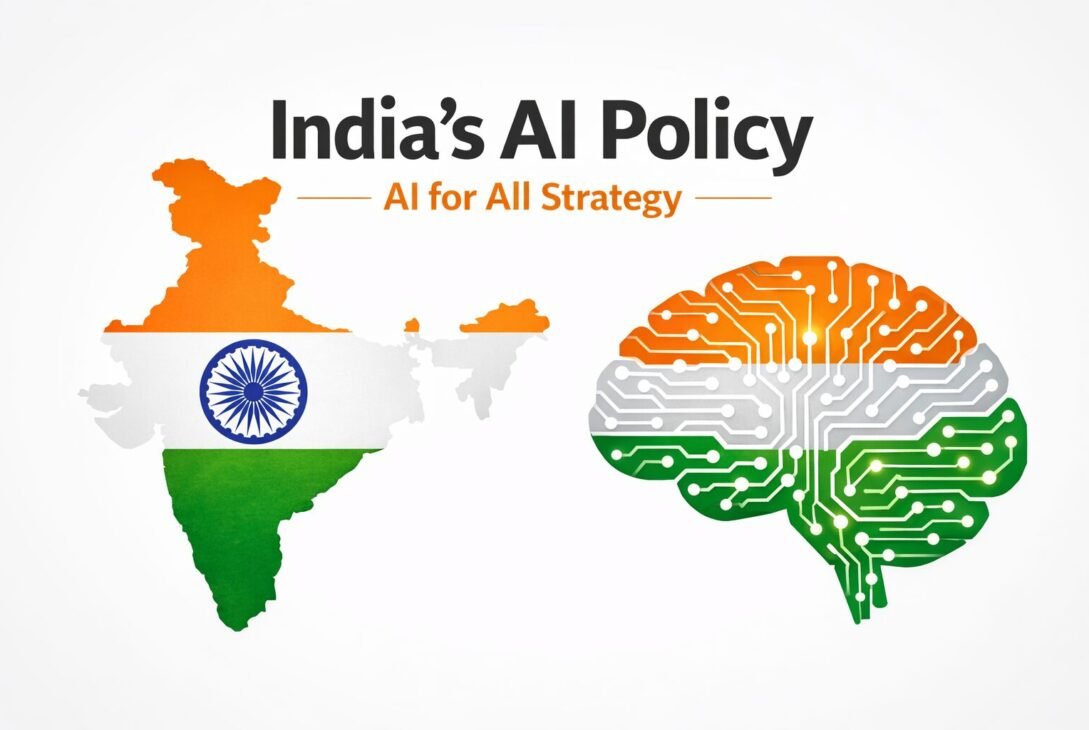
In 2018, the Finance Minister mandated NITI Aayog — India’s apex public policy institution — to establish a National Programme on AI. The result was the National Strategy for Artificial Intelligence, a document that did something rare for a government paper: it had a point of view. Rather than chasing what the US or China were doing, India’s strategy proposed a distinct brand of AI leadership, which it called #AIforAll — technology deployed not for maximizing commercial returns, but for social and inclusive growth.
That framing still drives AI policy in India today. Here’s what it means in practice, and why it matters beyond the policy document.
What NITI Aayog’s AI Strategy Actually Proposes
The National Strategy for Artificial Intelligence, authored by NITI Aayog, opens with a frank admission: India is not a pioneer in foundational AI research. It is, in the document’s own framing, a “late mover.” However, the strategy suggests that late movers can leapfrog — if they’re strategic about where they focus.
The approach is built around three pillars. First, India as an AI opportunity: Accenture’s research, cited in the strategy, estimates that AI could boost India’s annual growth rate by 1.3 percentage points by 2035. Second, AI for the greater good — using intelligent systems to address healthcare access, agricultural productivity, and educational inequality. Third, India as an “AI Garage” for the developing world: solutions built and tested in India could scale to the 40% of the global population living in economies with similar challenges.
Here’s the thing — this third pillar is genuinely distinctive. When India solves for its own problems, it’s potentially solving for Southeast Asia, Africa, and Latin America simultaneously. An AI tool for early tuberculosis detection refined in rural Bihar doesn’t just help Bihar. It has immediate application across dozens of nations where TB remains a top-ten cause of death.
The Five Priority Sectors
Rather than spreading thin across every industry, the National Strategy identifies five sectors where government intervention is most needed — because private sector incentives alone won’t get the job done:
Healthcare. India has 0.76 doctors per 1,000 people, against a WHO recommendation of 1. Private expenditure accounts for roughly 70% of all healthcare costs, with around 62% of that out-of-pocket. An estimated 63 million people fall into poverty each year due to healthcare spending. The strategy proposes AI-driven diagnostics, personalised treatment, and imaging solutions to address the access gap — particularly in rural areas.
Agriculture. Private AI investment in agriculture is low because financial returns are low. But the societal externalities are enormous. The strategy identifies real-time crop advisory, pest detection, and crop price forecasting as high-impact use cases for a sector that forms the backbone of India’s economy.
Education. With roughly 80% of engineering graduates reportedly unemployable on graduation — according to estimates cited in the strategy — the skills gap is structural, not marginal. AI-enabled personalised learning and early dropout prediction are identified as tools to address both access and quality.
Smart Cities and Infrastructure. India’s urban population is growing rapidly. Traffic management, congestion reduction, and energy efficiency in new smart city developments are areas where AI deployment could reduce costs and improve liveability.
Smart Mobility and Transportation. Road accidents carry both enormous human and economic costs. Semi-autonomous features, predictive vehicle maintenance, and autonomous logistics are the strategy’s focus areas here.
The Research Problem India Is Trying to Solve
One of the most candid sections of the NITI Aayog strategy is its diagnosis of India’s research gap. Between 2001 and 2016, the top 15 Indian institutions produced over 42% of all AI-related research publications — meaning the remaining hundreds of universities and tens of thousands of colleges contributed almost nothing. Industry fared worse: only 14% of all publications came from companies, and of that, roughly 70% were from Indian subsidiaries of international firms.
According to the analysis in the strategy, drawing on data from Scimago Journal and Country Rank, the number of papers published from India did jump tenfold, from 331 in 2006 to 3,301 in 2016. Growth, yes. But concentrated, fragile, and heavily dependent on a handful of elite institutions.
The strategy’s proposed solution is a two-tier research architecture. The first tier consists of Centres of Research Excellence (COREs) — institutions anchored at places like IISc and the IITs — focused on foundational AI research in areas including sensory AI, cognitive AI (natural language processing), physical AI (robotics), and general AI. The second tier is International Centres for Transformational AI (ICTAIs) — industry-partnered bodies focused on deploying AI in the five priority sectors, taking research outputs and converting them into market-ready applications.
The strategy also floats a more ambitious idea: a supranational research institution — a “CERN for AI” — which India could lead as part of its #AIforAll mandate. The concept, originally proposed by NYU Professor Gary Marcus at the #AIforGood Summit in Geneva, envisions a globally funded, openly shared AI research body that tackles problems no single corporation or country should own alone: explainable AI, advanced anonymisation, ethics frameworks, and general AI development.
One way to read this proposal: India isn’t just trying to catch up to the US and China. It’s trying to create a lane where those two countries have a conflict of interest in leading.
The Upskilling Push: FutureSkills PRIME and Beyond
Policy architecture is only as useful as the people trained to work within it. This is where India’s AI policy gets operational — and where the Ministry of Electronics and IT (MeitY) has moved fastest.
NASSCOM’s research, cited in the National Strategy, projected that by 2022, roughly 46% of India’s workforce would be engaged in jobs that either didn’t exist or had radically changed skill sets. The demand for AI and machine learning specialists was forecast to rise by 60%. Against that backdrop, the strategy identifies skilling as a national priority, not a secondary concern.
FutureSkills PRIME is the flagship response. A joint initiative of MeitY and NASSCOM, the programme offers reskilling and upskilling across 10 emerging technologies, including AI. According to the Ministry’s 2022 Lok Sabha response, 7 lakh candidates had signed up on the portal, with 1.2 lakh completing courses. Under AI specifically, 36,528 candidates were enrolled in deep-skilling courses and 47,744 in foundation courses. Incentives are available to learners — including those from economically weaker backgrounds — after successful assessment and certification.
The programme’s reach extends beyond major cities. Forty C-DAC and NIELIT centres across India are running blended learning programmes in a hub-and-spoke model, specifically designed to bring Tier 2 and Tier 3 city residents into the programme. The platform also includes a ‘Career Prime’ section with live listings for IT-ITeS jobs, internships, and hackathons.
Beyond FutureSkills PRIME, the Visvesvaraya PhD Scheme supports doctoral research in electronics and IT, with 82 PhD fellows in AI and 59 in machine learning under the scheme. And the National Programme on Responsible Use of AI for Youth has taken AI awareness into government schools: Phase I reached 50,666 students and 2,536 teachers across 2,252 schools in 35 states and union territories.
India’s International AI Commitments
India’s AI policy doesn’t operate in isolation. The country joined the Global Partnership on Artificial Intelligence (GPAI) as a founding member — alongside the US, UK, EU, Canada, Australia, France, Germany, Italy, Japan, Mexico, New Zealand, South Korea, and Singapore. GPAI is designed to guide responsible AI development grounded in human rights, inclusion, diversity, and economic growth.
In 2020, India hosted RAISE — Responsible AI for Social Empowerment — described as a first-of-its-kind global meeting on AI for social transformation. It drew over 79,000 stakeholders from academia, research, industry, and government across 147 countries, with 320 speakers from 21 nations. The event was designed to articulate India’s roadmap for responsible AI — and signal, internationally, that India sees itself as a shaping power in AI governance, not just an AI consumer.
The broader strategic signal here is worth noting. China has a domestic-first AI strategy, built around massive public funding and state-led development. The US approach is primarily private-sector-led. India is doing something different: positioning itself as the responsible, inclusive alternative — the country that builds AI for the world’s excluded populations, not for defence contracts or advertising algorithms.
The National AI Portal: One Ecosystem, One Address
Launched at indiaai.gov.in, the National AI Portal serves as India’s central repository for AI initiatives. As of the Ministry’s 2022 Lok Sabha submission, the portal hosted 1,024 national and international articles, 655 news items, 200 videos, 90 research reports, 279 startups, and 120 government initiatives in one place.
Think of it as the government’s attempt to solve one of AI adoption’s most persistent problems: fragmentation. Enterprises, researchers, startups, and students searching for what India’s government is doing in AI no longer need to hunt across ministry websites. The portal creates a single address for a scattered ecosystem.
Why AI Policy India Matters Beyond the Document
The National Strategy for Artificial Intelligence was published in June 2018. What’s been made since then — FutureSkills PRIME, the GPAI membership, RAISE, the National AI Portal, the Technology Innovation Hubs under the National Mission on Interdisciplinary Cyber-Physical Systems (NM-ICPS) — suggests the strategy is being implemented, not shelved.
The 25 Technology Innovation Hubs established under NM-ICPS across reputed institutes are directly connected to the strategy’s COREs concept. The Centres of Excellence for emerging technologies, designed to connect startups, enterprises, venture capital, government, and academia, are the ICTAIs framework made operational.
But here’s the real question the strategy forces — and that India’s AI policy trajectory hasn’t fully answered yet: can a country simultaneously lead in AI for social good and compete in commercial AI? The US built commercial supremacy first. China is pursuing both with state capital at a scale most nations can’t match. India’s bet is that the responsible, inclusive path builds a different kind of leadership — one based on trust, scale, and the credibility of solving problems that 40% of the world actually faces.
That’s not a guaranteed winning strategy. But it’s a coherent one. And in a global conversation about who should shape AI governance, coherence counts.India’s Ambitious AI Policy: Why the World Should Pay Attention