Introduction: When Victory Became a Legal Nightmare
The year 1971 marked one of India’s most dramatic transformations. What began as a landslide electoral victory for Prime Minister Indira Gandhi ultimately triggered a constitutional crisis that would shake the nation’s foundations.
The Indira Gandhi election court case started not from political rivalry alone, but from a stunning electoral defeat that seemed too impossible to believe. Raj Narain, who had confidently led a victory procession before vote counting, lost by over 110,000 votes in Rae Bareli. This crushing defeat sparked allegations, doubts, and ultimately, a historic legal challenge.
This is the story of how electoral politics became courtroom drama. It’s about belief, suspicion, and a constitutional battle that would redefine Indian democracy.
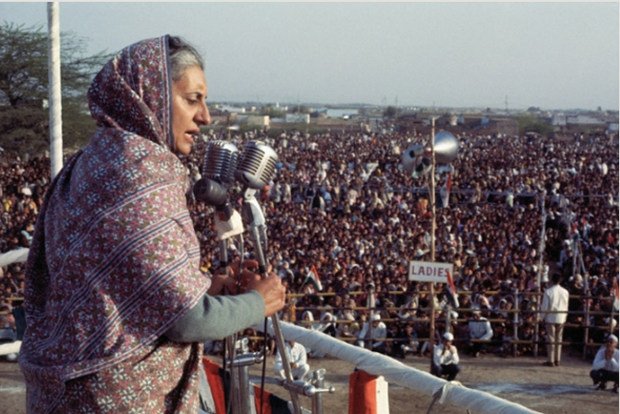
The Political Earthquake of 1969
Congress Split and Power Consolidation
Everything began in 1969 when the Congress party split dramatically. This wasn’t just internal party politics. It represented a fundamental ideological divide about India’s future direction.
After the split, Indira Gandhi’s faction found itself in the minority in the Lok Sabha. She needed the Communist Party of India’s support to pass legislation. This dependence frustrated her considerably.
However, when the Opposition blocked the Privy Purses Abolition Bill in the Rajya Sabha, opportunity knocked. Gandhi saw her chance to break free from political constraints.
The Strategic Gamble
On December 27, 1970, the President dissolved the Lok Sabha on Gandhi’s advice. Fresh elections were called for early March 1971. This move came one year before the scheduled elections due in 1972.
The Opposition parties were caught off guard initially. However, they recovered quickly. They announced the formation of a grand alliance to challenge Gandhi’s Congress.
This alliance included major non-communist opposition parties. Congress (Organization), Jan Sangh, Swatantra Party, and Samyukt Socialist Party joined forces. Their singular goal was defeating Indira Gandhi.
Battle Lines Drawn: Rae Bareli Becomes the Battlefield
Choosing the Champion
Indira Gandhi had won her first Lok Sabha election from Rae Bareli in 1967. She decided to contest from the same constituency again. Despite speculation about changing constituencies, she emphatically denied any such plans.
Meanwhile, Opposition parties strategized their candidate selection carefully. On January 19, 1971, they made a crucial announcement. Raj Narain would be their joint candidate against Gandhi in Rae Bareli.
This wasn’t accidental. Raj Narain had a reputation as a fiery, outspoken critic. Gandhi herself acknowledged this by calling him “a well-known Nehru hater and baiter” in a Coimbatore speech.
The Symbol War
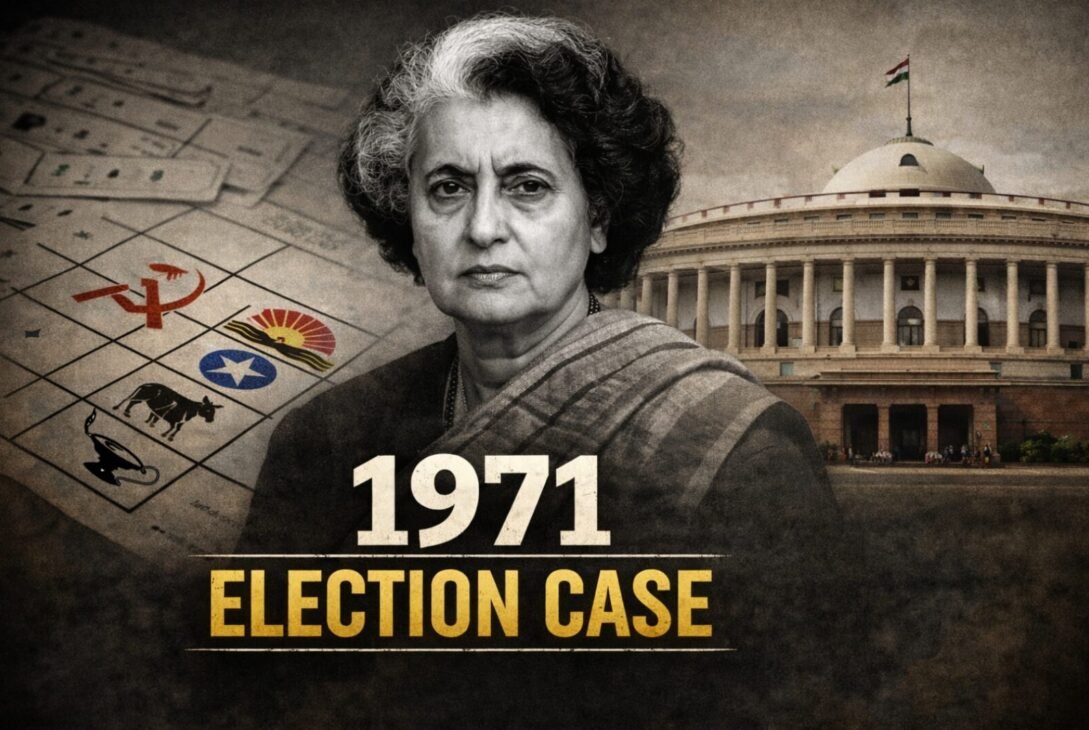
On January 25, the Election Commission allotted campaign symbols. Gandhi’s Congress received the cow and calf symbol. Congress (Organization) led by Morarji Desai got the lady with the charkha symbol.
This allocation itself became controversial. Some viewed the cow and calf as a religious symbol. However, legal challenges were considered impractical once the election process had formally begun.
Gandhi filed her nomination papers on February 1 in Rae Bareli. She appointed Yashpal Kapoor as her election agent. Interestingly, Kapoor was her former Private Secretary who had resigned from government service just days earlier.
The Battle of Slogans: Ideology vs Personality
“Indira Hatao” – Remove Indira
The Opposition alliance crafted a simple, direct slogan: “Indira Hatao” (Remove Indira). Their main accusation focused on corruption. They blamed Gandhi for governance deterioration during the previous two years.
This strategy made the election a referendum on Gandhi personally. It wasn’t about policies or programs. It became about her leadership, her style, her very presence.
“Garibi Hatao” – Remove Poverty
Gandhi’s response demonstrated political genius. She had recently nationalized fourteen major banks. She had attempted to abolish princely privileges. Her image as a radical socialist was already established.
She coined a counter-slogan: “Garibi Hatao” (Remove Poverty). This brilliantly reframed the election narrative. In every speech, she drew the stark contrast. “The Opposition wants Indira’s removal. I want poverty’s removal. You decide what matters.”
This rhetoric’s effectiveness would soon become devastatingly clear.
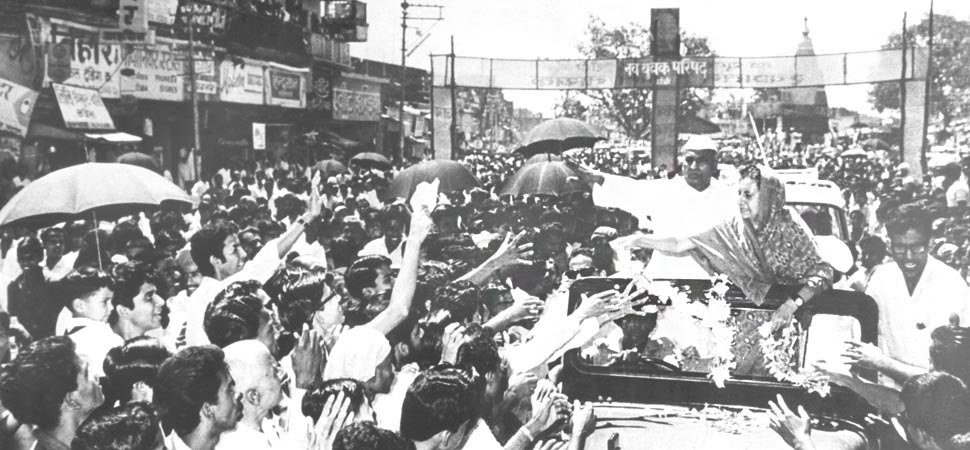
Source: Indiragandhi.in
The Socialist Image
Gandhi successfully positioned herself as championing the poor against entrenched privilege. Bank nationalization symbolized taking on wealthy interests. The privy purses’ abolition attempt showed commitment to equality.
Whether these moves genuinely helped the poor became secondary. What mattered was public perception. Gandhi appeared as someone fighting for ordinary Indians against the corrupt, elite Opposition.
March 7, 1971: Democracy at the Ballot Box
The Confident Opposition
Polling day in Rae Bareli arrived on March 7. The day passed without major incidents. However, confidence levels differed dramatically between camps.
Raj Narain was supremely optimistic about victory. So confident was he that on March 8—before vote counting even began—he led a victory procession through Rae Bareli streets. He thanked people for electing him.
This premature celebration would soon haunt him. Political overconfidence rarely ages well.
Counting Day Shock
Vote counting began on March 9. Results started trickling in by March 10. Early returns showed something extraordinary happening. Congress was heading toward a landslide beyond anyone’s wildest predictions.
The 1971 election in India was stunning. Her Congress party swept the nation. But the most dramatic result came from Rae Bareli itself.
Indira Gandhi routed Raj Narain by over 110,000 votes. She polled 183,309 votes. Raj Narain managed only 71,499 votes. The independent candidate Swami Adwaitanand received negligible votes.
This wasn’t just a victory. This was a complete, crushing defeat for the Opposition.
When Victory Seems Too Perfect: The Seeds of Doubt
Raj Narain’s Disbelief
The results shook Raj Narain to his core. His confident victory procession now seemed embarrassingly premature. How could his reading of public mood be so catastrophically wrong?
Defeat is one thing. Humiliation is another. Losing by such a massive margin after confidently predicting victory triggered a deep psychological impact.
Narain began hearing stories circulating among Opposition circles. These stories spoke of the chemical treatment of ballot papers. The allegations seemed outlandish but gained traction.
The Chemical Treatment Theory
According to these stories, ballot papers underwent sophisticated manipulation. The actual stamp mark’s ink allegedly disappeared after some time due to chemical treatment.
Simultaneously, an invisible stamp mark—supposedly placed during ballot paper printing—would appear just before counting. This would explain seemingly impossible results.
If true, these manipulated marks should be identically placed on all ballot papers. However, verification required examining actual ballot papers. This could only happen through an election petition.
From Conspiracy Theory to Legal Strategy
Whether Raj Narain genuinely believed these allegations or saw them as a legal strategy remains debatable. What’s certain is that these doubts provided motivation for his next move.
The fear that massive rigging had occurred became the primary driver. Corrupt practice charges were initially considered subsidiary issues. The main goal was to examine those ballot papers.
This background set the stage for the Raj Narain vs Indira Gandhi legal battle. What started as electoral politics would soon become constitutional history.
[Image: Ballot papers and election materials from 1971]
The Decision: From Streets to Courtroom
Why File an Election Petition?
Election petitions are serious legal undertakings. They require substantial evidence, skilled legal representation, and significant resources. They’re not filed on whims.
Raj Narain had multiple motivations converging. First, a genuine suspicion about ballot manipulation existed in his mind. Second, political reputation was at stake. Third, the Opposition alliance needed to maintain credibility.
Filing an election petition served several purposes simultaneously. It questioned the result’s legitimacy. It kept Narain politically relevant. It signaled the Opposition wouldn’t accept defeat quietly.
The Legal Path Forward
Under Indian electoral law, any election can be challenged through proper legal channels. An election petition questions the validity of an elected candidate’s victory. It can allege corrupt practices, procedural violations, or systematic fraud.
However, such petitions face high bars. Evidence must be substantial. Legal arguments must be sound. The process is lengthy and expensive.
Raj Narain decided to walk this difficult path. His decision set in motion events that would eventually reach the Supreme Court. The Indira Gandhi election court case was born from this choice.
Why This Moment Matters in Indian History
From Election to Constitutional Crisis
What began as one defeated candidate’s challenge evolved into something far larger. The election petition would ultimately question fundamental issues about democratic governance.
Could a sitting Prime Minister be held accountable through the courts? What limits exist on executive power? How do the judicial and legislative branches balance during such conflicts?
These questions would dominate Indian politics for years. The Rae Bareli election of 1971 became more than a local contest. It became a referendum on India’s constitutional structure.
The Larger Context
The 1971 election occurred during the Cold War’s height. India was navigating complex international relations. The Bangladesh Liberation War would follow soon after these elections.
Internally, India faced economic challenges, social tensions, and political polarization. Gandhi’s massive mandate seemed to give her unprecedented power. This concentration of power would soon become deeply controversial.
Personal Becomes Political
Indira Gandhi’s personality dominated Indian politics during this era. She was Jawaharlal Nehru’s daughter, but determined to establish her own legacy. She was called “India’s only man” by political opponents, acknowledging her political toughness.
However, this personalization of politics carried dangers. When everything revolves around one leader, challenges to that leader threaten the entire system. The election petition wasn’t just about Rae Bareli results. It became about Gandhi herself.
The Transformation: Electoral Politics Becomes Legal Drama
What Changed After March 1971
Before the election petition, political battles happened in Parliament, newspapers, and on the streets. After Raj Narain filed his challenge, courtrooms became crucial political battlegrounds.
This shift had profound implications. Courts operate differently from legislatures. Evidence matters more than rhetoric. Legal procedures constrain political maneuvering.
Gandhi’s massive electoral mandate should have consolidated her power. Instead, the election petition created vulnerability. Legal challenges can’t be dismissed through political popularity alone.
The Beginning, Not the End
The filing of the election petition marked a beginning rather than a conclusion. Years of legal proceedings would follow. Evidence would be examined. Witnesses would testify.
Eventually, the Indira Gandhi election court case would reach the Allahabad High Court. The judgment in that case would trigger an even larger constitutional crisis. The Emergency period of 1975-77 had roots in this electoral challenge.
Understanding this moment helps explain what followed. India’s democratic journey included this critical juncture where law and politics collided dramatically.
Conclusion: The Story That Shook India
The journey from Indira Gandhi’s 1971 election landslide to a historic court battle reveals democracy’s complexity. Victory at the ballot box didn’t end the political contest. It merely shifted the battlefield.
Raj Narain’s decision to file an election petition seemed quixotic initially. How could a defeated candidate challenge such a massive mandate? Yet this challenge would ultimately contribute to profound changes in Indian governance.
The Garibi Hatao slogan had won Gandhi enormous popular support. Her image as a champion of the poor seemed unassailable. Yet beneath this triumph lurked questions about means and methods.
Did ballot manipulation actually occur in 1971? Historical evidence doesn’t support the chemical treatment theory. However, the election petition would ultimately reveal other irregularities—technical violations that nonetheless violated electoral law.
This story matters because it demonstrates that in genuine democracies, legal processes can check even overwhelming political power. Electoral mandates, however large, don’t place leaders above the law.
From electoral battle to court battle—this transformation defined a crucial period in Indian history. What began in Rae Bareli’s polling booths would eventually reach the highest courts. A local election became a national constitutional drama.
The case that shook India started here, with one defeated candidate’s refusal to accept an implausible result. Whether motivated by genuine suspicion or political calculation, Raj Narain’s challenge triggered events that would test India’s democratic foundations.
Democracy survived this test, though not without significant upheaval. The story reminds us that in democracies worth defending, even the most powerful can be questioned, challenged, and held accountable.
Understanding this history helps us appreciate the delicate balance between popular mandate and constitutional accountability that defines Indian democracy.
Was Raj Narain’s election petition a brave legal challenge against power or simply a conspiracy theory from a defeated politician? Do you think the 1971 election results were genuinely suspicious or a legitimate landslide? Share your thoughts in the comments below.