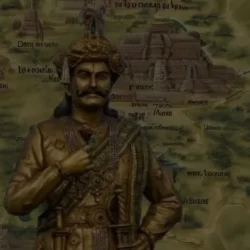
Introduction: When a Dynasty Broke Caste Barriers
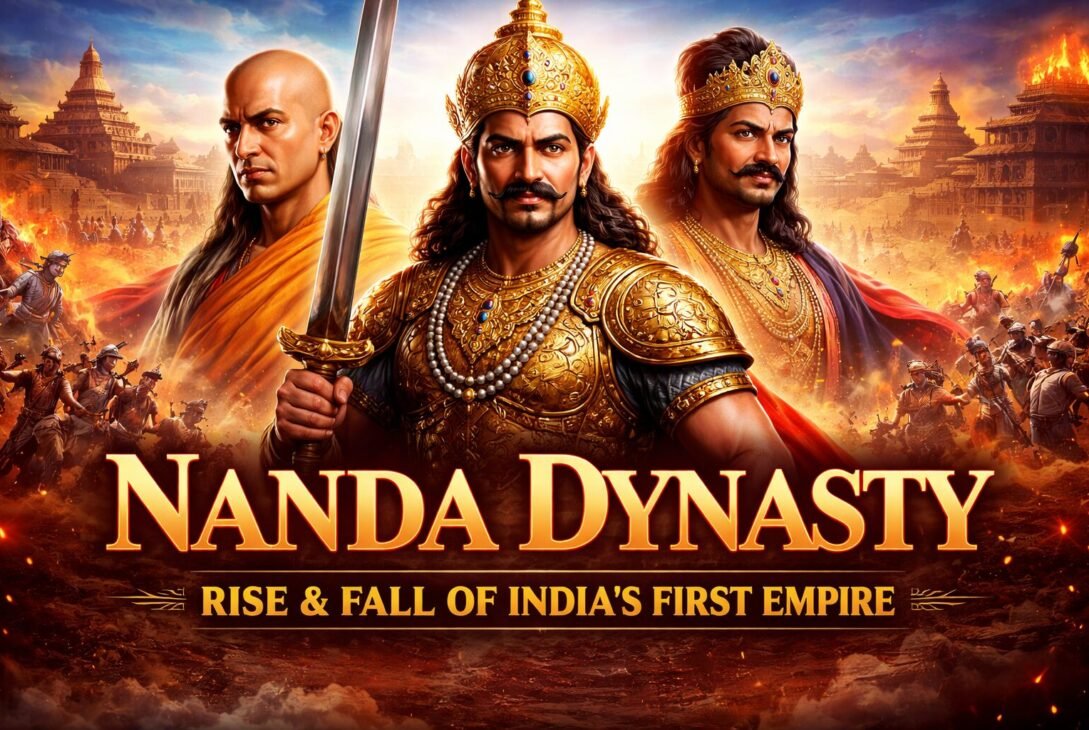
Following the decline of the Shishunaga Dynasty, Magadha underwent a revolutionary transformation. The Nanda Dynasty emerged as a ruling dynasty, marking a significant departure from tradition. For the first time in Magadha’s history, power transferred to non-Kshatriya hands.
This wasn’t merely a change in rulership. It represented a fundamental shift in ancient Indian political structures. The Nandas proved that military might and administrative capability mattered more than birth lineage.
Despite their controversial origins, the Nanda Dynasty became one of Magadha’s most powerful ruling families. They expanded their territories dramatically. They built India’s first genuinely centralized empire. Their story combines ambition, betrayal, military conquest, and eventual downfall.
Understanding the Nandas helps us comprehend how ancient Indian empires functioned. Their rise challenged social hierarchies. Their fall set the stage for the Mauryan golden age.
Origins of the Nanda Dynasty: Two Conflicting Accounts
The Hindu Scripture Version
Hindu texts present Mahapadma Nanda, the founder of the Nanda dynasty, as the illegitimate son of King Mahanandin. Mahanandin was the last ruler of the Shishunaga Dynasty. His mother was reportedly a palace maid or a woman from lower castes.
This version emphasizes Mahapadma’s mixed heritage. He possessed royal blood through his father. However, his mother’s low social status made him illegitimate in the rigid caste system.
The Greek Historical Account
Greek sources tell a dramatically different story. They describe Mahapadma Nanda as an ordinary barber without any royal connection. His attractive appearance allegedly caught the queen’s attention.
According to this account, the queen developed an intimate relationship with him. She subsequently appointed him as the king’s personal barber. This position gave Mahapadma direct access to King Mahanandin.
Resolving the Historical Puzzle
Both accounts agree on one crucial point: Mahapadma came from humble origins. Whether he was an illegitimate prince or a clever barber remains debatable. What matters historically is his non-Kshatriya background.
The Greek version might reflect outsider perspectives on Indian court politics. The Hindu scriptural account might attempt to reconcile his rule with traditional legitimacy requirements. Truth likely lies somewhere between these narratives.
What’s undeniable is Mahapadma’s extraordinary rise from obscurity to absolute power. This rise required exceptional intelligence, ambition, and ruthlessness.
Mahapadma Nanda: The Architect of Betrayal
Winning Trust, Planning Treachery
Mahapadma Nanda understood power dynamics intimately. As King Mahanandin’s barber or illegitimate son, he observed court politics closely. He studied vulnerabilities. He identified opportunities.
Gradually, he won the king’s complete trust. This proximity allowed him to understand the kingdom’s inner workings. He learned about military structures, treasury management, and administrative systems.
However, beneath this loyal facade, Mahapadma harbored dangerous ambitions. He wanted the throne for himself. Traditional succession paths were closed to someone of his background. Therefore, he chose treachery.
The Assassination and Coup
Mahapadma struck with calculated precision. He assassinated King Mahanandin, removing the primary obstacle to power. But eliminating the king wasn’t enough. The young princes represented legitimate heirs.
Mahapadma displayed remarkable cunning in his next move. He positioned himself as the princes’ guardian and protector. Court members believed he would serve as regent until the princes matured.
Instead, Mahapadma systematically eliminated all potential rivals. He killed every prince at the first opportunity. With all male heirs dead, he married the widowed queen. This marriage provided additional legitimacy to his rule.
Thus, through a combination of assassination, deception, and political maneuvering, Mahapadma seized Magadha’s throne. A man from society’s lowest strata became the kingdom’s absolute monarch.
Military Conquests: Building India’s First Empire
The Campaign of Expansion
Mahapadma Nanda wasn’t content with merely holding Magadha. He harbored imperial ambitions unprecedented in Indian history. He transformed Magadha from a regional kingdom into a vast empire.
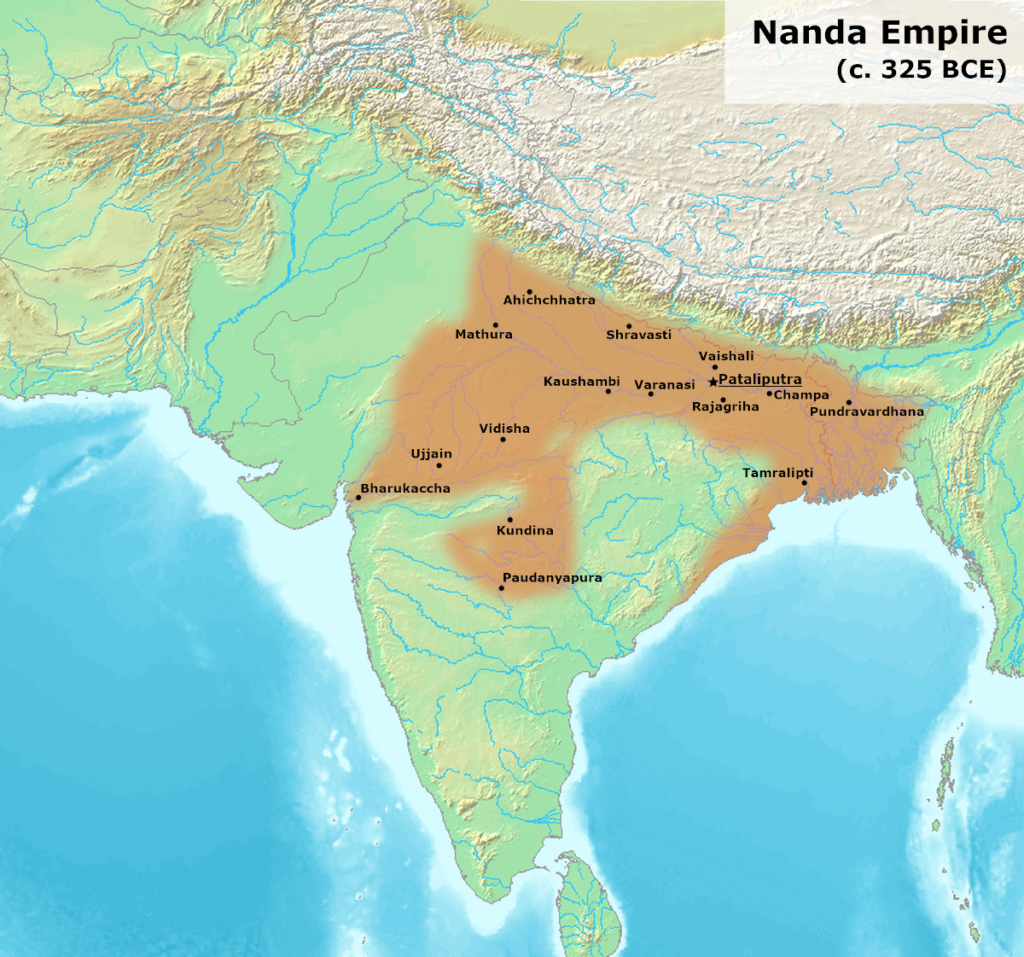
His military campaigns were ruthless and effective. He defeated Panchal, establishing control over the Gangetic plains. Haihaya fell before his armies. Kalinga, despite its strong maritime tradition, submitted to the Nanda power.
The kingdoms of Ashmaka, Kuru, and Surasena also succumbed to his forces. These weren’t minor victories these were major political entities with their own armies and resources.
The Kosala Rebellion
Kosala, which had previous connections with Magadha, attempted a rebellion against Nanda rule. This presented a serious challenge to Mahapadma’s authority. Allowing a successful rebellion would encourage other territories to resist.
Mahapadma responded decisively. He crushed the Kosala rebellion with overwhelming force. Rather than merely punishing rebels, he fully integrated Kosala into Magadha’s administrative structure.
Expanding to the Deccan
Mahapadma’s most significant achievement was pushing Magadha’s boundaries to the Vindhya Range. This meant controlling territory reaching the Deccan Plateau. No previous North Indian ruler had achieved such extensive southern expansion.
This expansion earned him the title “Ekrat”—the sole monarch. The term wasn’t mere flattery. It reflected genuine geopolitical reality. For the first time, a single ruler controlled territories spanning from the Gangetic plains to the Deccan.
India’s First Empire Builder
Historians credit Mahapadma Nanda as India’s first true empire builder. Previous kingdoms had expanded territorially. However, Mahapadma created something qualitatively different—a centralized administrative structure governing diverse regions.
He commanded an enormous army, earning another title: “Ugrasen” (one with a formidable army). This military might wasn’t just for conquest. It maintained order across vast territories and deterred potential rivals.
Administration, Economy, and Governance
Accelerated Urban Growth
During Mahapadma Nanda’s reign, Magadha experienced unprecedented economic growth. Trade and commerce flourished across the empire. Small towns transformed into bustling urban centers.
This urbanization wasn’t accidental. It resulted from deliberate policies encouraging commercial activities. Markets expanded. Artisan communities grew. Long-distance trade networks strengthened.
Agricultural Revolution
Mahapadma invested heavily in agricultural infrastructure. He ordered the construction of extensive canal networks. Irrigation projects brought water to previously barren lands.
These investments made farming significantly easier and more productive. Previously marginal lands became cultivable. Farmers could rely on the water supply regardless of monsoon patterns.
The Iron Age Advantage
The growing use of iron tools during this period revolutionized agriculture. Iron plows could break harder soil. Iron axes cleared forests more efficiently. Iron sickles harvested crops faster.
Agricultural production spiked dramatically. Surplus grain accumulated. This surplus supported larger non-farming populations in cities. India was becoming a genuinely agrarian economy with significant urban components.
Economic Impact
These developments had profound consequences. Increased agricultural productivity meant more tax revenue. Urban growth created new economic opportunities. Trade expansion brought wealth from distant regions.
The Nanda Dynasty was building not just a territorial empire but an economic powerhouse. This economic foundation would later support the even more extensive Mauryan Empire.
The End of an Era
Mahapadma Nanda died at the remarkable age of 88. His long reign allowed complete consolidation of his conquests. The empire he built seemed unshakeable. However, his successors would prove far less capable.
Dhananand: The Last Ruler’s Fatal Flaws
Inheritance of Power and Wealth
After Mahapadma’s death, Dhananand became the last ruler of nanda dynasty. He inherited an enormous empire, overflowing treasuries, and a massive military machine. The army included 200,000 infantrymen, 20,000 cavalrymen, 2,000 chariots, and 3,000 war elephants.
This inheritance should have guaranteed continued Nanda dominance. Dhananand possessed every resource necessary for successful rule. Yet he would squander this legacy through greed and arrogance.
The Corruption Problem
Historical sources consistently describe Dhananand king, as greedy and corrupt. He allegedly stole and hoarded government funds for personal use. Public resources disappeared into his private coffers.
His very name—Dhananand—reportedly came from subjects mocking his obsession with wealth. “Dhana” means wealth or money. The name wasn’t an honor but an insult reflecting his notorious greed.
Oppressive Taxation System
Dhananand’s tax collection methods were particularly harsh. The royal tax on agricultural produce was one-sixth of total production. This might seem reasonable by modern standards. However, collection methods were brutal.
Archaeological evidence reveals taxes were collected in cash or kind, primarily as paddy. Farmers who couldn’t pay faced severe consequences. Tax collectors showed no mercy to struggling families.
Exemptions and Inequity
Soldiers and priests were completely exempted from taxation. This placed the entire tax burden on common people—farmers, artisans, and merchants. The policy bred deep resentment among the productive classes.
Artisans faced additional exploitation. They had to work one day per month in the king’s court for free. This forced labor was their “tax payment.” It disrupted their businesses and reduced their income.
Growing Discontent
These oppressive policies created widespread dissatisfaction. The common people, who had prospered under Mahapadma, now suffered under Dhananand. Resentment simmered throughout the empire. People awaited someone who could challenge this corrupt regime.
That someone would soon appear a scholar named Chanakya.
Chanakya, Alexander, and the Turning Point
The Scholar from Taxila
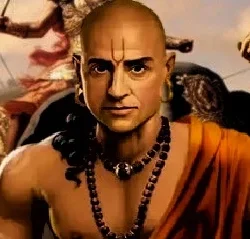
Chanakya was a renowned teacher and scholar at Taxila University. When Alexander the Great began his Indian invasion, Chanakya recognized the threat. He traveled to Magadha seeking military assistance.
Chanakya’s plan was simple: unite Indian kingdoms against the foreign invader. Magadha possessed the strongest army. Dhananand’s support could rally other kingdoms to resist Alexander.
The Fatal Insult
However, Dhananand refused to help kingdoms outside his borders. Worse, he insulted Chanakya publicly. The exact nature of this insult varies across sources. Some suggest Dhananand mocked Chanakya’s appearance. Others claim he dismissed the scholar’s warnings contemptuously.
Regardless of specific details, the insult was severe enough to transform Chanakya from a concerned patriot into a determined enemy. He vowed to dethrone Dhananand and destroy his corrupt regime.
Alexander and Dhananand’s Power
Greek sources provide interesting perspectives on Dhananand’s military strength. After Alexander’s difficult victory against King Porus, Greek soldiers learned about Dhananand’s massive army.
The war-weary Greek troops refused to advance further into India. They understood that confronting Dhananand’s forces would be catastrophic. Alexander, despite his ambitions, had to retreat from India.
Ironically, this demonstrated Dhananand’s genuine military power. His army was so formidable that even Alexander’s legendary forces avoided direct confrontation.
Alexander’s Exit Wasn’t Salvation
However, Alexander’s departure didn’t save Dhananand. The real threat wasn’t the Greek conqueror. It was the insulted scholar who had left Magadha with a burning desire for revenge.
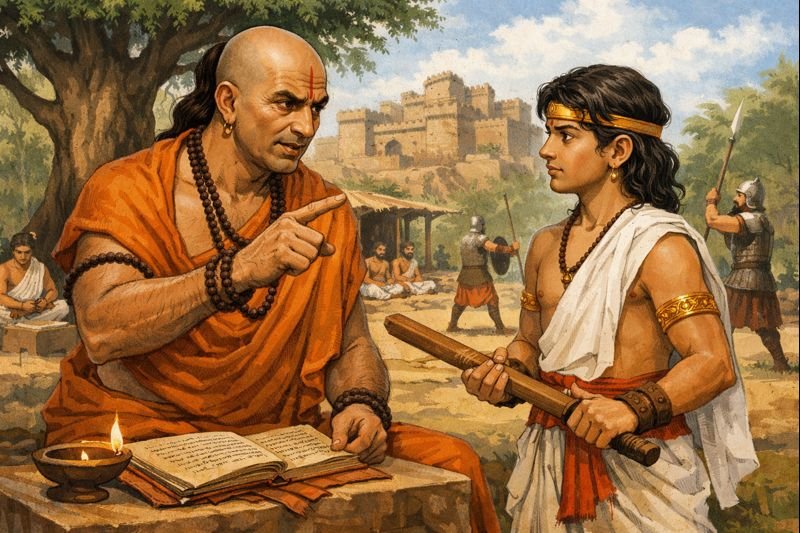
Chanakya found a young man named Chandragupta. He recognized the youth’s potential and made him his pupil. Through years of careful training and strategic planning, Chanakya prepared Chandragupta for kingship.
Fall of the Nanda Dynasty and Rise of the Mauryas
The Inevitable Confrontation
The fall of nanda dynasty came not through foreign invasion but internal rebellion. Chanakya’s preparation was meticulous. He didn’t just train Chandragupta in combat. He taught him statecraft, diplomacy, and administration.
More importantly, Chanakya built alliances. He connected with groups discontented under Dhananand’s rule. Merchants tired of excessive taxation, soldiers resentful of the king’s corruption, and common people suffering under oppression—all became potential supporters.
The Overthrow
When Chanakya finally moved against Dhananand, the regime collapsed surprisingly quickly. Despite his enormous army, Dhananand couldn’t withstand the combined force of popular resentment and strategic brilliance.
Chandragupta, guided by Chanakya’s genius, overthrew Dhananand’s corrupt government. The exact details of this overthrow remain historically unclear. However, the outcome was definitive—the Nanda Dynasty ended, and the Mauryan Dynasty began.
Why the Nanda Dynasty Fell
The fall of nanda dynasty offers important lessons about governance. Mahapadma built an empire through military conquest and administrative skill. However, he couldn’t ensure his successors possessed similar capabilities.
Dhananand’s corruption and oppression alienated the very people who supported the empire. His greed destroyed the economic prosperity Mahapadma had built. His arrogance created powerful enemies like Chanakya.
An empire built on military might alone cannot survive incompetent leadership. Without popular support and effective administration, even the strongest military forces become irrelevant.
The Mauryan Beginning
The rise of the Maurya dynasty directly resulted from the Nanda failures. Chandragupta learned from Dhananand’s mistakes. Under Chanakya’s guidance, the Mauryas would build an even larger empire—but with better administration and governance.
The Mauryan Empire would eventually control almost the entire Indian subcontinent. It would reach heights the Nandas never achieved. However, the Mauryan success was built on the foundations the Nandas had laid.
Historical Significance of the Nanda Dynasty
Breaking Caste Barriers
The Nanda Dynasty’s most revolutionary aspect was its non-Kshatriya origin. For centuries, Indian political theory insisted that only Kshatriyas could rule. The Nandas shattered this belief permanently.
Their success proved that administrative capability and military prowess mattered more than birth. This precedent influenced future Indian dynasties. Many subsequent rulers came from non-Kshatriya backgrounds.
India’s First Empire
Mahapadma Nanda deserves recognition as India’s first genuine empire builder. He created a centralized administrative structure governing diverse regions. He expanded territories more extensively than any previous ruler.
This imperial model influenced subsequent empires. The Mauryas built on the Nanda administrative structures. The Guptas later learned from both. Imperial India’s history traces back to Mahapadma’s innovations.
Economic Foundations
The Nanda period witnessed significant economic development. Agricultural productivity increased dramatically. Urban centers flourished. Trade networks expanded across regions.
These economic developments created wealth that supported larger political structures. The Mauryan Empire’s prosperity had Nanda-era foundations.
Military Organization
The Nandas maintained an enormous, well-organized military. The army’s size and structure impressed even Greek observers. This military organization became the model for subsequent Indian armies.
The Lesson of Decline
The dynasty’s fall teaches crucial lessons about governance. Military power alone cannot sustain an empire. Economic exploitation destroys popular support. Corruption weakens even the strongest regimes.
Dhananand possessed every resource for successful rule. Yet he failed because he forgot that empires ultimately depend on their people’s support.
Conclusion: A Dynasty That Changed India
The Nanda Dynasty ruled for a relatively brief period in Indian history. Yet their impact resonates through centuries. They proved that social origin doesn’t determine governing capability. They built India’s first truly centralized empire. They created economic prosperity through agricultural and urban development.
Mahapadma Nanda, despite his controversial rise to power, demonstrated exceptional administrative and military genius. He expanded Magadha’s boundaries beyond anything previously achieved. He created governmental structures that influenced subsequent empires.
However, the dynasty’s decline under Dhananand illustrates how quickly empires can fall. Corruption, oppression, and arrogance destroyed what military might had built. The insult to Chanakya became the catalyst for complete regime change.
The Nanda Dynasty founder broke caste barriers and built an empire. The last ruler of nanda dynasty destroyed that legacy through greed and incompetence. Between these two rulers lies a fascinating story of rise and fall, achievement and failure.
Understanding the Nandas helps us comprehend how ancient Indian empires functioned. Their story combines military conquest, economic development, social revolution, and political intrigue. It reminds us that empires rise through capability but fall through corruption.
The fall of nanda dynasty cleared the path for Mauryan greatness. Yet the Mauryas built on foundations the Nandas had laid. In this sense, the Nanda legacy survived their political demise.
What do you think—was Mahapadma Nanda a brilliant ruler who revolutionized Indian politics, or a treacherous usurper who happened to be militarily successful? Did Dhananand deserve his downfall, or was he merely unlucky to face someone as brilliant as Chanakya? Share your perspective in the comments below.