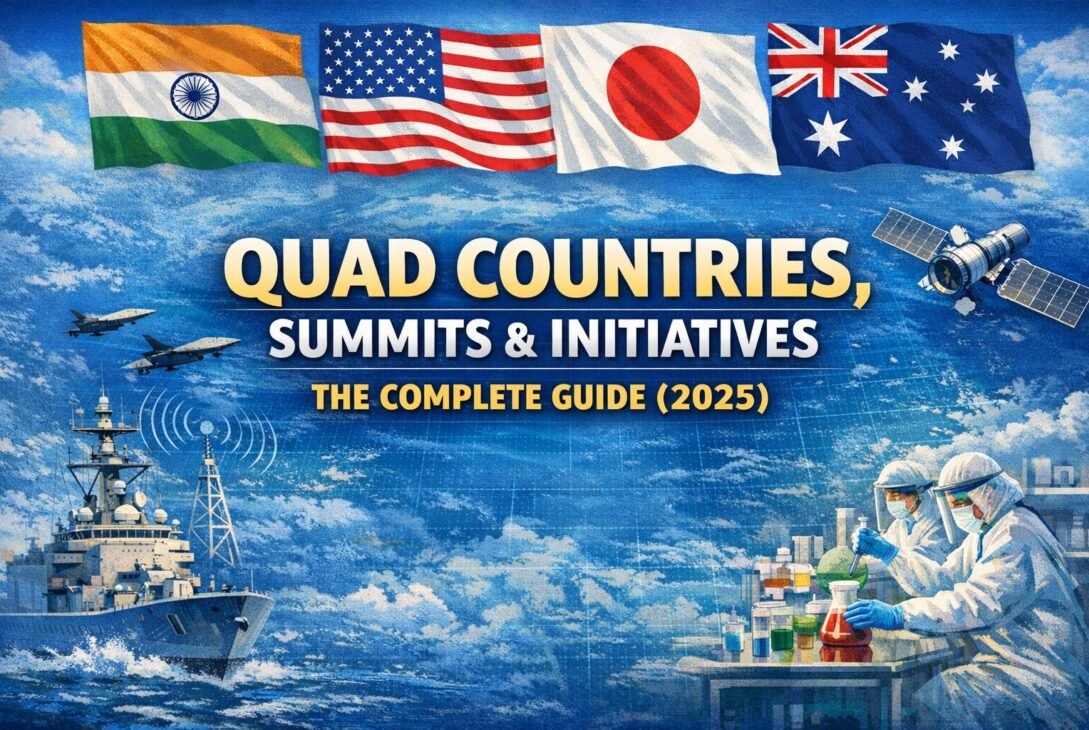
Four countries. Three oceans’ worth of shared coastline. One strategic bet is that cooperation, not coercion, can shape the future of the Indo-Pacific region. That, in essence, is what the Quad — formally the Quadrilateral Security Dialogue between India, Australia, Japan, and the United States — is all about.
But here’s the thing: the Quad isn’t a military alliance, and it isn’t a trade bloc. It occupies a space that didn’t really exist before — a flexible grouping of democracies that tackles everything from vaccine delivery and climate data to undersea cables and counter-terrorism. If you’ve been searching “what is the Quad summit” or wondering which countries sit in this group, you’re not alone. The Quad is one of the most-discussed and least-understood formations in contemporary geopolitics.
This guide covers the full picture: origins, every leader’s summit from 2021 through the Wilmington meeting of 2024, the ten working groups driving day-to-day cooperation, and what India’s hosting of the 2025 summit could mean for the region.

How the Quad Began — and Why It Took So Long to Stick
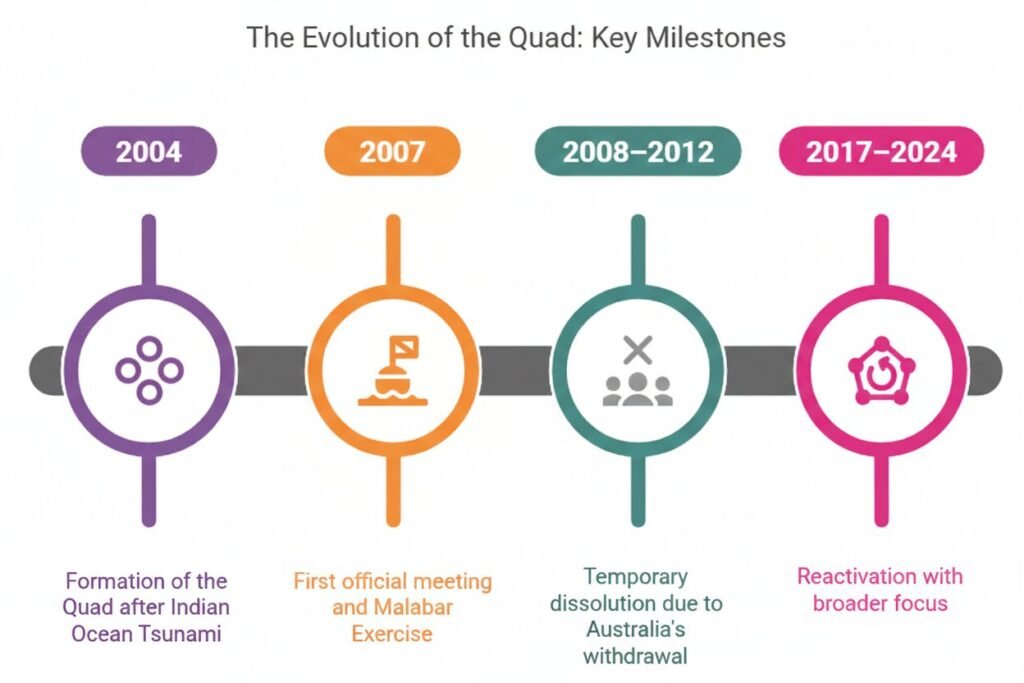
The Quad didn’t start in a treaty room. It started with a tsunami. When the 2004 Indian Ocean disaster struck, India, Australia, Japan, and the United States coordinated emergency response across the devastated region. That practical collaboration planted the seed for something more structured.
The first formal meeting of Quad officials happened on the sidelines of the ASEAN Regional Forum summit in the Philippines in May 2007. Then — silence. For a full decade, the grouping went dormant. Geopolitical pressures, shifting domestic priorities, and diplomatic sensitivities surrounding the naming of a coalition that implicitly countered any single power meant the Quad was shelved before it had a chance to prove itself.
You might wonder why it took until November 2017 for Quad officials to meet again, this time in Manila on the margins of the East Asia Summit. The agenda had sharpened: connectivity issues, maritime security, counter-terrorism, shared principles for a free and open Indo-Pacific, and proliferation threats in Asia. By September 2019, Quad Foreign Ministers were meeting for the first time, on the margins of the UN General Assembly in New York. Two years later, in 2021, the grouping was elevated to a leader-level format.
One way to interpret this slow-to-fast trajectory is that the Quad required a world that was ready for it. The 2007 version arrived when optimism about multilateral institutions was still high. By 2017, the strategic landscape in the Indo-Pacific region had shifted enough — contested waters, debt-diplomacy concerns, supply chain fragility — that a flexible, action-oriented grouping finally made sense to all four capitals.
Every Quad Leaders’ Summit — From Virtual Debut to Wilmington
The Quad summit format didn’t exist before March 2021. When the first Quad Leaders’ Summit took place virtually on 12 March 2021, it was a deliberate escalation — a signal that heads of government, not just officials, would own this agenda. Three working groups were announced immediately: Vaccine Partnership, Climate Change, and Critical & Emerging Technology. The tone was unmistakable: this wasn’t going to be a talking shop.
2021: Washington DC — The First In-Person Summit
The second Quad Leaders’ Summit, held on 24 September 2021 in Washington DC, was the first time all four leaders met face to face. Three new working groups were added — Infrastructure, Space, and Cyber issues. One announcement grabbed particular attention: 100 STEM fellowships, 25 from each Quad country, for graduate and doctoral students at US universities. It was a quiet but telling bet on long-term influence through education rather than short-term political statements.
2022: Ukraine, Japan, and an Expanding Agenda
A virtual summit on 3 March 2022 addressed the situation in Ukraine and its impact on the Indo-Pacific — a reminder that Quad countries can’t wall off regional strategy from global shocks. The leaders also launched a Quad Partnership on Humanitarian Assistance and Disaster Relief (HADR).
Japan hosted the fourth summit on 24 May 2022. The deliverables were concrete and wide-ranging: a Satellite Data Portal for space-based climate and disaster forecasting, Q-CHAMP for climate action and technology transfer, a Debt Management Resource Portal to tackle unsustainable financing in the region, and a formalised HADR Partnership — an India-led initiative providing assistance across the Indo-Pacific.
Quad Summit 2023 Held in Which Country? Hiroshima, Japan
If you’ve searched “Quad summit 2023 held in which country”, the answer is Japan — specifically, Hiroshima, on 20 May 2023. This fifth summit produced a Joint Statement alongside a separate Vision Statement titled “Enduring Partners for the Indo-Pacific,” which outlined principles of sovereignty, territorial integrity, and peaceful resolution of disputes. Choosing Hiroshima carried its own symbolism, anchoring the free and open Indo-Pacific vision in a city defined by its experience with conflict and recovery.
2024: Wilmington — Setting the Stage for India
The most recent summit took place in Wilmington, Delaware (USA) on 21 September 2024. The leaders adopted four documents: the Wilmington Declaration, a Quad Joint Statement Factsheet, a Quad Cancer Moonshot Factsheet, and Principles for Development and Deployment of Digital Public Infrastructure. New initiatives announced included a Quad-at-Sea Ship Observer Mission, a Quad Indo-Pacific Logistics Network pilot project, and a Quad Ports of the Future Partnership.
What makes the Wilmington summit noteworthy isn’t any single announcement but the sheer breadth — from cancer treatment to port infrastructure to coast guard interoperability. The agenda has expanded well beyond security, and the next host, India in 2025, inherits that expanded mandate.
Quad Foreign Ministers’ Meetings — The Diplomatic Engine
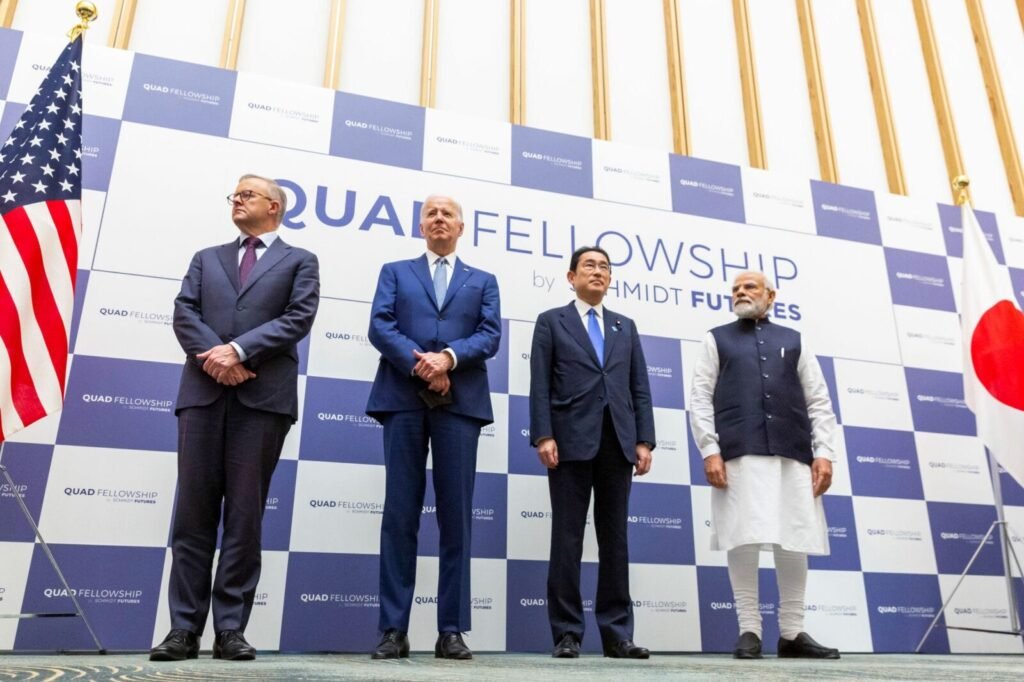
Between summits, the Quad foreign ministers meeting cycle keeps the machinery running. Nine meetings have taken place between September 2019 and January 2025, rotating between New York (on the margins of the UN General Assembly), Tokyo, Melbourne, and New Delhi, with the most recent in Washington, D.C.
Following the January 2025 meeting in Washington, D.C., the Foreign Ministers issued a Joint Statement reaffirming their shared commitment to a Free and Open Indo-Pacific, where the rule of law, democratic values, sovereignty, and territorial integrity are upheld. They also committed to strengthening regional maritime, economic, and technology security and promoting reliable and resilient supply chains.
Consider what these ministerial meetings actually do: they test political alignment between summits, advance working-group mandates, and issue statements — like the September 2022 Statement on Ransomware — that would be too granular for leaders but too significant to leave to bureaucrats alone.
Quad Working Groups — Where Talk Becomes Action
The Quad’s practical agenda is carried forward through ten working groups. Here’s the thing about the Quad that most analysis misses: the summits generate headlines, but the working groups generate outcomes. Here is what each group does and why it matters.
Climate Change and Clean Energy
Quad partners are collaborating on sustainable consumption, clean hydrogen, disaster risk management, climate information sharing, green shipping and ports, and capacity building across the Indo-Pacific. The Clean Energy Supply Chains Initiative, announced at the 2023 summit, supports energy transition in the region. The Climate Information Services Taskforce, part of Q-CHAMP, is working to increase access to early warning systems and climate data. India is executing off-grid solar projects in Comoros, Madagascar, Seychelles, and Fiji in collaboration with the International Solar Alliance, at an estimated cost of US$ 2 million.
What makes the climate pillar noteworthy is how it blends infrastructure with information — not just building solar panels, but ensuring small island nations can actually access the satellite data they need to prepare for cyclones.
Critical and Emerging Technologies
The Quad is working to strengthen supply chain resilience and digital connectivity through access to advanced telecommunications, including 5G. An Open RAN pilot in Palau — the first in the Pacific — supports the diversification and security of telecom networks. The Quad Investors’ Network (QUIN) acts as a private-sector platform for investment in strategic technologies. A Statement of Principles on technology standards was published, grounded in transparency, openness, security, and interoperability. Through AI-ENGAGE, Quad science agencies are funding collaborative research to increase crop yield and resilience.
Cybersecurity
Quad Cyber Challenges promote awareness and capacity building across the region. The 2023 summit released Joint Principles for Secure Software and Joint Principles for Cyber Security of Critical Infrastructure, aimed at strengthening defences against cyber threats to the software supply chain and essential services.
Health Security and the Cancer Moonshot
Under the Quad Vaccine Partnership, member countries delivered more than 400 million safe and effective COVID-19 vaccine doses to Indo-Pacific countries and almost 800 million doses globally. At the 2023 summit, this evolved into a broader Health Security Partnership. The 2024 summit introduced the Quad Cancer Moonshot — an initiative leveraging public and private resources to combat cancer in the Indo-Pacific, with an initial focus on cervical cancer.
The pivot from vaccine delivery to cancer treatment is telling. It signals that the Quad’s health agenda is not crisis-driven alone — it’s building durable, long-term health infrastructure in the region.
Infrastructure and Digital Public Infrastructure
The Quad shares assessments of regional infrastructure needs and coordinates transparent, demand-driven, quality, and climate-resilient infrastructure delivery. Quad Infrastructure Fellowships, announced in 2023, aim to empower more than 1,800 practitioners. The Partnership for Cable Connectivity strengthens undersea cable systems across the Indo-Pacific. At the 2024 summit, the Quad Principles for Development and Deployment of Digital Public Infrastructure (DPI) were adopted, alongside the Quad Ports of the Future Partnership for quality port infrastructure investment.
Space Cooperation
Quad partners are exchanging Earth observation satellite data to help Indo-Pacific countries adapt to climate change, prepare for natural disasters, and manage marine resources. India is developing a cloud-enabled web-based platform based on archival satellite data for extreme weather event analysis, initially serving Mauritius.
Humanitarian Assistance and Disaster Relief (HADR)
The Quad Foreign Ministers signed the HADR Guidelines in September 2022 to enable rapid coordination in the face of natural disasters. Standard Operating Procedures are now in place for an effective multi-country response.
Counter-Terrorism
The Counter-Terrorism Working Group, announced in March 2023 in New Delhi, has condemned terrorism in all forms, denounced the use of terrorist proxies, and emphasised denying logistical, financial, or military support to terrorist groups. Quad Leaders have condemned the 26/11 Mumbai attacks and the Pathankot attacks. Five counterterrorism tabletop exercises have been held in the Quad format so far.
Maritime Security and IPMDA
Through the Indo-Pacific Partnership for Maritime Domain Awareness (IPMDA), announced at the 2022 summit, the Quad provides near-real-time maritime domain data to agencies across the region, supporting efforts against illegal fishing and other illicit activities. The 2024 summit introduced MAITRI — a regional Maritime Initiative for Training — alongside a Quad-at-Sea Ship Observer Mission, a Quad Indo-Pacific Logistics Network for shared civilian disaster-response airlift, and a Maritime Legal Dialogue.
Maritime security is arguably the Quad’s most operationally mature pillar. Where other working groups produce principles and frameworks, this one produces shared data feeds and joint coast guard missions. That distinction matters.
Policy Planners’ Dialogue
This dialogue fosters cooperation among strategic thinkers across the four countries. The inaugural Raisina Young Leaders’ Fellowship — Quad Edition and a Quad Think Tank Network were organised in February 2024 in India.
Quad STEM Fellowships — Investing in the Next Generation
Announced at the 2023 summit, the Quad STEM Fellowships are scholarship programmes designed to build ties among future leaders in science, technology, engineering, and mathematics. The first batch of 100 students — 25 from each Quad country — commenced courses at US universities in Fall 2023. The second cohort, starting in 2024, expanded to 50 fellows representing 12 countries, including South East Asian nations. Applications for the third cohort opened in January 2025.
During the 2024 summit, India announced a separate initiative: fifty Quad scholarships worth $500,000 for students from the Indo-Pacific to pursue a four-year undergraduate engineering programme at an Indian government-funded technical institution. This is a deliberate move to make India a destination for regional talent, not just a source of it.
India and the 2025 Quad Summit — What to Expect
India is set to host the next Quad Leaders’ Summit in 2025. The hosting role comes at a time when the agenda has never been broader — spanning climate resilience, digital infrastructure, cancer treatment, maritime security, counter-terrorism, and space cooperation.
India’s hosting will likely spotlight its own initiatives: the HADR Partnership it leads, the MAITRI maritime training programme, the solar projects across Indo-Pacific island nations, and the new undergraduate scholarships. But the real test for the 2025 summit will be whether the Quad can move from announcements to measurable outcomes. After six leader-level summits and dozens of working-group meetings, the question is no longer “what is the Quad?” — it’s “what has the Quad delivered?”
Why the Quad Matters — Beyond the Headlines
Most commentary frames the Quad alliance as a geopolitical counterweight. That’s only half the story. The Quad’s working groups — from vaccine delivery to satellite data to undersea cables — represent something less dramatic but potentially more durable: an infrastructure of cooperation that outlasts any single summit or diplomatic cycle.
The Quad countries — India, Australia, Japan, and the United States — haven’t signed a treaty. They haven’t created a secretariat. What they’ve done is build a network of practical partnerships, each anchored in a specific deliverable. That approach is messy, incremental, and deliberately undramatic. It may also be the only kind of multilateralism that actually works in a region where formal alliances are often viewed with suspicion.
As India prepares to host the 2025 Quad summit, the grouping’s next chapter will be defined not by declarations but by delivery — on clean energy, on maritime security, on health, on technology. That’s the test worth watching.
References: MEA