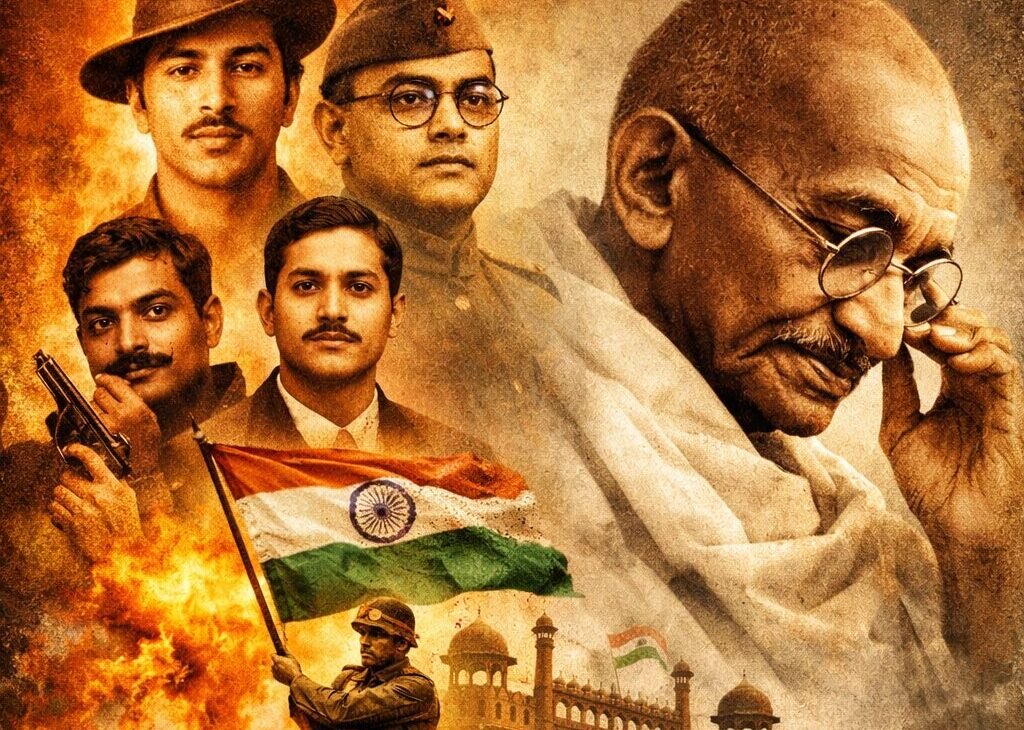
The role of revolutionaries in the Indian freedom struggle remains one of the most contested chapters in Indian history. A widespread narrative credits Mahatma Gandhi’s non-violent methods as the primary force behind India’s independence in 1947. Yet historical evidence suggests a far more complex reality one where armed revolutionaries, constitutional reformers, and economic circumstances played decisive roles that mainstream accounts often minimize or ignore.
This examination challenges the singular focus on Gandhian leadership. It presents documented events, dates, and movements that shaped India’s path to independence through means other than passive resistance.
The Freedom Movement Before Gandhi’s Arrival
India’s struggle for independence did not begin with Gandhi’s return in 1914-15. The freedom movement had deep roots that extended back for decades.
The Maratha Empire’s final subjugation in 1818 did not silence resistance. Sikh forces challenged British supremacy in Northern India until their defeat at Gujrat in 1848. Within a decade, the 1857 rebellion erupted with such force that British authorities seriously considered abandoning India.
Veer Savarkar’s documentation of the 1857 uprising reveals its organized nature and widespread participation. After the British regained control, the Indian National Congress emerged in 1885 to challenge colonial domination through constitutional channels.
Early Revolutionary Violence
By 1906, revolutionary methods manifested openly. Khudiram Bose’s bomb attack that year marked a turning point. Armed resistance spread rapidly across Bengal, Maharashtra, and Punjab before Gandhi even arrived in India.
The revolutionary movement in India before Gandhi had already established networks, martyrs, and momentum. These forces operated independently of any single leader’s philosophy.
Growth of Armed Revolutionary Movements in India
The period between 1906 and 1918 witnessed intense revolutionary activity. British officials and their Indian collaborators faced systematic assassinations by nationalist revolutionaries.
The Rowlatt Report documented the strength and reach of these movements. British authorities feared for their very existence in India. This climate of instability prompted political concessions.
Revolutionary Martyrs and Their Impact
Names like Madanlal Dhingra, Kanhere, Bhagat Singh, Rajguru, Sukhdev, and Chandrashekhar Azad became symbols of armed resistance. These individuals came from educated, respectable families who sacrificed comfort for national liberation.
Lokmanya Tilak built upon the foundation that their sacrifices created. The armed struggle in the Indian freedom movement provided momentum that constitutional politicians later leveraged.
The Gadar Party operated simultaneously in Europe and America during World War I. Their efforts to overthrow British rule with the Axis Powers’ assistance demonstrated the international dimensions of revolutionary activity.
Constitutional Progress and the Shadow of Revolution
Legislative reforms between 1892 and 1935 marked the gradual expansion of Indian participation in governance. Each concession followed periods of revolutionary pressure.
The 1892 extension of the Legislative Council came after sustained agitation. The Morley-Minto Reforms of 1909 granted elected representatives voting rights for the first time. This followed years of revolutionary violence that shook British confidence.
The 1919 Reforms and Jallianwala Bagh
The Montague-Chelmsford Reforms of 1919 introduced partial provincial autonomy. Secretary of State Montague’s visit followed intense revolutionary activity documented in the Rowlatt Report.
The Jallianwala Bagh massacre in 1919 occurred when General Dyer shot hundreds of Indians protesting the Rowlatt Act. This brutality exposed the repressive nature of colonial rule. Twenty years later, Udham Singh shot Sir Michael O’Dwyer dead in London as retribution.
The Government of India Act 1935 granted complete provincial autonomy. Each constitutional advance emerged against the backdrop of revolutionary forces that British authorities could not ignore.
The Pattern of Concessions
Evidence suggests that each stage of constitutional progress between 1909 and 1935 resulted from revolutionary forces working in the background. The British made concessions not from moral persuasion but from strategic calculation about maintaining control.
Gandhi publicly denounced revolutionary violence repeatedly. Yet the masses gave silent but wholehearted support to armed resistance. Revolutionary theory held that nations owe no allegiance to foreign conquerors and may overthrow them at any moment.
Gandhi and His Opposition to Revolutionary Violence
Gandhi’s arrival in 1914-15 coincided with an already flourishing revolutionary movement. His philosophy of non-violence directly conflicted with armed resistance methods.
From 1920 onward, Gandhi actively discouraged force despite having recruited soldiers for Britain just years earlier. He called parliamentary bodies “prostitutes” and urged their boycott, even as constitutional progress continued.
The Karachi Congress Incident of 1931
The Karachi Congress session in March 1931 revealed popular sentiment. Despite Gandhi’s opposition, delegates passed a resolution admiring Bhagat Singh’s courage after he threw a bomb in the Legislative Assembly in 1929.
Gandhi never forgot this defeat. When Gogate shot Acting Governor Hotson months later, Gandhi blamed the Karachi resolution’s admiration for Bhagat Singh. This statement drew immediate challenge from Subhash Chandra Bose at the All-India Congress Committee meeting.
The incident marked the beginning of Gandhi’s disfavor toward Bose. It also demonstrated that revolutionary methods enjoyed broader support than non-violent methods among the masses.
Subhash Chandra Bose and the Alternative Path to Freedom
Subhash Chandra Bose’s contribution to the freedom struggle represents the most significant challenge to the Gandhian narrative. Bose advocated all honorable means, including force when necessary, for liberation.
Gandhi’s treatment of Bose reveals the lengths to which the Congress leadership went to suppress alternative approaches. Bose spent six years in deportation without a recorded protest from Gandhi.
The Presidential Election Controversy
Bose’s election to Congress presidency at Haripura required him to disavow sympathy for violence. Despite this, he refused to follow Gandhi’s directives during his term.
When Bose stood for reelection against Gandhi’s preferred candidate, Dr. Pattabhi, he won with a substantial majority—even from Pattabhi’s home province of Andhra. Gandhi declared this success as his own defeat, not Pattabhi’s.
Gandhi’s response was vindictive. He absented himself from the Tripura Congress session and staged a rival show at Rajkot through a manipulative fast. Bose was eventually expelled from the presidential office.
This incident exposed Gandhi’s hypocritical claim after 1934 that he was not even a four-anna Congress member. His interference proved his continued control and engrossing interest in Congress rivalries while professing detachment.
Bose’s Escape and the INA
Bose mysteriously escaped from Calcutta in January 1941. His journey through Afghanistan to Kabul and eventually Berlin involved extraordinary hardships documented by Uttam Chand.
By 1942, Bose reached Japan, where he organized an invasion of India. Hitler had invested him with the title “His Excellency.” Japan provided support for the Indian National Army after its attack on Pearl Harbor.
The Japanese occupation of Burma, the Dutch East Indies, Malaya, and the Andaman Islands enabled Bose to establish a provisional Indian Republican Government on Indian territory by 1944.
The INA Campaign
The INA consisted of volunteers from Indian populations in the Far East and deserters from Japanese prisons. By early 1944, Bose’s forces reached Manipur State and parts of the Assam Frontier.
The campaign ultimately failed due to inadequate modern armaments, no air support, weak supply lines, and a lack of medical facilities. Many died from starvation and illness. Yet the spirit Bose created was extraordinary.
His troops called him “Netaji” and adopted the slogan “Jai Hind” under his leadership. They fought with determination despite overwhelming odds.
Political Opportunism After Bose’s Death
Gandhi opposed Bose’s invasion. Nehru declared he would fight Bose if he entered India with Japanese support. Both leaders rejected his methods while he lived.
After Bose’s death outside India in 1945, the Congress suddenly professed love and admiration for him and the INA. They defended INA officers in the 1946 Red Fort trials. They adopted “Jai Hind” as their slogan.
The Congress traded on Bose’s name during the 1945-46 elections. Their two winning issues were pretended affection for the INA and hypocritical homage to Bose’s memory. They also promised to resist Pakistan at all costs—a promise they later betrayed.
Quit India Movement and the Reality of Violence
The Quit India Movement violence exposed the failure of Gandhian non-violence. On August 8, 1942, the Congress launched this movement on Gandhi’s initiative. Authorities quickly arrested most leaders before they could act.
Another Congress section went underground. These members avoided jail and instead inflicted maximum damage on the government through sabotage, arson, looting, and violence, including murder.
The “Do or Die” Campaign
Gandhi’s statement urging people to “Do or Die” was interpreted as authorization for obstruction and sabotage. Underground activists committed acts directly opposed to Congress’s non-violent creed.
Police stations burned. Postal communications faced violent interruption. In North Bihar, nearly 900 railway stations were destroyed or burnt. Administration reached a near standstill in some areas.
Gandhi’s Dilemma
These violent activities contradicted Gandhi’s core philosophy. He could neither support nor oppose them publicly.
Supporting them would expose his non-violent creed as hollow. Opposing them would make him unpopular with the masses who cared little whether British expulsion came through violence or non-violence.
The Quit India campaign became known more for violence by Congress supporters than anything else. Gandhi’s non-violence died within weeks of starting the campaign.
Forced Condemnation
Only when Lord Linlithgow challenged Gandhi in 1943 correspondence to own or disown the violence did Gandhi condemn it from jail. By then, whatever damage occurred resulted from violent activities, not so-called non-violence.
Non-violence had completely failed. Violence appeared to have some success. The revolutionary struggle for independence faced discouragement from Gandhi while his own strategy collapsed after August 8, 1942.
Why the British Left India — The Three Real Reasons
The actual causes of British withdrawal involved three distinct forces. Gandhian methods are not among them.
First Force: Revolutionary Movements (1857-1947)
The continuous revolutionary movement from 1857 to Chandrashekhar Azad’s death in 1932 at Allahabad formed the first force. The countrywide rebellion of 1942 continued this revolutionary character, not a Gandhian type.
Bose’s armed revolt and its resulting spread of revolutionary mentality in Indian military forces shattered the foundation of British rule. Gandhi opposed all these effective efforts toward freedom.
The revolutionary movements demonstrated that Indian resistance would not cease. Each generation produced martyrs willing to sacrifice their lives for liberation. This persistent threat made colonial administration increasingly difficult and costly.
Second Force: Constitutional Fighters
Significant credit belongs to patriots who fought British rule on strictly constitutional lines in the assembly floors. This section sought maximum advantage from the obtained concessions while fighting for more.
Late Lokmanya Tilak, N.C. Kelkar, C.R. Das, Vithhalbhai Patel (Sardar Patel’s brother), Pandit Malaviya, Bhai Parmanand, and Hindu Sabha leaders represented this approach during the last decade.
Gandhi and his followers ridiculed these men of sacrifice and intelligence as “job hunters” or “power seekers.” Yet Congress ultimately resorted to the same constitutional methods these leaders pioneered.
Third Force: British Economic Collapse
The advent of the Labour Government and Churchill’s overthrow coincided with Britain’s frightful economic conditions. World War II reduced Britain to financial bankruptcy.
Why the British left India in 1947 relates fundamentally to Britain’s inability to maintain its empire after the war’s economic devastation. The cost of suppressing continuous resistance exceeded the diminishing returns from colonial extraction.
Labour’s anti-imperial ideology, combined with economic necessity, made withdrawal inevitable. Britain lacked the resources to continue controlling a hostile population that demonstrated increasing willingness to fight.
Rethinking the Narrative of Indian Independence
The claim that Gandhi won India’s freedom lacks a historical foundation. Constant pandering to the Muslim League did not win freedom—it created a Frankenstein that devoured one-third of Indian territory.
Gandhi’s Actual Contribution
Gandhi may be acknowledged as a sincere patriot. However, his teachings produced opposite results, and his leadership stultified the nation.
His charkha program, after 34 years, expanded the machine-run textile industry by 200 percent but failed to clothe even one percent of the nation. His non-violence broke down conspicuously in 1942. The truthfulness of average Congressmen proved no higher than that of ordinary citizens—often untruth masked by pretended truthfulness.
So long as Gandhian methods dominated, frustration was inevitable. Gandhi opposed every spirited revolutionary, radical, and vigorous individual or group while promoting charkha, non-violence, and truth as solutions.
The Supreme Hero of Modern India
Subhash Chandra Bose deserves recognition as the supreme hero and martyr of modern India. He kept alive and fostered a revolutionary mentality in the masses. He advocated all honorable means, including necessary force, for liberation.
Gandhi and his self-seeking followers tried to destroy Bose. Representing the Mahatma as the architect of Indian independence is entirely incorrect. The real architects were revolutionaries, constitutional fighters, and economic circumstances—forces that Gandhi often opposed.
Historical Revisionism
True Indian history from 1895 onward for the country’s freedom cannot be written while Gandhian groups control Indian affairs. The memorable share of revolutionary youth remains suppressed.
The revolutionaries played a noble and creditable part that mainstream narratives minimize. Their sacrifices provided the cement for India’s church of independence. Tilak built upon it. Gandhi gained advantage from the accumulated momentum he did not create.
Conclusion
The role of revolutionaries in Indian independence extends far beyond what popular narratives acknowledge. From Khudiram Bose’s 1906 bomb to Bose’s INA in 1944, armed resistance maintained continuous pressure on British rule.
Constitutional fighters like Tilak advanced Indian participation in governance through parliamentary means Gandhi dismissed. Economic collapse after World War II made British withdrawal necessary regardless of any leader’s philosophy.
Gandhi’s non-violence failed its crucial test during the Quit India Movement when widespread violence occurred under Congress auspices. His opposition to revolutionaries, constitutional reformers, and alternative leaders like Subhash Chandra Bose hindered rather than helped liberation efforts.
Historical honesty requires acknowledging these uncomfortable truths. India’s independence resulted from multiple forces operating over decades—revolutionary sacrifice, constitutional progress, armed resistance, and British economic exhaustion. No single leader or method deserves sole credit for achievements that cost thousands of lives and spanned generations of struggle.
The question remains: Why has one narrative dominated while others remain marginalized? Perhaps examining whose interests such narratives serve provides the answer. True understanding of India’s freedom struggle demands confronting all evidence, not just politically convenient versions that support preferred mythologies.