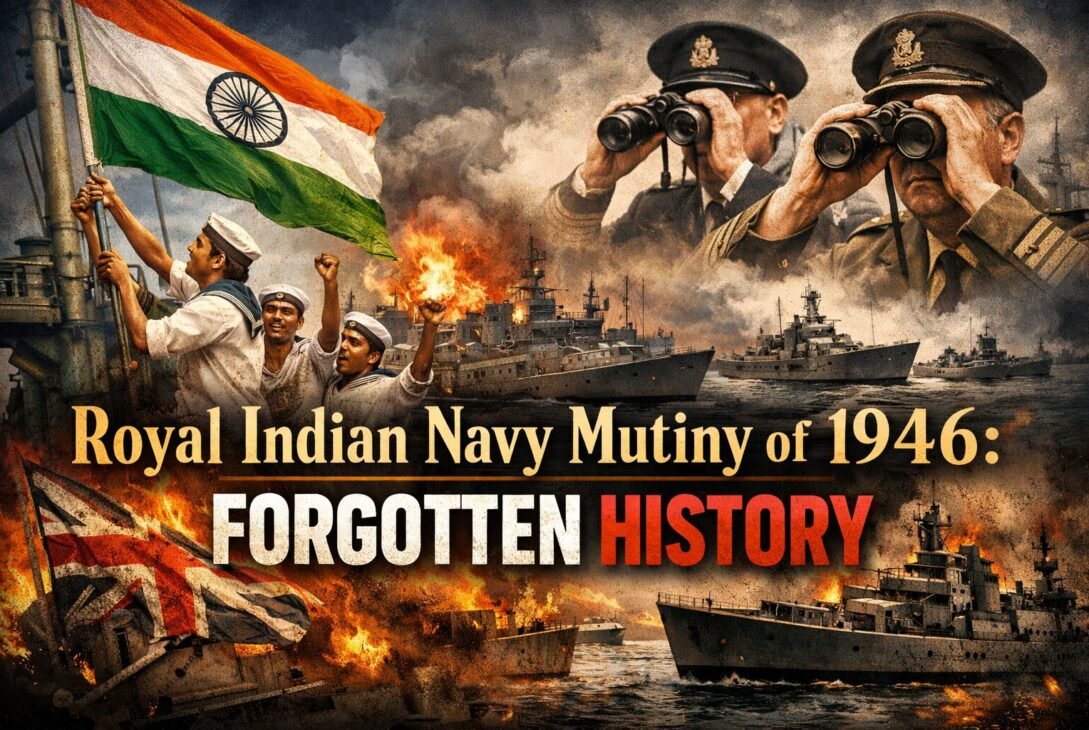
In February 1946, more than 10,000 Indian sailors seized control of ships across Bombay harbour, tore down the Union Jack, hoisted the Congress Party flag, and dared the British Empire to respond. They renamed their base from ‘Royal Gate’ to ‘Azad Gate.’ They called themselves not the Royal Indian Navy, but the Indian National Navy. For a few extraordinary days, the colonial authority could do nothing but watch from a distance.
This was the Royal Indian Navy mutiny — widely called the last war of Indian independence. And yet, if you went through school in India, there’s a good chance you’ve never heard of it.
That’s not an accident. It’s a choice. And the story of why this uprising was buried tells us almost as much about Indian independence history as the uprising itself.
The Men Who Were Promised a Better Life
Understanding what sparked the naval mutiny of 1946 requires going back to how the British recruited Indian sailors in the first place. The Royal Indian Navy ran advertisements guaranteeing recruits a secure, permanent job with strong promotion prospects for young men from ordinary backgrounds, which was a compelling offer.
What they found upon arrival was something entirely different.
[SOURCE: indianculture.gov.in — The Naval Mutiny of 1946, Ministry of Culture, Government of India]
Between 1942 and 1945, small-scale agitations had already begun breaking out across naval bases in Bombay and Odisha. Indian ratings — the common sailors — were given poor quality food, made to perform menial jobs, and denied the right to complain about European officers regardless of the severity of their grievance. The British didn’t even permit Indian music to be played on the bases. Medical facilities for Indian sailors were notably inferior to those provided to British personnel.
Here’s the thing: this wasn’t just day-to-day unfairness. It was a systematic architecture of humiliation, designed to remind Indian sailors at every turn that they were subordinates, not partners — despite fighting in the same wars, on the same ships, under the same flag.
The final trigger came with the appointment of Arthur Frederick King, an open racist, as Commander of the HMIS Talwar — the second-largest signal point in the entire British Empire, based in Mumbai. His appointment made an already volatile situation inevitable.
The Spark: One Resignation That Changed Everything
On 1 February 1946, an Indian rating named R. K. Singh did something that had never been done before: he resigned. In the Royal Indian Navy, resignation simply wasn’t a thing. People were sacked, or they retired. Singh walked away on his own terms, in open defiance of his commanding officer.
It was symbolic, and everyone knew it.
The day after Singh’s resignation, Dutt and Rishi Dev Puri (Deb) painted nationalist slogans — “Quit India” and “Jai Hind” — on the podium where British naval authorities were meant to stand during a Field Marshal’s visit. Dutt also distributed anti-colonial pamphlets across the ship. He was arrested and sent to solitary confinement. He answered every British interrogation as a patriot of Free India.
That arrest was the match.
Dutt’s detention sparked open defiance from other ratings against Commander King, who responded with racial abuse. The ratings filed a formal complaint, which escalated into a naval court proceeding. On 18 February, the ratings launched a ‘No Food, No Work’ strike over inedible food. King, humiliated and isolated, eventually begged Dutt to let him leave the base. He ran and was never seen again.
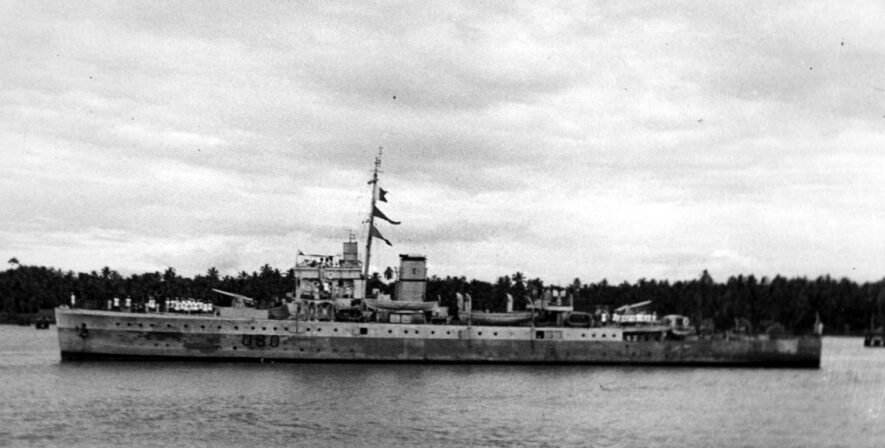
From Strike to National Uprising
What’s easy to miss in the standard telling of this story is how quickly a local labour dispute transformed into something far bigger. The ratings weren’t simply protesting bad food. Their demands to the Rear Admiral included political demands: the release of those imprisoned in Indian National Army (INA) trials, and an immediate inquiry into public firings across India. They were fighting for India’s freedom, not just better rations.
The news reached All India Radio and spread to every corner of the country. The nationalist press supported the ratings without reservation. Naval bases in Assam, Madras, Sind, and Karachi all saw sailors revolt, raising the Congress Party flag in solidarity.
Ratings from across Bombay reached the harbour — more than 10,000 of them. They boarded every ship, stripped every symbol of British authority, and renamed the Royal Indian Navy the Indian National Navy. The movement spilled into the streets: sailors urged shopkeepers to close, and most did. British retailers who refused received a rather less polite response. Even British mail vans became targets.
One way to read this is that the mutiny stopped being about the Navy at all. It became the expression of a country that had simply run out of patience.
The planning committee for the uprising was headquartered in a private home on Marine Drive, Mumbai, belonging to Pran and Kusum Nair, who were deeply involved in the independence movement. That house also served as the birthplace of the Ex-Services Association, an anti-British organisation supported by the Indian People’s Theatre Association. Y. K. Menon and Aruna Asaf Ali were among the outside supporters of the mutiny.
Source: Tripadvisor
The Betrayal That History Quietly Buried
Here’s what most people get wrong about the Royal Indian Navy mutiny: the sailors weren’t defeated by the British. They were persuaded to surrender by their own side.
The major political parties of the time, instead of standing publicly behind the ratings, convinced the mutiny’s leaders to stand down. They promised that no action would be taken. Then watched as the British court-martialed, imprisoned, and tried the very men they’d asked to surrender. A year later, when India gained independence, the sailors didn’t get their jobs back. Their names were absent from the celebrations.
Consider what that means. These were men who had risked everything — not just for better food or fairer pay, but for India’s freedom. And the political leadership of the time chose, at the decisive moment, to distance itself from them.
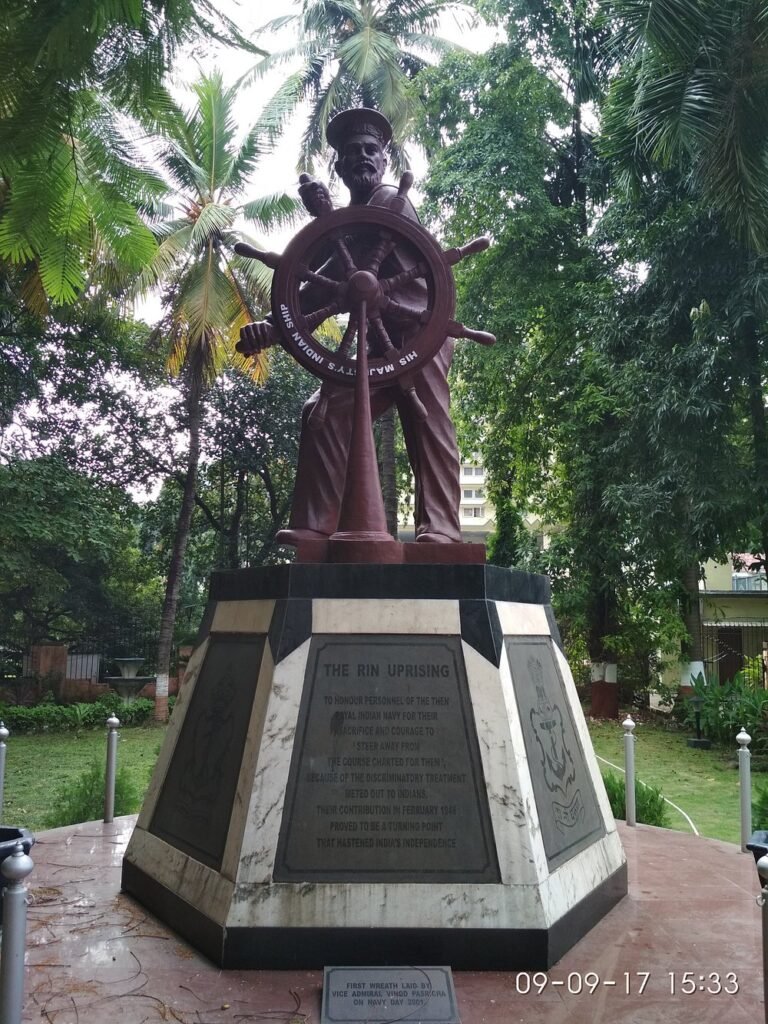
Salil Shyam, B. C. Dutt, Madan Singh, Rishi Dev Puri (Deb), and M. S. Khan were the central leaders of the uprising. Their names are not in most history textbooks. Their memorial exists in Mumbai. That’s where the story ends, officially.
What makes the silence particularly consequential is this: the ratings at Talwar included sailors from Bombay and Karachi, united under one nationalist cause. Had political leadership embraced that unity — had the moment been treated as what it was — it might have altered the trajectory of Partition. That is speculation, but it is not idle speculation.
Why the British Finally Knew It Was Over
The mutiny of 1946 rattled the British in a way that went well beyond the disruption of a few harbour bases. When news of the uprising reached Britain, the Prime Minister announced a plan to send the Cabinet Mission to India to discuss the transfer of self-government. Winston Churchill was forced to resign over his handling of the uprising.
British Prime Minister Clement Attlee would later acknowledge that the Indian National Army and the Naval mutiny were decisive in convincing Britain that holding India was no longer viable. The colonial government had, by this point, seen every Indian — sailor, civilian, shopkeeper, revolt in some way. The Empire’s grip had not just weakened. It had broken.
The naval ratings understood something that formal political negotiation had not fully grasped: freedom is not given. It is taken. The Royal Indian Navy mutiny was the moment that truth became impossible for the British to ignore.
Conclusion
The Royal Indian Navy mutiny of 1946 sits at an uncomfortable intersection in Indian independence history — too significant to dismiss, too politically inconvenient to fully celebrate. The sailors of HMIS Talwar didn’t just revolt. They renamed their base, their navy, and their identity. They proved to an empire that it had run out of time, and to a country that the path to independence ran through blood and defiance, not just dialogue.
That they were then abandoned by the political establishment they fought for is a stain that honest accounts of Indian independence history cannot ignore.
The names of Salil Shyam, B. C. Dutt, R. K. Singh, and their fellow ratings deserve to be remembered — not as a footnote, but as the last, and possibly most decisive, act of India’s freedom struggle. The Royal Indian Navy mutiny didn’t just shake British confidence. It ended it.