Introduction
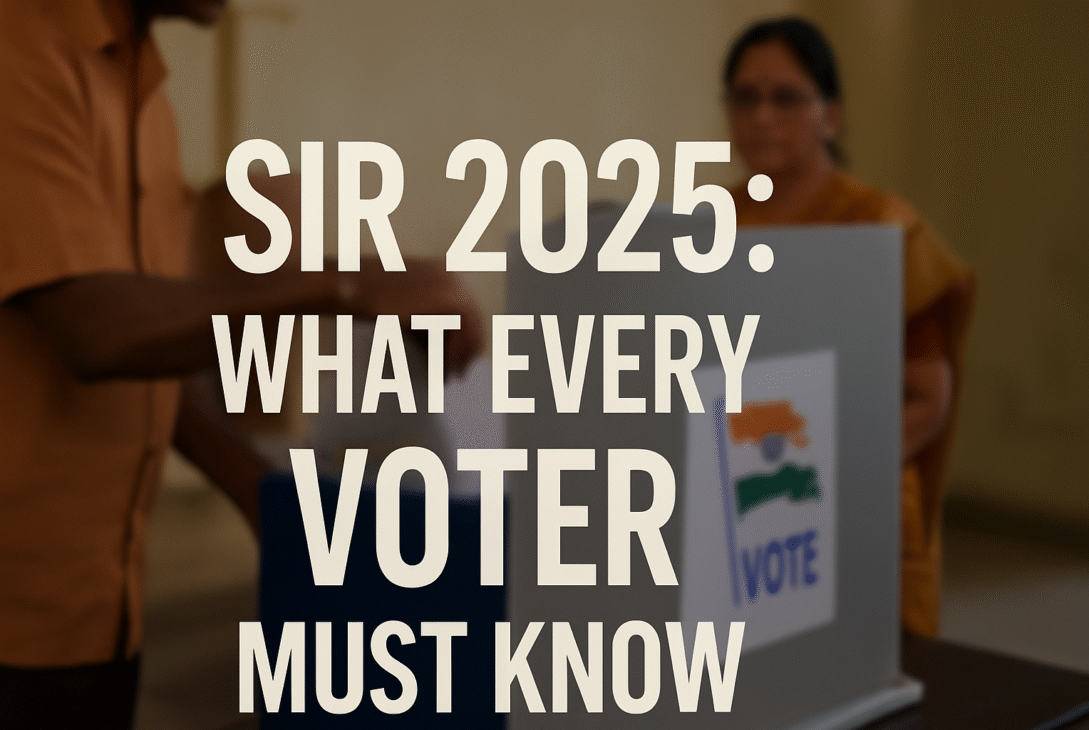
The Special Intensive Revision of Electoral Rolls (SIR) is one of India’s biggest electoral exercises in decades—covering nearly 51 crore voters across 12 states and UTs. Scheduled just months before the 2026 state elections, this extraordinary ground-up verification has triggered a national debate.
Supporters call it a necessary cleanup to eliminate duplicates and strengthen democracy. Critics warn it may impose documentary burdens, create barriers for marginalized groups, and risk mass disenfranchisement.
Is SIR a much-needed democratic reset—or a politically fraught exercise at the wrong time?
What Is the Special Intensive Revision (SIR)?
The Special Intensive Revision of Electoral Rolls is a complete, fresh house-to-house verification of every registered voter. Unlike the routine annual revision, SIR requires every elector to fill out a new Enumeration Form (EF) and validate their details with updated photographs.
This is the first nationwide SIR since 2002–2004, marking a major overhaul after 21 years of demographic change, migration, and inconsistencies in voter lists.
The legal basis for SIR comes from Section 21 of the Representation of the People Act, 1950, which empowers the Election Commission of India (ECI) to order a special revision “at any time” for recorded reasons.
Legal & Constitutional Framework
Article 326: Universal Adult Suffrage
Every Indian citizen aged 18 or above has the right to be registered as an elector unless disqualified by law.
Article 324: ECI’s Superintendence
The Election Commission has full constitutional authority to direct and control the preparation of electoral rolls.
Eligibility Requirements
An individual must be:
- An Indian citizen
- 18+ years old
- Ordinarily Resident in the constituency
- Not otherwise disqualified
Notably, owning property in an area does not establish ordinary residence, while temporary absence does not break it.
Important Clarification: Aadhaar ≠ Citizenship
Though Aadhaar can serve as ID proof, it cannot be used to verify citizenship or date of birth. This distinction lies at the core of multiple objections to SIR.
The SIR 2025 Process: Step-by-Step
1. Pre-Enumeration
- Training of BLOs, EROs, DEOs
- Computer and manual matching with 2002–2004 rolls
- Meetings with political parties
- Training of Booth Level Agents (BLAs)
2. Enumeration (Nov 4 – Dec 4, 2025)
BLOs must:
- Visit each household at least three times
- Distribute pre-filled Enumeration Forms
- Collect updated photos
- Match voters with their entries in the previous SIR
- Identify duplicate, dead, or shifted voters
Citizens can also fill out forms online.
3. Draft Rolls (Dec 9, 2025)
Only electors whose forms are received are included. Lists of absent/shifted/dead/duplicate voters are published separately.
4. Claims & Objections (Dec 9, 2025 – Jan 8, 2026)
Voters and BLAs may file objections using:
- Form 6 – Inclusion
- Form 7 – Deletion
- Form 8 – Correction/Shifting
5. Notice & Hearing Phase (Dec 9 – Jan 31, 2026)
Unmatched voters receive notices and must provide indicative documents.
6. Final Electoral Rolls (Feb 7, 2026)
Polling Station Rationalization
No polling station may have more than 1,200 electors, ensuring accessibility and reducing crowding.
Why Now? The ECI’s Stated Rationale
According to the Election Commission, SIR is necessary because:
- Massive migration has made many roles outdated
- Voters are often registered at multiple locations
- Dead voters remain on lists
- Foreign nationals may have been included
- Political parties have repeatedly complained about roll quality
The ECI highlights that Phase I in Bihar saw “zero appeals”—though this claim itself has been contested.
Controversies & Criticisms
Despite official assurances, SIR has become one of the most politically charged exercises in recent memory.
1. Risk of Disenfranchisement
In Bihar’s draft, 65 lakh names were removed, triggering fears of similar outcomes nationwide.
2. Burden on Post-2003 Voters
Roughly 3 crore voters must provide:
- Their date and place of birth
- Their parents’ date and place of birth
- Additional early-life documents
For many rural, elderly, or migrant families, these records simply don’t exist.
3. Impact on Marginalized & Migrant Groups
Field reports show disproportionate scrutiny in:
- Muslim-majority districts
- Urban slums
- Border regions (e.g., Kishanganj)
Migrant workers, despite being “ordinarily resident,” risk being marked as “shifted.”
4. Opposition Parties’ Alarm
- Congress: Calls SIR an “electoral fraud in the making.”
- DMK: Labels it a “vote theft scheme” benefiting the BJP.
- TMC: Alleges attempts to remove Muslim voters using SIR as a cover.
5. Documentary Confusion Among Citizens
Daily-wage workers, elderly voters, and women often lack access to essential documents, including birth certificates and land records. Multiple house visits create panic and confusion.
6. Administrative Overstretch
Even with BLOs, volunteers, and BLAs:
- Verification is rushed
- Instructions vary widely
- Notice that delivery is inconsistent
The scale makes error-free execution extremely difficult.
Supreme Court & Safeguards
The Supreme Court has allowed SIR to proceed—but with strict safeguards.
Key Directions:
- Publish district-wise, booth-level lists of deleted voters
- Provide reasons for deletion
- Accept Aadhaar or EPIC for filing objections
- Ensure online filing options
- Involve BLAs proactively
- Enhance transparency and accessibility
The Court emphasized that clean rolls are vital—but timing and implementation must not disenfranchise citizens.
Ground Realities: Who Pays the Price?
On-the-ground experiences highlight several practical challenges:
- Elderly citizens struggle with form-filling
- Migrants cannot prove “ordinary residence” despite living in cities for years
- Illiterate voters depend entirely on BLOs or party workers
- Many fear loss of voting rights
- Rural areas face inadequate BLO outreach
- Women, especially widows, lack formal documents
In border districts and minority-dominated areas, fear of exclusion is acute.
Conclusion
India needs clean, accurate, and fraud-free electoral rolls. No democracy can function when duplicates, deceased voters, or ineligible entries clutter the system.
However, democracy also demands inclusion. And inclusion requires empathy, clarity, reasonable timelines, and zero tolerance for wrongful exclusions.
At its best, SIR can strengthen trust. At its worst, it can erode it.
A democratic nation must remember:
Excluding one eligible voter is a greater injustice than including one ineligible voter.
The success of SIR will ultimately depend on whether India can balance administrative efficiency with constitutional compassion—ensuring that every eligible citizen remains visible, valued, and enfranchised.