The Strait of Hormuz is a narrow passage with outsized consequences for India. A large share of India’s crude oil and LNG imports—and much of its trade with West Asia—moves through this route.
Roughly 20 million barrels of oil per day pass through the strait, along with a significant portion of global LNG trade. For India, this creates a specific vulnerability: not just dependence on imports, but dependence on a single maritime corridor with limited alternatives.
Even limited disruption—attacks on shipping, higher insurance costs, or rerouting—can push up fuel prices, delay cargo, and feed into inflation. That is why Hormuz sits at the core of India’s energy security and maritime policy.
What is the Strait of Hormuz?
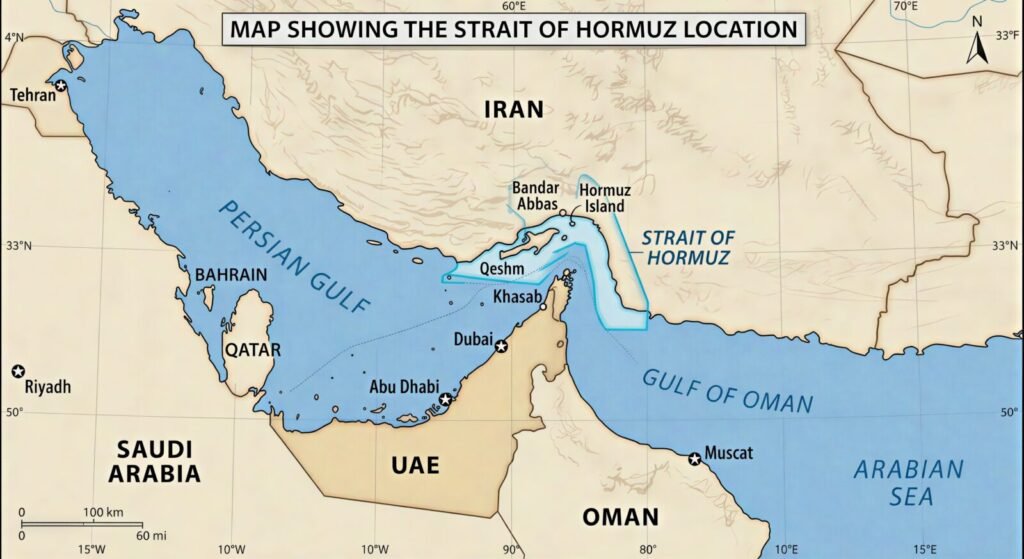
he Strait of Hormuz links the Persian Gulf to the Gulf of Oman and the Arabian Sea, between Iran and Oman.
At its narrowest operational point, ships pass through two 2-mile-wide channels, separated by a buffer zone. Traffic is tightly concentrated. This makes the strait sensitive to even small disruptions—whether from conflict, mines, or interception.
Why is the Strait of Hormuz important globally?
The strait is central to global energy flows:
- Around 20–25% of seaborne oil trade passes through it
- About one-fifth of global LNG trade uses the same route
- Major exporters—Saudi Arabia, Iraq, UAE, Kuwait, Qatar—depend on it
Markets react quickly to any threat in the region. Disruption does not require a full closure. Higher insurance costs, rerouting, or delays are often enough to affect prices and supply chains.
Why the Strait of Hormuz matters to India
Energy imports: the route problem
India’s energy exposure is not only about import dependence—it is about routing.
- Gulf suppliers remain central to India’s oil basket
- Much of this supply must pass through Hormuz
- Diversification (such as Russian imports) reduces some risk, but does not remove it
This leaves India tied to a chokepoint it cannot easily bypass.
LNG vulnerability: a sharper constraint
The risk is more acute for LNG.
- India imported 27.79 million tonnes of LNG in 2024
- Qatar supplied over 40%
- UAE added a significant share
Both depend heavily on Hormuz transit.
Unlike crude, LNG cannot be rerouted at scale. There are no comparable alternative routes for Qatari and Emirati LNG exports.
In a disruption, LNG supply shocks tend to be immediate and harder to manage—especially for power generation and industry.
A network of chokepoints
Hormuz is only one part of a larger system.
India–Europe trade typically moves through:
- Strait of Hormuz
- Arabian Sea
- Bab al-Mandeb
- Red Sea
- Suez Canal
Disruptions in the Red Sea have already shown how stress in one segment affects the whole route. Ships have been forced to reroute around Africa, increasing travel time and costs.
This means India faces not a single risk, but a chain of vulnerabilities across connected sea lanes.
Also Read: String of Pearls vs Necklace of Diamonds
Economic impact on India
Oil prices and inflation
Global oil price movements pass quickly into India’s economy:
- A 10% rise in crude prices can increase inflation by about 20 basis points
- A sustained $10 per barrel increase raises the import bill and widens external balances
The effects are visible in fuel prices, transport costs, and broader inflation.
Shipping and trade costs
Maritime disruption shows up in logistics:
- Higher war-risk insurance premiums
- Longer routes and delivery delays
- Increased freight costs
Rerouting via the Cape of Good Hope instead of Suez can add 10 days or more to journeys.
These costs eventually affect export competitiveness and domestic prices.
Legal framework and freedom of navigation
The Strait of Hormuz falls under UNCLOS provisions on transit passage, which allow continuous movement through international straits.
However:
- Oman has ratified UNCLOS
- Iran has signed but not ratified it
This creates ambiguity in how rules are interpreted during crises. For India, the consistent position is that freedom of navigation and commercial shipping must be protected.
How India is managing Hormuz-related risks
India’s response combines naval presence, monitoring systems, and diplomacy.
Naval deployments
- Operation Sankalp (2019) initiated active protection of Indian shipping
- Expanded deployments since 2023 include ships, aircraft, and surveillance
- Focus remains on mission-based presence in key sea lanes
Monitoring and control
India has built a structured maritime oversight system:
- 24×7 monitoring
- Real-time vessel tracking
- Mandatory reporting for Indian ships
- Coordination through IFC-IOR
These systems improve response time and reduce uncertainty during crises.
Diplomatic engagement
India continues to push for:
- safe passage of commercial shipping
- protection of seafarers
- stability in West Asian sea lanes
Diplomacy remains essential where military solutions have limits.
Diversification and alternative corridors
India is also working on longer-term resilience:
- INSTC for Eurasian connectivity
- Chabahar Port as an alternative access point
- IMEC as a future India–Europe link
These do not replace Hormuz for energy flows but reduce dependence for trade.
Can the Strait of Hormuz be bypassed?
Only partially.
- Saudi Arabia and UAE operate pipelines that bypass the strait
- These routes have limited capacity
- LNG exports remain tied to Hormuz
In practice, there is no full substitute for the strait.
The emerging pattern
The risk is shifting from total closure to persistent disruption:
- tanker seizures
- drone and missile threats
- electronic interference
- higher insurance premiums
These pressures can disrupt trade without halting it entirely.
For India, the challenge is ongoing risk management—not a one-off crisis response.
Conclusion
The Strait of Hormuz is a structural constraint on India’s energy and trade systems.
India’s exposure comes from:
- reliance on Gulf energy supplies
- concentration of routes through a narrow corridor
- interconnected maritime chokepoints
India’s response—naval deployments, monitoring systems, diplomacy, and alternative corridors—reduces risk but cannot eliminate it.
The priority is clear: limit the impact of disruption, not assume it can be avoided.
FAQ
Why is the Strait of Hormuz important to India?
A large share of India’s oil and LNG imports from Gulf countries passes through it, making it central to energy security.
Can India avoid using the Strait of Hormuz?
No. Some diversification exists, but there are no scalable alternatives, especially for LNG.
What happens if the Strait of Hormuz is disrupted?
Energy prices rise, shipping slows, and India’s import bill and inflation increase.
How is India responding to risks in the Strait of Hormuz?
Through naval deployments, monitoring systems, diplomacy, and investment in alternative trade corridors.