Introduction
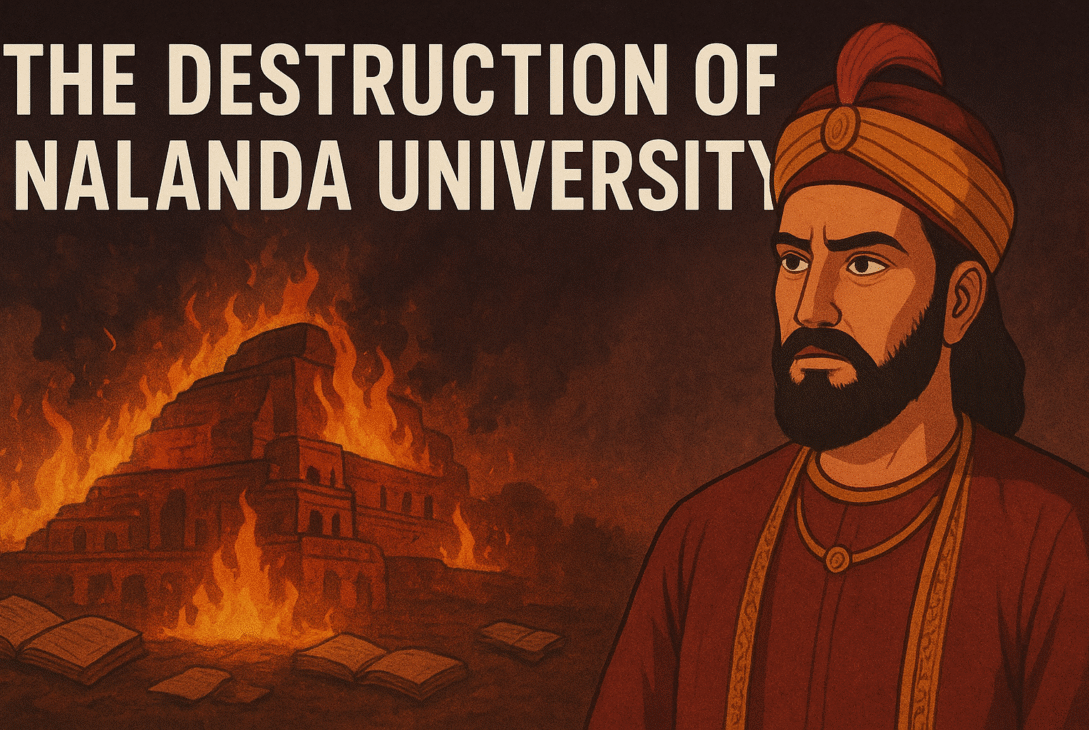
The destruction of Nalanda University in 1193 by Bakhtiyar Khilji marked a decisive attempt to cripple the intellectual framework of India. More than the loss of a building, it was a strategic act intended to burn the very system of knowledge that defined a civilization, transforming a single event into one of history’s most significant acts of cultural genocide.
Nalanda’s flames did not merely consume manuscripts. They consumed centuries of Indian brilliance, scientific understanding, and spiritual inquiry. The ripple effects of this loss still echo across the subcontinent.
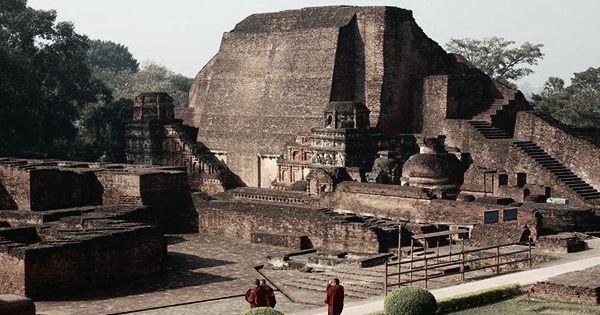
Nalanda: The Cradle of World Knowledge
Nalanda was born during the Gupta Dynasty, a period celebrated as the Golden Age of India. It was the world’s first residential university, offering living quarters, lecture halls, and vast libraries for thousands of students.
Moreover, Nalanda was an international hub of scholarship. Students and monks travelled from China and Tibet to learn here and carry its teachings back to their homelands. Knowledge flowed in all directions.
Notably, even the legendary mathematician Aryabhatta is associated with this university. Nalanda was not only the heart of Indian culture and Buddhist learning but also a center for scientific exploration and philosophical debate.
With such influence, Nalanda became the intellectual engine of an entire civilization.
The Attacker: Bakhtiyar Khilji’s Ambition
Bakhtiyar Khilji, from the Khilji dynasty of Afghanistan, rose within the Delhi Sultanate around 1193. Although he had earned military recognition, he lacked stable financial power. When opportunities opened in Bihar, he seized them quickly.
His ambition grew rapidly. Once he gained soldiers, money, and autonomy, he launched fresh attacks on regions of Bihar to expand his control. In this aggressive expansion lies the beginning of Nalanda’s destruction.
The Pretext: The Cure and the Quran
During this period, Khilji fell seriously ill. Despite the many physicians who accompanied him, none could treat him. Word soon reached him that only Acharya Rahul Sribhadra, head of Nalanda’s Ayurvedic department, could help.
Reluctantly, Khilji approached him—still arrogant and dismissive.
He challenged the Acharya:
“If you are truly intelligent, heal me without using any medicine.”
Acharya Rahul Sribhadra agreed. After a few days, he handed Khilji a Quran and instructed him to read it daily. Khilji’s health began improving rapidly. Disturbed and suspicious, he demanded to know the truth.
The Acharya revealed the secret:
He had applied medicine to the pages of the Quran. As Khilji read it, the medicinal compounds were absorbed through his fingers and body.
The revelation enraged Khilji.
He could not tolerate that Indians possessed knowledge deeper, more refined, and more effective than anything he had known. For him, this was not just a personal humiliation but a political threat.
In that moment, an idea took root in his mind—terrible, cold, and strategic.
The Inferno: A Deliberate Attack on Roots
Khilji understood a brutal truth of conquest:
To dominate a civilization, destroy its knowledge first.
He attacked Nalanda University with a clear objective—to uproot India’s intellectual foundation.
The vast Nalanda Library, one of the greatest repositories of knowledge in world history, was set on fire. According to accounts, the fire burned for months, feeding on thousands of manuscripts.
These weren’t ordinary books. They were the distilled wisdom of generations—science, astronomy, medicine, philosophy, linguistics, and metaphysics. Once gone, they could never be recreated.
This was not collateral damage.
It was a premeditated cultural annihilation.
A Classic Tactic: The Strategy of Cultural Genocide
Destroying centers of learning to weaken societies is a recurring strategy in history. Bakhtiyar Khilji’s destruction of Nalanda illustrates this pattern—eliminating knowledge to break a civilization’s strength, a tactic not unique to medieval India.
The Mongols, after being denied support by the Abbasid Caliph, invaded Baghdad and destroyed the House of Wisdom, the greatest center of Islamic learning. So many books were thrown into the Tigris River that the river turned black from the ink. The Islamic Golden Age ended soon after.
Centuries later, the British used a different method. Through Lord Macaulay, they dismantled India’s Gurukul system and imposed the Downward Filtration Model. The goal was simple: sever Indians from their culture and produce a class that was, in Macaulay’s own words,
“Indian in blood and color, but English in taste, opinions, morals, and intellect.”
Whether through fire or education policy, the objective remained the same:
Break the roots. Control the people.
This is cultural genocide—an attempt to erase a civilization’s identity from within.
The Legacy of Loss and Modern Debates
Nalanda’s destruction scattered its surviving monks. Many fled to Tibet. Even the Dalai Lama acknowledges that Tibetan Buddhist traditions are directly connected to Nalanda’s lineage.
Modern debates exist about Nalanda’s fall. Some historians, like Mr. Jha, argue that Minhaj-i-Siraj may have referred to Udantpuri, a nearby university. But scholars like Arun Shourie counter this with strong evidence:
- All major universities in the region—Nalanda, Odantapuri, Vikramshila—were destroyed by Khilji’s troops.
- Minhaj-i-Siraj explicitly described the shaving of monks’ heads and the scale of destruction—details matching Nalanda’s traditions.
- The text file you provided confirms the same conclusion: “Nalanda was destroyed, and it was destroyed by Bakhtiyar Khilji.”
The truth remains unchanged.
India lost not just manuscripts.
India lost centuries of accumulated genius.
The consequences of that loss continue to shape the subcontinent’s intellectual landscape today.
Conclusion
The burning of Nalanda was a targeted effort to destroy India’s most vital asset—its intellectual foundation. Its fall deprived a civilization of its anchor in knowledge and learning.
Rebuilding such depth takes centuries. Recovering its spirit takes even longer.
Today, reconnecting with our indigenous knowledge systems is not about returning to the past blindly. It is about understanding our roots, questioning colonial narratives, and reviving wisdom that can guide us in modern times.