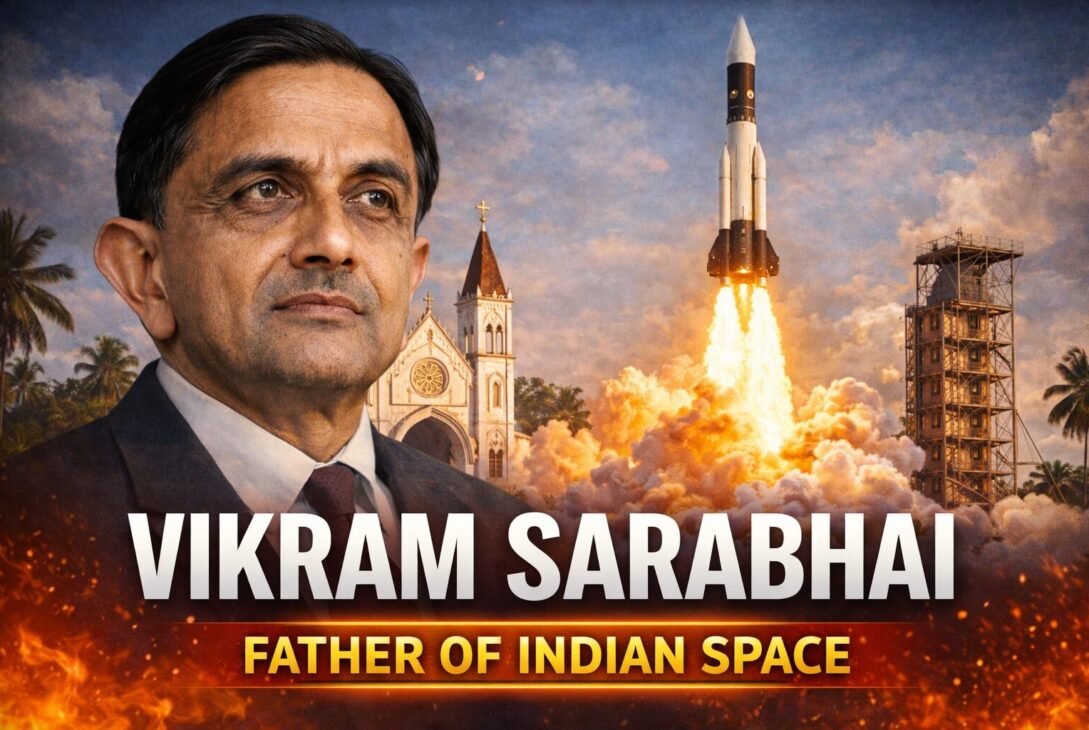
Introduction: The Man Who Told India to Look Up
On November 21, 1963, a rocket pierced the skies above Thumba, a small fishing village in Kerala. Children clapped with wonder. Fishermen stared in amazement. This was India’s first sounding rocket, Nike-Apache, announcing a new revolution.
This Vikram Sarabhai biography tells the story of the man behind that moment. Dr. Vikram Sarabhai, the father of indian space programme, transformed impossible dreams into India’s reality. When the world questioned why a poor nation needed space research, he answered with vision.
India struggled with poverty, illiteracy, and unemployment in the 1960s. Newspapers printed “We Need Rice, Not Rockets.” Yet Vikram Sarabhai argued the opposite—precisely because India was poor, it needed space technology more urgently.
He proved satellites could improve communication, weather forecasting, agriculture, and education. Space wasn’t about war or prestige. It was about serving humanity. He founded institutions that opened new doors for a struggling nation.
This is the story of a scientist who worked for ₹1 monthly salary. A patriot who invested personal wealth in national development. A visionary whose 52-year life laid the foundations for India’s journey to the moon.
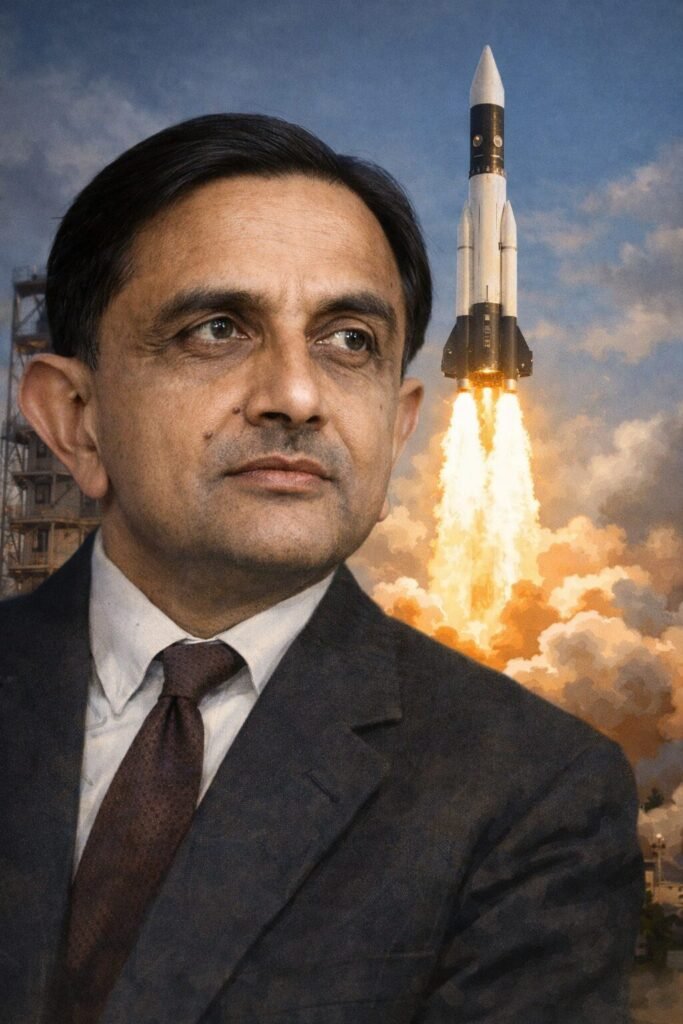
Early Life: Born into Privilege, Chose Service
The Wealthy Industrialist Family
Vikram Ambalal Sarabhai was born on August 12, 1919, in Ahmedabad, Gujarat. He came from an extremely wealthy industrialist family. His father, Ambalal Sarabhai, was a major textile trader owning several mills across Gujarat.
His mother was Sarala Devi. Vikram was one of eight children in this prosperous household. However, wealth alone didn’t define the Sarabhai family. They had deeper commitments.
The Freedom Fighter Father
India was shackled by colonial rule when Vikram was born. The Jallianwala Bagh massacre had recently occurred. The freedom struggle was intensifying under Mahatma Gandhi’s leadership.
Many major industrialists joined this fight. Ambalal Sarabhai was among them. He didn’t just participate in the freedom movement. He provided substantial financial support to freedom fighters.
A Home Visited by Giants
Consequently, the Sarabhai home became a meeting place for great personalities. Rabindranath Tagore, Mahatma Gandhi, J. Krishnamurti, Motilal Nehru, Jawaharlal Nehru, Sarojini Naidu, Maulana Azad, C.F. Andrews, and scientist C.V. Raman regularly visited.
Whenever these luminaries came to Gujarat, they stayed at Ambalal Sarabhai’s home. Young Vikram grew up breathing this atmosphere of intellectual excellence and patriotic dedication.
Tagore’s Prophetic Words
A few months after Vikram’s birth, Rabindranath Tagore visited the Sarabhai home. Tagore was renowned for making accurate predictions. He could allegedly foresee someone’s future by observing their forehead.
Ambalal Sarabhai requested Tagore to predict his newborn son’s future. Tagore examined Vikram’s broad, unusual forehead carefully. He smiled and said, “This child will accomplish great things one day.”
This prophecy would prove remarkably accurate.
Vikram Sarabhai Education: From Ahmedabad to Cambridge
Early Schooling in India
Vikram Sarabhai completed his early education at the school his parents had built. He then studied at R.C. High School for matriculation. Gujarat College provided his intermediate education.
From childhood, Vikram showed a special affinity for science. This interest would soon transform into an obsession. He decided to pursue higher studies in England.
Cambridge University Journey
Vikram chose Cambridge University for advanced studies. Rabindranath Tagore wrote a recommendation letter facilitating his admission. This support proved crucial for his educational journey.
He joined St. John’s College at Cambridge University. In 1940, he completed his Natural Sciences Tripos. His scientific passion was growing stronger with each passing year.
The PhD Under Extraordinary Circumstances
Vikram then began PhD research on cosmic rays at Cambridge. However, World War II disrupted his plans. He came to India for a brief vacation but couldn’t return due to war conditions.
He requested university permission to conduct research in India. The university agreed on one condition—his thesis must be supervised by Nobel Prize winner C.V. Raman.
Working with India’s Greatest Minds
C.V. Raman was then Professor of Physics at the Indian Institute of Science (IISc) in Bangalore. Vikram began researching there. Another great scientist, Homi Bhabha, led IISc’s Cosmic Ray Department.
Cosmic rays were a common interest for both Homi Bhabha and Vikram Sarabhai. Consequently, they met frequently. A strong friendship developed quickly. Proximity to giants like C.V. Raman and Homi Bhabha shaped Vikram profoundly.
First Scientific Publication
In 1942, his first scientific paper, “Time Distribution of Cosmic Rays,” was published. Dr. C.V. Raman himself introduced the paper. He said:
“Although Vikram comes from a rich family, he stands here not because of his privileged background. He has conducted original experiments independently. Through his research, he has entered the scientific world. I am confident his talent and dedication will prove crucial for our country’s scientific growth.”
This appreciation from such a great scientist was significant. It was Vikram’s first formal introduction to the scientific world.
The Scientist and The Dancer: A Love Story
Meeting Mrinalini
Vikram Sarabhai wasn’t just a brilliant scientist. He was also a romantic, lively person. During his IISc research period, he fell in love with classical dancer Mrinalini.
Reportedly, Homi Bhabha introduced them. While Mrinalini immersed herself in classical dance, Vikram loved music deeply. He maintained an excellent collection of all types of songs.
Unique Courtship Gifts
Vikram surprised Mrinalini with unique gifts. Despite being a millionaire, he gave her a simple Tibetan turquoise ring for their engagement. On their wedding day, he sent a rare blue lotus flower on a copper tray.
Mrinalini often recalled: “There couldn’t be a more beautiful way to express love.” They married on September 3, 1942. They later had two children together.
Return to Independent India: Building Scientific Infrastructure
Completing the PhD
Most of Vikram’s PhD research happened in India. However, he needed to return to Cambridge for degree completion. After World War II ended, he returned to Cambridge in 1945.
He completed his PhD on “Cosmic Investigations in Tropical Latitudes.” In November 1947, he returned to India. However, major changes had occurred in his absence.
India had gained independence three months before his return. The nation was free but backward in every field after 200 years of colonial rule. Industry and technology were particularly weak.
The Decision to Serve
Vikram decided to dedicate his entire life to advancing India in science, technology, research, and management. His first step was establishing the Physical Research Laboratory (PRL) in Ahmedabad with his parents’ help.
This PRL would later become the birthplace of India’s space research. He also established the Ahmedabad Textile Industry Research Association (ATIRA). This promoted research and innovation in the textile industry.
These initiatives laid the groundwork for India’s scientific culture, research and development, and young scientist training. They showed India the path toward self-reliance in science and business.
Also Read: Homi Bhabha – Architect of India’s Nuclear Programme
Vision Beyond the Laboratory: IIM Ahmedabad
The Management Education Gap
In 1950, Vikram’s father made him chairman of Sarabhai Chemicals. This required weekly travel to Baroda for business management. However, research remained his first love.
Even during travel, he never stopped working. He always kept a Physical Research Laboratory student with him. This ensured discussions and brainstorming continued during journeys.
Founding India’s Premier Business School
India lacked formal management education then. Vikram believed management education was as crucial as science and technology for economic growth. He discussed establishing a national-level management institute with Prime Minister Jawaharlal Nehru.
The government responded in 1957, announcing plans for a national management institute. After two years of detailed analysis, the committees recommended opening it in Mumbai with full autonomy.
However, the Union and Maharashtra governments couldn’t agree on autonomy terms. Vikram proposed establishing the institute in Ahmedabad instead. He convinced Gujarat’s Chief Minister, Dr. Devaraj Mehta, to provide land.
Birth of IIM Ahmedabad
After considerable back-and-forth, the Union Government decided to open two IIMs simultaneously—one in Ahmedabad, another in Kolkata. IIM Kolkata was established in November 1961. IIM Ahmedabad followed in December 1961.
Vikram Sarabhai became IIM Ahmedabad’s part-time director. Interestingly, personal factors also motivated this achievement. However, his daughter Mallika later clarified that reducing his vision solely to personal reasons would be unjust.
The establishment of IIM Ahmedabad represented his commitment to building institutions serving India’s long-term development needs.
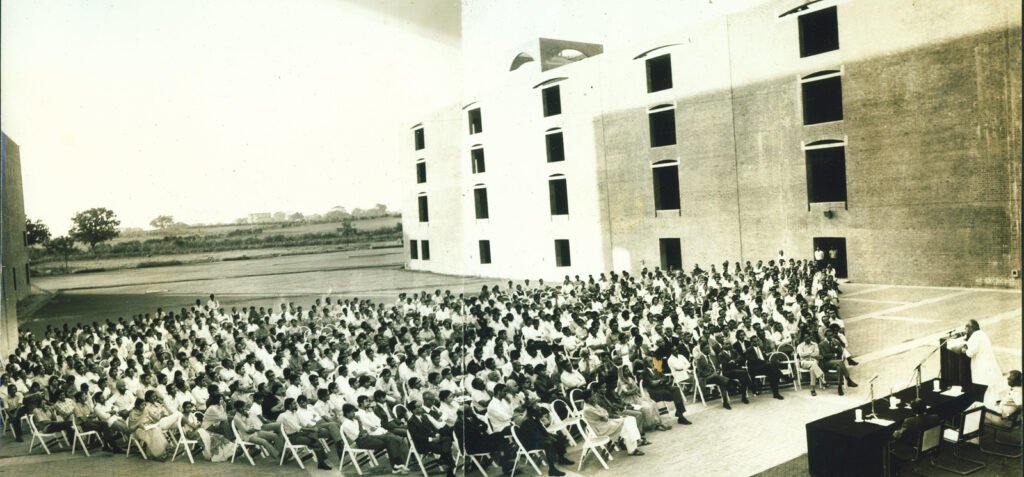
Source: IIMA Archives
Founding India’s Space Programme: The Thumba Story
The Space Race Context
By the early 1960s, the space race between America and the Soviet Union was intensifying. The Soviet Union had launched Sputnik 1. America had sent Explorer 1. These developments deeply influenced Vikram.
He understood space technology was the key to the future. India would lag behind without it. He presented a visionary idea to Prime Minister Jawaharlal Nehru, seeking permission to proceed.
“We Need Rice, Not Rockets”
India struggled with poverty, hunger, and illiteracy then. Many mocked the idea of a poor country pursuing space research. Newspapers printed “We Need Rice, Not Rockets.”
However, Vikram Sarabhai was a visionary. He argued that precisely because India was poor, it should invest more heavily in space technology. His logic was clear and compelling.
The Social Application of Space
Satellites would improve communication. Education could reach remote areas. Accurate weather forecasting would help farmers directly. Space technology would solve India’s real problems, not just compete with superpowers.
Prime Minister Nehru and nuclear scientist Homi Bhabha fully supported this vision. In 1961, they jointly established the Indian National Committee for Space Research (INCOSPAR) within the Department of Atomic Energy.
Vikram became its first chairman. India’s space roadmap was ready. However, they now needed a rocket launching station.
Finding Thumba
The station required a coastal, isolated location near Earth’s magnetic equator. Such locations are perfect for sounding rockets and scientific experiments. Vikram assigned this responsibility to his student E.V. Chitnis.
Chitnis toured southern India, creating a list of 200 potential sites. Vikram selected two locations: Thumbattu and Thumba. After a detailed inspection with Homi Bhabha, they chose Thumba in Kerala.
Thumba was located very close to the magnetic equator. Additionally, the airport was nearby, facilitating equipment transportation for experiments.
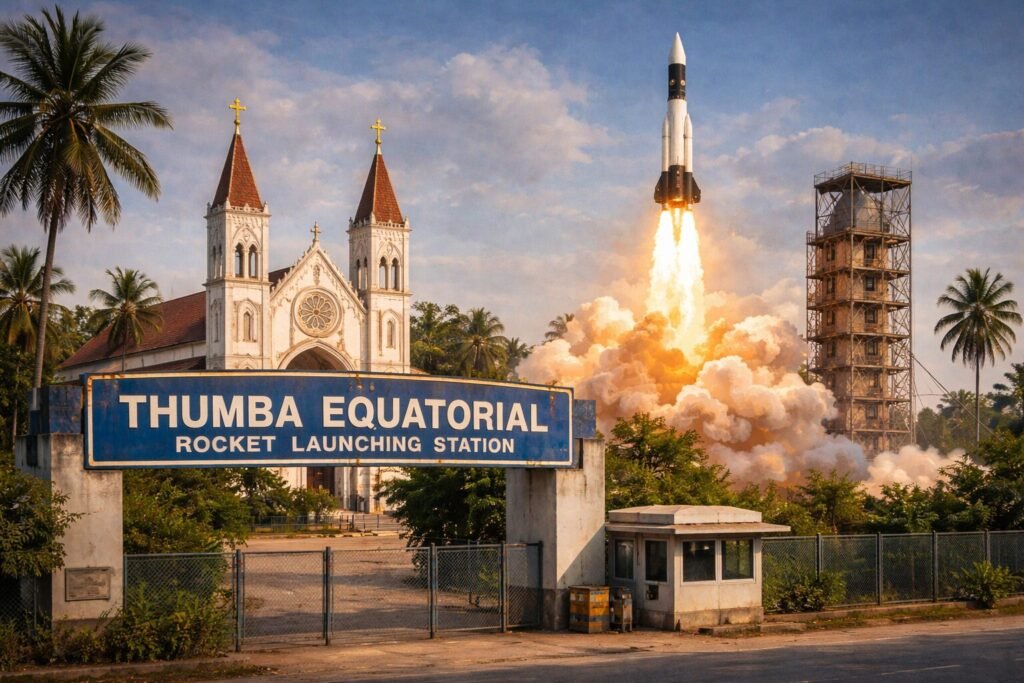
The Church Becomes Control Room
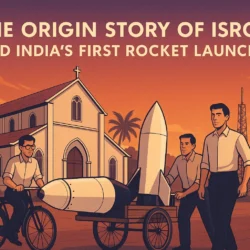
After site selection, Vikram and Homi Bhabha converted St. Mary Magdalene Church into the rocket launching station’s control room. The priest’s residence became the office.
Religious people initially opposed this. However, the church priest himself explained to people that this work was crucial for the nation’s welfare. People agreed, though fishermen living in the surrounding areas needed relocation.
Displacing them was necessary because even small mistakes during rocket launches could endanger lives. With Thumba Collector Madhavan Nair’s help, proper houses were arranged for the fishermen. Only then did they obtain land for the station.
Building with Limited Resources
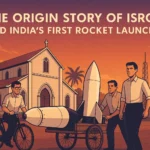
Obtaining land wasn’t enough. The real challenge was building a proper rocket launching station in this barren coastal area. Resources were severely limited. They didn’t even have trucks to transport equipment from railway stations and airports.
Equipment had to be carried on bicycles and bullock carts. Though means were limited, scientist morale under Vikram’s leadership touched the sky. This spirit would become India’s space journey’s defining characteristic.
International Cooperation
Vikram sought help from America, the Soviet Union, and European countries. NASA and France’s space agency CNES provided sounding rockets and basic instruments. After months of hard work, the Thumba Equatorial Rocket Launching Station (TERLS) was completed in 1962.
November 21, 1963: India’s First Launch
On November 21, 1963, India’s first sounding rocket Nike-Apache launched from this station. This rocket launch was Vikram Sarabhai’s message to the world—India had entered the space race.
A spark rising from a church would one day make India a space superpower.
The Founder of ISRO: Creating an Independent Space Organization
From INCOSPAR to ISRO
Vikram gradually realized INCOSPAR couldn’t fulfill his grand space vision. Being a sub-organization under the Department of Atomic Energy limited its potential. India’s space programme needed an independent, full-fledged organization.
This organization required its own structure, budget, and long-term planning capability. With this intent, in 1969, Vikram separated INCOSPAR from the Department of Atomic Energy.
August 15, 1969: ISRO is Born
He established the Indian Space Research Organisation (ISRO). This ISRO would eventually take India to the moon. Vikram Sarabhai became ISRO’s first chairman.
His dedication to making this organization successful was extraordinary. He worked for ISRO for a monthly token salary of merely ₹1. For him, the nation’s development came before everything else.
He always said, “We will use this for humanity’s service, not to compete like developed countries in space fights.”
Satellite Television Initiative
Vikram Sarabhai played a major role in bringing satellite TV to India. He sent an important proposal to the government about using satellite TV to promote education.
This later led to the development of the Satellite Instructional Television Experiment (SITE). Additionally, Vikram initiated Project Aryabhata by forming a dedicated team under Dr. Udupi Ramachandra Rao’s leadership for creating and launching India’s first satellite.
Dual Responsibilities: Atomic Energy and Space
Taking Over After Homi Bhabha’s Death
India suffered a major blow when Vikram’s close friend and great nuclear scientist, Dr. Homi Jehangir Bhabha, died in a plane crash. Homi Bhabha laid the foundations of India’s nuclear programme. His international scientific stature was very high.
His replacement needed someone scientifically capable who could also represent India globally. Vikram Sarabhai was the perfect choice. In May 1966, he was made Atomic Energy Commission chairman.
Philosophical Differences
Notably, Vikram supported the peaceful use of nuclear energy. However, developing nuclear bombs seemed like leading the world toward destruction to him. He believed atomic bombs as weapons were merely paper tigers.
Reportedly, after becoming Atomic Energy Commission chairman, he first prepared to halt India’s nuclear bomb programme. Additionally, nuclear physics wasn’t remotely his area. His background was space research.
Many people at the Atomic Energy Commission didn’t like seeing him as their boss for these reasons. However, Vikram was not only a scientist but also an excellent administrator.
Building Nuclear Infrastructure
He possessed an extraordinary ability to work with people and quickly adapt to any environment. He soon succeeded in coordinating with Atomic Energy Commission scientists. Within months, he brought the nuclear programme back on track.
After assuming nuclear programme responsibility, Vikram emphasized giving institutional form to uranium mining and processing under the Atomic Energy Commission. In 1967, the Uranium Corporation of India Limited (UCIL) was established in Jadugoda.
UCIL was part of the long-term plan related to thorium and the nuclear fuel cycle. Through this, Vikram wanted to realize Homi Bhabha’s three-stage nuclear programme dream.
Electronics Corporation of India
Vikram played a major role in establishing the Electronics Corporation of India Limited (ECIL) to make India self-reliant in electronics. ECIL gave India indigenous complex electronic products, reducing dependence on imported technology.
These included India’s first digital computer, electronic voting machines, and crucial electronic systems for nuclear power, defense, space, and telecom. Today, ECIL has helped India significantly reduce dependence on imported technology.
Vikram Sarabhai Achievements: A Legacy in Multiple Fields
Scientific Contributions
Vikram Sarabhai’s achievements spanned multiple disciplines. He published numerous papers on cosmic rays. He established institutions that transformed India’s scientific landscape. He brought management education to India through IIM Ahmedabad.
Space Programme Milestones
As the founder of ISRO, he laid the complete groundwork for India’s space journey. The Thumba station became the birthplace of Indian rocketry. ISRO’s structure and vision came entirely from his planning.
Institutional Legacy
Physical Research Laboratory (PRL) in Ahmedabad became the cradle of space research. ATIRA promoted textile innovation. IIM Ahmedabad became one of the world’s premier business schools. These institutions continue serving India decades after his death.
Mentoring Future Legends
Vikram always believed India’s development required giving opportunities to new scientists. He constantly motivated his juniors to take risks. When missions failed, he publicly took responsibility for mistakes.
When success came, he credited his team. The biggest example was India’s Missile Man, Dr. A.P.J. Abdul Kalam. Kalam credited his success to Vikram Sarabhai, calling him his guru.
Kalam respectfully shared moments spent with Vikram in his autobiography “Wings of Fire.” This mentorship legacy became as important as Vikram’s scientific contributions.
Vikram Sarabhai’s Cause of Death: The Sudden End
The Warning from Indira Gandhi
Vikram had a special relationship with Prime Minister Indira Gandhi. He was among the select few she called by first name. Whenever she visited his city, Vikram personally prepared fresh rose bouquets for her.
In November 1971, just before the India-Pakistan War, Indira Gandhi called Vikram to the PMO. She said: “I’m creating a new Space Commission under your leadership. However, you already have too much work. You should resign from the Atomic Energy Commission chairmanship.”
Hearing this, Vikram felt rejected. He thought Indira Gandhi no longer trusted him as before. She explained: “If you continue working at this pace, we fear we’ll lose you very soon.”
Working 18-20 Hours Daily
Indira Gandhi was concerned about his health. Vikram often worked 18-20 hours daily. He never acknowledged fatigue. However, Indira Gandhi wanted to free him from some responsibilities so the nation could benefit from his vision longer.
Vikram decided that day to resign from the Atomic Energy Commission chairmanship. However, the India-Pakistan War broke out in December 1971. Before any public announcement about separating space and atomic departments could occur, Indira Gandhi’s fear came true one month later.
December 30, 1971: The Fateful Night
On December 30, 1971, Vikram came to Thiruvananthapuram to attend a conference at Thumba Equatorial Rocket Launching Station. After participating, he stayed at Kovalam Beach Guesthouse.
Work on the Satellite Launch Vehicle (SLV) design was ongoing under Dr. Abdul Kalam’s leadership. That night, Vikram discussed SLV progress extensively with Kalam by phone. Then he went to sleep.
The Morning That Shocked India
The next morning, when his door didn’t open for a long time, people suspected something was wrong. Later, his room door was broken down. People saw Vikram lying very peacefully inside the mosquito net with a book on his chest.
However, when people approached to wake him, they found he wasn’t breathing. This created panic. A doctor was called for examination. The doctor reported that Vikram had left this world two hours earlier.
He had suffered a heart attack. Being alone, he couldn’t recover from it. His death was a major loss for India. The nation lost its most visionary scientist at just 52 years old, at his career peak.
The Mysterious Circumstances
Vikram Sarabhai’s cause of death was particularly shocking because he maintained fitness carefully. Every morning, he performed 12 Surya Namaskars. He swam whenever time permitted—considered the best exercise.
To prevent fat increase, he ate only one roti with curd, pickle, papad, and salad. His mortal remains were brought to Ahmedabad, where his final rites were performed in his family’s presence.
When the priest wanted to place frozen ghee pieces on his pyre, his mother cried, “Place it gently, Vikram will get hurt.” This moment was extremely poignant. Everyone present had tears in their eyes.
No Postmortem, No Inquiry
Some people suspected a conspiracy behind his death. However, no postmortem was conducted, nor any inquiry ordered. His mother didn’t want even a single scratch on his body.
Legacy: Why He Remains the Father of the Indian Space Programme
Immediate Recognition
For his great contributions, the Indian government honored him posthumously in 1972 with Padma Vibhushan, the nation’s second-highest civilian award. In his honor, Thumba Equatorial Rocket Launching Station (TERLS) was renamed Vikram Sarabhai Space Centre (VSSC).
This was the place where India took its initial steps in rocket technology. Not just India—internationally, too, his legacy received honor. In 1974, the International Astronomical Union renamed the Bessel Crater on the moon’s Sea of Serenity region as Sarabhai Crater.
Aryabhata: The Dream Fulfilled
After Vikram’s death, Satis Dhawan took ISRO’s reins. Under his leadership, India sent its first satellite, Aryabhata, to space orbit in April 1975. Thus, the project Vikram started became successful nearly three years after his death.
This was the truest tribute by his colleagues. The seeds he sowed began blooming when India launched its first moon mission, Chandrayaan-1, in 2008. Through this, India discovered water molecules on the moon.
Mars and Beyond
Five years later, India made history by reaching Mars orbit through the Mars Orbiter Mission. India became the world’s first country to reach Mars orbit in its very first attempt.
Subsequently, ISRO launched Chandrayaan-2 and Chandrayaan-3. To honor their founder and first chairman, these landers were named “Vikram.” Today, this lander on the moon’s surface testifies to Vikram Sarabhai’s vision.
The Vision Lives On
In 2023, the Aditya L1 mission was launched to study the Sun from space. Today, when Indian farmers save crops using satellite data, when village children study in digital classrooms, and when accurate weather information saves lakhs of lives, Vikram Sarabhai’s words are remembered.
“We don’t want to go to space to earn a name. We want this technology to solve our society’s real problems.” Every Indian space mission and achievement today reflects Vikram Sarabhai’s foresight.
He taught us that science and technology’s real purpose is serving society. His ₹1 salary symbolized his belief that patriotism isn’t about profit—it’s about purpose.
Conclusion: The ₹1 Salary Patriot
This Vikram Sarabhai biography reveals a man who transformed India’s scientific destiny. Born into privilege, he chose service. Educated at Cambridge, he returned to build India. Wealthy beyond measure, he worked for ₹1 monthly.
The father of indian space programme wasn’t just a title. It was recognition of the vision that saw satellites serving villages, not just orbiting planets. The founder of ISRO created not just an organization, but a movement.
Vikram Sarabhai’s achievements include founding institutions still leading India—PRL, ATIRA, IIM Ahmedabad, and ISRO. His mentorship shaped legends like Abdul Kalam. His foresight laid the foundations for Chandrayaan and Mars missions.
The Vikram Sarabhai cause of death—a sudden heart attack at 52—robbed India of its greatest scientific mind. Yet his seeds grew into mighty trees. Every satellite launch, every space mission, every scientific achievement carries his DNA.
Tagore’s prophecy about the child with the broad forehead came true beyond imagination. Vikram didn’t just do great things. He ensured India could keep doing great things long after he was gone.
What aspect of Vikram Sarabhai’s life inspires you most his scientific vision, his ₹1 salary patriotism, or his belief that space technology should serve the poor? Share your thoughts in the comments below.