Introduction
The question of why Nathuram Godse assassinated Mahatma Gandhi continues to provoke intense debate in India’s historical and political discourse. On 30 January 1948, Mahatma Gandhi—globally revered as the apostle of non-violence was shot dead in New Delhi. The act stunned a newly independent nation still reeling from the trauma of Partition.
During the subsequent Nathuram Godse trial, Godse delivered a lengthy and carefully structured courtroom statement. Rather than expressing remorse, he sought to explain his motivations through political reasoning, ideological conviction, and historical interpretation. His speech reflected the profound polarization of late colonial and early post-colonial India.
Historians do not examine this statement to legitimize violence. Instead, they study it to understand how religious identity, nationalism, and Partition-era trauma converged in certain sections of Indian society. This article reconstructs the trial narrative and Godse’s reasoning to provide a critical, contextual, and historically grounded analysis.
Political Background to the Gandhi Assassination
The Late Colonial Political Landscape
To understand the Gandhi assassination political context, one must return to the final decades of British rule. Indian politics in the early twentieth century was shaped by competing visions of nationhood. The Indian National Congress promoted a broad, inclusive nationalism, while other groups emphasized religious or cultural identity.
Godse framed his arguments around what he perceived as a gradual erosion of national unity. In his courtroom statement, he claimed that British policies of divide and rule were not merely imposed but increasingly accommodated by Indian leaders themselves. Measures such as communal electorates introduced in 1906 became, in his view, the seeds of permanent division.
From Godse’s perspective, the failure to resist these policies decisively weakened India’s ability to remain united after independence.
Congress, Communal Politics, and Godse’s Grievance
Godse acknowledged that the Congress was founded on ideals of representation and equality. However, he argued that over time it compromised excessively with communal forces. In particular, he criticized what he saw as appeasement of the Muslim League.
According to Godse, the Congress leadership underestimated the long-term consequences of these concessions. He believed that by the 1930s and 1940s, communal politics had hardened into irreconcilable demands. For him, this trajectory culminated in the Partition of India.
This interpretation reveals that Godse framed his grievance primarily as political, not personal—a claim central to his defense during the Gandhi murder trial.
Nathuram Godse’s Ideological Worldview
Critique of Gandhi’s Moral Politics
A core section of the Nathuram Godse courtroom statement focused on Mahatma Gandhi’s leadership style. Godse acknowledged Gandhi’s personal virtues—truthfulness, simplicity, and moral courage. Yet he argued that these qualities, when elevated to absolute political principles, became dangerous.
Godse criticized Gandhi’s unwavering commitment to Ahimsa (non-violence). In his view, absolute non-violence was impractical for governing a nation facing external threats, internal violence, and mass displacement.
He claimed that Gandhi’s moral authority discouraged legitimate self-defense and weakened the Hindu community at a time of unprecedented crisis.
Invocation of Hindu Historical Tradition
To justify his rejection of non-violence, Godse cited Hindu epics and historical figures. He referenced Lord Rama, Lord Krishna, Shivaji Maharaj, Rana Pratap, and Guru Gobind Singh as examples of righteous resistance against injustice.
Godse argued that these figures represented dharma upheld through strength, not passivity. He accused Gandhi of denouncing or marginalizing such traditions, thereby alienating those who saw them as defenders of Indian civilization.
Historians note that this selective reading of tradition formed a key pillar of Godse’s ideological reasoning.
Gandhi’s Political Journey Through Godse’s Lens
Three Phases of Gandhi’s Leadership
In explaining why Nathuram Godse assassinated Mahatma Gandhi, Godse divided Gandhi’s political life into three phases:
- 1915–1939/40: Gandhi’s rise as a unifying national leader
- 1939–1947: Wartime negotiations and the road to Partition
- 1947–1948: Gandhi’s final months, marked by fasts for communal peace
Godse claimed that while Gandhi’s early leadership strengthened India, his later political decisions weakened national resolve.
The Khilafat Movement and Its Consequences
Godse’s sharpest criticism targeted Gandhi’s support for the Khilafat Movement (1920–21). Gandhi allied with Muslim leaders to oppose British policies affecting the Ottoman Caliphate, hoping to build Hindu-Muslim unity.
Godse viewed this alliance as a strategic error that introduced religious politics into the nationalist movement. He cited the Moplah Rebellion in Malabar—where communal violence erupted—as evidence that such unity was fragile and dangerous.
Modern historians, however, interpret the Khilafat alliance as an early experiment in inter-communal cooperation against colonial rule, not an endorsement of religious nationalism.
Partition, Trauma, and Disillusionment
The Human Cost of Partition
The years 1946–47 marked one of the largest human displacements in history. The Mountbatten Plan of 1947 led to the creation of India and Pakistan, triggering mass migration, communal massacres, and humanitarian catastrophe.
Millions were killed or displaced. Entire communities were uprooted overnight. This environment of fear and loss profoundly shaped political consciousness.
Godse framed Partition as the ultimate failure of Gandhi’s vision of unity.
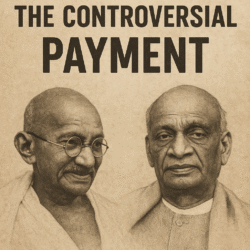
The ₹55 Crore Payment and Gandhi’s Fast
In his courtroom statement, Godse identified two events that crystallized his disillusionment:
- India’s payment of ₹55 crore to Pakistan
- Gandhi’s fast supporting the transfer
Godse interpreted these actions as betrayal of national interest. He argued that moral persuasion had overridden political responsibility.
From his viewpoint, Gandhi’s insistence on reconciliation—even amid widespread suffering—demonstrated an inability to confront harsh realities.
Historians see this reasoning as a tragic misdirection of grief into ideological absolutism.
The Nathuram Godse Trial and Courtroom Statement
Legal Context of the Trial
The Nathuram Godse trial was one of independent India’s first major criminal proceedings. Conducted under extraordinary public scrutiny, it symbolized the young republic’s commitment to rule of law.
Godse’s courtroom statement was not impulsive. It was prepared, structured, and delivered with deliberate intent. He sought to transform a murder trial into a political manifesto.
Political Justification Versus Legal Guilt
Legally, Godse admitted to shooting Gandhi. His defense was not factual denial but ideological justification. He argued that his act was motivated by political necessity, not personal hatred.
The court rejected this reasoning. Godse was convicted and later executed. Yet his speech continued to circulate, debated and contested across generations.
Historians’ Interpretation of Godse’s Argument
Ideology Versus Moral Politics
Modern scholarship views the conflict between Gandhi and Godse as a clash of worldviews:
- Gandhi: moral universalism, non-violence, pluralism
- Godse: assertive nationalism, cultural identity, political realism
Historians emphasize that Gandhi’s philosophy sought to break cycles of violence, while Godse’s ideology legitimized violence as corrective action.
Post-Partition Trauma and Radicalization
Many scholars interpret Godse’s reasoning as a product of post-Partition trauma. Anger, loss, and humiliation created fertile ground for radical ideologies.
Instead of dialogue, violence became a means of asserting identity and control.
Conclusion: A Tragic Collision of Ideals
The question of why Nathuram Godse assassinated Mahatma Gandhi cannot be answered through ideology alone. It must be understood within the broader historical context of Partition, political breakdown, and moral crisis.
Godse’s courtroom statement reveals how conviction can harden into absolutism, and how trauma can be transformed into justification for violence. Gandhi’s assassination silenced a man, but it also exposed unresolved tensions within Indian society.
Studying this trial is not about validating Godse’s claims. It is about understanding how fragile nations navigate identity, justice, and moral responsibility in times of upheaval.