Introduction
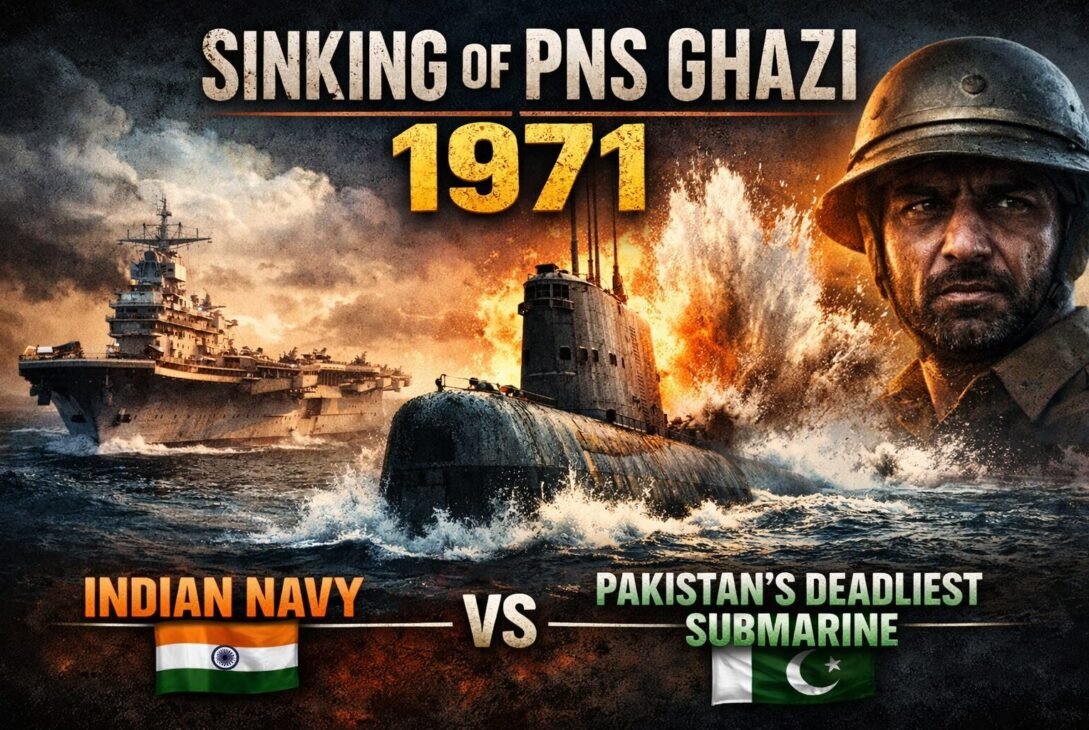
In early November 1971, unusual radio activity began to appear on Indian naval interception networks. Communications between Karachi and Dhaka were rising sharply, signaling that Pakistan was preparing for a major military operation. At the center of this intelligence breakthrough was Major Dharmadev Dutt, commanding officer of an Indian wireless interception unit.
After nearly 72 hours of continuous decoding, Indian intelligence uncovered a critical plan: Pakistan had dispatched its most formidable submarine, PNS Ghazi, to destroy India’s only aircraft carrier, INS Vikrant. The mission was simple in theory neutralize Vikrant and cripple Indian naval dominance in the Bay of Bengal.
What followed, however, was one of the most brilliant naval deception operations in modern military history. Instead of losing its prized carrier, the Indian Navy lured PNS Ghazi into a deadly trap, permanently altering the course of the Indo-Pakistan War of 1971.
The Strategic Background of the 1971 War
Following the partition of India in 1947, Pakistan emerged as a geographically divided nation, comprising West Pakistan and East Pakistan, separated by more than 1,600 kilometers of Indian territory. Despite having a larger population, East Pakistan remained politically, economically, and militarily marginalized.
By 1970, political tensions reached a breaking point. Sheikh Mujibur Rahman’s Awami League won a decisive electoral mandate, but West Pakistan’s military leadership refused to transfer power. This political suppression escalated into mass protests, which were violently crushed during Operation Searchlight in March 1971.
The resulting humanitarian catastrophe forced nearly 10 million refugees into India. Diplomatic efforts failed, and by late 1971, war between India and Pakistan became inevitable.
Why INS Vikrant Was Pakistan’s Primary Target
India’s aircraft carrier INS Vikrant posed a serious strategic threat to Pakistan. Operating as a floating airbase, Vikrant could launch fighter jets deep into enemy territory, disrupt supply routes, and enforce naval blockades.
In the event of war, Vikrant’s presence in the Bay of Bengal would:
- Cut East Pakistan off from West Pakistan
- Destroy Pakistani ports like Chittagong and Khulna.
- Prevent reinforcements and supplies from reaching Pakistani forces.
Pakistan’s naval leadership concluded that the war could not be won unless INS Vikrant was neutralized before hostilities formally began.
PNS Ghazi: Pakistan’s Most Powerful Submarine
PNS Ghazi was not an ordinary submarine. Originally commissioned into the US Navy as USS Diablo in 1945, it was leased to Pakistan in 1964 under a military assistance program. Renamed Ghazi, it became Pakistan’s first long-range attack submarine and the most advanced naval asset in South Asia at the time.
Ghazi had already attempted to hunt INS Vikrant during the 1965 Indo-Pakistan War, but the mission failed. In 1971, Pakistan entrusted Ghazi with an even more critical objective:
- Track and destroy INS Vikrant.
- Lay naval mines near Indian ports
- Disrupt India’s eastern naval operations.
The submarine set sail from Karachi in November 1971, confident of achieving a decisive victory.
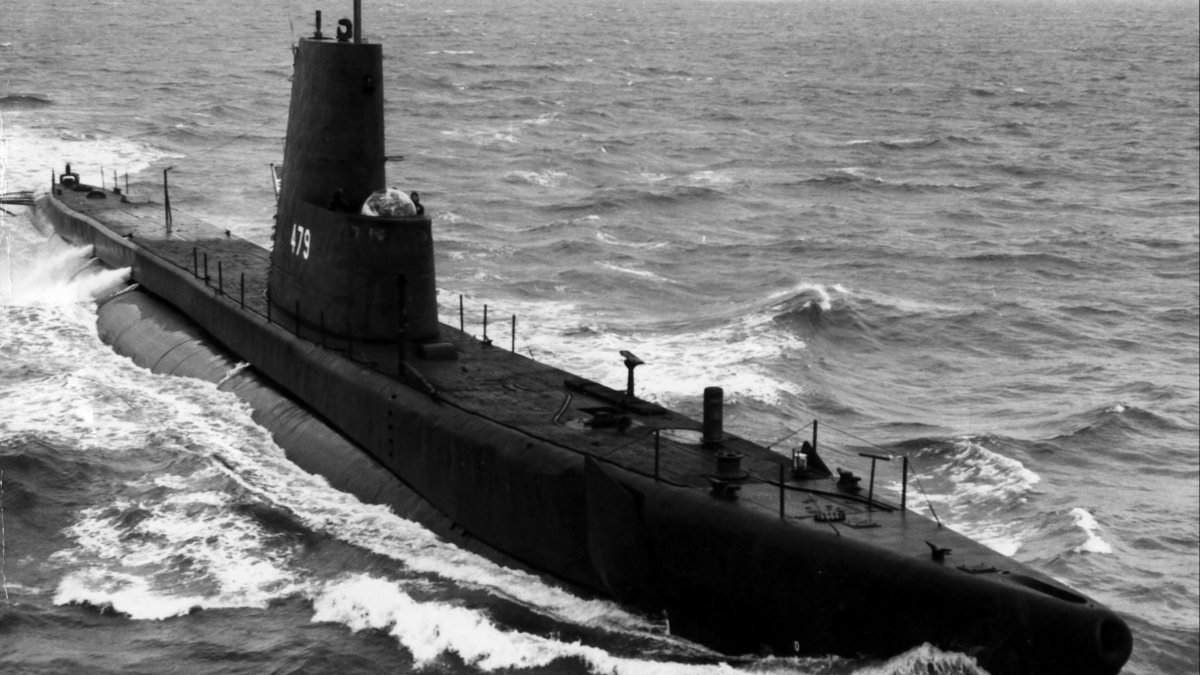
Source: Wikipedia
Indian Intelligence Breaks the Code
Unknown to Pakistan, India had already gained the upper hand in intelligence warfare. By September 1971, India had established multiple wireless interception stations across its eastern command.
When Indian naval analysts intercepted conversations referring to special-grade lubrication oil, alarm bells rang. Such oil was used only in submarines and mine-sweepers. Since Pakistan’s smaller submarines lacked long-range capability, Indian intelligence correctly concluded that PNS Ghazi was operating in the Bay of Bengal.
The final confirmation came on 10 November 1971, when Major Dharmadev Dutt successfully decoded the Pakistan Navy’s encrypted communications. The entire Ghazi mission was now exposed—but India ensured Pakistan never realized its codes had been compromised.
The Master Deception Plan of the Indian Navy
Vice Admiral N. Krishnan, Commander-in-Chief of India’s Eastern Naval Command, understood one critical fact:
As long as PNS Ghazi remained operational, INS Vikrant was under constant threat.
Instead of confronting Ghazi directly, Admiral Krishnan devised a brilliant deception strategy.
Key Elements of the Plan:
- INS Vikrant was secretly moved to the Andaman Islands
- A decoy ship resembling Vikrant was stationed near Visakhapatnam.
- Fake radio transmissions and supply requests were deliberately leaked.
- Indian intelligence ensured Pakistani agents “confirmed” Vikrant’s false location.
Pakistan fell for the deception completely.
INS Rajput: The Silent Hunter
The responsibility of executing the final trap fell on INS Rajput, India’s first guided-missile destroyer, commanded by Captain Inder Singh.
Rajput patrolled the waters off Visakhapatnam with sonar systems running silently. For days, the crew searched patiently for any underwater movement, knowing that one mistake could cost hundreds of lives.
By late November, Pakistani naval intelligence instructed PNS Ghazi to move toward Visakhapatnam—exactly where India wanted it.
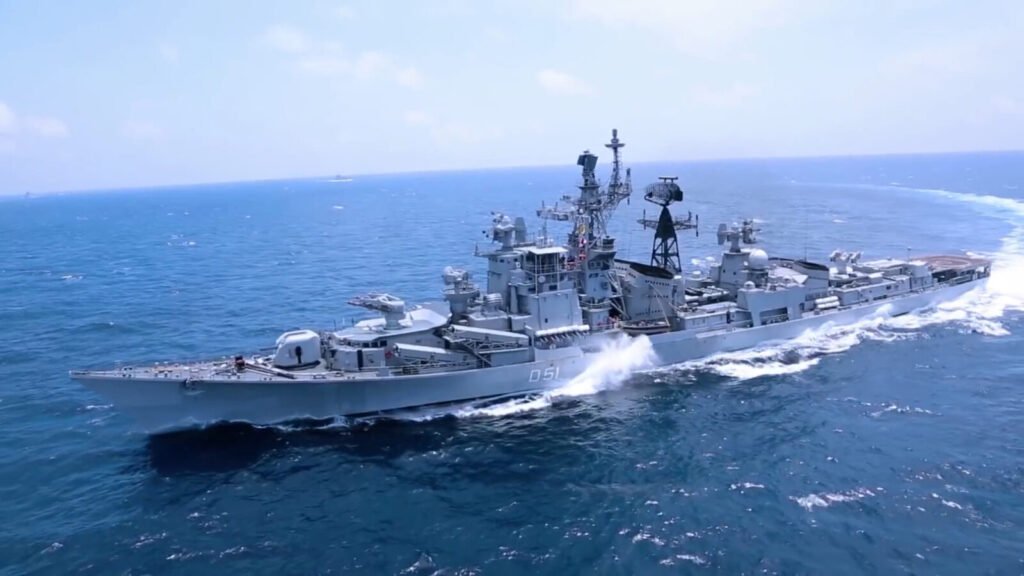
Source: Wikipedia
The Sinking of PNS Ghazi
On the night of 1 December 1971, PNS Ghazi entered the navigational channel near Visakhapatnam. The submarine’s commander, Captain Zafar Mohammad Khan, faced three operational options:
- Lay naval mines
- Attack Vikrant inside the harbor.
- Wait underwater and strike as Vikrant exited.
Due to shallow waters, Ghazi chose the third option.
However, prolonged submersion caused a dangerous buildup of hydrogen gas inside the submarine. Forced to rise closer to the surface, Ghazi was finally detected by INS Rajput’s sonar.
The Final Strike
INS Rajput immediately launched two depth charges.
Moments later, a massive underwater explosion shook the coastline. Windows shattered in nearby buildings, and a towering column of water rose into the air.
PNS Ghazi had been destroyed, killing all 93 crew members on board.
Strategic Impact of Ghazi’s Destruction
The sinking of PNS Ghazi had immediate and irreversible consequences:
- The Bay of Bengal was cleared of Pakistani naval threats.
- INS Vikrant could operate freely
- Indian naval aviation launched sustained attacks on East Pakistan.
On 4 December 1971, INS Vikrant’s aircraft bombed Chittagong, Cox’s Bazar, Mongla, and Khulna, cutting off Pakistan’s supply lines completely.
Within two weeks:
- Pakistani forces collapsed
- 93,000 soldiers surrendered
- Bangladesh emerged as an independent nation.
Pakistan’s Narrative vs Reality
Pakistan later claimed that PNS Ghazi sank due to an internal explosion or accidental detonation of its own mines. However, recovered debris, survivor evidence, and Indian naval records clearly confirm that Indian Navy depth charges caused the explosion.
The truth remains undisputed among military historians.
Where Is PNS Ghazi Today?
The wreck of PNS Ghazi still lies on the seabed near Visakhapatnam, hundreds of feet below the surface silent, forgotten, and defeated.
It serves as a permanent reminder that intelligence, deception, and strategy outweigh raw firepower.
Conclusion
The sinking of PNS Ghazi was not just a naval victory—it was a strategic masterstroke that reshaped South Asian history. Through superior intelligence, calculated deception, and disciplined execution, the Indian Navy eliminated Pakistan’s greatest maritime threat without risking its most valuable asset.
In military history, few operations demonstrate the power of strategic thinking as effectively as the destruction of PNS Ghazi in 1971.