May 1999. India was fighting a war on its own soil, unprepared for the crisis unfolding in the icy mountains of Kargil. Pakistani forces occupied strategic peaks thousands of feet high, raining artillery fire on Indian positions and ammunition dumps below. Hundreds of brave Indian soldiers fought against over 5,000 Pakistani infiltrators entrenched in fortified bunkers, yet India lacked the modern weapons and advanced technology needed to locate enemy positions hidden in the treacherous mountain terrain.
Operation Vijay became India’s military response—a massive ground campaign to evict Pakistani intruders from Kargil’s frozen heights. Yet midway through the operation, India faced mounting casualties. Fighter jets fell to Pakistan’s Stinger missiles. The situation turned critical. Then, defying American pressure and international sanctions, Israel stepped forward with game-changing weapons that transformed the war’s trajectory.
This is the complete, untold story of Operation Vijay 1999 how India fought against impossible odds, how Israel’s precision technology turned defeat into victory, and why this partnership forged between Kargil’s frozen battlefields became one of the world’s strongest strategic alliances.
Pakistan’s Revenge: The Road to Operation Badr
Pakistan never recovered from the crushing defeat in the 1971 Indo-Pak War, which led to East Pakistan becoming independent Bangladesh. That humiliation burned deep in Pakistani military minds. Then came another blow in 1984 when India secured the Siachen Glacier in a swift military operation, denying Pakistan access to this strategic high-altitude territory.
Pervez Musharraf, a Pakistani Army officer consumed by the desire for revenge, waited patiently for his opportunity. He vowed that when power came into his hands, his first strike would be against India. In 1998, fortune favored Musharraf—he was appointed Chief of Army Staff of the Pakistani military.
Almost immediately after taking command, Musharraf saw his path clearly. To fulfill his long-held ambitions, he launched Operation Badr against India. Under this covert operation, the Pakistani Army crossed the Line of Control (LoC), entered Indian territory, and began infiltrating the mountainous Kargil region.
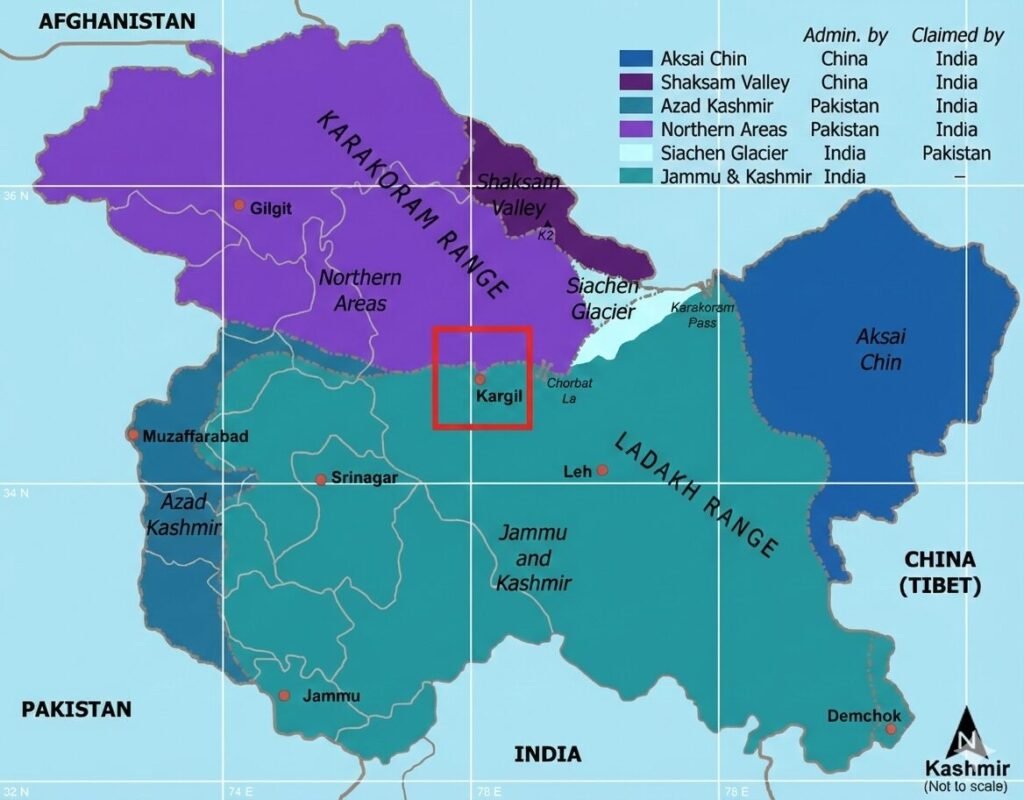
Pakistan’s strategic objective was control of National Highway 1A, which runs through the Kargil valley. This highway, now part of NH1, connects Srinagar to Ladakh and serves as the vital strategic route to Siachen. Pakistan’s plan was to capture NH1A, partially cut off Ladakh from India, and completely sever the Siachen supply line. Ultimately, Pakistan aimed to grab Kashmir from India.
The Shepherd Who Saved India: Discovery of Infiltration
Pakistan’s elaborate plan nearly succeeded—until one local shepherd’s vigilance changed everything. Tashi Namgyal, a resident of Batalik town in Kargil, was searching for his lost yak in early May 1999. Suddenly, he noticed something suspicious: men dressed in Pathan clothing were building bunkers on Indian territory, equipped with rifles, grenades, and heavy weapons.
Tashi’s suspicion was immediately aroused. He rushed to the nearest Indian Army post and reported everything he had witnessed. This was how, on May 3, 1999, the Indian Army first became aware of infiltration in Kargil.
Initially, suspicion fell on Pakistan, but concrete proof was lacking. However, two days later, on May 5, when infiltrators brutally murdered five Indian soldiers, and then on May 9 destroyed several Indian ammunition dumps, all doubt vanished. Pakistan was clearly behind this massive infiltration.
Pakistani forces had captured several key strategic points in the Kargil region, including Tololing and Tiger Hill. They had penetrated several kilometers deep into Indian territory. Throughout this period, Pakistani Prime Minister Nawaz Sharif continued denying the LoC crossing and infiltration incidents. But India now knew the truth—Pakistani forces were occupying Tololing, Tiger Hill, Mushko Valley, Kaksar village, Batalik Range, and Chorbat Valley, continuously expanding their infiltration.
Operation Vijay Launched: India’s Ground Assault Begins
To drive out Pakistani infiltrators, the Indian Army launched Operation Vijay on May 10, 1999. Thousands of soldiers were mobilized from different parts of Kashmir toward Kargil. These soldiers faced an extraordinary challenge: climbing mountains ranging in altitude from 10,000 to 16,000 feet to confront the enemy.
The problem was severe. Pakistani infiltrators’ bunkers were positioned at such high altitudes that they could easily locate Indian soldiers and open fire. Climbing during daytime meant risking lives unnecessarily. Therefore, nighttime was chosen for the mountain ascent to avoid enemy surveillance.
However, climbing mountains at night presented even greater difficulties. At night, these peaks experienced bone-chilling cold, and oxygen levels were extremely low. Breathing at such high altitudes became incredibly difficult. Despite these tough challenges, Indian soldiers advanced their mission through Kargil’s treacherous mountains in the dark, freezing nights, facing multiple obstacles.
The soldiers’ passion and determination yielded results. Just days after Operation Vijay began, the Indian Army recaptured the Dras-Mushkoh sector on May 16, peaks 4295 and 4460 on May 18, and the Mushko sub-sector on May 24. But these were merely fragments of success. The Army still faced enormous difficulties achieving complete victory.
Pakistani infiltrators held the high ground, allowing them to directly target Indian soldiers, causing continuous casualties. In this situation, to fight infiltrators hidden thousands of feet high in Kargil’s mountains and win this war, the Army needed Air Force support.
Operation Safed Sagar: The Indian Air Force Enters the Battle
Although the Air Force had been used for logistics and reconnaissance up to this stage of the war, full Air Force involvement now became critically necessary. Consequently, on May 26, 1999, the Air Force joined the conflict by launching Operation Safed Sagar.
Through Operation Safed Sagar, the Air Force not only provided cover for the Army but also air-dropped essential supplies that soldiers couldn’t carry to the peaks themselves. The Air Force began targeting several Pakistani bunkers with fighter jets to drive away Pakistani infiltrators.
However, conducting air operations in Kargil’s high mountains proved extremely difficult for the Air Force. Adding to these challenges were Prime Minister Atal Bihari Vajpayee’s strict orders that under no circumstances should the Air Force cross the LoC. Tracking the location of Pakistani infiltrators positioned on high peaks while staying within the LoC, then attacking them, would be quite challenging for the Air Force.
Despite all these challenges, the Air Force deployed four MI-17 helicopters and three fighter aircraft—MiG-21, MiG-23, and MiG-27—to attack the enemy. While MI-17 helicopters fired rockets, the squadron of three fighter jets also rained havoc on the enemy. Many Pakistani positions were destroyed, and several Pakistani soldiers were killed.
Everything was proceeding according to plan when suddenly, the MiG-27 fighter jet that had fired 80mm rockets developed engine trouble. The aircraft’s speed rapidly decreased. Sensing the danger of a crash, Flight Lieutenant Nachiketa, aboard the MiG-27, first informed Squadron Leader Ajay Ahuja in the MiG-21, then ejected from the aircraft.
The Sacrifice of Squadron Leader Ajay Ahuja
Upon receiving information about Nachiketa, Squadron Leader Ajay Ahuja turned his aircraft in the direction where Nachiketa’s aircraft was flying. By doing so, Nachiketa’s location could be determined, and he could be rescued. However, due to the mountainous terrain, determining Nachiketa’s exact location wasn’t easy. Still, Ajay Ahuja didn’t give up and reached quite close to the LoC while searching for Nachiketa.
Upon reaching there, Ahuja realized a missile had struck the rear portion of his aircraft. This was actually a Stinger missile fired from Pakistan’s side to target Ajay Ahuja’s MiG-21. After the missile struck, Ajay Ahuja managed to safely exit his jet and successfully landed within Indian borders near the LoC. However, his jet fell on the other side of the LoC.
The Pakistani Army crossed into Indian territory, first captured Squadron Leader Ajay Ahuja, and then brutally murdered him. Meanwhile, Flight Lieutenant Nachiketa landed in Pakistani territory while ejecting from the aircraft, where the Pakistan Army immediately captured him.
The murder of Squadron Leader Ajay Ahuja by Pakistan and the capture of Flight Lieutenant Nachiketa were a major blow to the Air Force. However, due to international pressure, Pakistan returned Nachiketa to India on June 3. But within the first three days of Operation Safed Sagar, the Indian Air Force faced one failure after another. Within three days, the Pakistan Army shot down several of India’s fighter jets and helicopters using Stinger missiles.
Israel’s Critical Support: The Turning Point
While the Indian Army struggled with Kargil’s altitude challenges, the Air Force now also faced significant problems. The Air Force needed to attack while avoiding being targeted by Pakistani infiltrators positioned at high altitudes, plus faced the challenge of not crossing the LoC. Crossing would mean becoming a target of Pakistan’s missiles.
Therefore, Air Chief Marshal Anil Yashwant Tipnis needed advanced military tools that could determine the exact location of enemies hiding in Kargil’s mountains and eliminate them. However, the Indian Air Force didn’t have such advanced equipment available at that time. They needed to be imported from another country.
But India faced another difficulty: due to the nuclear tests conducted at Pokhran in 1998, America had imposed sanctions on India. This made obtaining military weapons and tools from any other country extremely difficult. After the nuclear tests, America and Europe made every effort to prevent India from receiving any modern weapons.
In this hour of crisis, the Indian Air Force desperately needed advanced weapons. This war was passing through a quite critical situation for India. Therefore, without delay, India approached Israel. From India’s side, a long list of advanced tools and weapons was presented to Israel with an appeal for the quickest possible delivery.
While America had even refused to give India GPS access (which could have helped track Pakistani infiltrator locations in Kargil’s mountains), Israel, understanding India’s emergency, immediately provided every possible assistance. Israel not only provided laser-guided missiles for Indian Air Force fighter jets but also surveillance drones through which Pakistani positions could be easily monitored.
Additionally, Israel shared several intelligence details about Pakistan with India, which would give India a significant advantage in this war. However, during this period, America and other Western countries put considerable pressure on Israel to help India. America pressured Israel heavily not to support India with military equipment. But despite this pressure, Israel remained committed to helping India.
After this, America also attempted to delay delivery. But Israel, even setting aside American friendship, made all necessary items available to India as quickly as possible.
The Game-Changing Litening Targeting Pods
Israel provided India with Litening electro-optical targeting pods, which India had already made a deal to purchase from Israel in 1997. However, according to the deal, delivery of these targeting pods was still a considerable time away. But understanding the Kargil War situation, Israel delivered them to India even before the scheduled delivery date.
The specialty of Litening targeting pods was that, due to their advanced precision targeting system, any target could be identified from a great distance with the help of infrared radiation. These were going to prove quite helpful for the Air Force.
But the problem now was that the Indian Air Force didn’t have enough expertise at that time to use these modern weapons the targeting pods and other advanced tools. To resolve India’s confusion, Israel took another helping step and sent its technical engineers to India. This enabled Air Force pilots and technical teams to learn quite a bit about using all these weapons, which would now be used in the Kargil War against Pakistani infiltrators.
With the help of Israeli engineers, targeting pods were installed in Mirage fighter jets, through which Pakistanis hiding in the mountains could now be easily targeted.
The Innovative Jugaad: Dumb Bombs Made Smart
Now the Air Force had to decide on which identified targets to attack. Actually, at that time India only had 60 laser-guided bombs available, which could be used in fighter jets with targeting pods. Due to being laser-guided, these bombs were more effective. But due to the shortage of these bombs, the Air Force wanted to use them as minimally as possible so that if the war dragged on longer, it wouldn’t affect India’s preparedness.
However, to increase the number of these bombs, India had already made a deal to purchase Paveway laser-guided bombs from the US a few years earlier. But due to sanctions imposed on India, the US flatly refused to supply anything.
In this critical situation, the Indian Air Force acted quite wisely and installed 1,000-pound dumb bombs in Mirage fighter jets along with targeting pods. Actually, this was essentially an experiment to compensate for the lack of laser-guided bombs, which had never been tested before. Therefore, this jugaad could either prove cost-effective and effective, or this experiment could completely fail. But keeping the situation in mind, the Air Force took a big risk and planned to attack the enemy by attaching dumb bombs to fighter jets.
Mirage fighter jets were now in the sky and fully prepared to surround and destroy the enemy. With the help of Israeli targeting pods, pilots were learning the exact location of Pakistanis. Additionally, clear images of those places were being received in the pilot’s cockpit. Thus, after the target became clear, fighter jets could easily attack the Pakistanis.
The Air Force’s formula had succeeded. One by one, several Pakistani bunkers were being destroyed. Where dumb bombs weren’t proving effective, laser-guided bombs were used.
Tiger Hill: The Decisive Victory
The Air Force’s air operation achieved major success when, on June 24, a Mirage 2000 fighter jet attacked the Pakistani bunker built on the 16,000-foot-high Tiger Hill Kargil with a laser-guided bomb. This was the first time the Air Force had used a laser-guided bomb. It was fired by Air Marshal Raghunath Nambiar seated in the Mirage 2000. His attack completely destroyed the Pakistani bunker on Tiger Hill within just a few seconds. Several Pakistanis were immediately killed, while some were badly wounded.
The remaining work was completed by the Indian Army. On July 4, the 18 Grenadiers of the 192 Mountain Brigade climbed Tiger Hill’s high mountains and began firing at enemies. The Pakistani soldiers, who were already badly wounded from the air attack, couldn’t hold out long against Indian soldiers. Due to this, one by one, all Pakistanis on Tiger Hill were killed.
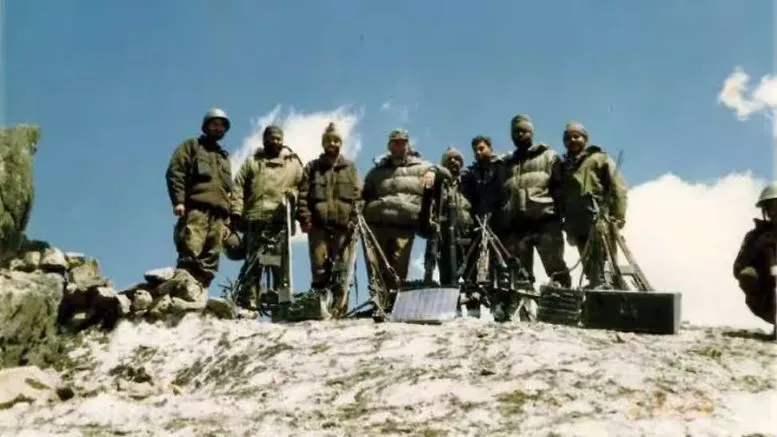
The 18 Grenadiers unit, demonstrating bravery, recaptured Tiger Hill. During this, the most valorous work was done by 19-year-old Yogendra Singh Yadav, who, even after taking 15 bullets and being drenched in blood, crushed the enemy. For this bravery, he was honored with the Param Vir Chakra.
Recapturing Tiger Hill was a major victory for India. Meanwhile, several steps were being taken from India’s side against Pakistan at the international level regarding the war.
International Pressure Forces Pakistan’s Retreat
Actually, during the war, when Pakistani infiltrators began weakening before India’s brave soldiers and Pakistan’s defeat became clearly visible, Pakistani Prime Minister Nawaz Sharif began seeking help from the US to stop the war. The surprising thing was that the Pakistan government, which wasn’t even taking responsibility for this infiltration, was now knocking on America’s door to stop the war.
However, when US President Bill Clinton and Atal Bihari Vajpayee discussed this matter, Vajpayee’s clear statement was that either the Pakistani Army should leave Indian borders on its own, or our military would forcefully drive them out. During this time, when Vajpayee learned that Pakistan might also use nuclear bombs in the Kargil War, Atal Bihari Vajpayee said in clear words that if that happened, before the next morning’s sun rises, Pakistan would disappear from the world map.
From Vajpayee’s stance, US President Bill Clinton understood clearly that India wouldn’t end the war until it had recaptured Kargil. Therefore, to end the war as quickly as possible, America pressured Nawaz Sharif to call back the Pakistani Army from Kargil. Seeing America’s attitude, Nawaz Sharif’s face fell.
For Pakistan, this was a double defeat in the Kargil War. On one hand, they were being defeated by India at the ground level, while on the other hand, America and other countries were scolding Pakistan for starting an unnecessary war.
Operation Vijay’s Triumphant Conclusion
While Pakistan’s Prime Minister was under international pressure, the Indian Army and Air Force were raining death on Pakistani soldiers. With the help of Israeli targeting pods, all Pakistani positions were being targeted one by one. The Indian Air Force had already destroyed Pakistan’s command and control center built at Tiger Hill with its attacks. Additionally, the Air Force had also demolished the Pakistani Army’s supply dump at Muntho Dhalo.
These attacks had broken the Pakistani Army’s back. They had neither bunkers left to hide in nor any supply line to fight and stay alive. The morale of Pakistanis, who had harbored the intention to capture Kargil and grab Kashmir from India, had been shattered. Therefore, due to defeat and pressure, the Pakistani Army had to retreat from Kargil.
So that Pakistani troops could cross the LoC and return to Pakistan, from India’s side, the Air Force’s Operation Safed Sagar was stopped on July 12, 1999. However, when some Pakistani soldiers showed cunning by continuing infiltration and attacking Indian soldiers, they were again made to understand in their own language. Due to this, by July 26, every single Pakistani was forced to leave Kargil.
This is why on July 26, 1999, the Kargil War officially ended with India’s victory. Therefore, this day is celebrated every year as Kargil Vijay Diwas (Kargil Victory Day).
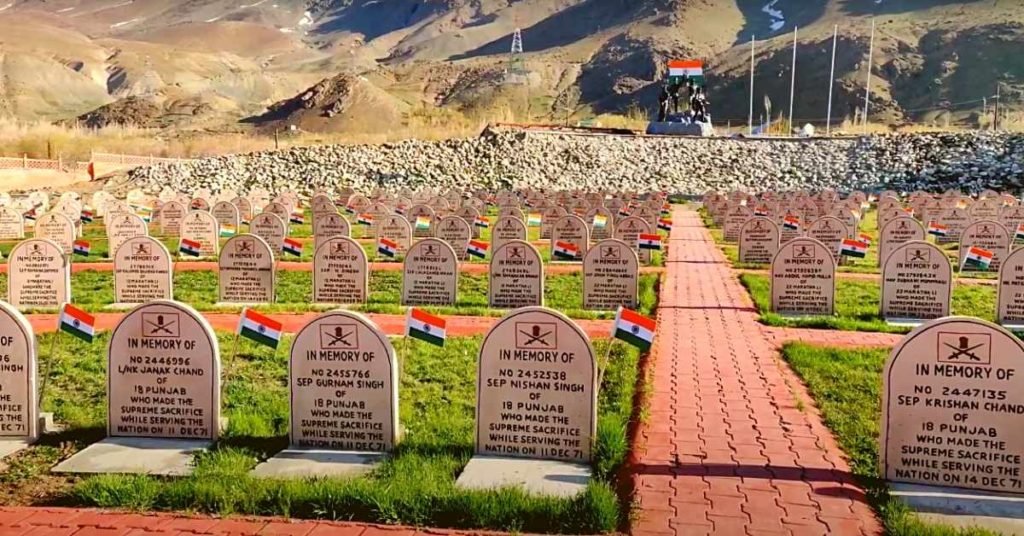
The Human Cost: Casualties and Sacrifice
How many soldiers died in the Kargil War? In making this war victorious, Indian soldiers killed approximately 4,000 Pakistanis, while about 527 brave Indian soldiers were martyred. On one hand, where Indian forces’ courage and sacrifice are included in the Kargil War victory, Israel’s contribution also cannot be forgotten.
Israel played an important role in the Kargil War by providing India with the right weapons and military tools at the right time. This was why, after the Kargil War ended in the year 2000, External Affairs Minister Jaswant Singh and Home Minister Lal Krishna Advani toured Israel and expressed gratitude to Israel.
The Strategic Partnership Born from Kargil
India was well aware of Pakistan’s intentions. Therefore, for situations like the Kargil War, India now wanted to keep its preparedness strengthened in advance. For this reason, between 2000 and 2010, India imported approximately $10 billion worth of military equipment from Israel.
Looking at it, after the Kargil War, a very important turning point came in India-Israel relations, after which not only did weapons transactions increase, but the foundation of India and Israel’s friendship also became stronger.
However, this wasn’t the first time Israel had helped India. Rather, even before this, Israel had stood shoulder to shoulder with India several times. In 1947, Prime Minister Jawaharlal Nehru voted against Israel for Palestine’s division and refused to give Israel recognition as an independent nation. Jawaharlal Nehru cited geopolitical compulsion and national interest for this.
However, three years after Israel came into existence, after Iran and Turkey, India also recognized Israel in 1950. India had given Israel recognition, but without maintaining any diplomatic relations with it, India’s foreign policy remained tilted in Palestine’s favor.
Despite all this, Israel supplied weapons to India in the 1962 Indo-China War. Additionally, Israel continuously extended the hand of friendship toward India. First in 1962, then in 1971, when a terrible war broke out between India and Pakistan over Bangladesh, during that time, Israeli Prime Minister Golda Meir provided weapons to India despite weapon shortages.
But even after Israel’s repeated support, diplomatic relations weren’t developed with Israel from India’s side. In 1992, for the first time in Prime Minister PV Narasimha Rao’s government, diplomatic relations with Israel were formally established. After this, Israel and India’s bond became stronger with each passing year.
After the Kargil War, Israel and India emerged as friends before the world. However, a thought-provoking matter is that despite India not maintaining any diplomatic relations for about 40 years, why did Israel continue a one-sided relationship? Also, whether it was the 1971 war or the Kargil War against Pakistan, why did Israel come forward first to help India?
Why Israel Always Stood With India
If we consider the reasons behind all this, the main reason is Pakistan’s opposition to Israel from the very beginning. Pakistan has always spoken against Israel, and in fact, in the 1948 Arab-Israeli War, Pakistan gave aggressive support to Palestine against Israel.
Additionally, during the 1967 Six-Day War and the 1973 Yom Kippur War, the Pakistan Air Force sent a group of its fighter pilots to fight against Israel, which helped Palestine considerably. Pakistan has given Israel this message of enmity several times in this way.
Additionally, Pakistan has never given Israel recognition as a country nor ever developed any diplomatic relations with Israel. The bad relationship between Israel and Pakistan, along with the continuous war and tension situation between Pakistan and India since partition, has kept bringing Israel closer to India.
And as it’s said, the enemy’s enemy is a friend. In the same way, against Pakistan, Israel has come with India every time.