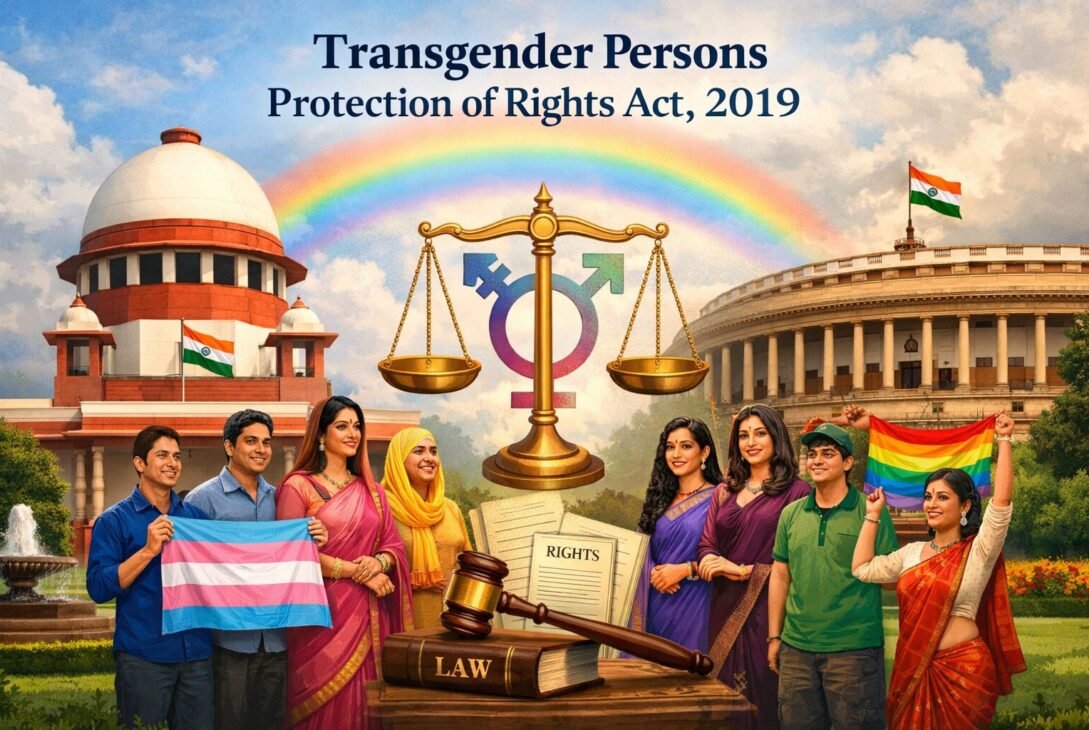
India’s Transgender Persons (Protection of Rights) Act, 2019, is the main central law on transgender rights. It prohibits discrimination in education, employment, healthcare, public services, housing, and related areas. It also creates a legal recognition process through a certificate issued by the District Magistrate. The law remains controversial because it recognizes self-perceived gender identity in principle, while tying legal recognition to state-issued certification. For recognition as male or female, it also links the process to medical documentation after surgery.
That gap defines most of the debate around the Act. It shapes how the law is read, how the NALSA judgment is invoked, and why the Transgender Persons Rules, 2020, matter so much. It also explains why later court cases and amendment proposals did not settle the issue.
The legal background before the 2019 Act
The policy conversation around transgender rights in India did not begin with Parliament in 2019. Some states had already taken institutional steps. Tamil Nadu, for example, established a Third Gender Welfare Board in 2008, often cited as an early state-level initiative addressing livelihood, education, social security, and grievances.
At the national level, one of the most cited official baselines came from the 2011 Census, which recorded 487,803 persons in the “other” gender category. That figure has often appeared in government material, though many observers have treated it as an undercount. Even so, it shaped the official policy frame in which later legislation emerged.
The constitutional turning point came with the Supreme Court’s judgment in National Legal Services Authority v. Union of India, better known as NALSA, on 15 April 2014. The Court recognized transgender persons, including hijras and eunuchs, as a third gender for constitutional protection. It also affirmed that transgender persons have the right to decide their self-identified gender as male, female, or third gender. Beyond recognition, the Court directed governments to treat transgender persons as socially and educationally backward classes. It extended reservations in education and public appointments.
Any later statute on transgender rights would be judged against that constitutional foundation. NALSA did not frame gender identity as something to be cleared by a medical board or a bureaucratic screen. It tied self-identification to dignity, autonomy, expression, and personal liberty. It also rejected the idea that surgery should be a precondition for legal recognition.
From the 2014 Bill to the 2019 Act
After NALSA, the legislative path was uneven.
A notable step came with the Rights of Transgender Persons Bill, 2014, a private member’s bill that passed the Rajya Sabha in 2015. That was unusual in itself, since private members’ bills rarely pass, but it did not become law.
The government then introduced the Transgender Persons (Protection of Rights) Bill, 2016. This version drew criticism because it moved away from NALSA in important ways. It proposed a District Screening Committee for identity certification and used a partly biological definition of transgender identity. The issue was no longer only whether Parliament would legislate, but what kind of recognition model the law would adopt.
The Transgender Persons (Protection of Rights) Bill, 2019, came as a revised framework. It was approved by the Union Cabinet in July 2019 and later passed by both Houses of Parliament that year. What came into force was the Act, effective from 10 January 2020.
That distinction matters. Many readers search for the “Bill, 2019,” but rights in practice are governed by the Act, together with the Transgender Persons Rules, 2020.
What the Transgender Persons (Protection of Rights) Act, 2019 says
The Act begins with a statutory definition. It treats a transgender person as someone whose gender does not match the gender assigned at birth. It also explicitly includes trans-man, trans-woman, persons with intersex variations, genderqueer persons, and socio-cultural identities such as kinner, hijra, aravani, and jogta.
That definition is broader than many older statutory approaches because it tries to cover both identity-based categories and socio-cultural communities. The Act is framed as a nationwide legal framework, not just an administrative procedure.
Its core provision is the ban on discrimination. The Act prohibits discrimination in education, employment, healthcare, access to public facilities, movement, residence, the ability to rent or occupy property, and the opportunity to hold public or private office. It also places duties on the government to take welfare measures, support inclusion, and promote full and effective participation.
The law adds sector-specific provisions. It requires inclusive education in government-funded or government-recognized institutions. It refers to livelihood measures, including vocational training and self-employment support. In healthcare, it mentions HIV sero-surveillance centres, medical care including sex reassignment surgery and hormonal therapy, counselling, review of medical curriculum, and insurance coverage for relevant medical expenses.
The Act also creates the National Council for Transgender Persons (NCTP). This body includes central ministries, state or Union Territory representation, and members from the community and civil society. The Act further requires establishments to appoint a complaint officer to deal with grievances arising from violations of the law.
Taken together, the statute does more than declare rights. It combines anti-discrimination guarantees, welfare obligations, sector-specific duties, and an institutional framework.
The central issue: recognition, identity, and the District Magistrate
The most debated part of the Act is the recognition framework.
The Act says that a transgender person has a right to be recognized as such and that a recognized person has a right to self-perceived gender identity. That language appears to move toward the constitutional position set out in NALSA.
But the statute also creates an administrative process. A transgender person must apply to the District Magistrate for a certificate of identity. The District Magistrate then issues a certificate showing the person’s gender as transgender.
The second step is more contested. If a person seeks a revised certificate reflecting a change of gender to male or female, the Act requires proof that the person has undergone surgery, along with a medical certificate from the appropriate hospital authority.
This is the core legal dispute around the Act. The law speaks of self-perceived identity, yet it also creates a state-controlled system of certification. For recognition as male or female, it further ties the process to surgery and medical documentation.
That is why critics say the statute sits uneasily with NALSA, which did not place surgery at the centre of legal recognition. The law is often described as a hybrid model: rights language alongside bureaucratic gatekeeping.
How the Transgender Persons Rules, 2020 changed the picture
The Transgender Persons Rules, 2020, are essential to understanding how the law works in practice.
The Rules operationalised the certificate system in more detail than the Act itself. One of the most important features appears in Rule 4, which says the District Magistrate should process the initial application on the basis of an affidavit declaring gender identity, without any medical or physical examination.
Critics of the 2016 Bill had objected strongly to overt medicalisation and screening. On paper, the 2020 Rules soften that part of the process by removing medical examination from the initial stage.
The Rules also provide timelines and connect the certificate to changes in official documents, including name, gender, and photograph. They provide for an identity card. At the same time, the revised certificate route for recognition as male or female still involves documentation of medical intervention.
The Rules soften the first stage of the process, but they do not remove the central tension in the law. They reduce one form of direct medical gatekeeping at the initial stage, but they do not remove the central role of the state certificate. Nor do they remove the surgery-linked pathway for recognition as male or female.
Why the 2019 Act was seen as different from the 2016 Bill
The move from the 2016 Bill to the 2019 Act is best understood as a shift in design, not a complete break.
The 2016 Bill had proposed a screening committee model involving medical and administrative actors. The 2019 Act did not retain that exact structure. In that sense, it moved closer to NALSA’s language by dropping the most visible form of screening.
But it did not adopt a pure self-identification system. It kept the District Magistrate at the centre of recognition. That is why the 2019 law is often described as having reduced explicit medicalisation while preserving bureaucratic control.
The main continuity points remained. Concerns around the definition, the offence structure, and the lack of explicit reservation provisions did not disappear. The 2019 framework looked less overtly clinical than the 2016 proposal, but the underlying dispute over who controls recognition remained.
The main criticisms of the Act
The criticisms fall into three broad categories: textual, constitutional, and practical.
The first major criticism concerns self-identification versus district validation. The law says a person has a right to self-perceived gender identity, yet it makes state-issued certification central to recognition in documents and institutions. Critics argue that this does not fully match the constitutional logic of NALSA.
The second major criticism concerns Section 7 and the surgery-linked route for recognition as male or female. For many observers, this is the clearest point at which the Act appears to depart from the anti-compulsion logic associated with NALSA.
A third criticism concerns Section 18, which prescribes punishment of not less than six months and up to two years for various forms of abuse, exclusion, or violence under the Act. That penalty framework has drawn sustained criticism, especially where sexual abuse is concerned, because it is seen as much weaker than the penalties available for comparable offences against cisgender women under other criminal provisions.
A fourth criticism concerns the absence of explicit reservations. This issue matters because NALSA had directed governments to extend reservations by treating transgender persons as socially and educationally backward classes. The Act does not codify that position in statutory form.
Another point of concern is Section 12(3), under which a competent court may direct placement in a rehabilitation centre if the parent or immediate family is unable to care for a transgender person. Critics have argued that this can raise concerns about adult autonomy and alternative family structures.
Some of these objections challenge the law’s compatibility with constitutional principles. Others point to the gap between recognition on paper and institutional design.
How the government defended the law
The state’s justification for the 2019 law was not framed as a rejection of rights. Officially, the law was presented as a mechanism for empowerment, inclusion, and access to schemes and benefits. That helps explain the emphasis on certificates, welfare duties, and administrative structure.
From that point of view, official documentation was treated as a route to recognition in public systems, not only as a restriction. The government’s case, in broad terms, was that a nationwide statutory mechanism would reduce stigma and bring transgender persons into formal welfare delivery.
That also explains why the law has drawn such different readings. It combines anti-discrimination commitments and welfare language with a recognition design that many critics see as limiting.
Implementation after 2019: where law met bureaucracy
Implementation raised a different set of problems.
A major implementation step was the creation of the National Portal for Transgender Persons, launched as a system for online applications for certificates and identity cards without a physical interface. In official terms, the portal was meant to reduce friction in the certificate process.
Government material later reported that more than 11,000 certificates and identity cards had been issued across 32 States and Union Territories. That shows the certificate system was not merely symbolic.
At the same time, the portal also revealed something more basic: access to rights and official recognition remained closely tied to possession of a valid certificate or identity card. Digitisation did not remove the centrality of the certificate; it changed the mode of access.
In practice, the certificate system became a bottleneck. The law promises recognition and protection, but implementation often runs through documentation. That affects passports, education records, welfare access, employment, and routine interaction with public institutions.
How courts later exposed the implementation gap
Later litigation showed that the statutory framework had not resolved everything.
An important development came with Jane Kaushik v Union of India in 2025. The Supreme Court’s treatment of implementation failures drew attention to the absence of effective grievance redress systems, welfare boards, and protection mechanisms in practice. The case mattered because it shifted attention from the text of the 2019 law to the question of whether rights were actually being realised.
The 2019 Act cannot be judged only by its text. It also has to be examined through the institutional weaknesses that later reached the courts.
There were also more specific administrative-law disputes. The Allahabad High Court has been reported as holding that passport authorities cannot insist on a fresh medical examination when a person already holds a valid certificate under the 2019 framework. The same court has also been reported as directing educational authorities to issue updated records reflecting gender identity after transition-related procedures.
Both cases point to the same pattern: even where a legal framework exists, people may still need court intervention to secure recognition in ordinary documentation systems.
Why the reservation issue still matters
Among the major gaps in the 2019 framework, the reservation issue remains central.
NALSA had directed governments to treat transgender persons as socially and educationally backward classes and extend reservations. The Act, however, does not expressly translate that direction into a statutory entitlement. This gap has continued to shape legal challenges and policy arguments.
It also makes the law look incomplete when read against its constitutional background. A reader who begins with NALSA and then moves to the 2019 Act can see that anti-discrimination and welfare language made it into the statute, but reservation did not receive the same legislative treatment.
That omission shapes how the law is judged against NALSA. It suggests a framework more comfortable with protection and documentation than with redistributive justice.
The 2026 amendment debate and why the story is still live
The law’s trajectory did not stop in 2019 or 2020.
Later policy developments kept the issue open. One track involved proposals to insert reservation-related provisions into the law. Another, much more dramatic development came with the Transgender Persons (Protection of Rights) Amendment Bill, 2026.
According to tracking summaries, the 2026 Bill proposed a substantial shift. It removed the earlier definition and replaced it with a narrower list of included categories. It also excluded certain self-perceived identities and proposed a more formal medical board role in the certificate process.
That changes the terms of the debate. Earlier criticism focused heavily on the tension between self-identification and District Magistrate certification. The amendment debate shifted attention toward definition narrowing and renewed medical-board gatekeeping.
This later development matters because it shows that the struggle over recognition did not end with the 2019 Act.
Why the Transgender Persons (Protection of Rights) Act, 2019, remains contested
The Transgender Persons (Protection of Rights) Act, 2019, is more than a symbolic declaration. It prohibits discrimination, imposes welfare obligations, sets out education and healthcare duties, and creates a national institutional structure. In that sense, it marked a major step in giving transgender rights a central statutory framework.
At the same time, the law remains contested because its recognition model never fully escaped bureaucratic control. It adopted the language of self-perceived identity, but attached that identity to certification. It softened some forms of gatekeeping through the Transgender Persons Rules, 2020, yet preserved a surgery-linked route for recognition as male or female. It created rights on paper, but later cases exposed how uneven implementation could be. And when placed next to NALSA, its silence on reservations still stands out.
Taken together, the Transgender Persons (Protection of Rights) Act, 2019, is best understood as a law of real consequence built around unresolved tensions. Any serious discussion of transgender rights in India has to reckon with both.
6. FAQ
What is the Transgender Persons (Protection of Rights) Act, 2019?
It is India’s main central law on transgender rights. It prohibits discrimination in areas such as education, employment, healthcare, residence, and access to public services, and it creates a legal recognition process through a certificate issued by the District Magistrate.
What is controversial about the Act?
The biggest controversy is the gap between the Act’s recognition of self-perceived gender identity and its certificate-based recognition model. The law also links revised recognition as male or female to surgery and medical documentation, which has been heavily criticised.
Does the law provide a reservation for transgender persons?
The Act itself does not expressly provide a reservation. This remains a major point of debate because the Supreme Court in NALSA had directed governments to extend reservations by treating transgender persons as socially and educationally backward classes.
What do the Transgender Persons Rules, 2020 do?
The Rules operationalise the certificate process. They state that the initial application should be processed on the basis of an affidavit, without medical or physical examination, and they provide for timelines, identity cards, and changes in official documents.
Why is the District Magistrate important under the Act?
The District Magistrate is the key authority for issuing the certificate of identity under the law. Because so many rights and document changes depend on that certificate, the office of the District Magistrate sits at the centre of the law’s recognition framework.