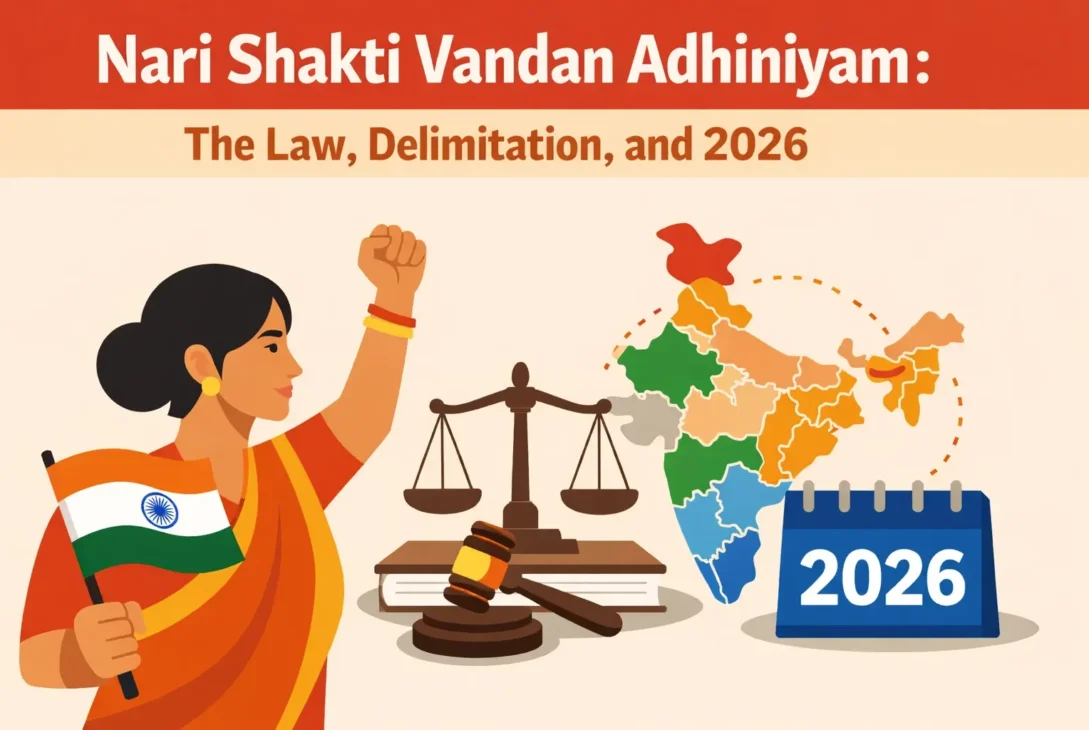
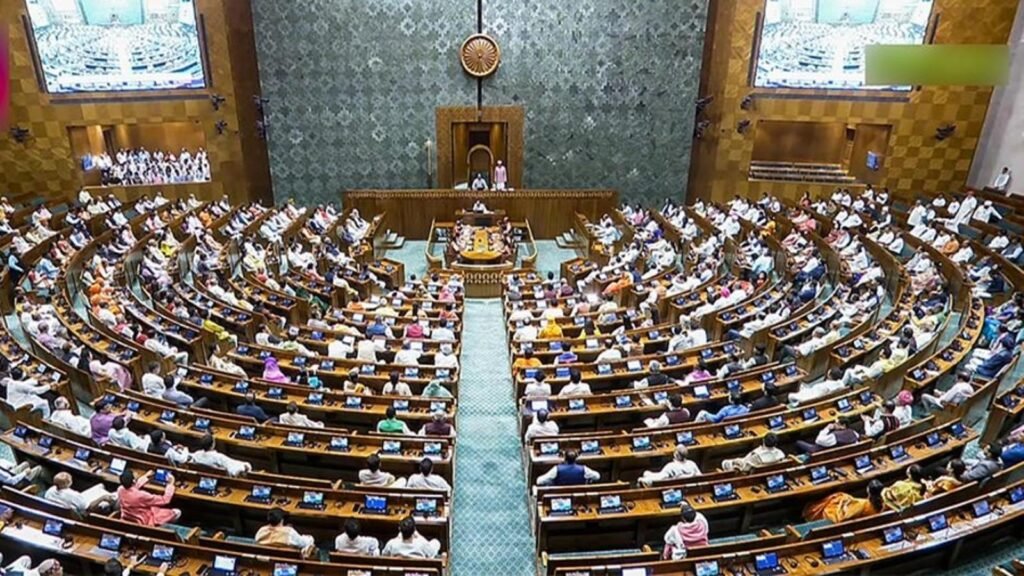
India enacted a law in September 2023 that, at least on paper, guarantees one-third of seats in Parliament and State Assemblies for women. The bill moved through both Houses in three days, received presidential assent, and was hailed as a historic shift. And then — nothing changed.
That gap between the law existing and the law working is what this article explains.
If you have searched for “Nari Shakti Vandan Adhiniyam,” you have probably run into three different names for what seems to be the same reform, a confusing reference to a census that hasn’t happened yet, and headlines from April 2026 about a bill that failed. This piece untangles all of it.
Three Names, One Reform
The Constitution (128th Amendment) Bill, 2023, is what the reform was called before it became law — the bill number assigned during parliamentary passage. After it cleared both Houses and received presidential assent, it became the Constitution (One Hundred and Sixth Amendment) Act, 2023 — the official Gazette title. Nari Shakti Vandan Adhiniyam is the public-facing name the government uses in communication, roughly translating to the Women’s Empowerment Homage Act.
All three refer to the same measure. [SOURCE: Sansad “as passed” bill text, September 2023; Official Gazette of India, September 2023]
Any article — or any search result — that treats these as separate policies is wrong. When you see the 128th Bill referenced in older reporting and the 106th Act in legal analysis, they are describing different stages of the same reform’s journey.
What the Law Actually Does
The 106th Amendment Act inserted three new articles into the Constitution: Article 330A, Article 332A, and Article 334A, and also amended Article 239AA (which governs Delhi’s assembly). [SOURCE: Official Gazette text, Constitution (One Hundred and Sixth Amendment) Act, 2023]
In plain terms:
- Article 330A reserves not less than one-third of Lok Sabha seats for women, including within the seats already reserved for Scheduled Castes and Scheduled Tribes.
- Article 332A does the same for seats in State Legislative Assemblies.
- Article 334A sets out when this reservation actually comes into force.
That last article is where everything gets complicated.
The Implementation Switch: Article 334A
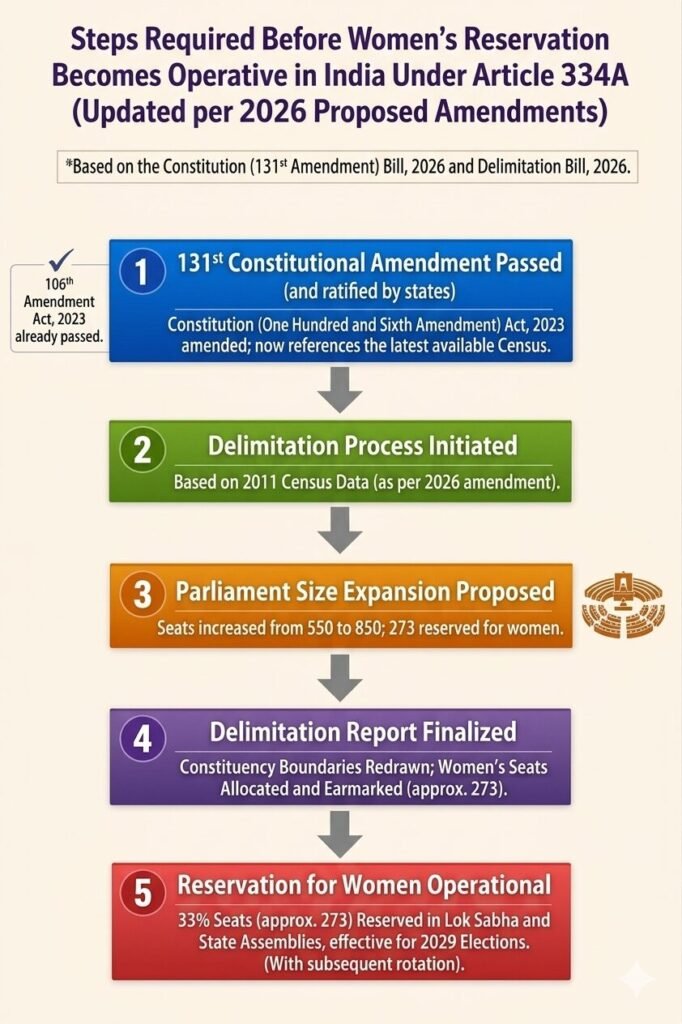
Article 334A says the women’s reservation provisions “shall come into effect” only after a delimitation is undertaken for that purpose, and that delimitation can only happen after the relevant figures from the first census taken after the Act’s commencement are published.
This is a constitutional condition, not a political delay. The law exists. But it cannot operate until a specific sequence of events is complete.
That sequence is:
- A census is conducted.
- The relevant population figures are officially published.
- A delimitation exercise is carried out specifically for this purpose.
- Only then does the one-third reservation come into force.
This is why the question “has women’s reservation started?” has a frustrating but technically accurate answer: the constitutional framework is in place, but the operational trigger has not been met.
See also: What is Delimitation in India?
Why Delimitation Is Not Just a Technicality
Delimitation in India is the process of readjusting parliamentary and assembly constituency boundaries — and potentially the total number of seats — based on updated census data. It is not merely about redrawing lines on a map. Constitutional articles govern not only boundary changes but also how seats are distributed across states.
Article 82 separately provides that until the relevant figures of the first census taken after 2026 are published, it is not necessary to readjust state-level seat allocation or constituency boundaries.
What this means in practice: even if the government wanted to conduct delimitation tomorrow, the constitutional framework already holds that exercise in place until post-2026 census data exists. The women’s reservation law entered an architecture that was already frozen.
The last full census India conducted was in 2011. The last Delimitation Commission was constituted in 2002, with its orders finalized in 2008. [SOURCE: Press Information Bureau, Government of India, 2025]
Census 2027: The Key Date
The government’s current official plan is Census 2027. A Cabinet approval in December 2025 set housing listing for April to September 2026 and population enumeration for February 2027, with a reference date of 1 March 2027 for most of the country. [SOURCE: Press Information Bureau, Cabinet approval release, December 2025]
The census exercise will involve roughly 30 lakh field functionaries and has been approved at a cost of approximately ₹11,718 crore. [SOURCE: Press Information Bureau, Ministry of Home Affairs census release, 2025]
But “census is happening” is not the same as “reservation will start.” The constitutional trigger requires the publication of relevant figures followed by a delimitation exercise. Publication and delimitation together take additional time after fieldwork concludes. This is why analysts have noted that even under the original 2023 route, the reservation was unlikely to be operational before the 2029 Lok Sabha election. [SOURCE: PRS Legislative Research, Delimitation Bill 2026 Analysis, April 2026]
The Numbers That Explain Why This Matters
The 18th Lok Sabha, constituted in June 2024, has 74 women MPs — approximately 14% of the House.
As of April 2026, India ranks 147th globally in women’s representation in the lower house of Parliament, with 13.8% women, according to the Inter-Parliamentary Union’s monthly ranking. [SOURCE: Inter-Parliamentary Union, Women’s Ranking Data, April 2026]
The contrast with local government is striking. More than 21 states and 2 Union Territories with Panchayati Raj Institutions have 50% reservation for women at the local level. This has produced approximately 14.5 lakh women elected representatives — around 46% of all local elected representatives across the country. [SOURCE: Ministry of Women and Child Development, Government of India, March 2025]
The local-body record matters because it is India’s own domestic evidence for what reservation can produce. The concern about “proxy representatives” — the fear that husbands or family members would run the show while women held formal positions — was not borne out at the scale critics predicted.
Also Read: Women in Panchayati Raj
What the April 2026 Package Was Trying to Do
In April 2026, Parliament took up three bills linked to delimitation and women’s reservation:
- The Constitution (131st Amendment) Bill, 2026 — proposed raising Lok Sabha’s strength from 543 to 850 seats.
- The Delimitation Bill, 2026, aimed to constitute a new Delimitation Commission.
- The Union Territories Laws (Amendment) Bill, 2026, made associated changes.
The political logic was to accelerate or redesign the 2023 implementation pathway. A legislative research analysis noted that the Delimitation Bill, 2026, would have used the latest published census as on the constitution of the commission — implying the 2011 Census if the commission were set up before the 2027 census results were published.
The 131st Amendment Bill required a two-thirds majority of members present and voting. On 17 April 2026, it received 298 votes in favour and 230 against — below the constitutional threshold required. The bill failed.
As of 18 April 2026, PRS Legislative Research tracks the Delimitation Bill, 2026 as “Introduced — Infructuous” and the Constitution (131st Amendment) Bill, 2026 as “Introduced — Negatived.” [SOURCE: PRS Bill Track, viewed April 18, 2026]
The 2026 package was separate from, and built on top of, the 2023 framework. Its failure did not undo Nari Shakti Vandan Adhiniyam. The 2023 constitutional framework remains the operative base.
Why the North-South Argument Erupted
The political combustion around the 2026 bills was not purely about women’s reservation. It was about what any new delimitation would do to the relative weight of states in Parliament.
A legislative research analysis projected that, if seats were recalculated using the 2011 Census with the total number of Lok Sabha seats unchanged, Tamil Nadu would fall from 39 to 32 seats and Kerala from 20 to 15, while Uttar Pradesh would rise from 80 to 89 and Bihar from 40 to 46.
States that invested in population control and demographic transition stand to lose political weight in a seat recalculation. That structural tension — not opposition to women’s reservation as a principle — drove much of the debate. The proposal to expand the House to 850 seats was partly an attempt to ensure that no state would lose seats in absolute terms, but the analysis suggests the relative shift in seat share would persist regardless of the total House size.
Opposition to the 2026 package, in other words, was often opposition to how it bundled women’s reservation with a seat redistribution that smaller southern states viewed as penalising their own governance success.
The Unresolved Questions Inside the 2023 Law
Even if everything proceeds under the original 2023 route, several design gaps remain.
OBC sub-quota: The enacted framework addresses women within SC/ST reserved seats, but does not create a separate Other Backward Classes sub-quota within the women’s reservation. That remains a political demand, not an enacted feature.
Rajya Sabha exclusion: The law expressly covers Lok Sabha and State Legislative Assemblies (and Delhi’s assembly). It does not cover the Rajya Sabha or the State Legislative Councils. Earlier parliamentary committee processes had recommended working out modalities for these bodies and considering OBC reservation at an appropriate time, but none of that has been enacted.
Rotation: In the 2023 Act, reserved seats rotate after each delimitation exercise — not after each general election, as the 2008 Women’s Reservation Bill had proposed. A legislative research note flags that rotation linked to delimitation (which happens infrequently) may weaken re-election incentives for women MPs compared to the 2008 model.
These are not reasons to dismiss the law. They are reasons to understand that even a historic constitutional amendment leaves implementation architecture to be resolved over time.
What Is True as of 18 April 2026
| Question | Answer |
| Is the 2023 women’s reservation law in force? | Yes — as a constitutional amendment. |
| Has the operational trigger been met? | No — census and delimitation are still pending. |
| What census is planned? | Census 2027, with enumeration in February 2027. |
| Will reservation apply in the 2029 Lok Sabha election? | Uncertain — depends on when census figures are published and delimitation is completed. |
| Did the April 2026 package pass? | No — the 131st Amendment Bill was negatived; the Delimitation Bill is infructuous. |
| Does the law cover Rajya Sabha? | No. |
| Is there an OBC sub-quota? | No. |
The Honest Summary
Nari Shakti Vandan Adhiniyam — the Constitution (One Hundred and Sixth Amendment) Act, 2023 — is real, enacted, and constitutionally binding. But the law contains its own implementation lock: it cannot become operational until after a census is completed, the relevant figures are published, and a fresh delimitation exercise is carried out for this specific purpose.
The April 2026 package was an attempt to redesign or speed up that route. It did not pass. The original 2023 pathway remains in place.
What that means for the next election is genuinely uncertain. Stating with confidence that women’s reservation will begin in 2029 would require knowing when census figures will be published and when delimitation can be completed — and neither of those is fixed yet.
The law exists. The implementation sequence is running. The timeline is not yet written.
Frequently Asked Questions
What is Nari Shakti Vandan Adhiniyam?
It is the public name for the Constitution (One Hundred and Sixth Amendment) Act, 2023, which reserves not less than one-third of seats in the Lok Sabha and State Legislative Assemblies for women. It was introduced as the Constitution (128th Amendment) Bill, 2023.
Is the 128th Amendment Bill the same as the 106th Amendment Act?
Yes. They refer to the same reform at different stages — the bill number before assent and the act number after enactment.
Why hasn’t women’s reservation started if the law already exists?
Article 334A makes the reservation operative only after a delimitation exercise conducted after publication of census figures from the first census taken after the Act’s commencement. That census — Census 2027 — has not yet been completed.
Did the Delimitation Bill 2026 pass?
No. The Constitution (131st Amendment) Bill, 2026, which was part of the April 2026 package, failed in the Lok Sabha on 17 April 2026. The Delimitation Bill, 2026, is currently tracked as infructuous.
Does Nari Shakti Vandan Adhiniyam include the Rajya Sabha?
No. The enacted law covers the Lok Sabha, the State Legislative Assemblies, and the Delhi Legislative Assembly. It does not reserve seats in the Rajya Sabha or the State Legislative Councils.
Does the law include an OBC sub-quota?
No. The 2023 framework addresses women within SC/ST reserved seats, but does not create a separate OBC sub-quota within the women’s reservation.