Every ten years, most democracies redraw their electoral maps. They count people, recalculate how many representatives each area should get, and adjust the boundaries accordingly. The principle is simple: one person, one vote, one value.
India has a constitutional mandate to do exactly this. It has a dedicated independent body — the Delimitation Commission — to carry it out. And yet, the last time India’s Delimitation Commission completed its work was in 2008, based on 2001 census data.
That gap — between what the Constitution envisioned and what has actually happened — is the story of delimitation in India. It involves two constitutional amendments that deliberately froze the system, a north-south political fault line that has grown sharper over decades, and a direct link to when women’s reservation in Parliament can actually begin.
What Delimitation Actually Means
Delimitation is the process of defining the boundaries of electoral constituencies and allocating seats among states so that each legislator represents roughly equal numbers of people. [SOURCE: Business Standard, “Delimitation in India: How it was done before and why it was paused”, April 2026]
The goal is the “one person, one vote, one value” principle — no voter should have a significantly stronger or weaker vote than any other.
In practice, this means two things happen during a delimitation exercise. First, constituency boundaries are redrawn to account for population shifts. Second, which constituencies are reserved for the Scheduled Castes and the Scheduled Tribes is recalculated based on their updated share of the population.
What delimitation does not automatically do — and this is a common misconception — is change the total number of seats a state gets in Parliament. That requires a separate constitutional amendment. India’s seat counts have been frozen since 1976, a point we will return to shortly.
The Constitutional Basis: Articles 82 and 170
The authority for delimitation sits in two articles of the Constitution.
Article 82 requires that after each census, Parliament must enact a law to readjust Lok Sabha seats among states and divide each state into constituencies. Article 170 does the same for State Legislative Assembly seats. [SOURCE: Drishti IAS, “Delimitation and Women’s Reservation in Legislatures”, April 2026; Indian Kanoon, Article 82 text]
Both articles make this a constitutional duty, not a political choice. Delimitation must happen after every census — unless Parliament amends these articles to delay it, which is exactly what happened twice in India’s history.
The Commission established under these articles has a specific composition: a sitting or retired Supreme Court judge as chairperson, the Chief Election Commissioner or an Election Commissioner, and the State Election Commissioners of the states being delimited. [SOURCE: Drishti IAS, “To The Point: Delimitation”, August 2019]
Crucially, once the Commission issues its final orders, those orders have the force of law and cannot be challenged in any court. They are placed before Parliament and state legislatures, but legislators cannot modify them.
This finality is deliberate. It is what makes the Delimitation Commission genuinely independent — its output cannot be undone by a parliamentary majority that dislikes the result.
How Many Times Has the Delimitation Commission Been Formed?
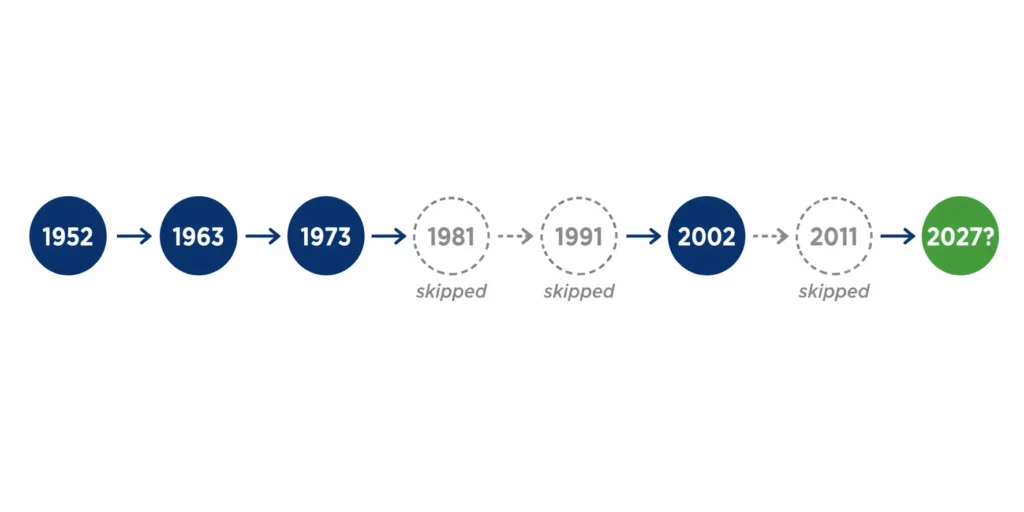
India has constituted the Delimitation Commission four times — in 1952, 1963, 1973, and 2002. Each was based on the census that preceded it: the 1951, 1961, 1971, and 2001 censuses, respectively.
First Commission (1952): Based on the 1951 Census. Established India’s original constituency map for a newly independent democracy. The Election Commission assisted in this exercise.
Second Commission (1963): Based on the 1961 Census. Made adjustments as India’s population had shifted in the decade after independence.
Third Commission (1973): Based on the 1971 Census. This commission’s work coincided with the political events that led to the first freeze — its recommendations were being implemented when the 42nd Amendment arrived and locked seat counts in place.
Fourth Commission (2002): Based on the 2001 Census. Its final orders were implemented in 2008 and applied to the 2009 general election. This commission redrew constituency boundaries in every state except Assam, Arunachal Pradesh, Nagaland, and Manipur, where it was deferred for security reasons. [SOURCE: Shankar IAS Parliament, “All About Delimitation”]
Notably, no commission was formed after the 1981 or 1991 censuses — a direct consequence of the constitutional freezes described below.
Why Delimitation Was Frozen — And Why It Still Is
The most important thing to understand about delimitation in India today is this: the total number of seats each state holds in the Lok Sabha has not changed since 1976.
This is not an accident or an oversight. It is the result of two deliberate constitutional amendments.
The 42nd Amendment (1976) froze the allocation of seats to states — and the division into constituencies — at 1971 Census levels until after 2000. The reason was explicitly to prevent states that had successfully controlled their population from losing parliamentary seats as a result. [SOURCE: Drishti IAS, “Delimitation”, February 2024]
The 84th Amendment (2001) extended that freeze for another 25 years — until the first census taken after 2026. [SOURCE: Business Standard, April 2026]
The 87th Amendment (2003) then allowed the 2002 Delimitation Commission to use the 2001 Census data — but explicitly preserved the 1971-based seat totals. So when the Commission completed its work in 2008, it redrew boundaries without changing how many MPs each state sends to Parliament.
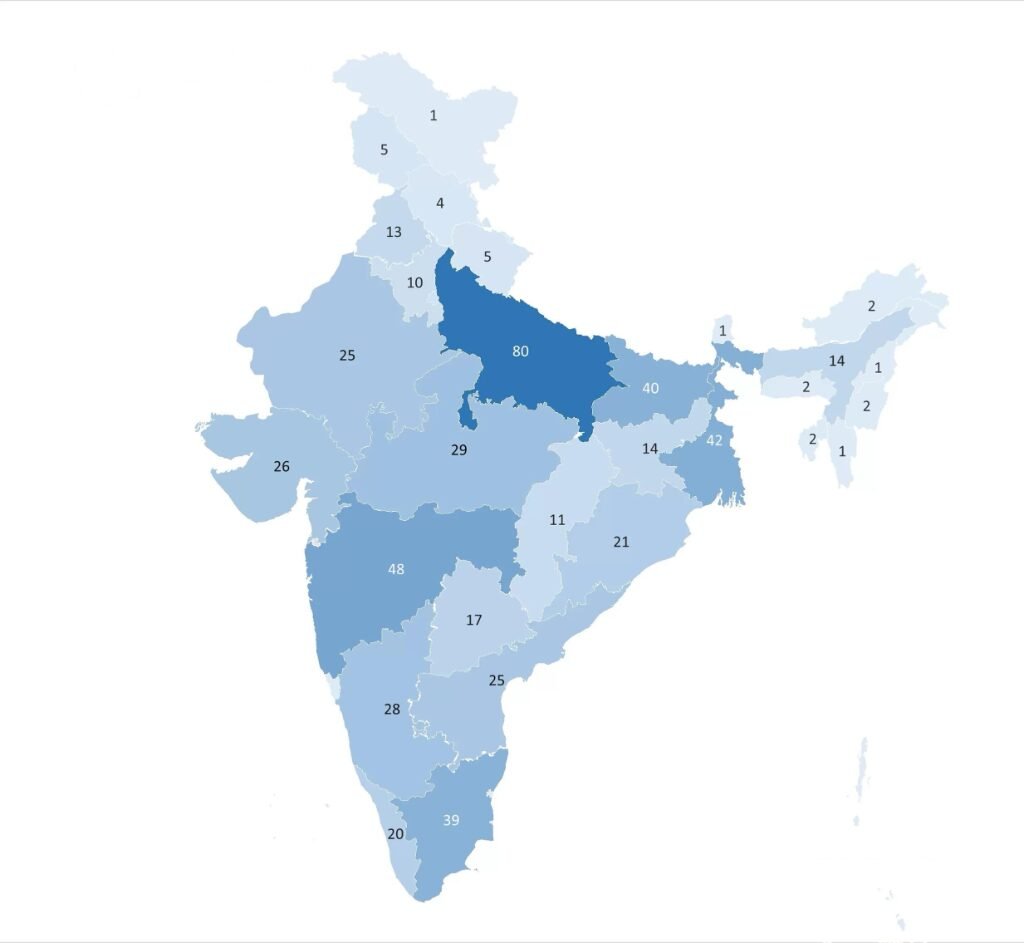
The result is a system where today’s constituency map reflects 2001 population data, but today’s seat allocation per state reflects 1971 population data. Uttar Pradesh, for example, has had 80 Lok Sabha seats since 1976 — unchanged through four censuses, two delimitation exercises, and five decades of population change.
This matters enormously because the first census after 2026 — currently planned for 2027, with population enumeration in February of that year — will finally lift the freeze. [SOURCE: Press Information Bureau, Cabinet approval release, December 2025]
How the Delimitation Process Actually Works
Understanding the step-by-step process helps demystify what “delimitation is happening” actually means in practice.
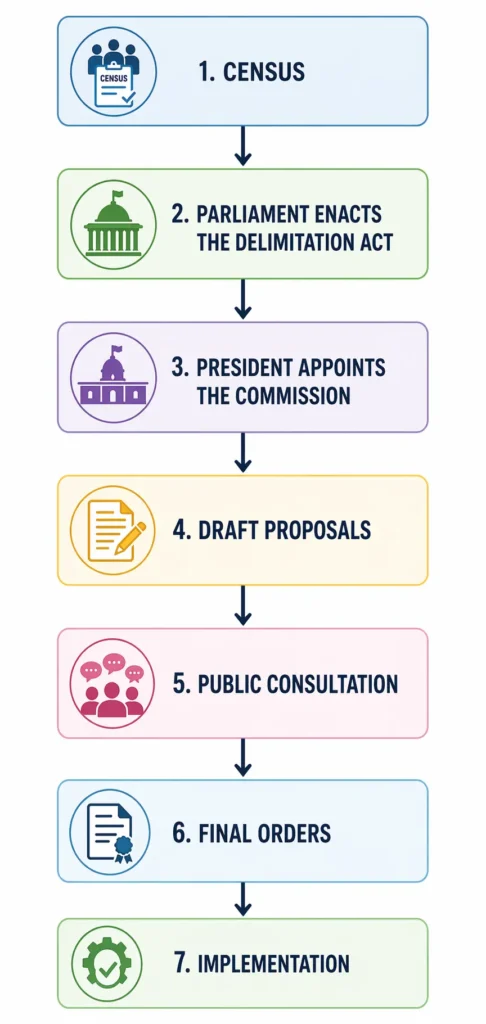
Step 1 — Census: Population data is collected. This provides the raw numbers the Commission will use.
Step 2 — Parliament enacts a Delimitation Act: After census figures are published, Parliament passes a law specifying how the readjustment will be carried out — who will form the Commission, what its mandate is, and what timelines it will follow. [SOURCE: Drishti IAS, “Delimitation and Women’s Reservation in Legislatures”, April 2026]
Step 3 — The President appoints the Commission: Under the Act, the President constitutes the Commission — a Supreme Court judge as chair, the Chief Election Commissioner, and the relevant State Election Commissioners.
Step 4 — Draft proposals: The Commission calculates the ideal population per constituency and drafts new boundary maps. It decides which seats are reserved for SC/ST based on their population share. It aims for geographically compact constituencies that respect administrative boundaries. [SOURCE: Business Standard, April 2026]
Step 5 — Public consultation: Draft proposals are published in the Gazette. Political parties and the public can submit objections. State-level hearings are held. The Commission may revise its plans based on feedback.
Step 6 — Final orders: The Commission submits final orders to the President. These are placed before Parliament — but cannot be altered. Once the President notifies them, they become law and apply from the next general election.
The entire process is designed to be transparent but also final. Unlike legislative redistricting in some other democracies, no political body can change what the Commission decides.
The North-South Fault Line
The biggest political flashpoint around delimitation is one of simple arithmetic. The population has grown faster in northern states than in southern ones. When seat counts are eventually updated using newer census data, northern states stand to gain seats while southern states stand to lose their current share.
Southern India — Tamil Nadu, Kerala, Karnataka, Andhra Pradesh, Telangana — has roughly 18% of India’s population but currently holds around 24% of Lok Sabha seats. That overrepresentation exists precisely because these states invested early and successfully in population control. Under a strict population-based reallocation, their share would shrink. [SOURCE: The Guardian, “India fails to pass bill to boost women’s representation after delimitation row”, April 2026]
A legislative research analysis projected that under a 2011-census-based delimitation with the total House size unchanged at 543, Tamil Nadu would fall from 39 to approximately 32 seats, and Kerala from 20 to 15. Uttar Pradesh, meanwhile, would rise from 80 to approximately 89 seats, and Bihar from 40 to 46.
This is not abstract — it represents a direct shift in political weight between states. Legislation that matters to Tamil Nadu or Kerala requires fewer seats to block under this scenario. For states that built their economies partly around a stable, educated population, it feels like a constitutional penalty for good governance.
The government’s proposed answer in April 2026 was to expand the total number of Lok Sabha seats by roughly 50% — from 543 to around 850 — so that no state would lose seats in absolute terms. Under Home Minister Amit Shah’s projections, Tamil Nadu’s seats would rise from 39 to 59, Karnataka’s from 28 to 44, and the total number of southern MPs across all states would increase from 129 to 195. [SOURCE: Press Information Bureau, Home Minister’s statement on delimitation, April 2026]
Whether that arithmetic actually resolves the federal grievance — or merely softens it while preserving the same relative shift — was at the heart of the April 2026 political debate.
The Connection to Women’s Reservation
The Delimitation Commission’s work is not only about constituency maps. It has become the constitutional trigger for one of India’s most significant pending reforms.
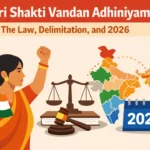
The Constitution (One Hundred and Sixth Amendment) Act, 2023 — Nari Shakti Vandan Adhiniyam — reserves not less than one-third of seats in the Lok Sabha and State Legislative Assemblies for women. But Article 334A, inserted by that amendment, says these provisions will come into force only after a delimitation exercise is conducted on the basis of the first census taken after the Act’s commencement.
In plain terms: women’s reservation cannot begin until the Delimitation Commission completes its next exercise — and that exercise cannot begin until post-2026 census figures are published.
This is why analysts have noted that the reservation is unlikely to be operational before the 2029 Lok Sabha election.
What the 2026 Bills Tried to Do — And Why They Failed
In April 2026, Parliament took up three bills designed to fast-track this entire process. The centrepiece was the Constitution (131st Amendment) Bill, 2026, which proposed expanding Lok Sabha from 543 to 850 seats and allowing the new Delimitation Commission to use the latest published census — effectively the 2011 Census — rather than waiting for the post-2026 data. [SOURCE: Times of India, “Delimitation decoded”, April 2026; PRS Legislative Research, Delimitation Bill 2026]
The plan was architecturally elegant: expand seats by 50%, ensure no state loses seats in absolute terms, redraw constituencies, and simultaneously trigger women’s reservation — all before the 2029 election.
It required a two-thirds majority in both Houses plus ratification by at least half the state legislatures. On 17 April 2026, the bill received 298 votes in favour and 230 against in the Lok Sabha — below the constitutional threshold. The bill failed. It was the first time a constitutional amendment bill of the current government was defeated in Parliament.
The companion Delimitation Bill, 2026 — an ordinary law that would have reconstituted the Commission — was not even tabled in the Rajya Sabha before Parliament adjourned. PRS Legislative Research currently tracks it as “Introduced — Infructuous”. [SOURCE: PRS Legislative Research, Delimitation Bill 2026, viewed April 2026]
Opposition arguments centred on two things: the north-south seat redistribution they saw as penalising population-controlling states, and a broader suspicion that women’s reservation was being used as political cover for a rebalancing that served other interests.
What Is True as of April 2026
| Question | Answer |
| How many times has the Delimitation Commission been formed? | Four times — 1952, 1963, 1973, 2002 |
| When were the last delimitation orders implemented? | 2008, based on 2001 Census data |
| Are constituency boundaries changing before 2029? | No — Home Minister confirmed all elections up to 2029 use current seats |
| When is the next census? | Census 2027, enumeration beginning February 2027 |
| When could the next delimitation begin? | After publication of 2027 census figures — earliest possible around 2029–30 |
| Did the Delimitation Bill 2026 pass? | No — the 131st Amendment Bill failed; the Delimitation Bill is infructuous |
| Does delimitation affect women’s reservation? | Yes — Article 334A makes women’s reservation operative only after delimitation |
What to Watch For Next
The failure of the April 2026 package does not end the delimitation story — it delays it and returns it to the original constitutional route.
Three things are worth tracking. First, Census 2027 — the houselisting phase runs from April to September 2026, with population enumeration in February 2027 and a reference date of 1 March 2027. Once these figures are officially published, the constitutional trigger for delimitation becomes active.
Second, new legislation. The government will need to introduce a fresh Delimitation Act — an ordinary law — to constitute a new Commission once census figures are available. That Act will define which census is used, the Commission’s timeline, and whether any modifications are made to how the exercise works. Watch for that bill in the 2028–29 parliamentary session.
Third, the women’s reservation timeline. Since Article 334A ties implementation directly to delimitation, every month that delimitation is delayed is a month that women’s reservation remains on paper but not in practice. The 2029 election is almost certainly too soon. The first election where it could realistically apply is now 2034, depending on how quickly delimitation is completed after census figures are published.
Home Minister Amit Shah stated clearly in April 2026 that all elections up to 2029 will be conducted on existing seats and that there is no possibility of delimitation being implemented before 2029.
Frequently Asked Questions
What is the Delimitation Commission of India?
It is an independent body constituted by Parliament to redraw electoral constituency boundaries and allocate seats among states based on census data. It is headed by a sitting or retired Supreme Court judge and includes the Chief Election Commissioner and relevant State Election Commissioners.
How many times has the Delimitation Commission been formed in India?
Four times — in 1952, 1963, 1973, and 2002 — based on the 1951, 1961, 1971, and 2001 censuses, respectively.
Why was no Delimitation Commission formed after the 1981 and 1991 censuses?
The 42nd Amendment (1976) froze seat allocations at 1971 levels until after 2000. The 84th Amendment (2001) extended this freeze until the first census after 2026. No commission was needed because seat counts could not change.
Can the Delimitation Commission’s orders be challenged in court?
No. The Commission’s final orders have the force of law and cannot be challenged or modified by Parliament, state legislatures, or courts.
Who appoints the Delimitation Commission?
The President of India appoints the Commission under the authority of a Delimitation Act passed by Parliament.
When will the next delimitation happen in India?
The next delimitation can only begin after the publication of figures from the first census taken after 2026 — currently planned as Census 2027. The earliest a new commission could complete its work is around 2029–30, making implementation more likely for elections after 2029.
How does delimitation connect to women’s reservation?
Article 334A of the Constitution, inserted by the Nari Shakti Vandan Adhiniyam (106th Amendment Act, 2023), states that women’s reservation in Parliament and State Assemblies will come into force only after a delimitation exercise based on the first post-2026 census.