Before 1992, Panchayati Raj in India existed largely on paper. States could hold elections or skip them, devolve power to village councils, or simply not bother. Local governance had no constitutional protection and existed only at the pleasure of state governments. In many states, it barely existed at all.
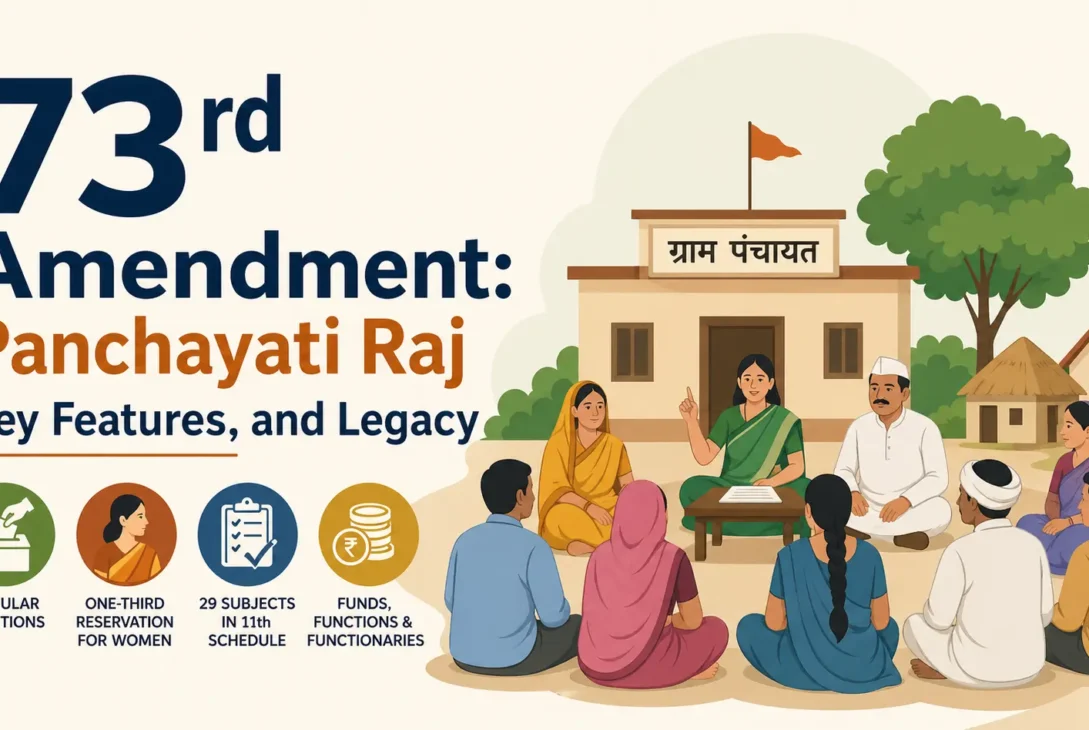
The 73rd Constitutional Amendment Act changed that permanently. Passed in 1992 and coming into force on 24 April 1993, it inserted Part IX into the Constitution — Articles 243A through 243O — and added the Eleventh Schedule listing 29 subjects that Panchayats could be empowered to handle. For the first time, rural local self-government was not a state government’s discretionary choice. It was a constitutional mandate. [SOURCE: Encyclopaedia Britannica, “Panchayati raj”, updated March 2026]
What followed was one of the largest expansions of democratic participation in Indian history — and, as a direct consequence of the one-third women’s reservation it mandated, one of the most significant interventions for women’s political representation the country has ever made.
Why a Constitutional Amendment Was Needed
The short answer is that the system without constitutional backing had largely failed.
Before 1992, Panchayati Raj existed under various state laws but with no uniform structure, no guaranteed elections, and no protected powers. Studies of the pre-1992 era describe Panchayats as “largely advisory entities with minimal powers… frequently overshadowed by state governments.” [SOURCE: IJFMR academic paper, 2025] States could — and frequently did — supersede Panchayats, defer elections indefinitely, or ignore local bodies in favour of district-level bureaucracy.
Article 40 of the Directive Principles of State Policy had urged state governments to organise village panchayats and endow them with “such powers and authority as may be necessary to enable them to function as units of self-government.” But Directive Principles are not enforceable — they carry moral weight, not legal compulsion. So states followed them when convenient and ignored them when not. [SOURCE: DownToEarth, “30 years after the 73rd Constitutional Amendment”, June 2024]
Key committees — including the Balwant Rai Mehta Committee (1957) and the Ashok Mehta Committee (1978) — had repeatedly recommended stronger local governance. Their recommendations went largely unimplemented. The 73rd Amendment was the constitutional reckoning with that thirty-year failure.
What Part IX Actually Says: Articles 243A to 243O
The Amendment added seventeen new articles to the Constitution under Part IX. Together, they form a complete legal framework for rural local self-government. Here is what the most important ones do:
Article 243A — Gram Sabha: Establishes the Gram Sabha — the village-level assembly of all registered voters — as the foundation of local democracy. The Gram Sabha has the power to review plans, audit accounts, and approve development works at the village level. [SOURCE: SecforUTs/MHA, “73rd Amendment of Panchayati Raj in India”, updated August 2024]
Article 243B — Three-tier structure: Mandates Panchayats at three levels — village (Gram Panchayat), intermediate or block (Panchayat Samiti), and district (Zila Parishad). States with a district population below 20 lakh may omit the intermediate tier. [SOURCE: Maharashtra State Election Commission, Constitutional Provisions Part IX PDF]
Article 243C — Composition: Specifies that Panchayat seats are filled by direct election from territorial constituencies (wards). Local MPs and MLAs may also be members, as state law provides.
Article 243D — Reservation of seats: Reserves seats for the Scheduled Castes and the Scheduled Tribes in proportion to their population at each tier. Critically, at leastone-third of all seats — including one-third of SC/ST seats — must be reserved for women. States may also reserve one-third of chairperson positions for women. [SOURCE: PIB Press Release, Ministry of Panchayati Raj, December 2021]
Article 243E — Five-year term: Panchayats have a fixed five-year term. Elections must be completed before the term expires. If a Panchayat is dissolved, elections must be held within six months.
Article 243G — Powers and functions: Empowers state legislatures to devolve the 29 subjects listed in the Eleventh Schedule to Panchayats, along with the funds and staff needed to carry them out. [SOURCE: PIB backgrounder, “Review of implementation of Panchayati Raj System”]
Article 243K — State Election Commission: Requires every state to constitute an independent State Election Commission to superintend, direct, and control Panchayat elections. The head of the SEC can only be removed in the same manner as a High Court judge — protecting the Commission’s independence. [SOURCE: SecforUTs/MHA, updated August 2024]
Article 243I — State Finance Commission: Requires every state to constitute a State Finance Commission every five years to review the financial position of Panchayats and recommend how state funds should be shared with them. [SOURCE: SecforUTs/MHA, updated August 2024]
Article 243M — Exemptions: Part IX does not apply to Nagaland, Meghalaya, and Mizoram, or to scheduled tribal areas in several states, and the Darjeeling Gorkha Hill Council area. Reservation provisions under Article 243D do not apply to Arunachal Pradesh.
Article 243O — Bar on courts: No court can intervene in Panchayat electoral matters. Election disputes must go through special election tribunals — the same principle that applies to parliamentary elections.
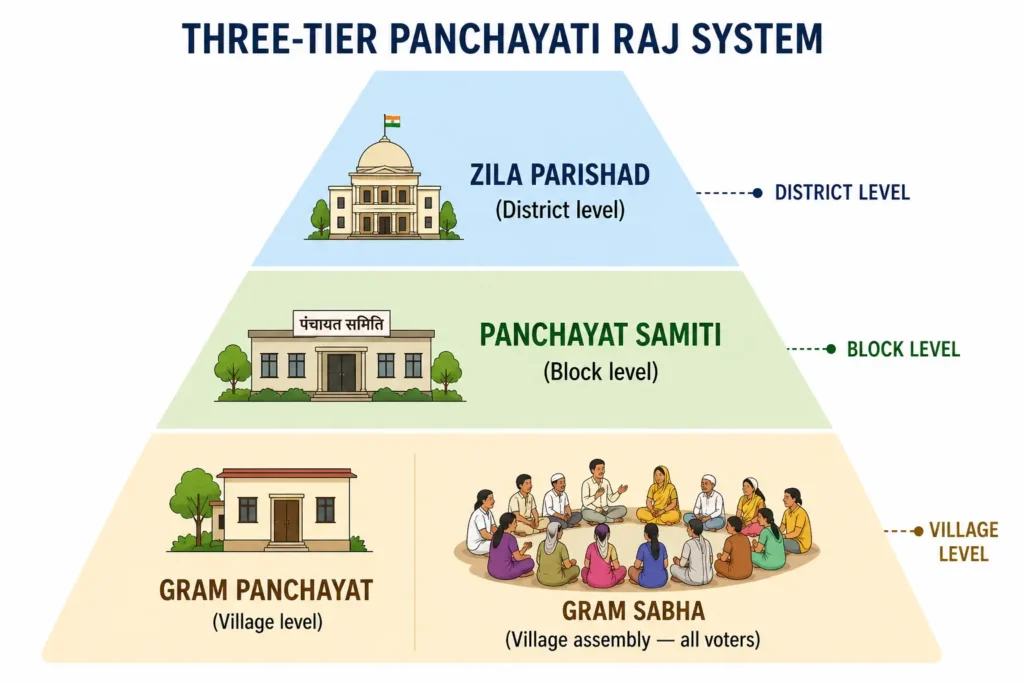
The Three-Tier Structure in Practic
As of 2025, India has approximately 2.3 lakh Gram Panchayats, around 6,000 Panchayat Samitis at the block level, and over 600 Zila Parishads at the district level. [SOURCE: SecforUTs/MHA, updated August 2024]
All states and Union Territories except Nagaland, Meghalaya, Mizoram, and Delhi operate Panchayati Raj Institutions under Part IX. [SOURCE: Encyclopaedia Britannica, “Panchayati raj”, March 2026]
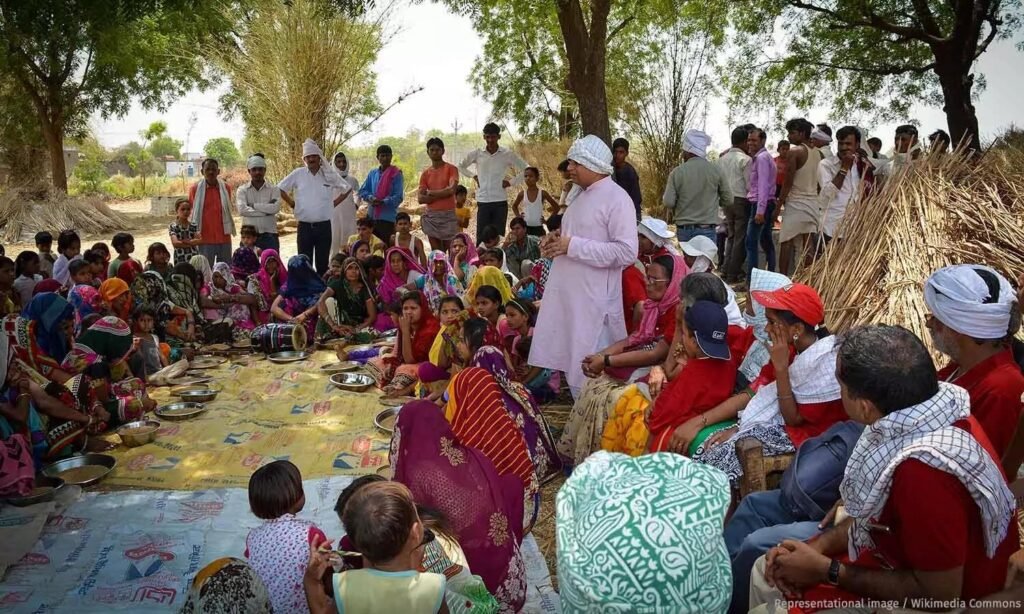
The Gram Sabha sits below all three tiers — not as a fourth tier but as the electorate body itself. Every adult voter registered in a village is a member of the Gram Sabha. They elect the Gram Panchayat members and Sarpanch, and they have the constitutional right to be consulted on local plans, budgets, and development works. This makes the Gram Sabha the conceptual foundation of the entire structure — a formal space where village democracy is supposed to happen, not just be represented.
One common misconception is that the Amendment prescribes exactly which subjects go to which tier. It does not. The Eleventh Schedule lists what Panchayats may be empowered to handle; each state decides which tier gets which subject and how much staff and money come with it.
The Eleventh Schedule: 29 Subjects
Article 243G, read with the Eleventh Schedule, empowers state legislatures to devolve 29 subjects to Panchayats. These cover essentially every dimension of rural life — from agriculture to education, from drinking water to cultural activities. [SOURCE: PIB backgrounder, “Review of implementation of Panchayati Raj System”; SecforUTs/MHA, updated August 2024]
The full list is: agriculture (including agricultural extension); land improvement and soil conservation; minor irrigation, water management, and watershed development; animal husbandry, dairying, and poultry; fisheries; social forestry and farm forestry; minor forest produce; small-scale industries (including food processing); khadi, village, and cottage industries; rural housing; drinking water; fuel and fodder; roads, culverts, bridges, and waterways; rural electrification (including distribution); non-conventional energy sources; poverty alleviation programmes; primary and secondary education; technical training and vocational education; adult and non-formal education; libraries; cultural activities; markets and fairs; health and sanitation (including hospitals, primary health centres, and dispensaries); family welfare; women and child development; social welfare (including for the differently abled); welfare of weaker sections (including SC/ST); maintenance and management of the public distribution system; and maintenance of community assets.
The critical word in the constitutional text is “may” — state legislatures may endow Panchayats with these powers. They are not required to transfer all 29. In practice, devolution has been uneven. Thirty years after the Amendment, the Ministry of Panchayati Raj has acknowledged that states have generally not transferred all subjects, funds, and functionaries — the “three Fs” — to Panchayats in full. [SOURCE: DownToEarth, June 2024]
Women’s Reservation: Article 243D
The single most consequential provision of the 73rd Amendment for India’s democratic story is Article 243D — the one-third women’s reservation.
It requires that not less than one-third of all directly elected Panchayat seats at every tier be reserved for women. It also requires that one-third of the seats reserved for the Scheduled Castes and the Scheduled Tribes must go to women of those communities. States may additionally reserve one-third of chairperson positions for women. [SOURCE: PIB Press Release, Ministry of Panchayati Raj, December 2021]
The constitutional minimum is one-third. But many states have gone further. By 2021, 21 states and Union Territories had raised the legal quota to 50% through their own Panchayati Raj Acts — including Bihar (first to do so in 2006), Rajasthan, Chhattisgarh, Madhya Pradesh, and Uttarakhand, among others. [SOURCE: PIB Press Release, Ministry of Panchayati Raj, December 2021]
The results at the national level are striking. India today has approximately 14.5 lakh women in elected local office — around 46% of all Panchayati Raj representatives. [SOURCE: PIB Press Release, Ministry of Women and Child Development, March 2025]
This is the same number cited in your pillar article on Nari Shakti Vandan Adhiniyam. There, the contrast is drawn with Parliament, where women hold just 14% of seats. The gap — 46% at the local level, 14% at the national level — is a direct consequence of where reservation has been in force and where it has not. Article 243D created the 46%. Its absence from parliamentary law is why 14% persisted for three decades, until the 2023 constitutional amendment changed the framework at the national level.
It is important to be clear about what these two laws are and are not. Article 243D is strictly a local body provision. It has no bearing on Parliament or State Legislative Assemblies. The Constitution (One Hundred and Sixth Amendment) Act, 2023 — Nari Shakti Vandan Adhiniyam — is a separate constitutional amendment that addresses Parliament and State Assemblies. The two laws operate independently.
See Also: women’s reservation in Panchayati Raj
The 73rd and 74th Amendments: What Is the Difference?
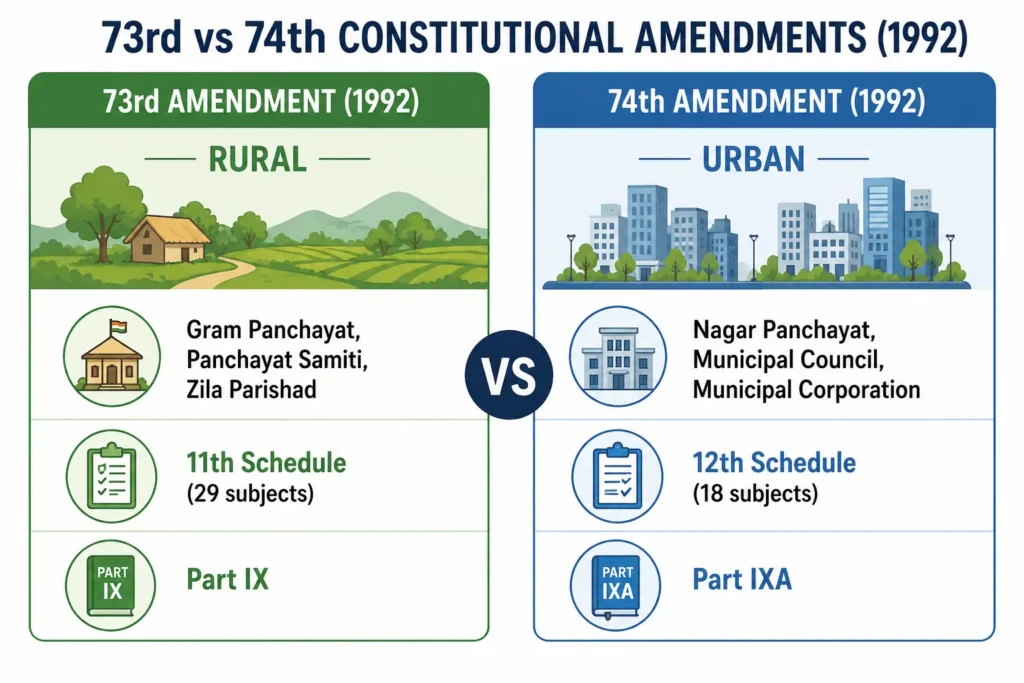
The 73rd Amendment was passed alongside its urban counterpart — the 74th Constitutional Amendment Act (1992) — and both came into force in 1993. The 74th added Part IXA (Articles 243P to 243ZG) to the Constitution, creating the same constitutional framework for urban local bodies that the 73rd created for rural ones. [SOURCE: SecforUTs/MHA, “74th Amendment and Municipalities in India”, updated August 2024]
The key differences:
Scope: The 73rd Amendment covers rural areas — villages, blocks, and districts. The 74th covers urban areas — towns and cities. They do not overlap.
Structure: Under the 74th, there are three types of urban local bodies: Nagar Panchayats (for transitional areas moving from rural to urban), Municipal Councils (smaller urban areas), and Municipal Corporations (larger cities). [SOURCE: SecforUTs/MHA, 74th Amendment page]
Functions: The 73rd’s Eleventh Schedule lists 29 subjects for rural devolution. The 74th’s Twelfth Schedule lists 18 subjects for urban devolution — covering town planning, regulation of land use, public health, solid waste management, urban forestry, and similar city-level functions.
Reservation: Both amendments mandate the same one-third reservation for women and proportional reservation for SC/ST. States may raise this to 50% for either type of local body.
Finance: The 74th also provides for State Finance Commissions covering municipal finances (under Article 243Y), and specifies that the Panchayat Finance Commission should cover municipal finance too — a provision not in the 73rd.
The cleanest way to remember the distinction: 73rd = villages and rural India; 74th = towns and cities. Both are constitutionally protected. Both require regular elections, independent State Election Commissions, and women’s reservation.
The Limitations: What the Amendment Did Not Achieve
Thirty years after the 73rd Amendment came into force, the honest assessment is that constitutional status was necessary but not sufficient.
Incomplete devolution is the central criticism. The “three Fs” — functions, funds, and functionaries — were supposed to move from state governments to Panchayats. In most states, they have not fully done so. States have transferred some subjects from the Eleventh Schedule but retained real control through state departments, district collectors, and centrally-funded schemes that bypass Panchayats. [SOURCE: DownToEarth, June 2024]
Financial weakness is a direct consequence. Panchayats cannot generate most of their own revenue. They depend on state grants and central scheme allocations. Without independent financial resources, constitutional powers remain largely theoretical. The 14th and 15th Finance Commissions both allocated specific grants to Panchayats to partially address this, but the structural dependence on state transfers remains. [SOURCE: DownToEarth, June 2024]
Bureaucratic and political interference persists. On the ground, district collectors and state-level officials continue to direct many functions that are constitutionally within Panchayat jurisdiction. As one assessment of the post-Amendment experience in Himachal Pradesh noted, PRIs “are dominated by elites,” and the roles of bureaucracy and elected local bodies remain inadequately demarcated.
Awareness and capacity gaps mean that even where Panchayats have constitutional powers, residents often do not know how to use them. Gram Sabha meetings — constitutionally mandated forums for community decision-making — frequently lack quorum or are held irregularly in many states.
None of this means the Amendment failed. It means that constitutional change creates the structure; political will and administrative follow-through determine what happens inside it. Kerala and Karnataka are frequently cited as states where devolution has worked better than average. The gaps in other states reflect political choices, not constitutional impossibility.
Why the 73rd Amendment Still Matters Today
National Panchayati Raj Day is observed on 24 April each year — the date Part IX came into force in 1993. [SOURCE: Encyclopaedia Britannica, “Panchayati raj”, March 2026]
The Amendment’s most durable legacy is the women’s representation it created. More than 28 lakh individuals have held elected Panchayat office since 1993. [SOURCE: SecforUTs/MHA, updated August 2024] The 14.5 lakh women currently serving in local elected office represent a model — and an evidence base — for what political reservation produces at scale.
That evidence base is directly relevant to the national debate around Nari Shakti Vandan Adhiniyam (the 106th Amendment, 2023), which reserves seats in Parliament and State Assemblies. The Panchayat experience — 30 years of women in reserved seats, the decline of proxy behavior over time, the documented shift in what local governments prioritise — is India’s own domestic proof of concept.
The 73rd Amendment also sits at the centre of the current delimitation debate. Just as the Nari Shakti Vandan Adhiniyam requires a delimitation exercise before national women’s reservation begins, Panchayat ward boundaries are periodically revised at the state level after each census. The constitutional architecture for local democracy and the constitutional architecture for national representation now point toward the same mechanism: census, then delimitation, then updated representation.
Frequently Asked Questions
What is the 73rd Amendment?
The 73rd Constitutional Amendment Act (1992) gave constitutional status to India’s rural local self-government system — Panchayati Raj. It added Part IX (Articles 243A to 243O) and the Eleventh Schedule to the Constitution, mandating a three-tier Panchayat structure, regular elections, one-third reservation for women, and proportional reservation for Scheduled Castes and Scheduled Tribes.
When did the 73rd Amendment come into force?
It came into force on 24 April 1993 — a date now celebrated annually as National Panchayati Raj Day.
What is the difference between the 73rd and 74th Amendments?
The 73rd Amendment applies to rural local bodies (Panchayats). The 74th Amendment (also 1992) applies to urban local bodies (municipalities). Both have identical provisions on elections, women’s reservation, and independent State Election Commissions — but govern different tiers of local government with different schedules of functions (11th Schedule for rural, 12th Schedule for urban).
What are the 29 subjects in the 11th Schedule?
The Eleventh Schedule lists agriculture, land improvement, minor irrigation, animal husbandry, fisheries, social forestry, minor forest produce, small-scale industries, khadi and village industries, rural housing, drinking water, fuel and fodder, roads and bridges, rural electrification, non-conventional energy, poverty alleviation, primary and secondary education, technical and vocational training, adult education, libraries, cultural activities, markets and fairs, health and sanitation, family welfare, women and child development, social welfare, welfare of weaker sections, public distribution system maintenance, and maintenance of community assets.
Which states are exempt from the 73rd Amendment?
Under Article 243M, the amendment does not apply to Nagaland, Meghalaya, and Mizoram. It also does not apply to specified scheduled and tribal areas in several states. The reservation provisions of Article 243D do not apply to Arunachal Pradesh.
How does Article 243D differ from Nari Shakti Vandan Adhiniyam?
Article 243D reserves seats for women in Panchayati Raj Institutions — local rural bodies only. The Nari Shakti Vandan Adhiniyam (Constitution 106th Amendment, 2023) reserves seats for women in the Lok Sabha and State Legislative Assemblies. They are separate constitutional provisions. Article 243D has been in force since 1993. The 2023 national law has not yet come into force — it requires a delimitation exercise after Census 2027.
Can Panchayat elections be challenged in court?
No. Article 243O bars courts from intervening in Panchayat electoral matters. Election disputes must be resolved through special election tribunals, not regular courts.