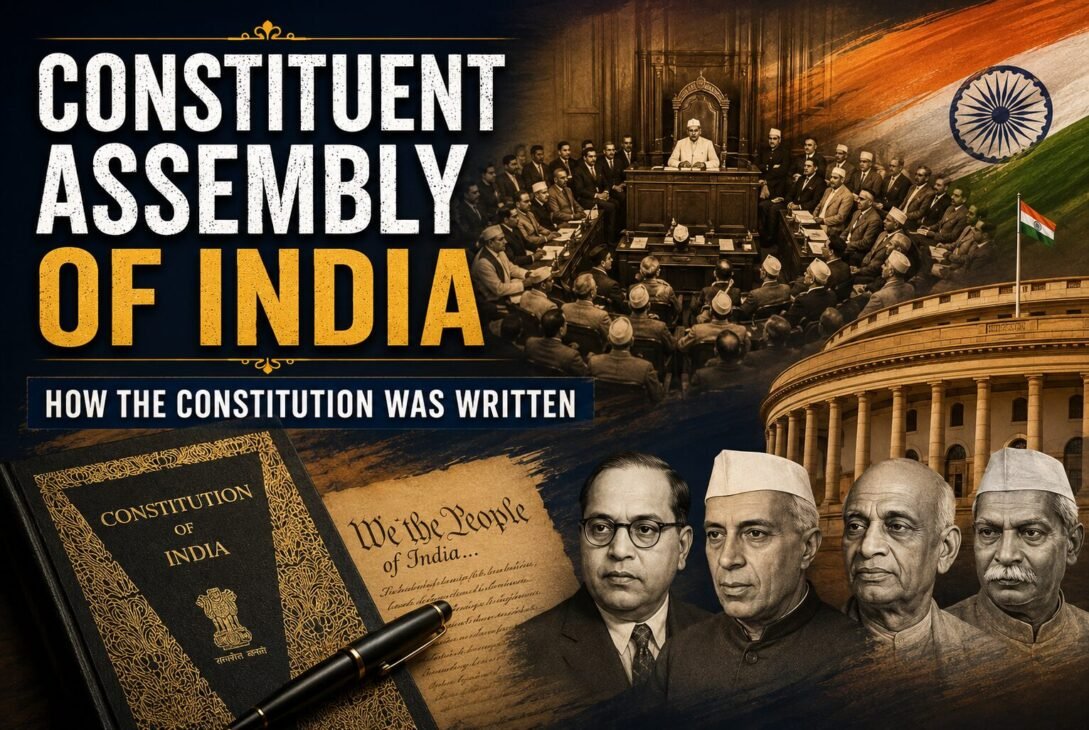
Every clause of the Indian Constitution—guaranteeing free speech, establishing Parliament, protecting minorities—was debated, amended, and refined by the Constituent Assembly of India. From December 1946 to November 1949, the Assembly met in eleven sessions, debated 7,635 amendments, and produced a document governing the world’s largest democracy. [SOURCE: Lok Sabha Secretariat / Sansad.in, Constituent Assembly page]
Understanding the making of the Indian Constitution means understanding the process. This includes how the Assembly was formed and who its members were. Committees turned political aspirations into constitutional text. B. N. Rau, the constitutional adviser, prepared the first draft before the famous “Drafting Committee” existed. Dr. B. R. Ambedkar, Chairman of the Drafting Committee, guided a complex and deliberative body. The process ended in a historic conclusion on 26 November 1949.
This is that story, told in the order it actually happened.
Quick Reference: Key Facts
| Detail | Fact |
|---|---|
| First sitting | 9 December 1946, Constitution Hall, New Delhi |
| President of the Assembly | Dr. Rajendra Prasad (elected 11 December 1946) |
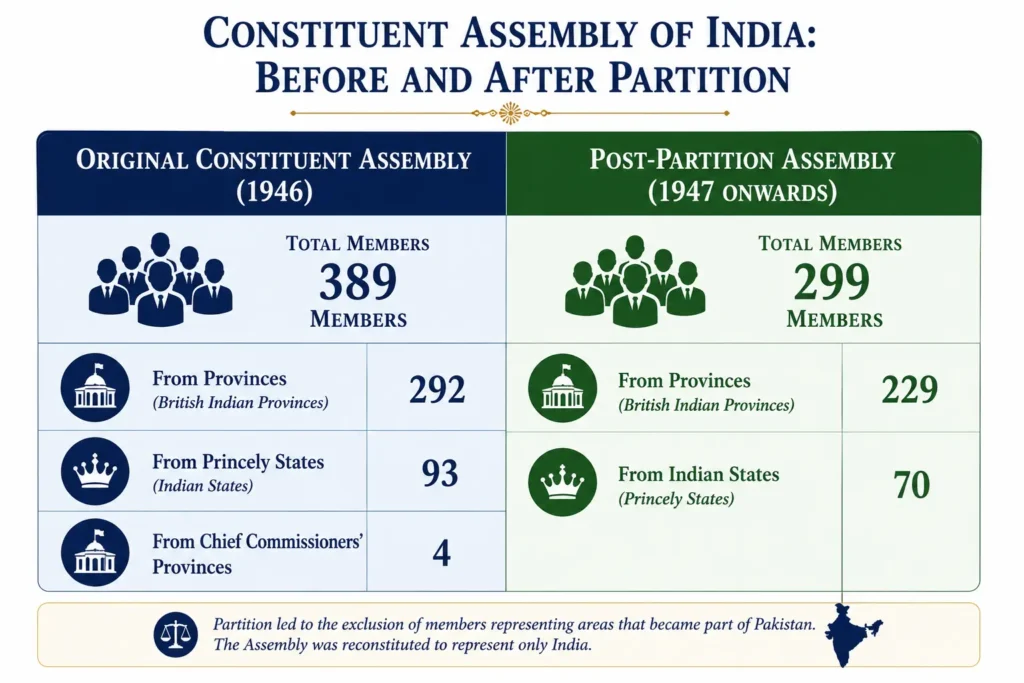
| Original membership | 389 members |
| Membership after Partition | 299 members |
| Drafting Committee Chairman | Dr. B. R. Ambedkar (appointed 29 August 1947) |
| Constitutional Adviser | Sir B. N. Rau |
| Total sessions | 11 |
| Days on Draft Constitution | 114 |
| Amendments tabled | 7,635 |
| Amendments moved and disposed | 2,473 |
| Constitution adopted | 26 November 1949 |
| Constitution signed | 24 January 1950 (284 members) |
| Constitution came into force | 26 January 1950 |
[SOURCE: Lok Sabha Secretariat, Constituent Assembly page, sansad.in]
The Cabinet Mission Plan: Why the Assembly Existed
The Constituent Assembly of India did not emerge from an election or a revolution. It was the product of a negotiated proposal. On 16 May 1946, the British government’s Cabinet Mission Plan proposed the mechanism whereby provincial legislatures would elect members to a Constituent Assembly, with seats distributed on the basis of population and divided among general, Muslim, and Sikh constituencies. Princely states would negotiate their own representation separately. [SOURCE: ConstitutionofIndia.net, Cabinet Mission Plan 1946]
This was an indirect election by design. The broader Indian population did not vote directly for Assembly members. Provincial legislators — who had themselves been elected under the limited franchise of the 1935 Government of India Act — chose the Assembly representatives. This is a fact worth fixing in mind, because one of the most persistent misconceptions about the Constituent Assembly is that it was directly elected by universal adult suffrage. It was not. The Assembly it produced, however, built universal adult suffrage into the Constitution it wrote — specifically through Article 326, which established the right to vote for every adult Indian citizen. [SOURCE: ConstitutionofIndia.net, Article 326; Cabinet Mission Plan]
The original Assembly had 389 members. After the partition in August 1947, the representatives of the territories that became Pakistan left the body. By December 1947, the Assembly had 299 members — 229 from provinces and 70 from Indian princely states. The Muslim League had initially boycotted the proceedings; after Partition, Muslim members representing Indian provinces participated in the Assembly’s work. [SOURCE: Lok Sabha Secretariat; ConstitutionofIndia.net, Constitution Framers page]
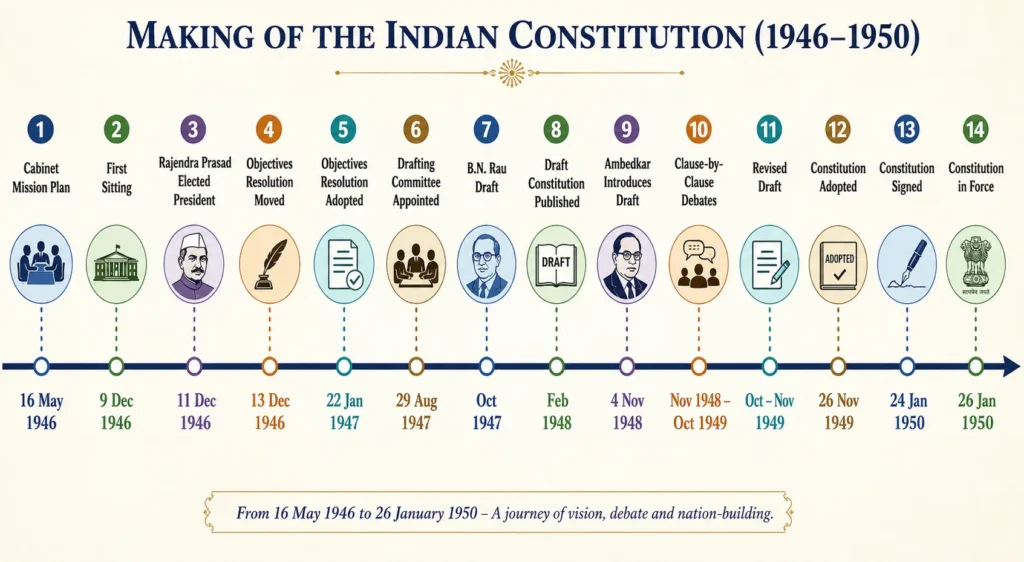
9 December 1946: The First Sitting
The Constituent Assembly met for the first time on 9 December 1946 in Constitution Hall, New Delhi — the building now known as the Central Hall of Parliament. [SOURCE: ConstitutionofIndia.net, 9 Dec 1946 debate archive; Sansad.in]
Dr. Sachchidananda Sinha served as the provisional President for the opening session. On 11 December 1946, the Assembly elected Dr. Rajendra Prasad as its permanent President. H. C. Mookerjee was elected Vice-President. [SOURCE: ConstitutionofIndia.net, 11 Dec 1946 debate archive]
Two days later, on 13 December 1946, Jawaharlal Nehru moved what would become the Assembly’s founding statement of purpose: the Objectives Resolution. [SOURCE: ConstitutionofIndia.net, 13 Dec 1946 debate archive]
The Objectives Resolution: India’s Constitutional Vision
Nehru’s Objectives Resolution, moved on 13 December 1946 and adopted on 22 January 1947, was not just a preamble draft. It was the Assembly’s declaration of what kind of country India intended to become. [SOURCE: ConstitutionofIndia.net, 13 Dec 1946 and 22 Jan 1947 debate archives]
The Resolution proclaimed India a sovereign, independent, democratic republic. It called for the territories of India to be a union. It promised its citizens justice — social, economic, and political; freedom of thought, expression, belief, faith, and worship; equality of status and opportunity. It is committed to adequate safeguards for minorities, backward and tribal areas, and depressed and other backward classes. These commitments later shaped both the Preamble and the substantive chapters on Fundamental Rights and Directive Principles of State Policy.
The Objectives Resolution and the final Preamble are not identical, but the lineage is unmistakable. Understanding the Resolution is essential for understanding why the Preamble reads the way it does. [SOURCE: ConstitutionofIndia.net, Preamble and debate records]
Also Read: Preamble of the Indian Constitution
The Committee System: How Ideas Became Clauses
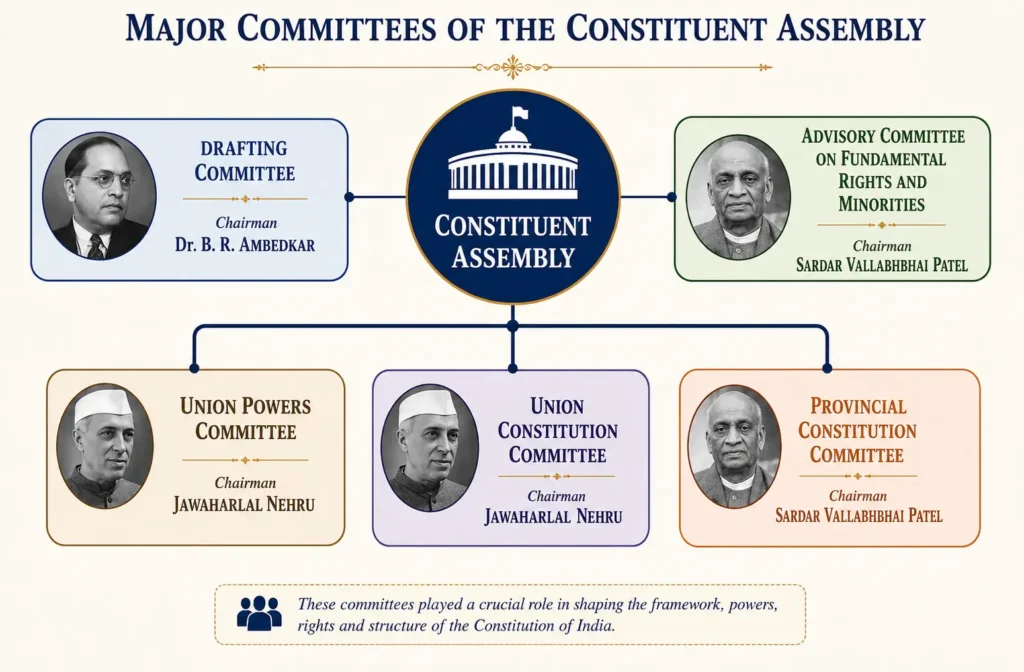
The full Constituent Assembly — nearly three hundred members debating together — was not the primary site of drafting work. That work happened in committees. The Assembly operated through a layered system: standing committees on procedure and credentials, and then the substantive committees that actually shaped constitutional choices.
The major working committees included:
The Advisory Committee on Fundamental Rights, Minorities, and Tribal and Excluded Areas, chaired by Vallabhbhai Patel. This committee produced recommendations on what rights would be enforceable and how minority communities would be protected — including the critical decision to reject separate electorates in favour of joint electorates with reservations. [SOURCE: ConstitutionofIndia.net, Report of the Advisory Committee on Minority Rights]
The Union Powers Committee and the Union Constitution Committee, both chaired by Jawaharlal Nehru. These committees worked through the architecture of the Union — which powers would rest with the Centre, how Parliament would be constituted, and how the executive would relate to the legislature. The debates in these committees established the foundations for India’s quasi-federal, parliamentary structure.
The Provincial Constitution Committee, also chaired by Patel, worked through the corresponding structure for the provinces.
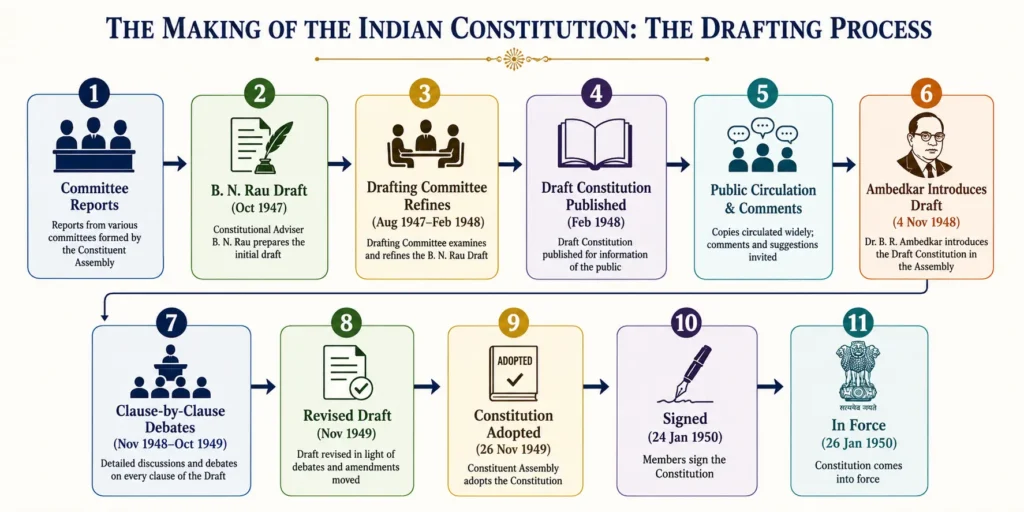
Each committee produced reports. Those reports fed into B. N. Rau’s work as Constitutional Adviser. Rau then used those reports — along with comparative constitutional research — to produce the first comprehensive draft. [SOURCE: ConstitutionofIndia.net, Committee Reports page; ConstitutionofIndia.net, Draft Constitution prepared by the Constitutional Adviser]
This multi-layered process is why it is inaccurate to say any single person “wrote” the Indian Constitution. The Constituent Assembly made the decisions. The committees translated political discussions into proposals. B. N. Rau synthesised those proposals into a draft. And the Drafting Committee — as you will see — refined, resolved, and defended that draft through the Assembly.
B. N. Rau: The Man Before the Drafting Committee
Sir Benegal Narsing Rau is the figure most often left out of popular accounts of the making of the Indian Constitution. That is a serious omission.
Rau served as the Constitutional Adviser to the Constituent Assembly. It was his job to take the committee reports, absorb comparative constitutional scholarship from around the world, and produce a working draft. He completed his constitutional draft on approximately 1 October 1947. This draft — known as the Draft Constitution prepared by the Constitutional Adviser — became the foundation document that the Drafting Committee worked from and refined. [SOURCE: ConstitutionofIndia.net, Draft Constitution prepared by the Constitutional Adviser]
Rau also travelled abroad to study constitutional arrangements in other countries, consulting legal experts and examining constitutional frameworks to inform his draft. The result was a document that gave the Drafting Committee something substantive to work with — not a blank page, but a detailed first version of a constitution for India.
When Ambedkar himself spoke on 25 November 1949 — the day before the Constitution’s adoption — he explicitly acknowledged Rau’s contribution and that of the Drafting Committee’s chief draftsman, S. N. Mukherjee. He described Mukherjee as possibly the greatest draftsman of the time, a man who could put the most difficult proposals into the simplest and most precise legal form. Ambedkar’s speech on that day is, among other things, a deliberate correction of the “one man wrote it” narrative — made by the person most often cited as that one man. [SOURCE: ConstitutionofIndia.net, 25 Nov 1949 debate archive]
The Drafting Committee: Ambedkar’s Task
On 29 August 1947, the Constituent Assembly appointed the Drafting Committee under Dr. B. R. Ambedkar. The committee had seven members. [SOURCE: Lok Sabha Secretariat; ConstitutionofIndia.net, Drafting Committee blog]
The Drafting Committee’s task was not to decide what the Constitution would say on the big questions — those decisions came from the Assembly and its committees. The Drafting Committee’s task was to take the accumulated committee reports and B. N. Rau’s draft and produce a coherent, precise constitutional text: resolving internal inconsistencies, ensuring legal accuracy, checking that the language matched the Assembly’s intentions, and fitting everything into a structure that could be read and applied as law.
Ambedkar worked on this with extraordinary focus, despite poor health, and became the dominant public voice defending the draft when it came before the full Assembly. His 4 November 1948 speech introducing the Draft Constitution — running to several hours — is one of the most detailed defences of constitutional choices ever made in an Indian forum. In it, he addressed the choice of parliamentary over presidential government, the quasi-federal structure, the treatment of Fundamental Rights versus Directive Principles, and the specific language of individual articles. [SOURCE: ConstitutionofIndia.net, 4 Nov 1948 debate archive]
On the question of whether India “copied” other constitutions, Ambedkar’s reply was direct: what single constitution could be called original? Every constitution draws on prior experience. The question is whether the borrowing serves the country’s needs — and the Drafting Committee believed it did. [SOURCE: ConstitutionofIndia.net, 4 Nov 1948 debate archive]
The Draft Constitution: Published, Circulated, Debated
The Drafting Committee submitted the Draft Constitution to the President of the Constituent Assembly on 21 February 1948. It contained 315 Articles and 8 Schedules. [SOURCE: ConstitutionofIndia.net, Draft Constitution of India 1948]
Crucially, the draft was then made public. Members of the public, provincial governments, and other institutions were given the opportunity to send their comments. The draft received a significant public response. Some of those comments led to revisions before the text went back to the full Assembly.
This public circulation phase is often forgotten, but matters for understanding the Assembly’s character. The body was not simply insulated from legislators producing a document in private. The draft was released, commented on, and revised in response to that feedback — an unusual step that gives the making of the Indian Constitution a quality of public deliberation that goes beyond the Assembly chamber itself. [SOURCE: ConstitutionofIndia.net, Draft Constitution of India 1948 page; ConstitutionofIndia.net, Stages of Constitution Making]
On 4 November 1948, Ambedkar introduced the Draft Constitution in the full Assembly, opening the phase of Article-by-Article consideration.
The Great Debates: Three Years of Argument
The clause-by-clause debate phase ran from 15 November 1948 to 17 October 1949 — nearly a year of session work in itself. The Assembly then considered a revised draft starting on 14 November 1949 before adopting the Constitution on 26 November 1949. [SOURCE: ConstitutionofIndia.net, Stages of Constitution Making]
What did the Assembly actually argue about? Here are the fault lines that shaped the Constitution’s final form:
Parliamentary versus Presidential government. The Assembly ultimately chose a parliamentary system — a government accountable to a directly elected legislature — over an executive president on the American model. Ambedkar’s defence of this choice was that parliamentary government, by making the executive removable by the legislature, offered a built-in accountability mechanism that a fixed-term presidential system did not. [SOURCE: ConstitutionofIndia.net, 4 Nov 1948 debate]
Federation versus Union of States. The Constitution does not describe India as a federation; it describes India as a “Union of States.” The distinction was deliberate. The framers drew on the experience of Partition and pre-independence princely-state integration to conclude that India’s unity required a centre strong enough to hold during a crisis. The Union can divide states, adjust state boundaries, and, in emergency conditions, assume direct administration of a state. This is a considerably stronger centre than classical federal theory contemplates. [SOURCE: ConstitutionofIndia.net, 4 Nov 1948 debate; Legislative Department, Constitution of India]
Separate electorates versus joint electorates. Perhaps the most sensitive political decision the Assembly made was to reject separate electorates — the system under which different religious communities voted for their own reserved seats — in favour of joint electorates with reserved seats. This was a departure from the Communal Award of 1932 and from the pre-independence settlement, made in the aftermath of Partition and with explicit endorsement from representatives of minority communities in the Assembly itself. [SOURCE: ConstitutionofIndia.net, Advisory Committee report on Minority Rights]
The language question. The Assembly’s debates on the official language of the Union were among the most heated of the entire proceedings. The final text — Article 343 — designates Hindi in the Devanagari script as the official language of the Union, with English continuing for a transitional period. The Constitution does not, and has never, declared a “national language.” This distinction matters. [SOURCE: ConstitutionofIndia.net, Article 343]
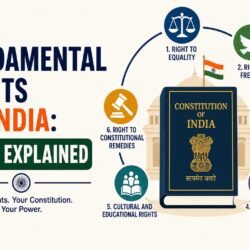
Fundamental Rights versus Directive Principles. The Assembly chose to make Fundamental Rights justiciable — enforceable in court — while placing Directive Principles of State Policy in a separate, non-enforceable but constitutionally mandated category. This division structured decades of subsequent constitutional interpretation, including landmark Supreme Court decisions on property rights and economic policy. [SOURCE: ConstitutionofIndia.net, 4 Nov 1948 debate; Constitution of India, Legislative Department]
Across 114 days of debate on the Draft Constitution, the Assembly considered 7,635 amendments tabled by members. Of these, 2,473 were formally moved and disposed of. Every article of the Constitution went through this scrutiny before adoption. [SOURCE: Lok Sabha Secretariat, Constituent Assembly page]
26 November 1949: Adoption and Legacy
On 26 November 1949, the Constituent Assembly formally adopted the Constitution of India. On 24 January 1950, 284 members signed the authenticated copies. On 26 January 1950 — chosen deliberately to coincide with the twentieth anniversary of Purna Swaraj Day — the Constitution came into force. [SOURCE: Lok Sabha Secretariat, Constituent Assembly page]
The distinction between these three dates matters, and confusion between them is common:
- 26 November 1949 — Constitution adopted (this is why 26 November is observed as Constitution Day / Samvidhan Divas in India)
- 24 January 1950 — Constitution signed by 284 members
- 26 January 1950 — Constitution came into force (this is Republic Day)
The Constituent Assembly did not dissolve immediately on 26 January 1950. It continued to function as the Provisional Parliament of India until the first general elections were held and the first Lok Sabha was constituted in 1952. [SOURCE: Sansad.in, Constituent Assembly page]
Who Was in the Assembly? A Note on Representation
The Constituent Assembly was not a perfect cross-section of India, and it is important to say so without distorting what it actually was. Because it was indirectly elected by provincial legislatures, voters with full adult suffrage did not choose it. The Indian National Congress dominated its proceedings. Certain communities and regions were under-represented by the structure of the Cabinet Mission Plan.
At the same time, the Assembly was not homogeneous. It included lawyers, landowners, industrialists, educationists, princes, scheduled caste representatives, tribal members, women, and figures from across the political spectrum who accepted the Congress’s constitutional project even if they disagreed with it on specific questions. Fifteen women members are highlighted in official commemorations, among them Hansa Mehta and Dakshayani Velayudhan, both of whom made substantive contributions to debates on rights and social equality. [SOURCE: Lok Sabha Secretariat; ConstitutionofIndia.net, Constitution Framers page]
The Assembly’s debates — 12 volumes available through the Lok Sabha Secretariat — record genuine disagreement and real deliberation. Members argued about federalism, rights, language, minority safeguards, and the nature of citizenship with a seriousness that refutes the “rubber stamp” characterisation sometimes applied to it. [SOURCE: ConstitutionofIndia.net, Constitution Assembly Debates page]
Frequently Asked Questions
Q: What was the Constituent Assembly of India?
The Constituent Assembly of India was the body that framed India’s Constitution. Constituted under the Cabinet Mission Plan of 1946, it first met on 9 December 1946, worked through committees and open debates over nearly three years, adopted the Constitution on 26 November 1949, and signed it on 24 January 1950 before it came into force on 26 January 1950. [SOURCE: Sansad.in, Constituent Assembly page]
Q: Who was the Chairman of the Drafting Committee of the Indian Constitution?
Dr. B. R. Ambedkar was the Chairman of the Drafting Committee, appointed on 29 August 1947. He was the most visible and authoritative defender of the draft before the full Assembly, but the Constitution also drew on B. N. Rau’s earlier draft, committee reports from bodies chaired by Nehru and Patel, and decisions taken by the Assembly itself. [SOURCE: Lok Sabha Secretariat; ConstitutionofIndia.net, August 1947 blog]
Q: Was the Constituent Assembly directly elected by Indian citizens?
No. It was indirectly elected by provincial legislators under the Cabinet Mission Plan. Only Indians eligible under the limited franchise of the 1935 Government of India Act voted. The Constitution that the Assembly subsequently produced established universal adult suffrage under Article 326 for future elections. [SOURCE: ConstitutionofIndia.net, Cabinet Mission Plan; Article 326]
Q: How long did the Constituent Assembly take to write the Constitution?
Parliament’s official summary records that the Assembly completed its task in approximately two years, eleven months, and seventeen days, across eleven sessions. Of those, 114 days were devoted specifically to debate on the Draft Constitution. [SOURCE: Sansad.in, Constituent Assembly page]
Q: Did Ambedkar write the Constitution alone?
No — and Ambedkar himself said so. In his 25 November 1949 speech, he acknowledged B. N. Rau’s foundational draft, the work of the Drafting Committee members, and the contribution of chief draftsman S. N. Mukherjee. The “Ambedkar alone wrote it” framing, however well-intentioned, does not reflect the record. He was the Chairman of the Drafting Committee and its most consequential public figure; he was not the sole author. [SOURCE: ConstitutionofIndia.net, 25 Nov 1949 debate]
Q: Is Hindi the national language of India under the Constitution?
No. Article 343 of the Constitution designates Hindi in the Devanagari script as the official language of the Union, with English retained for a transitional period. The Constitution does not use the phrase “national language” or declare any language to hold that status. [SOURCE: ConstitutionofIndia.net, Article 343]
Key Takeaways
- The Constituent Assembly was formed under the Cabinet Mission Plan of 1946 and was indirectly elected, not chosen by universal adult suffrage.
- It had 389 members originally, reduced to 299 after Partition, and worked through eleven sessions and 165 sitting days.
- The Constitution was a collective product: committee reports, B. N. Rau’s draft, Drafting Committee refinements, public comments, and 114 days of article-by-article Assembly debate all shaped the final text.
- Dr. B. R. Ambedkar chaired the Drafting Committee and was its most important defender; he was not the sole author, and he said so himself.
- Three dates matter and should not be confused: Constitution adopted (26 November 1949), Constitution signed (24 January 1950), Constitution in force (26 January 1950).