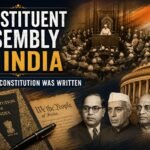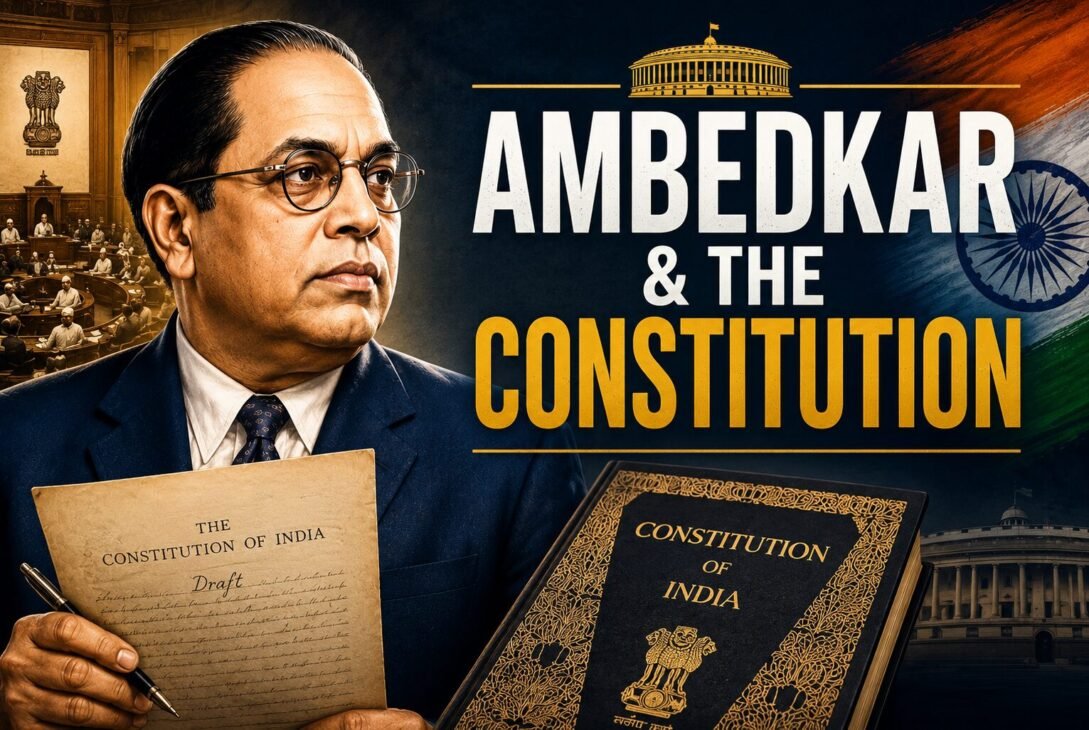
B.R. Ambedkar is routinely called the “architect” or “father” of the Indian Constitution. The label is everywhere — in civics textbooks, Supreme Court judgments, commemorative speeches, and political slogans. But what did Ambedkar actually do in the making of the Constitution, and why does it matter?
The honest answer is more interesting than the slogan. Ambedkar chaired the Drafting Committee, introduced the Draft Constitution on 4 November 1948, defended key provisions — especially Article 32 — in the Constituent Assembly, and delivered a closing speech on 25 November 1949 that remains one of the most serious pieces of democratic political thought in Indian history. He also resigned as Law Minister in 1951 over the government’s failure to pass meaningful social reform, a decision that is inseparable from his constitutional vision.
This article is built on primary sources: the Constituent Assembly debates, the 1947 Sub-Committee on Fundamental Rights report, the text of the Constitution, and Ambedkar’s own 1951 resignation statement. The aim is not to celebrate or diminish — it is to explain precisely what Ambedkar contributed, how the constitution-making process actually worked, and why his contribution was as specific and consequential as it was.
The Office He Held and What It Required
The Constituent Assembly resolved on 29 August 1947 to appoint a Drafting Committee. Ambedkar was elected to it and became its Chairman. The Committee held its first meeting the following day, 30 August 1947. [SOURCE: Constituent Assembly debate, 29 August 1947 — constitutionofindia.net]
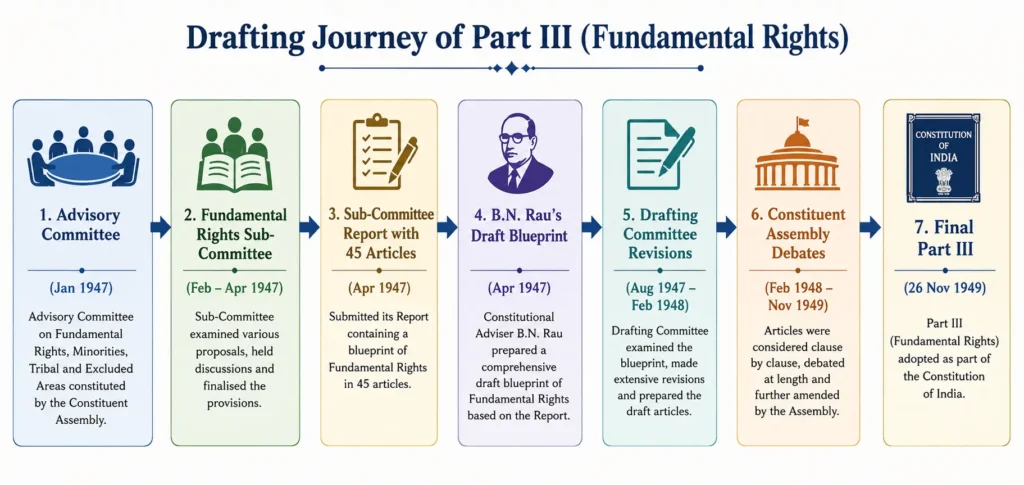
The Drafting Committee’s task was not to invent the Constitution from scratch. By the time it met, substantial groundwork already existed. Several specialist committees had been working for months. The Constitutional Adviser, Sir B.N. Rau, had prepared an earlier draft blueprint. The Assembly had already taken resolutions on major questions. What the Drafting Committee had to do — and this is not a small thing — was convert all of that material into a single, legally coherent constitutional text.
The Draft Constitution was submitted to the President of the Constituent Assembly on 21 February 1948 and formally introduced before the Assembly by Ambedkar on 4 November 1948. On that date, the draft contained 315 Articles and 8 Schedules. [SOURCE: Constituent Assembly debate, 4 November 1948 — constitutionofindia.net]
Ambedkar himself, in his final Assembly speech, was clear that the credit for the Constitution did not belong to him alone. He acknowledged the contributions of B.N. Rau, the other members of the Drafting Committee, and chief draftsman S.N. Mukherjee, who he said had no equal in the world when it came to drafting difficult constitutional text. The Drafting Committee, Ambedkar said, sat for 141 days. The Constituent Assembly spent 114 of its 165 sittings on the Draft Constitution. [SOURCE: Constituent Assembly debate, 25 November 1949 — constitutionofindia.net; and Dr. Ambedkar’s speech as reproduced in the official government archive]
This is worth stating plainly: the Constitution was produced through a collective process involving committees, political parties, elected representatives, and multiple rounds of revision. Ambedkar’s role was central, not sole.
How Part III, the Fundamental Rights, Was Actually Drafted
One of the most common claims about Ambedkar is that he “drafted Part III” of the Constitution — the chapter on Fundamental Rights. The reality is more layered, and understanding it actually makes his contribution clearer, not smaller.
The Advisory Committee on Fundamental Rights, Minorities, and Tribal and Excluded Areas was established on 24 January 1947. Within it, the Sub-Committee on Fundamental Rights — chaired by J.B. Kripalani, with Ambedkar as a member — began work on 27 February 1947 and submitted its report on 16 April 1947. That report proposed 45 articles and crucially distinguished between justiciable rights (enforceable through courts) and non-justiciable principles (norms to guide State policy). [SOURCE: Report of the Sub-Committee on Fundamental Rights, 1947 — constitutionofindia.net]
That distinction became the foundation for Parts III and IV of the Constitution as it was finally adopted.
Sardar Vallabhbhai Patel told the Assembly on 29 April 1947 that the legal wording of the justiciable rights should be left for formal drafting at the next stage. The Drafting Committee, chaired by Ambedkar, then took the rights as worked through by the committees and shaped them into the precise constitutional language found in the final text. [SOURCE: Constituent Assembly debate, 29 April 1947 — constitutionofindia.net]
Ambedkar’s contribution to Part III was therefore real and significant, but it operated within a staged collective process. A more accurate description is that he was one of the most influential participants in the rights drafting pipeline from 1947, and then, as Drafting Committee Chairman, the person most responsible for converting that pipeline’s outputs into final constitutional form.
Article 32: Why Ambedkar Called It the Constitution’s Heart and Soul
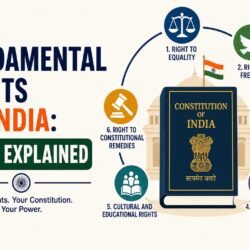
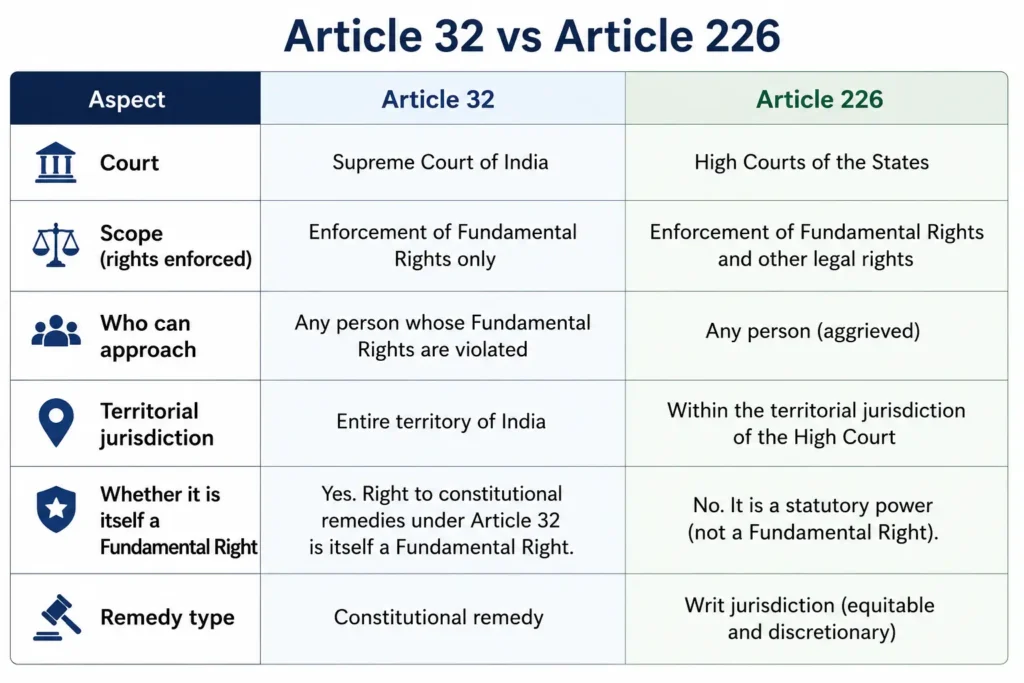
If there is one constitutional provision most directly associated with Ambedkar’s own theory of rights, it is Article 32. The article guarantees every person the right to move the Supreme Court of India for the enforcement of Fundamental Rights. Clause (2) empowers the Supreme Court to issue writs — including habeas corpus, mandamus, prohibition, quo warranto, and certiorari — for that purpose. [SOURCE: The Constitution of India — legislative.gov.in]
In the Constituent Assembly debate on 9 December 1948, Ambedkar defended what was then numbered Draft Article 25 (the article that became Article 32). He made an argument that goes to the heart of his constitutional philosophy: rights become real only when backed by remedies. Without an enforceable mechanism to protect them, Fundamental Rights are little more than declarations. He argued that ordinary legislation should not be able to strip citizens of this remedial pathway — the right to approach the Supreme Court had to be constitutionally guaranteed, not contingent on parliamentary goodwill. [SOURCE: Constituent Assembly debate, 9 December 1948 — Bombay High Court archival reproduction of Constituent Assembly Debates]
It was in this context that Ambedkar described Article 32 as “the very soul of the Constitution and the very heart of it.” The phrasing is widely quoted, but the argument behind it is often left unexplained. Ambedkar was not being rhetorical. He was making a specific jurisprudential point: that a constitution which grants rights without guaranteeing the institutional means to enforce them has not, in any meaningful sense, granted rights at all.
Article 32 is also why Ambedkar matters so much to constitutional law practitioners today. When the Supreme Court of India hears a writ petition about a violation of Fundamental Rights, the jurisdictional foundation is the article that Ambedkar defended on 9 December 1948.
It is also worth distinguishing Article 32 from Article 226 of the Constitution, which empowers High Courts to issue writs. Article 226 has a broader scope — it applies not just to Fundamental Rights but to any legal right — while Article 32 is specifically tethered to the enforcement of Part III rights and is itself a Fundamental Right. The distinction matters both doctrinally and practically: filing under Article 32 takes you directly to the Supreme Court, while Article 226 is the High Court route.
The 25 November 1949 Speech: Four Warnings for the Republic
Ambedkar’s final speech to the Constituent Assembly, delivered during the third reading on 25 November 1949, is one of the most important political texts in modern Indian history. It is also one of the most misquoted. A few phrases get plucked out of context. The full argument — which is substantive, measured, and genuinely prescient — is rarely presented whole.
The speech made four interconnected warnings.
First: use constitutional methods. Ambedkar argued that in a country with a functioning constitutional order, civil disobedience and extra-constitutional agitation are no longer justified as means of political change. Where constitutional pathways exist — elections, legislation, courts — they must be used. He described the abandonment of constitutional methods as “the grammar of anarchy.” This was not an argument against protest or dissent in principle; it was an argument that lawful democratic procedures, once available, should not be bypassed. [SOURCE: Constituent Assembly debate, 25 November 1949 — official government archive]
Second: beware hero-worship. Ambedkar warned that placing too much faith in individual leaders — at the cost of institutions, principles, and democratic accountability — was a path to dictatorship. This was a remarkable thing to say in 1949, in a room full of people who had just witnessed charismatic nationalist leadership. He borrowed John Stuart Mill’s formulation: “Do not lay your liberties at the feet of even a great man.” [SOURCE: Constituent Assembly debate, 25 November 1949]
Third: build social democracy alongside political democracy. This is perhaps the argument most central to Ambedkar’s entire constitutional project. He said that political democracy — the formal equality of votes — could not survive unless it rested on a foundation of social democracy: a way of life that recognised liberty, equality, and fraternity as inseparable values. He argued these three could not be treated independently. Liberty without equality produces domination. Equality without liberty crushes initiative. Both are empty without fraternity — the recognition of common humanity that prevents their reduction to formulas. [SOURCE: Constituent Assembly debate, 25 November 1949]
Fourth: India faces a contradiction. Ambedkar said India was entering a life of contradictions. In politics, the country was recognising the principle of one person, one vote — one value. In social and economic life, it was maintaining structures of profound inequality. Unless the social and economic side caught up with the political, he warned, the people who suffered inequality would use the political machinery they had been given to pull down the constitutional structure.
That warning, articulated on the day before the Constitution was adopted, is the context in which Ambedkar’s resignation less than two years later must be understood.
Why Ambedkar Resigned as Law Minister in 1951
Ambedkar tendered his resignation as Law Minister on 27 September 1951. He remained in office until the session ended, by convention, and issued his public explanation on 10 October 1951. [SOURCE: Statement by Dr. B.R. Ambedkar in Parliament in explanation of his resignation from the Cabinet — archived primary text]
The resignation statement identified several grievances. He cited dissatisfaction with the functioning of the cabinet, the treatment of Scheduled Castes and Backward Classes, and differences over foreign policy, including his exclusion from key policy committees.
But Ambedkar was explicit that the issue that finally drove him to resign was the treatment of the Hindu Code Bill. He had stayed in office partly — in his own telling — to see the Bill through. The Hindu Code Bill was a comprehensive reform of Hindu personal law, intended to codify and modernise rules governing marriage, inheritance, adoption, and family structure. For Ambedkar, it was not an administrative measure. It was a social reform measure, and its defeat was an indicator that the gap he had warned about in 1949 — between political equality and social inequality — was not narrowing.
The Bill effectively died after a long and uneven parliamentary process. Only four clauses had been passed when the government shelved it. Ambedkar argued in his resignation statement that leaving inequality between classes and between the sexes untouched, while the Constitution promised equal rights, was not merely a policy failure. It was a moral one. It would hollow out the Constitution’s own promise over time. [SOURCE: Statement by Dr. B.R. Ambedkar in Parliament, 10 October 1951]
One common misconception should be addressed directly: Ambedkar’s resignation was not primarily due to illness, and it was not a rejection of the Constitution. His statement explicitly rejected the illness explanation. And his argument was not that the Constitution was wrong — it was that the government was failing to use it seriously to address social inequality. The resignation was an act consistent with his constitutional vision, not a contradiction of it.
Quick Reference: Ambedkar’s Constitutional Role at a Glance
| Date | Event | Significance |
| 27 Feb 1947 | Sub-Committee on Fundamental Rights begins work | Ambedkar is a member; helps shape the justiciable rights framework |
| 16 Apr 1947 | 45-article Fundamental Rights report submitted | Foreshadows Part III and Part IV of the Constitution |
| 29 Aug 1947 | Drafting Committee appointed | Ambedkar elected; becomes Chairman |
| 21 Feb 1948 | Draft Constitution submitted | Product of 141 days of Drafting Committee work |
| 4 Nov 1948 | Ambedkar introduces Draft Constitution | 315 Articles, 8 Schedules |
| 9 Dec 1948 | Article 32 debate | Ambedkar defends remedies as essential to rights |
| 25 Nov 1949 | Final Constituent Assembly speech | Warns on constitutional methods, hero-worship, and social democracy |
| 26 Nov 1949 | Constitution adopted | |
| 26 Jan 1950 | Constitution comes into force | |
| 27 Sep 1951 | Resignation tendered | Immediate trigger: Hindu Code Bill |
| 10 Oct 1951 | Resignation statement issued | Full explanation of reasons |
[SOURCE: Constituent Assembly debates and official archives — constitutionofindia.net; legislative.gov.in]
Frequently Asked Questions
Why is B.R. Ambedkar called the architect of the Indian Constitution?
Ambedkar is called the architect because he chaired the Drafting Committee, introduced the Draft Constitution before the Assembly, and defended crucial provisions — especially Article 32 — through detailed parliamentary argument. The title is widely used and reflects real institutional centrality. It is an honorific; however, Ambedkar himself attributed shared credit to B.N. Rau, his colleagues on the Drafting Committee, and chief draftsman S.N. Mukherjee. [SOURCE: Constituent Assembly debate, 25 November 1949]
Did Ambedkar write the Constitution alone?
No. The Constitution was produced through a collective process. The Fundamental Rights Sub-Committee, the Advisory Committee, B.N. Rau’s blueprint, the Drafting Committee, party negotiations, and 165 sittings of the full Constituent Assembly all shaped the final document. Ambedkar played a uniquely central role, but “sole author” is factually wrong. He said so himself. [SOURCE: Constituent Assembly debate, 25 November 1949]
Why is Article 32 so important to Ambedkar’s constitutional vision?
Because for Ambedkar, rights without remedies are not rights at all — they are promises. Article 32 guarantees the right to approach the Supreme Court for the enforcement of Fundamental Rights and empowers the Court to issue writs. It makes Part III justiciable and therefore real. Ambedkar called it the Constitution’s “heart and soul” on 9 December 1948 — not as a figure of speech, but as a precise statement about constitutional architecture. [SOURCE: Constituent Assembly debate, 9 December 1948]
What did Ambedkar mean by “constitutional morality”?
Ambedkar drew the concept from the historian George Grote’s work on Athens. Constitutional morality, in Ambedkar’s use, means the norms and dispositions that constitutional actors must bring to their roles — respect for procedures, restraint in the use of power, and commitment to the spirit as well as the letter of constitutional rules. It is not merely legality; it is the culture of self-restraint that makes constitutional government work. He regarded it as more important and rarer than constitutional law itself.
What was Ambedkar’s social democracy argument?
In his 25 November 1949 speech, Ambedkar argued that political democracy — equal votes — cannot survive without social democracy: a way of life built on liberty, equality, and fraternity understood as indivisible. He warned that a country with formal political equality and entrenched social inequality was living a contradiction — and that the people bearing the burden of that inequality would eventually use political power to dismantle the constitutional structure. [SOURCE: Constituent Assembly debate, 25 November 1949]
Why did Ambedkar resign as Law Minister?
In his own statement, the immediate and decisive issue was the fate of the Hindu Code Bill, which Ambedkar regarded as foundational social reform legislation. He also cited dissatisfaction with cabinet functioning, the treatment of Scheduled Castes and Backward Classes, and differences over foreign policy. His resignation was not due to illness (he explicitly denied this) and was not a rejection of the Constitution. [SOURCE: Resignation statement, 10 October 1951]
What “Architect” Actually Means
The “architect of the Constitution” label deserves one final, careful treatment before this article ends.
Architecture involves design, structural judgment, and the capacity to hold a complex system together so that its parts serve a coherent purpose. Ambedkar brought all three to the making of the Indian Constitution: institutional knowledge of constitutional law (he had studied law at Columbia and in London), a clear theory of why rights need remedies, and the parliamentary skill to defend technical constitutional provisions under sustained questioning in the Constituent Assembly.
What the label does not mean — and should not be taken to mean — is that he worked alone, that the Constitution reflects only his vision, or that the many other committees, advisers, and elected members who shaped the document made lesser contributions. The Constitution was an institutional achievement, not an individual one.
Ambedkar’s specific contribution — as a committee member who shaped the rights framework from 1947, as a Drafting Committee Chairman who carried a disproportionate share of the drafting burden, as the member who most clearly articulated why Article 32 mattered, and as the person who delivered the most searching political warning about what the Constitution would require to survive — is more than enough. It does not need inflation.
The value of going back to the primary sources is precisely this: the actual record of what Ambedkar said, argued, and warned about is more interesting, more specific, and more useful than the simplified honorific. That record is available in the Constituent Assembly debates. It rewards reading.