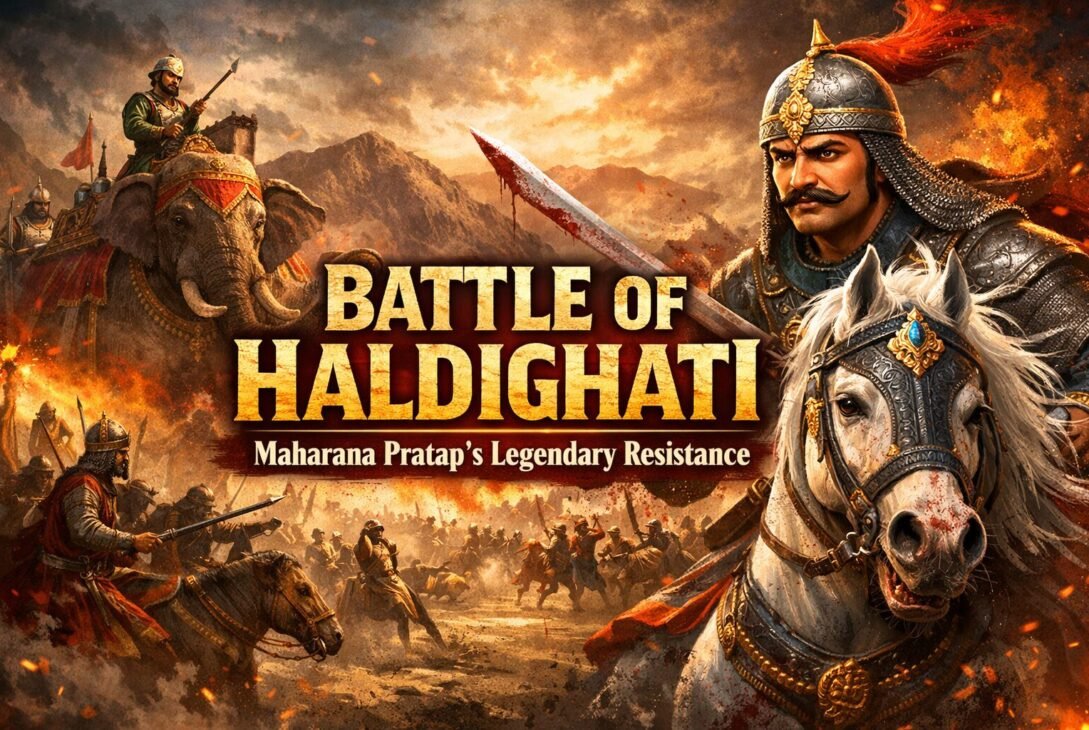
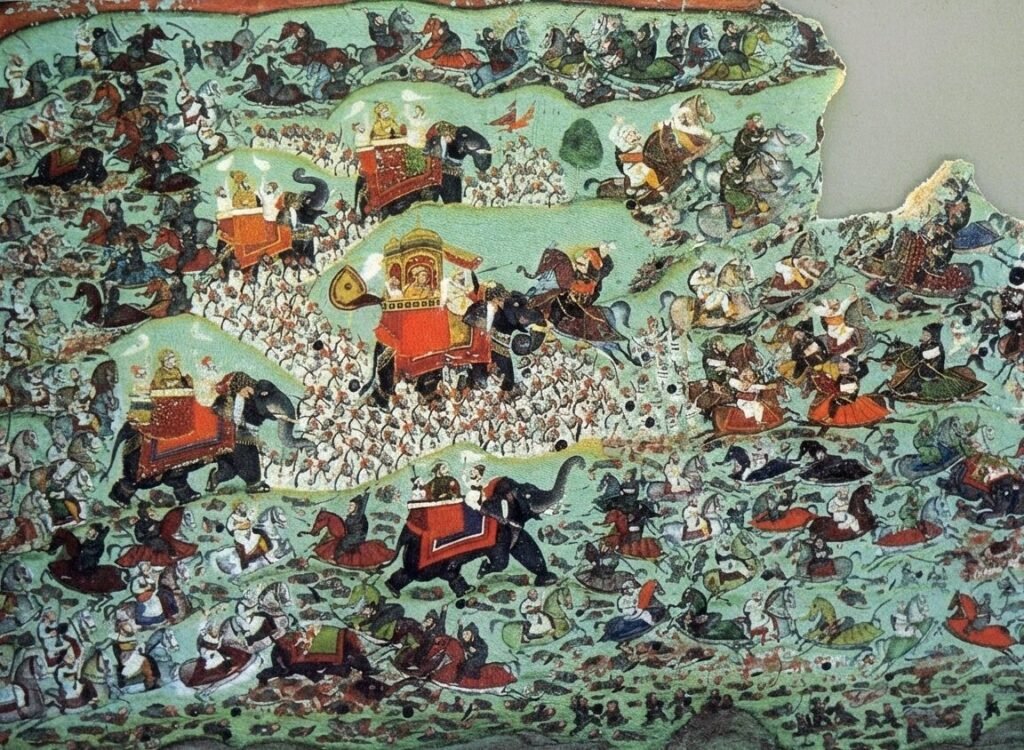
The Battle of Haldighati was fought between the forces of Maharana Pratap and the Mughal army on June 18, 1576. Historical records confirm this clash occurred in the Aravalli hills of Rajasthan’s Rajsamand district. One side had Emperor Akbar’s massive army with over 10,000 soldiers, hundreds of elephants, and gunmen. The other side had only 3,000 cavalry and a small number of Bhil archers led by Mewar’s lion, Maharana Pratap.
This was not merely a collision between two armies. It represented a battle between Maharana Pratap’s commitment to Mewar’s independence and Akbar’s determination to assert imperial control. Akbar, seeking to unify the Rajput states under his empire, wanted Mewar’s submission. However, Maharana Pratap was motivated by a resolve to defend his homeland and honor, expressing firmly that Mewar’s land would never become a slave to any foreign emperor.
The soil of Haldighati got its name from its turmeric-colored yellow earth. On that fateful day, this soil turned red with blood. This article explores the complete history of Maharana Pratap, the legendary story of Chetak the horse, and what happened after this epic confrontation.
The Rise of Mewar and the Birth of a Legend
Mewar’s glory and self-respect had been shining for centuries. According to historical documentation, this pride faced its toughest test in the 16th century. The Mughal Empire was establishing its roots in India during this period.
Babur, a descendant of Timur from Fergana in Central Asia, defeated Ibrahim Lodi in the First Battle of Panipat in 1526. He captured the Delhi Sultanate and laid the foundation of the Mughal Empire in India. After Babur’s death in 1530, his son Humayun ascended the throne. However, his rule remained unstable.
In 1540, Sher Shah Suri defeated Humayun and sent him into exile. During this same period, on May 9, 1540, a son was born to Mewar’s Rana Udai Singh and his first queen, Jaivantabai. They named him Pratap. This marked the beginning of a new era for Mewar.
Early Life and Training
Pratap’s mother was a devotee of Lord Krishna. She taught Pratap the stories of the Mahabharata and Lord Krishna’s teachings from childhood. She instilled ethical values in him from an early age.
Young Pratap also heard stories about his grandfather Rana Sanga and great ancestor Bappa Rawal. Rana Sanga had defended Mewar against foreign invaders. Bappa Rawal had made Mewar a powerful state. These stories planted deep roots of patriotism and self-respect in Pratap’s mind.
Pratap’s childhood was spent between the gurukul and Bhil tribal communities. Mornings involved learning Vedas, scriptures, and martial arts at the gurukul. Afternoons were spent in Bhil settlements. The Bhils lovingly called him “Kika” because they addressed their sons by this name in their community.
Living among the Bhils, Pratap developed physical strength and quick mastery in horse riding, swordplay, and archery. As Rana Udai Singh’s eldest son, he was recognized as the crown prince.
Akbar’s Expansion and Mewar’s Defiance
Meanwhile, in 1542, Humayun’s son Jalaluddin Akbar was born in Amarkot, Sindh. Akbar was placed on the Delhi throne in 1556 at just 13 years of age. Since Akbar was young, real power rested with his regent, Bairam Khan.
Soon, Akbar removed Bairam Khan and took complete control. Under his expansionist policy, he defeated Baz Bahadur of Malwa in the Battle of Sarangpur in 1562. He began continuously expand the Mughal Empire.
Akbar’s focus turned to Rajasthan because strategically important trade routes to Gujarat’s coast passed through this region. The valor of Rajputs was at its peak during this time. Akbar wanted them to bow before him.
He used every method to persuade and pressure them. Sometimes showing military might, sometimes using diplomacy, and sometimes creating marriage alliances. He brought many Rajput states under Mughal control. Raja Bharmal of Amer married his daughter Harkhabai to Akbar and made a treaty with the Mughals.
Gradually, Amer, Marwar, and Bundi came under Akbar’s control, increasing his power. Yet, as other Rajput states submitted, Mewar alone stood firm.
The Siege of Chittorgarh
Rana Udai Singh of Mewar refused to bow his head in Akbar’s court. He sent Akbar a clear message that he was only a servant of Lord Eklingji. He would never accept subordination to any human ruler.
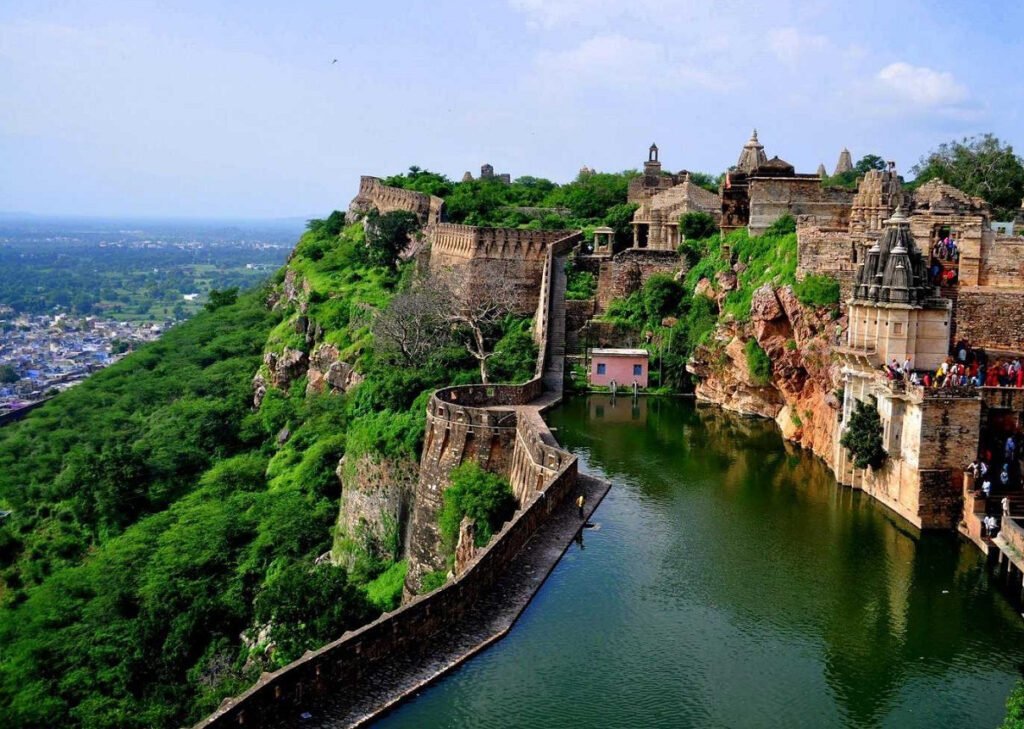
This response infuriated Akbar. He decided to bring Mewar under his control. Akbar planned to besiege Chittorgarh Fort. This fort was considered impenetrable due to its natural position and strong walls. Its high hills, steep slopes, and massive walls made it nearly invincible.
Akbar’s army adopted a long siege strategy instead of a direct attack. They surrounded the fort, built earthen mounds, attacked with cannons, and exploded gunpowder in tunnels. After months of siege and explosive attacks, the fort walls finally broke. The Mughal army entered.
Brave Rajputs chose to fight rather than surrender. Jaymal Rathore and Patta Sisodia, wearing saffron clothes, fought until their last breath. When it became clear that standing against Akbar’s massive army was impossible, Rajput women jumped into the fire of Jauhar to protect their honor.
After capturing the fort, the Mughal army massacred approximately 30,000 to 40,000 innocent civilians in anger and revenge. This cruelty became a deep stain on Akbar’s liberal image.
Maharana Pratap Ascends to Power
Due to the Mughal capture of Chittorgarh Fort, Rana Udai Singh had to leave and take shelter in Gogunda. Young Pratap wanted to stay in Chittorgarh and fight the Mughals. However, he also left the fort at the elders’ insistence. Living in Gogunda, Rana Udai Singh established the city of Udaipur and ruled from there.
Though Pratap was Udai Singh’s eldest son, Udai Singh declared Jagmal Singh as his successor. Jagmal was the son of his favorite queen, Dheerbai. This decision went against Rajput tradition, where the throne belonged to the eldest son. Jagmal was his ninth son.
Pratap accepted his father’s wish with respect. However, Mewar’s people were unhappy with this decision. The situation worsened when Rana Udai Singh died in 1572. Everyone except Jagmal Singh attended his last rites. Jagmal was getting himself coronated in the palace at that time.
This irresponsible behavior angered the nobles and common people further. In everyone’s eyes, Pratap was the rightful heir. The nobles and chieftains removed Jagmal from the throne. They performed Pratap’s coronation in the hills of Gogunda and declared him Rana of Mewar. In Rajput states, kings were called Rana. Thus, Pratap became Maharana Pratap.
The Oath of Freedom
When Maharana Pratap took power, Mewar’s condition was extremely poor. The treasury was empty. Mughals occupied Chittorgarh and large parts of Mewar. Surrounding states had already submitted to Akbar.
The pain of Chittorgarh’s defeat pierced Maharana Pratap’s heart like a thorn. Upon taking power, he called his chieftains and took an oath. The Mughal flag waving over Chittorgarh Fort tormented his heart.
He swore that until he completely liberated Mewar, he would not live in palaces. He would not sleep on beds. He would not eat in gold and silver vessels. Standing 7 feet 5 inches tall and weighing 110 kilograms, these words roared from Maharana Pratap’s mouth like a lion’s roar. They filled his chieftains with such enthusiasm that they were ready to face anyone.
Diplomatic Attempts Before Battle
Maharana Pratap first strengthened his defenses. He knew war with the Mughals was inevitable. He consolidated his hold on the Chappan and Gondwad regions of Mewar. He deepened his old relationships with the Bhils living in the Aravalli forests.
Blacksmiths were assigned the responsibility of making new weapons. Chieftains were given continuous practice in warfare. The spirit of sacrifice for their motherland was awakened among the people.
When Akbar learned of Maharana Pratap’s preparations, he was surprised. He knew Maharana Pratap would not surrender easily like other Rajput kings. Instead of a forceful attack, he first tried diplomacy.
In 1573, Akbar sent his courtier Jalal Khan Qorchi to Mewar. He appealed to Maharana Pratap to accept Mughal subordination. Pratap clearly refused. After this, Akbar sent Raja Man Singh of Amer, one of his court’s Navratnas. Man Singh was loyal to the Mughals and was also Akbar’s relative.
The Famous Feast at Udai Sagar
Before Man Singh, his father Bhagwant Das and Raja Todarmal had also come to persuade Maharana Pratap on Akbar’s behalf. All failed. But Man Singh thought he could convince Maharana Pratap to bow before Akbar.
He came to Udaipur with this intention. Maharana Pratap’s son Amar Singh welcomed him grandly. A feast was arranged for Man Singh on a mound near Udai Sagar Lake. Food was served on gold and silver plates.
However, Man Singh did not see Maharana Pratap anywhere. This deeply hurt his pride. He told Amar Singh he would not touch the food until Maharana himself sat and ate with him. Amar Singh told Man Singh that Maharana had stomach pain and could not dine with him.
Even hearing this, Man Singh insisted on his demand. When this matter reached Maharana Pratap, he sent a message that made Man Singh’s face turn pale. Maharana’s message was that he could not eat with a Rajput who had married his aunt to a Turk.
Maharana Pratap never considered Akbar an Indian. He always addressed Akbar as “Turk,” referring to where Akbar’s ancestors had their roots. Man Singh was infuriated. He did not eat and mounted his horse. He told Amar Singh that rejecting Mughal rule was a challenging struggle.
He declared he would crush Maharana’s pride. Their next meeting would be on the battlefield. Bhim Singh Dodiya, standing with Amar Singh, taunted Man Singh, saying that when he comes to fight, he should not forget to bring his uncle Akbar along.
After Man Singh left, Maharana Pratap had the vessels washed in which food had been served to him. This was to cleanse the sin that Man Singh had committed by marrying his aunt to Akbar.
The Battle of Haldighati: A Detailed Account
When Man Singh reached Akbar’s court and narrated the story of his humiliation, Akbar was furious. He had sent many envoys before. Every time, Maharana Pratap had clearly refused to bow before the Mughals. Filled with anger, Akbar decided to teach Mewar a lesson.
He gave Man Singh the responsibility of leading the army to subjugate Mewar. By now, two of Maharana Pratap’s brothers were also with Akbar. When Jagmal Singh was removed from the throne, he left Mewar and came to Akbar’s shelter. Akbar gave him the estate of Jahazpur so he would support him against Maharana Pratap.
Earlier, another brother, Shakti Singh, was also living on Akbar’s mercy. Thus, two of Maharana Pratap’s brothers had joined hands with the enemy.
Army Compositions
A massive Mughal army was prepared under Man Singh’s leadership. It included approximately 10,000 soldiers, hundreds of elephants, cavalry, archers, and gunmen. Asaf Khan was appointed second commander. The army included many well-known Muslim warriors like Ghazi Khan, Badakshi, Syed Ahmed Barha, Mehtar Khan, and Ali Murad.
Many Rajput chieftains were also fighting for the Mughal army against Maharana Pratap. These included Lonkaran Kachwaha, Madhav Singh, and Jagannath Kachwaha.
The Mughal army entered from Mewar’s northeastern part and camped at the town of Mandalgarh to prepare for war. Meanwhile, Maharana Pratap had been waiting for battle. Mewar’s army was strategizing in Gogunda.
Maharana Pratap’s army had approximately 3,000 cavalry and 400 Bhil archers. The Mughal army was four times larger. However, no one could match Pratap’s army in courage and persistence.
With him were brave Rajput chieftains like Jhala Singh of Badi Sadri, Krishnadas Chundawat of Salumber, and Rawat Netsi. Rao Punja, chief of the Bhil tribe, also supported the Rana. Another special warrior was Hakim Khan Sur, a descendant of Sher Shah Suri, who was with Mewar’s army due to his ancestral enmity against the Mughals.
When Was the Battle of Haldighati Fought
Maharana Pratap planned to trap the larger Mughal army in Haldighati’s pass. The valley got its name from its yellow turmeric-colored soil. The path through this valley was so narrow that many soldiers could not pass through at once.
On the morning of June 18, 1576, activity began in both camps before sunrise. Maharana Pratap divided his 3,000 cavalry into two parts. A smaller part was under Hakim Khan Sur’s leadership. This included warriors like Ramdas Rathore, Krishnadas Chundawat, and Rawat Netsi. The main part of the army was under Rana Pratap’s leadership. This unit included Raja Ramshah Tomar and Jhala Singh.
As the sun’s first rays fell on Haldighati, the war trumpet sounded. The Mughal army’s advance frontline unit moved toward Haldighati’s western part under Syed Hashim Barha’s leadership.
Maharana Pratap’s army was already prepared. As soon as the Mughal army approached, Mewar’s small unit launched a sudden, lightning-fast attack. This sudden, sharp attack completely scattered the Mughal frontline unit.
The rough terrain and thorny paths troubled the Mughal soldiers further. Confusion spread. Hashim Barha’s unit retreated and collided with another unit of their own army led by Asaf Khan and Jagannath Kachwaha. In this chaos, the Rajput soldiers of the Mughal army fled like sheep.
The Fierce Combat
Meanwhile, Maharana Pratap’s main unit launched a powerful attack on the Mughal army’s second unit at Haldighati’s mouth. This unit was led by Qazi Khan and the Sheikhzadas of Shikri. This attack under Maharana Pratap’s leadership was so powerful that Qazi Khan’s unit was devastated. Panic spread in the Mughal army.
When the battle moved from upper Haldighati to the open fields of Khamnor, both armies got space to maneuver. The fighting became even more fierce. Mewar’s army completely shook the Mughal army in their initial attacks.
When havoc spread across the Mughal army, Man Singh decided to enter the battlefield himself. Meanwhile, gunmen in the Mughal army started firing bullets at Mewar’s army. Spears and swords could not counter bullets. This time, Mewar’s army suffered heavy damage. Many soldiers were killed.
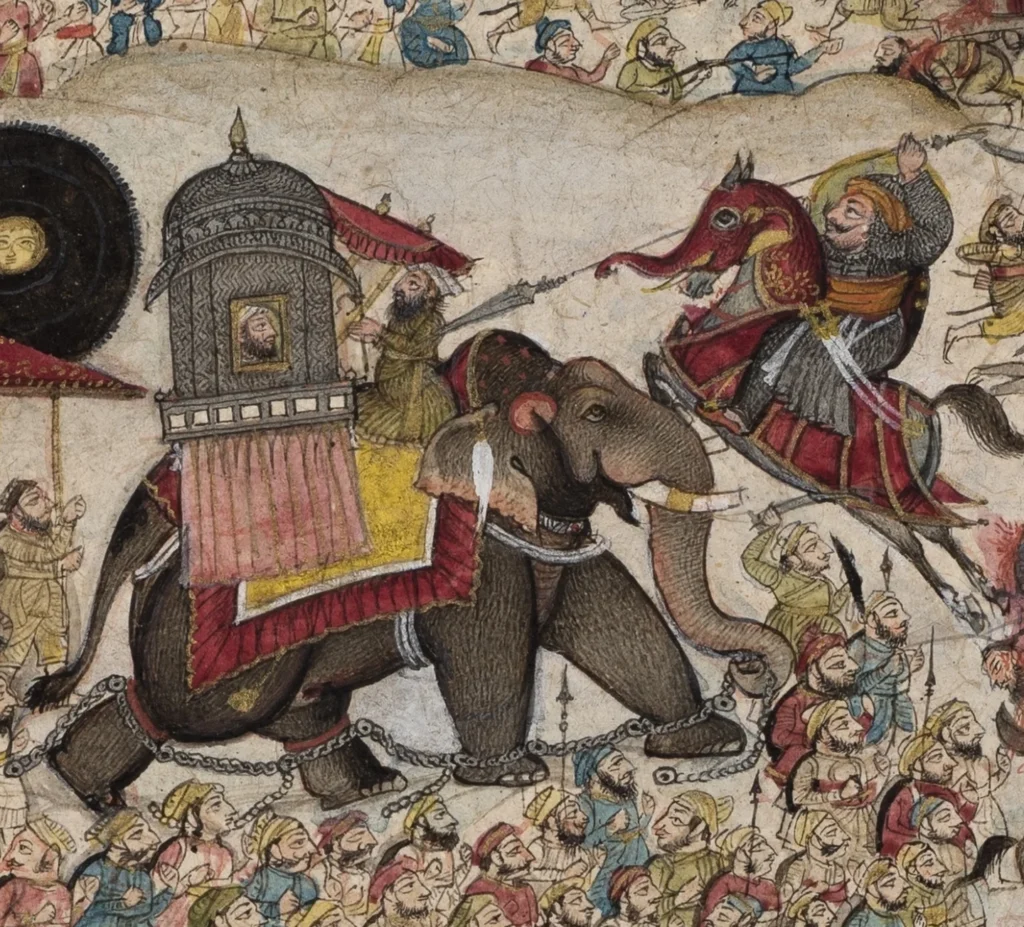
When Maharana Pratap felt the Mughal army was gaining the advantage, he ordered elephants onto the battlefield. The Mughal army’s elephant named Gajmukta entered the field. Mewar’s elephant Lona confronted it. Lona badly injured Gajmukta, who was about to flee when a bullet killed Lona’s mahout. This took Lona out of the battle.
Then Mewar’s most famous elephant, Ramprasad, joined the battle. Ramprasad was so massive that he caused heavy destruction in the Mughal army. Even the Mughal elephants Gajraj and Ranmandinagar could not stand long against Ramprasad. But then an arrow killed Ramprasad’s mahout too. The Mughal army captured Ramprasad.
This was the biggest success for the Mughals in this battle. This elephant was later presented as a gift to Akbar, who had heard many tales about it. Akbar changed its name from Ramprasad to Peer Prasad and offered it the finest foods. But this elephant’s loyalty to Maharana Pratap was such that he refused every delicious food. Without eating or drinking anything from the Mughals, Ramprasad died after 18 days.
The Legendary Chetak Horse Story
After Ramprasad was captured, Maharana Pratap’s sword began shining even more brightly. Mounted on his beloved horse Chetak, he was fighting among the Mughal army like lightning striking.
His sword turned wherever it went, and enemies’ heads separated from their bodies. Meanwhile, his brave chieftain Bhim Singh Dodiya spotted Mughal commander Man Singh from a distance. Man Singh was leading the battle while seated on his elephant.
Bhim Singh did not think for a moment. He threw his spear with full force toward Man Singh. The spear missed its mark slightly, and Man Singh barely escaped. Meanwhile, Mughal soldiers surrounded Bhim Singh.
Despite being alone, chieftain Bhim Singh Dodiya fought against hundreds of Mughal warriors simultaneously. He brought dozens of Mughal soldiers to the dust and, fighting valiantly, sacrificed his life on the battlefield.
The Charge Toward Man Singh
Seeing Bhim Singh fall, Maharana Pratap’s rage reached its peak. The flame of revenge against Man Singh blazed in his eyes. He turned his horse Chetak directly toward Man Singh’s elephant.
When the Rana’s war cry “Jai Eklingnath” pierced through the entire battle’s noise and reached Man Singh’s ears, his soul trembled. Chetak picked up such speed that no one could stop him. Amidst the shower of swords, spears, and arrows, Chetak reached Man Singh’s elephant.
Taking a great leap, Chetak placed his front legs on the elephant’s tusks. At this moment, Maharana Pratap struck Man Singh powerfully with his long spear. The spear pierced through the mahout and struck the howdah where Man Singh was hiding.
The mahout was instantly killed. The elephant went out of control and started running among the Mughal army. Seeing the elephant go out of control, Maharana Pratap thought Man Singh must have also died from the spear’s blow. So he withdrew. But this was the battle’s turning point.
If Man Singh had been killed here, the battle could have ended. But he had survived by luck.
Chetak’s Ultimate Sacrifice
During this, Maharana Pratap’s horse Chetak’s leg was badly injured. When Chetak had climbed onto Man Singh’s elephant’s trunk, a sword was tied to the trunk. Its sharp edge had wounded Chetak’s leg.
Meanwhile, Raja Ramshah Tomar also sacrificed his life protecting the Rana. He continuously fought as a shield before the Rana and kept blocking the Mughal army’s attacks. His three sons also sacrificed their lives fighting valiantly alongside their father.
Due to such brave warriors, Maharana Pratap’s army was still ahead of the Mughal army on every front. Despite being greater in number, Mughal soldiers were falling before Mewar’s army. It was clear that Maharana Pratap and his army were fighting for their self-respect and the protection of their motherland.
This is why every blow they struck was filled with passion. The Mughal army was fighting due to their emperor’s greed and expansionist policy. Their morale was crumbling before the Rana’s brave army. The scorching heat and thirst of this place had made the Mughal army’s condition even worse. Mewar’s army was accustomed to this heat.
Who Won the Battle of Haldighati
Due to these reasons, the Mughal army began fleeing the battlefield. Seeing the battle being lost, Mihtar Khan, who was with the Mughal army’s rear unit near the Banas River, played a clever trick.
He spread a false rumor by beating drums that Emperor Akbar himself was coming to join the battle with his massive army. This news filled the Mughal army with new enthusiasm. Soldiers who were fleeing started returning.
Believing this false news, Maharana Pratap’s army, which was already smaller in number, began feeling that if Akbar’s additional army arrived, they would suffer even greater losses.
In this situation, Maharana Pratap’s companion chieftains appealed that he should withdraw from the battle so he could continue the fight later. This was a tactical retreat. After his chieftains repeatedly insisted, Maharana Pratap agreed to withdraw.
Jhala Man Singh’s Supreme Sacrifice
To help Maharana escape from battle, it was necessary to distract the Mughal army. Then an old history was repeated on the battlefield.
In the Battle of Khanwa, fought in 1527 between Mughal Emperor Babur and Maharana Pratap’s grandfather, Rana Sanga, Jhala Ajja had fought disguised as Rana Sanga to save his life. Something similar happened in the Battle of Haldighati.
To safely extract Maharana Pratap, Jhala Man Singh took his royal umbrella and jumped into the battle himself. Notably, Jhala Ajja, who saved Rana Sanga’s life, was an ancestor of this very Jhala Man Singh.
Jhala Man Singh disguised himself as Maharana Pratap, penetrated deep into the Mughal army, and attained martyrdom fighting until the end with his companions. His bravery and sacrifice gave Maharana Pratap and many of his soldiers the opportunity to escape safely.
The Rana mounted his faithful horse Chetak and left the battlefield. Chetak was already badly injured from the sword on Man Singh’s elephant’s trunk.
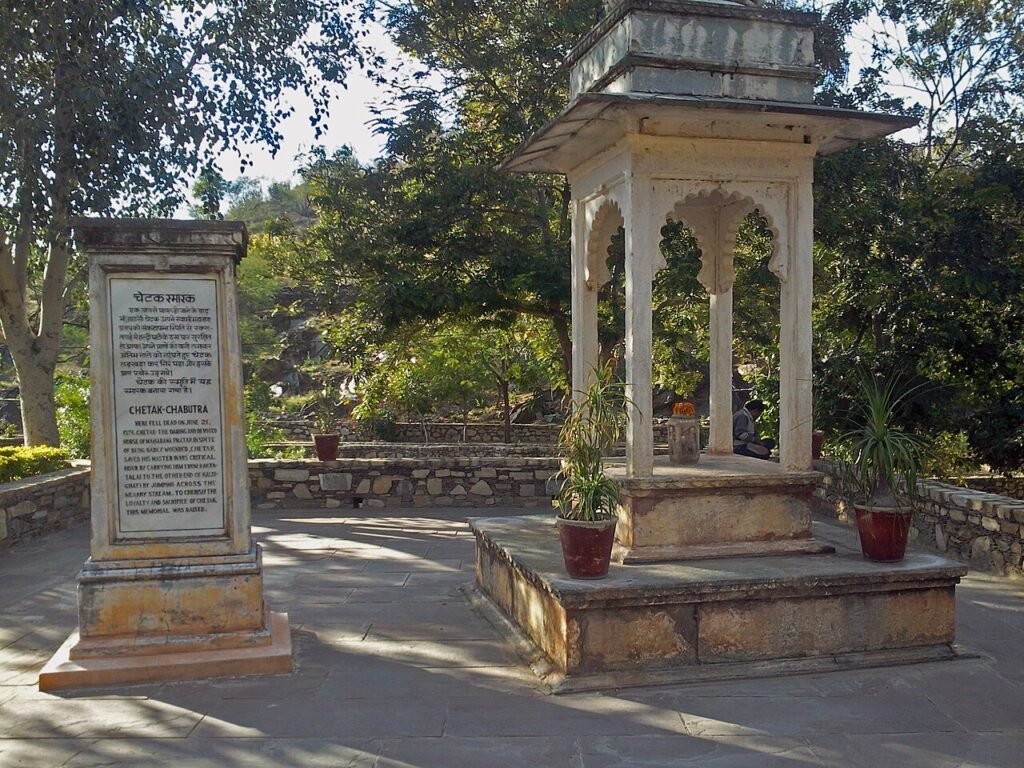
Despite this, when a very wide ditch came in Chetak’s path while fleeing, he crossed it with a powerful leap. Before breathing his last, he delivered Maharana safely to the hills. Maharana Pratap, who never accepted defeat before enemies and never weakened, placed his head on Chetak’s body and wept upon seeing him dead.
Later, he built a memorial in Chetak’s memory where he died. Man Singh and his army were so afraid of Maharana Pratap that they did not dare to chase Mewar’s army into the hills. They feared Maharana’s army might ambush them from hiding in the hills.
Source: Wikipedia
Aftermath: Guerrilla Warfare and the Battle of Dewair
The next day, Man Singh and other chieftains dug deep trenches and built high walls in Gogunda so the Rana’s army could not attack again. Despite this, Pratap cut off the supplies to the Gogunda fort. The Mughal army stationed at the fort faced food shortages. The situation became so dire that Mughal soldiers had to kill and eat their injured horses.
Maharana Pratap may have had to step back for future battles. But he had foiled Akbar’s plans. Akbar’s purpose was to capture Maharana Pratap alive and merge Mewar into the Mughal Empire. Akbar’s army failed in both objectives.
Because of this, Akbar was so angry that when Mughal commander Man Singh reached Akbar’s court after the battle, the angry Akbar closed his doors to him. Akbar did not allow the battle’s other generals, Asaf Khan and Qazi Khan, to sit in his court for a long time either. This makes it clear that Akbar was not at all happy with the Battle of Haldighati’s result.
The Guerrilla Strategy
Meanwhile, Maharana Pratap was focused on making himself even stronger. He also changed his battle strategy. His army had mastered guerrilla warfare. Instead of direct confrontation with the Mughals, he continued his attacks through this method.
With the local Bhils’ help, Maharana Pratap began waging a guerrilla war. They would ambush the Mughals and disappear into the forests. It seemed like Maharana Pratap was standing in 100 places at once. This broke the Mughal army’s morale.
The Mughals became so fearful that they did not know when or from where they would be attacked. Due to guerrilla warfare, the Mughal army that had set out to conquer Mewar remained trapped in Mewar itself.
Bhamashah’s Contribution
But Maharana Pratap would not rest until he snatched back every part of his kingdom from Akbar. He began preparing for another major battle. He told his chieftains to gather funds and build a massive army.
When Maharana Pratap’s childhood friend Bhamashah learned that Maharana needed money to raise an army, he handed over all his wealth to Maharana Pratap.
After this, Maharana Pratap raised a large army. Six years after the Battle of Haldighati, in 1582, the Battle of Dewair was fought between the Mughal army and Maharana Pratap.
His army descended like lightning on Mughal strongholds in Dewair’s passes. Akbar’s uncle, Sultan Khan, was leading the Mughal army in this battle. Maharana Pratap’s son Amar Singh killed Sultan Khan with a spear blow.
After the Mughal commander’s death, the Mughal army fled. Maharana Pratap achieved a decisive victory in this battle. 36,000 Mughal soldiers surrendered before Maharana Pratap.
This was the victory for which Maharana Pratap had stepped back in the Battle of Haldighati. Even after this victory, he did not stop. Moving forward, he destroyed 36 Mughal posts in a single day. Before long, the Rana’s army recaptured Kumbhalgarh, Gogunda, and Udaipur.
Final Campaigns and Akbar’s Last Attempt
During this period, Maharana Pratap also faced Akbar’s commander Bahlol Khan. It was said about him that he had never lost a battle. He was so cruel that he killed people in painful ways.
When Bahlol Khan faced Maharana Pratap in battle, he could not stand before him even for a short while. Maharana Pratap cut Bahlol in a single blow. It is said that this blow was such that Bahlol was split into two pieces along with his horse.
Frustrated by the defeat at Dewair, Akbar made his last attempt to defeat the Rana in 1584. He sent Jagannath Kachwaha to capture Pratap. But he was badly defeated. He returned after apologizing to Pratap and paying compensation.
Akbar now accepted that he could never cage this lion. He thought it better to leave Maharana Pratap alone. After 1585, the Mughal army’s attention turned toward the Northwest.
Taking advantage of this, Maharana Pratap recaptured most parts of Mewar. He made Chavand his new capital. Maharana Pratap wanted to teach Man Singh a lesson. He sent his son Amar Singh with an army to attack Malpura in Amer.
Soon, Amar Singh’s army defeated Man Singh’s army and captured his enormous wealth. After this, Maharana Pratap ruled Mewar for the next 12 years in such a manner that the kingdom’s lost glory returned.
How Did Maharana Pratap Die
In 1597, at the age of 56, when Maharana Pratap had gone hunting, he sustained an injury from which he never recovered. He passed away. His demise marked the end of an era.
Historical records indicate that when news of his death reached Akbar in his court at Lahore, even he wept, remembering his bravest enemy. At that time, Dursa Arha, a famous poet of Rajasthan, was also present in Akbar’s court.
The poem he wrote upon receiving news of Maharana Pratap’s death conveyed this essence: “You never let the royal brand be put on your horse. You never bowed your turban. You never let the royal seal be put on your horse. You never came to meet the emperor at Navroz.”
“Today, when the news of your death has come to court, see, the emperor’s head has bowed, and tears have flowed from his eyes. You won, Pratap.”
After hearing this poem, Akbar rewarded Dursa Arha. Thus, even after death, Maharana Pratap had won against his enemy. Through his courage and valor, he became immortal forever.
Legacy and Succession
After Maharana Pratap, his son Amar Singh became the Rana of Mewar. For nearly two decades, he too continued fighting the Mughals. But after a long struggle, in 1615, he made a treaty with the Mughals.
Under this treaty, Chittorgarh was returned to Mewar. It was decided that although Mewar would remain under the Mughals, its Maharana would never appear in the Mughal court.
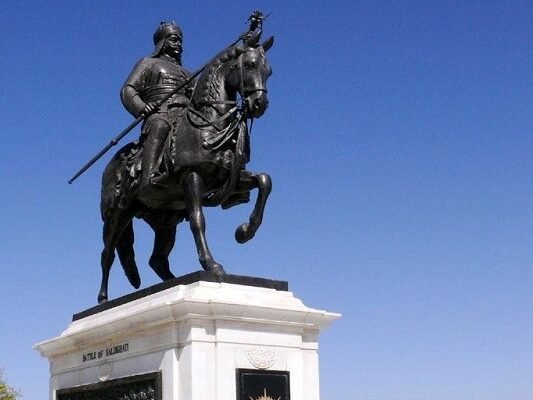
Conclusion
The Battle of Haldighati was fought between Maharana Pratap’s smaller but determined army and the massive Mughal forces. Though the battle ended inconclusively, it demonstrated that superior numbers do not guarantee victory against an unwavering spirit.
Maharana Pratap’s history teaches us about the power of self-respect, strategic thinking, and persistence. From the Chetak horse story to the Battle of Dewair, every chapter of his life inspires generations of Indians.
His guerrilla warfare tactics later influenced many freedom movements worldwide. Even Emperor Akbar, his greatest adversary, acknowledged his valor. Maharana Pratap remains a symbol of resistance against oppression. His legacy continues to fill every Indian heart with pride and courage.