The difference between states and union territories shapes India’s unique governance structure. According to the Indian Constitution, India is a union of states where power is shared between the central and state governments. However, not all regions enjoy the same administrative autonomy.
Article 1 of the Constitution declares India to be a union of states and union territories. The territory of India includes all territories of states and union territories listed in the First Schedule. This constitutional framework creates two distinct governance models within one nation.
The First Schedule outlines the names and boundaries of both states and union territories. Understanding why union territories exist reveals important insights into India’s federal system and administrative efficiency.
Historical Evolution of Union Territories in India
Union territories emerged from India’s administrative restructuring after independence. In the early years, Indian states largely followed the administrative structure of British India. Government historical records show provinces were governed through three distinct mechanisms.
Provinces operated under different administrative models based on their size and importance. Governor and executive councils managed major provinces like Bombay and Madras. Lieutenant governors oversaw smaller provinces and territories with varying degrees of autonomy.
Three-Tier British Administrative System
Chief commissioners directly controlled certain territories, reporting straight to the central government. Examples included the Andaman and Nicobar Islands and Minicoy. This direct administration model established the precedent for centralized governance in specific regions.
The system reflected British priorities for controlling strategic and smaller territories. Administrative efficiency demanded different governance approaches for regions with varying sizes and populations. This diversity in colonial administration influenced post-independence constitutional arrangements.
Constitutional Classification After Independence
When the Constitution was adopted in 1949, this administrative diversity was reflected in Parts A, B, C, and D. Each part represented a different governance model inherited from British administration. Part A included former governor provinces with elected legislatures representing major administrative units.
Part B covered princely states that also had legislatures. These were former kingdoms integrated into independent India. Part C comprised chief commissioner provinces with varying governance structures—some had legislatures while others operated with advisory councils.
Part D consisted of territories like Andaman and Nicobar that were directly administered by the center. These regions lacked any local legislative body and operated under complete central control. This classification system created administrative complexity requiring eventual reorganization.

The States Reorganisation Act of 1956
The States Reorganisation Act transformed this framework in 1956. Through the Seventh Constitutional Amendment, Parts C and D were formally designated as union territories. This restructuring simplified India’s administrative map and created clearer governance distinctions.
The reorganization aimed to rationalize administrative boundaries and governance models. It recognized that certain regions required centralized administration rather than full statehood. This constitutional change established the modern framework, distinguishing states from union territories.
Constitutional Framework: Articles 239-241
Part 8 of the Constitution, specifically Articles 239 to 241, deals with union territories. These articles establish the legal foundation for centralized administration. Article 239 empowers the President of India to govern territories directly.
The President may administer union territories personally or through an administrator appointed by him. This provision creates a direct chain of command from the central government to the union territory administration. Unlike states with elected governments, union territories operate under presidential authority.
Presidential Administration and Governance
This constitutional provision establishes the fundamental principle of central control. Union territories function as extensions of central government authority in specific regions. The President appoints administrators who serve at his pleasure and implement central policies.
Administrative decisions in union territories ultimately rest with the central government’s approval. This centralized model enables focused governance in smaller or strategically important regions. The system balances efficiency with democratic representation where appropriate.
Current Union Territories and Their Administration
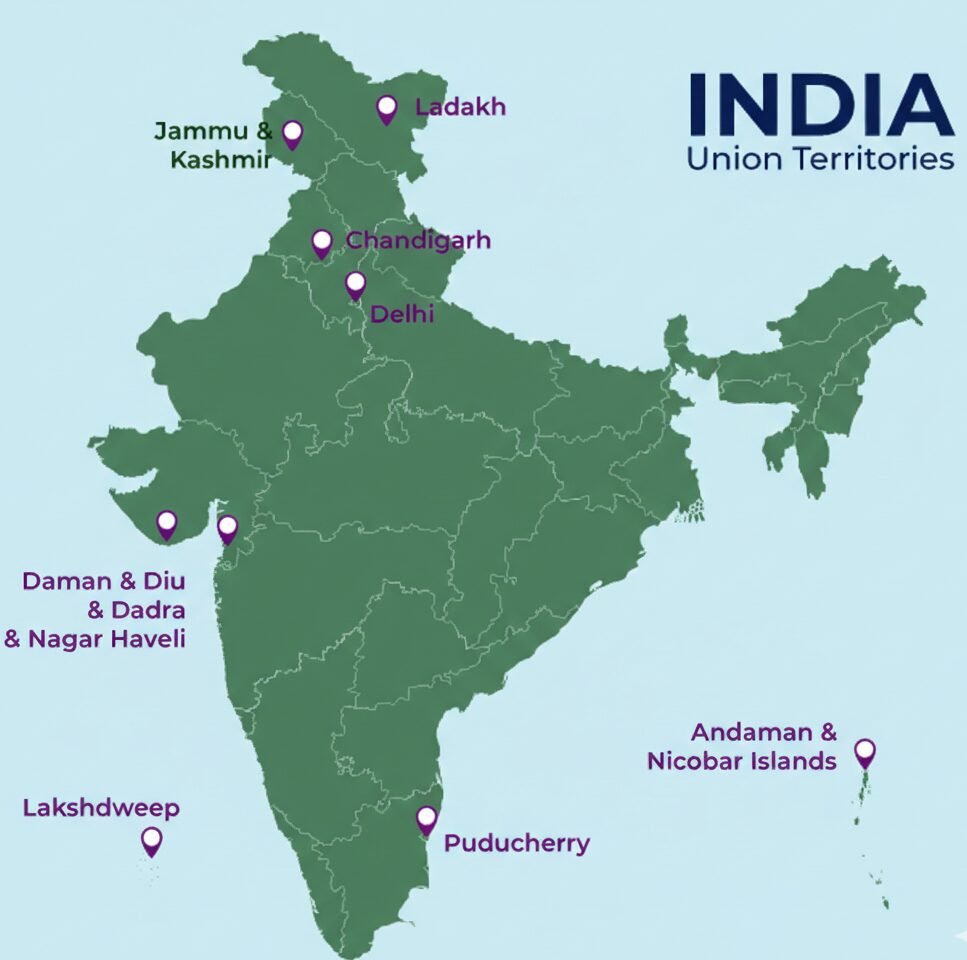
Currently, India has eight union territories. These include Delhi, Puducherry, Jammu and Kashmir, Ladakh, Chandigarh, Andaman and Nicobar Islands, Lakshadweep, and Dadra and Nagar Haveli and Daman and Diu. Each serves specific administrative, strategic, or cultural purposes.
Even though all union territories belong to one constitutional category, there is no uniformity in their administrative systems. This diversity reflects the varied reasons for creating union territories. Some require more democratic participation, while others need direct central oversight.
Union territories like Delhi, Puducherry, and Jammu and Kashmir have legislatures and partially elected governments. These territories possess larger populations, justifying representative institutions. Their elected assemblies handle certain state-list subjects under central supervision.
The remaining territories are administered directly by President-appointed lieutenant governors or administrators. These officials exercise both executive and limited legislative functions. Direct administration suits smaller populations and strategic regions requiring centralized control.
Article 240 and Presidential Regulations
Article 240 empowers the President to make regulations for union territories. These regulations address the peace, progress, and good governance of specific territories. Presidential authority enables flexible policy-making tailored to local circumstances.
These regulations hold the same authority as acts of Parliament. They can amend or repeal existing laws applicable to those territories. This regulatory power provides administrative agility unavailable in the more rigid state system.
The central government can quickly adapt policies to changing circumstances in union territories. Emergency measures, development initiatives, and security protocols can be implemented without legislative delays. This flexibility makes union territories administratively responsive to national priorities.
Why Union Territories Exist: Key Reasons
Not all regions are states because not every area is large or populous enough to function effectively. Several interconnected factors determine why certain regions remain union territories rather than becoming full-fledged states. Each reason reflects specific administrative, strategic, or cultural considerations.
Size and Population Constraints
Many regions lack the geographic size necessary to sustain state-level administration. Chandigarh is just 114 square kilometers, making it smaller than many metropolitan cities. Such compact territories cannot support the extensive administrative infrastructure that states require.
Small geographic areas face practical governance challenges. They lack the land base for diverse economic activities generating state revenues. Administrative overhead for full statehood would consume disproportionate resources relative to their economic output.
Population density and total population also play crucial roles in determining administrative status. Smaller populations may not generate sufficient revenue to maintain independent state governments. They cannot sustain the bureaucratic machinery that states require for autonomous functioning.
Union territory status allows these smaller regions to receive direct central funding and administrative support. Resources flow efficiently without state-level intermediaries. The central government can implement targeted development programs suited to specific local needs.
Administrative and Political Efficiency
Some union territories were formed specifically for smooth administrative and political efficiency. Delhi and Chandigarh fall into this category, serving special administrative purposes requiring central oversight. Their functions extend beyond regional governance to serve broader national or multi-state interests.
These territories function as administrative hubs requiring neutral governance structures. Chandigarh serves as the capital for both Punjab and Haryana, necessitating impartial administration. State control would create political complications and inter-state disputes.
Delhi serves as the national capital, requiring special administrative arrangements. Its status must balance local governance with national capital functions. Union territory status enables this delicate balance between democratic participation and central oversight.
Cultural Identity Preservation
Certain union territories exist to preserve unique cultural identities. Puducherry, Daman, and Diu maintain distinct cultural heritage, setting them apart from the surrounding regions. Their historical backgrounds differ significantly from mainland India’s cultural patterns.
These territories have unique colonial legacies, creating distinct local identities. Their cultures blend Indian traditions with French or Portuguese influences. Union territory status protects these cultural characteristics while integrating them into India’s administrative framework.
This arrangement balances cultural preservation with national unity. Direct central administration prevents cultural assimilation into neighboring states. Local traditions receive governmental protection, ensuring their continuity for future generations.
The central government can implement culturally sensitive policies respecting local heritage. Development programs account for unique cultural needs and preservation priorities. This approach maintains diversity within India’s unified administrative system.
Strategic and Security Considerations
Andaman and Nicobar Islands, Lakshadweep, Ladakh, and Jammu and Kashmir are vital for national security. Island territories protect India’s maritime boundaries and territorial waters. Their strategic locations require strong central oversight for defense purposes.
According to government historical documentation, these regions often have special administrative arrangements. The arrangements balance local interests with national priorities. Defense considerations necessitate centralized control over policy and administration.
Island territories serve as outposts protecting India’s exclusive economic zone. They house naval and air force installations critical for maritime security. Central administration ensures military requirements take precedence when necessary.
Border regions require direct central control for coordinated defense planning. Security protocols must align with national defense strategies rather than regional priorities. The central government administers them directly to ensure security, protect local cultures, and provide focused development wherever needed.
Key Differences Between States and Union Territories
The difference between states and union territories manifests in multiple aspects of governance and political representation. States have their own governments with elected leaders exercising significant autonomy. Union territories are mostly managed directly by the central government through appointed administrators.
These distinctions affect every administrative function from policy-making to resource allocation. Understanding these differences reveals how India’s federal system accommodates diverse governance needs. The constitutional framework creates flexibility while maintaining national unity.
Governance Structure and Power Distribution
States share powers with the center under a federal system. They exercise authority over subjects listed in the State List of the Constitution. State governments control education, agriculture, police, and local governance independently.
Union territories follow a unitary system where the center holds most authority. Central government decisions override local preferences in most administrative matters. This centralized control enables coordinated policy implementation across union territories.
In states, the governor acts on the advice of the elected government. The Chief Minister and Council of Ministers make policy decisions accountable to the legislative assembly. Democratic processes determine state priorities and governance approaches.
In union territories, the administrator or lieutenant governor represents the President directly. They exercise executive powers with limited accountability to local elected bodies where they exist. Administrative decisions prioritize central government directives over local preferences.
This fundamental distinction affects policy autonomy and decision-making authority. States enjoy independence in formulating policies suited to local conditions. Union territories implement centrally designed policies with limited local customization.
Legislative Assembly Powers and Functions
Every state has its own legislative assembly with full law-making powers. Elected representatives debate and pass laws on state subjects independently. State legislatures operate autonomously within their constitutional domain.
State assemblies control significant policy areas affecting daily life. They determine educational curricula, agricultural policies, and law enforcement priorities. Legislative independence enables states to address region-specific challenges effectively.
Only a few union territories have elected assemblies. Delhi, Puducherry, and Jammu and Kashmir maintain legislative assemblies representing their populations. Even these territories face limitations compared to state legislatures.
Their laws can be overridden by the central government in certain circumstances. The Lieutenant Governor exercises discretionary powers limiting legislative autonomy. The central government maintains ultimate authority over union territory legislation.
The remaining union territories lack any legislative assembly. Chandigarh, Andaman and Nicobar Islands, Lakshadweep, Ladakh, and Dadra and Nagar Haveli and Daman and Diu are governed entirely through administrative orders. All legislative functions are performed by the central government through the administrator.
Parliamentary Representation
States have representatives in both the Lok Sabha and the Rajya Sabha. This dual representation ensures state interests are voiced in both houses of Parliament. Each state receives seats proportional to its population in the Lok Sabha.
Rajya Sabha representation gives states a voice in reviewing and modifying national legislation. State legislative assemblies elect Rajya Sabha members representing state perspectives. This bicameral representation protects state interests in national policy-making.
Most union territories are represented only in the Lok Sabha. They lack representation in the Rajya Sabha, reducing their voice in parliamentary proceedings. This limited representation reflects their reduced political autonomy compared to states.
Delhi, Puducherry, and Jammu and Kashmir are exceptions among union territories. These three territories have representation in both houses due to their larger populations and legislative assemblies. However, their Rajya Sabha representation remains limited compared to states of similar population.
Parliamentary representation differences affect political influence and resource allocation. States leverage dual representation to advance regional interests nationally. Union territories rely primarily on the central government’s advocacy for their developmental needs.
Federal vs Unitary Character
States operate within India’s federal framework with constitutionally protected autonomy. The central government cannot unilaterally alter state boundaries or abolish states. Constitutional amendments requiring special majorities protect state sovereignty.
Federal principles ensure states retain significant independence in governance. Central-state relations operate through negotiation and constitutional mechanisms. States exercise coequal authority with the center in their constitutional domains.
Union territories exist under a unitary arrangement where central authority is supreme. The President controls their administration directly without constitutional limitations. Central government exercises complete authority over union territory affairs.
Parliament can reorganize union territories, merge them, or change their status through simple legislation. No special constitutional procedures protect union territory status or boundaries. This flexibility enables administrative reorganization based on changing national needs.
Role of Union Territories in India’s Federal Framework
Union territories play a vital role in India’s federal framework despite their smaller size and limited autonomy. They ensure every region, no matter how small or distinct, is efficiently governed. Each union territory serves specific purposes within the broader national administrative system.
Balancing Local and National Interests
Considering their unique history and circumstances, union territories often have special administrative arrangements. These arrangements balance local interests with national priorities effectively. Direct central administration enables focused attention on regional development needs without state-level bureaucratic complexity.
The central government can implement targeted development programs without navigating state political considerations. Resources flow directly from central ministries to union territory administrations. This streamlined approach often accelerates infrastructure development and service delivery in smaller regions.
Administrative efficiency improves when the central government directly manages compact territories. Policy implementation faces fewer bureaucratic layers and political obstacles. Union territories benefit from centralized expertise and resource allocation mechanisms.
Strategic Administrative Units
Union territories are special administrative units that balance governance, strategy, and cultural preservation. The strategic islands in the sea protect national maritime interests and territorial integrity. Administrative capitals like Delhi and Chandigarh facilitate efficient regional and national governance.
Each union territory addresses specific challenges that full statehood might not resolve effectively. Small size requires efficient administration rather than elaborate state machinery. Strategic importance demands direct central oversight rather than state-level mediation.
Cultural uniqueness needs protection that the central administration can provide consistently. Union territory status enables customized governance addressing each region’s specific requirements. This flexibility strengthens India’s ability to manage diverse territories effectively.
Ensuring Comprehensive Governance
India’s federal framework accommodates diverse administrative needs through this dual system of states and union territories. States serve large, diverse populations with significant autonomy suited to their scale. Union territories receive centralized administration appropriate for their unique requirements and smaller populations.
Constitutional provisions ensure flexibility in governance approaches across different regions. Articles 239-241 provide the legal framework for adapting administration to local circumstances. Presidential regulations under Article 240 enable customized solutions for each territory’s challenges.
This adaptability strengthens India’s governance while maintaining national unity and territorial integrity. The system recognizes that one-size-fits-all administration cannot serve all regions effectively. By creating union territories alongside states, the Constitution ensures every region receives appropriate governance.
Conclusion
Union territories play a vital role in India’s federal framework by addressing unique administrative, strategic, and cultural needs. The difference between states and union territories reflects India’s pragmatic approach to governance, accommodating geographic, demographic, and strategic diversity.
States enjoy greater autonomy suited to large populations and diverse regions requiring independent policy-making. Union territories receive centralized administration appropriate for smaller areas with special requirements needing focused central attention. This constitutional arrangement ensures efficient governance across India’s varied landscape.
From strategic islands protecting maritime boundaries to administrative capitals facilitating governance, union territories contribute meaningfully to national interests. Articles 239-241 provide the constitutional framework enabling flexible, focused administration tailored to each territory’s needs. Understanding these distinctions helps citizens appreciate how India’s federal system balances local autonomy with national priorities while ensuring every region is efficiently governed.