The Maurya Empire was not merely India’s first large empire. It was the first Indian polity to leave behind a sustained documentary record of how it governed, what it believed, and how it communicated with its subjects. That record survives not in royal chronicles or courtly literature, but in stone — in Ashoka’s edicts, cut into rock faces and polished pillars across a subcontinent that no single ruler had controlled before.
Founded by Chandragupta Maurya around 321 BCE after he overthrew the Nanda dynasty in Magadha, the Mauryan Empire grew over roughly 130 years to encompass most of the Indian subcontinent. It ended around 185 BCE when the last Mauryan king, Brihadratha, was overthrown by his commander Pushyamitra Shunga. Between those dates, the empire produced Ashoka — one of the most extensively documented rulers of the ancient world, and arguably the most consequential.
This article covers the Maurya Empire in full: its founding, its administration and economy, the Kalinga War and Ashoka’s Dhamma, the nature of its inscriptions, its foreign relations, and the multiple causes behind its eventual decline. Where historians disagree, or sources differ, this article says so — because treating all ancient sources as equally reliable is a mistake that distorts the history more than it explains it.
Quick Reference: Maurya Empire at a Glance
| Founded | c. 321 BCE |
| Ended | c. 185 BCE |
| Founder | Chandragupta Maurya |
| Capital | Pataliputra (near present-day Patna) |
| Most notable ruler | Ashoka (r. c. 268–232 BCE) |
| Greatest territorial extent | Under Ashoka — from Afghanistan to Karnataka |
| Key primary sources | Ashokan edicts, Megasthenes’ Indica (fragmentary), Arthashastra (debated date) |
| Dynasty ended | Brihadratha overthrown by Pushyamitra Shunga, c. 185 BCE |
| National connection | Sarnath lion capital → India’s National Emblem [SOURCE: ASI, Sarnath Museum] |
The Rise of the Maurya Empire
The political context that made the Mauryan Empire possible was Magadha, a kingdom in the middle Gangetic plain that had been expanding in power and territory since before the Mauryas. The Nanda dynasty, which Chandragupta overthrew, had itself made Magadha the dominant power in northern India.
Chandragupta’s foundation of the empire is conventionally dated to around 321 BCE. [SOURCE: Britannica, Mauryan Empire] The precise details of how he defeated the Nandas come mainly through later literary traditions — Buddhist, Jain, and the Greek accounts — rather than contemporary inscriptions. The tradition crediting Chanakya (also known as Kautilya) as the strategic mind behind Chandragupta’s rise is well-known and plausible, but historians treat the specific stories with caution because they come through later, layered sources rather than direct Mauryan-era documentation. [SOURCE: IDSA, One Hundred Years of Kautilya’s Arthasastra]
What is historically secure is what happened after the foundation. Around 305 BCE, Chandragupta came into conflict with Seleucus I Nicator, the Greek successor king who controlled territories stretching from Syria into Central Asia and had tried to reassert Macedonian influence in the north-west. The conflict ended in a treaty that ceded significant territories to the Mauryas, and the exchange involved 500 war elephants going to Seleucus. [SOURCE: ePG Pathshala, The Mauryan Empire; Britannica] This was not a minor transaction — 500 war elephants were a decisive military asset, and Seleucus would go on to use them at the Battle of Ipsus. The treaty also brought Megasthenes to Chandragupta’s court as a Seleucid envoy, whose observations about Pataliputra and Mauryan governance survive, fragmentarily, in later classical authors.
Chandragupta was succeeded by Bindusara, who continued the empire’s consolidation, and Bindusara by Ashoka, under whom the Mauryan Empire reached its greatest documented extent and left the richest historical record.
How Large Was the Maurya Empire?
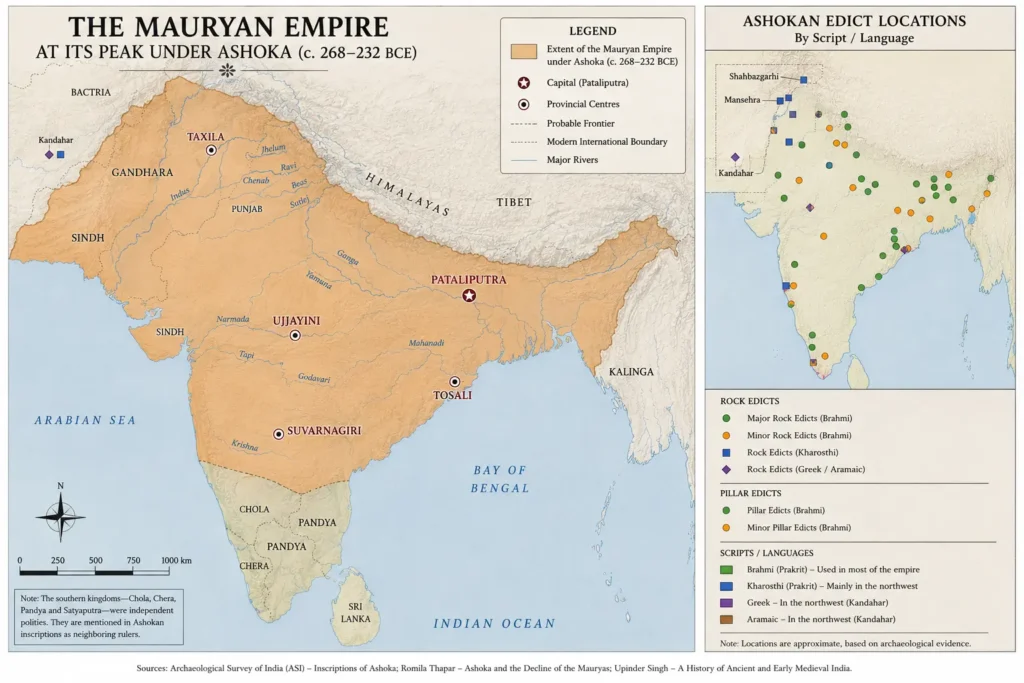
The standard textbook account places the Mauryan Empire as extending from Afghanistan to Karnataka under Ashoka. NCERT’s Themes in Indian History I is careful here: it describes the empire’s reach but also notes that the intensity of control varied across regions, and the southernmost parts of the subcontinent lay outside direct Mauryan rule. [SOURCE: NCERT, Themes in Indian History I]
Four provincial centres — Taxila in the north-west, Ujjayini in the west, Tosali in Kalinga (present-day Odisha), and Suvarnagiri in the south — served as administrative nodes. NCERT notes that Taxila and Ujjayini lay on long-distance trade routes, while Suvarnagiri was probably important for accessing gold resources. [SOURCE: NCERT, Themes in Indian History I]
The strongest evidence for the empire’s territorial extent comes from the distribution of Ashoka’s inscriptions. These appear across present-day India, Pakistan, and Afghanistan, written in Prakrit in much of the subcontinent but in Greek and Aramaic in the north-western regions, reflecting local linguistic realities. [SOURCE: NCERT, Themes in Indian History I] UNESCO’s 2025 serial nomination for Ashokan edict sites maps this distribution and treats the edict network as evidence for a communications infrastructure tied to imperial routes and provincial nodes. [SOURCE: UNESCO World Heritage Centre, serial nomination for Ashokan edict sites]
One important qualification: describing the Mauryas as ruling “all of India” in any modern territorial sense is an overclaim. The empire was the first polity to encompass most of the subcontinent — but control was exercised through a combination of direct administration in core zones and looser arrangements at the periphery.
Sources for Mauryan History: What We Actually Know and From Where
Understanding the Maurya Empire requires understanding its source base, because different sources carry different evidentiary weight. Historians who work on this period follow a clear hierarchy. [SOURCE: ePG Pathshala, Sources of Ancient Indian Polity]
Ashoka’s inscriptions come first. They are the oldest extensive, datable political texts from the Indian subcontinent, and they represent the Mauryan state speaking in something close to its own voice. They are carved on rock faces, stone pillars, and cave walls, and they are geographically distributed across the empire in a way that itself tells us something about how the state communicated.
Megasthenes’ Indica comes second. Megasthenes was the Seleucid envoy at Chandragupta’s court, and his account of Pataliputra, Mauryan governance, and Indian society is an important early source — but it did not survive intact. What we have are fragments quoted by later Greek and Roman writers such as Arrian, Strabo, and Diodorus. [SOURCE: ePG Pathshala, Sources of Ancient Indian Polity; Britannica, Megasthenes] Every claim attributed to Megasthenes must be understood as coming through this filter.
The Arthashastra is the third major source. Traditionally attributed to Kautilya or Chanakya and treated as a statecraft manual from Chandragupta’s court, its date and textual history are now seriously debated. The IDSA monograph One Hundred Years of Kautilya’s Arthasastra summarises scholarly positions that date the surviving text’s compilation to somewhere between the 2nd century BCE and the 1st–2nd century CE. [SOURCE: IDSA, One Hundred Years of Kautilya’s Arthasastra] The safest position for any article on this subject: the Arthashastra preserves important ancient statecraft traditions linked to the Mauryan tradition, but cannot be used as a straightforward administrative handbook directly reflecting Chandragupta’s court.
Buddhist and Jain literary traditions and Puranic king-lists fill in biographical and dynastic details, but these are later and require careful handling. They are evidence for how later communities remembered the Mauryas, not necessarily for what the Mauryas actually did.
Mauryan Administration and Governance
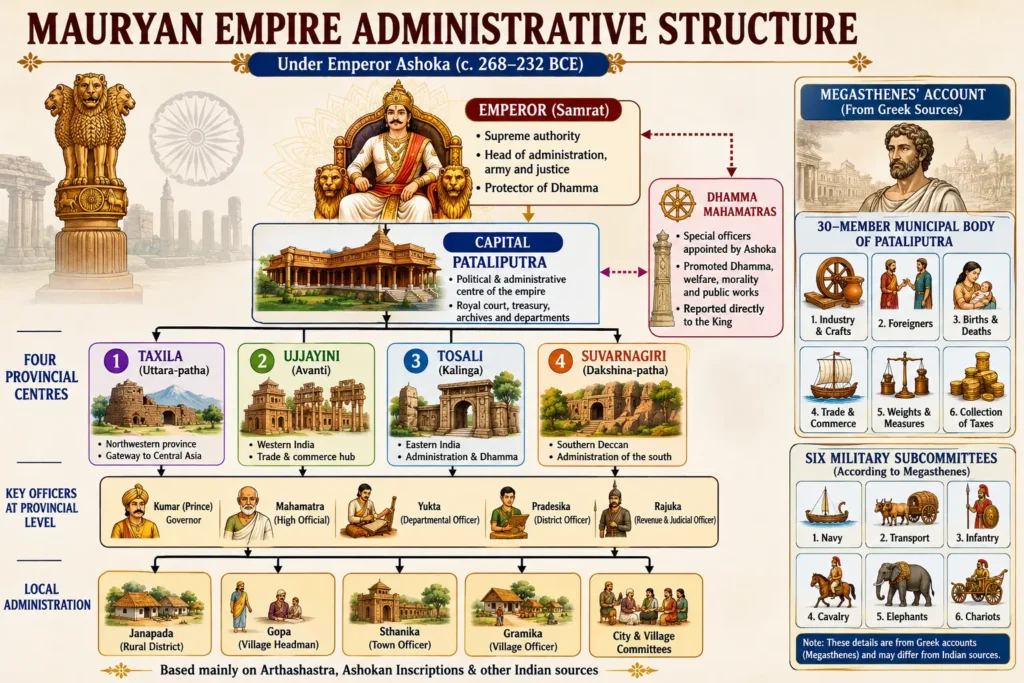
The Mauryan state combined a powerful imperial centre at Pataliputra with a network of provincial administration, specialist officers, and a direct communication system through inscriptions. The picture we can reconstruct comes from combining three distinct source traditions — and they do not always agree.
Pataliputra and the Imperial Centre
Pataliputra, near present-day Patna, was the imperial capital and one of the largest cities in Asia during the Mauryan period. [SOURCE: NCERT, Themes in Indian History I] The archaeological remains of ancient Pataliputra survive at Kumhrar, which the Archaeological Survey of India (ASI) protects as the “Site of Mauryan Palace.” Excavations there have uncovered the remains of a pillared hall and drainage infrastructure. [SOURCE: ASI, protected monuments schedule; Bihar Tourism, Kumhrar Puratav Park]
Megasthenes described Pataliputra as governed by a 30-member body divided into six boards, each handling a different aspect of urban life — from trade and public supervision to caring for foreigners in the city. [SOURCE: NCERT, Themes in Indian History I; ePG Pathshala, Economic Conditions during the Mauryan Period] This is a valuable account, but it must be read as Megasthenes’ observation of one city at one point in time — not as a description of how all Mauryan urban centres were governed.
Mahamatras and Dhamma Mahamatras
Ashoka’s own inscriptions introduce us to the Mahamatras — high officials deployed across the empire for administrative purposes. More specifically, he mentions the appointment of Dhamma Mahamatras: officers tasked with promoting Dhamma and overseeing welfare-related work across religious communities. [SOURCE: NCERT, Themes in Indian History I; Ashokan edicts] This is one of the clearest examples of Ashoka using his inscriptions not just to announce policy but to create a new administrative category to implement it.
Officers from the Arthashastra Tradition
The Arthashastra provides a list of specialist officers for different economic functions. These include the Samāhartā (chief revenue collector), Sannidhātā (chief treasurer), Paṇyadhyakṣa (superintendent of commodities), and Sītādhyakṣa (superintendent of crown lands). [SOURCE: ePG Pathshala, Economic Conditions during the Mauryan Period] These names are frequently cited in UPSC notes and textbooks. The appropriate caveat is that these roles come from the Arthashastra tradition — not from inscriptional evidence — and should be attributed accordingly.
Economy, Taxation, Trade, and Infrastructure
The Mauryan state, as described across its major sources, was deeply involved in the economy. Crown lands, supervised trade, regulated industries, and infrastructure investment were all part of how Mauryan governance worked. [SOURCE: ePG Pathshala, Economic Conditions during the Mauryan Period]
On taxation: Greek accounts associate urban trade with a levy of approximately one-tenth on goods sold. [SOURCE: ePG Pathshala, Economic Conditions during the Mauryan Period] The Arthashastra tradition adds complexity — different texts and modules describe different taxes in different contexts, and the common shorthand that “the Mauryan tax rate was one-sixth” flattens this into a false universal. [SOURCE: ePG Pathshala, Kautilya module] Agrarian dues and commercial levies were distinct, and both varied.
On infrastructure: Ashoka’s inscriptions themselves describe roadside trees planted, wells dug, rest houses built, and watering stations established for travellers. [SOURCE: Ashokan edicts, via cs.colostate.edu/~malaiya/ashoka.html] This is not imperial boasting — it is a specific welfare communication, and the specificity is what makes it credible. Separately, the Junagadh (Girnar) inscription of the later ruler Rudradaman remembers the Sudarshana Lake as having been originally built under Chandragupta’s governor Pushyagupta. This is invaluable evidence for Mauryan irrigation and hydraulic investment, preserved by a source that had no obvious reason to flatter the Mauryas. [SOURCE: ePG Pathshala, Junagadh Inscription of Rudradaman]
Trade networks included the Uttarapatha (northern route) and Dakshinapatha (southern route), connecting the imperial centre to provincial capitals and onward to the north-west and the coasts. [SOURCE: UNESCO World Heritage Centre serial nomination; ePG Pathshala, Economic Conditions during the Mauryan Period]
Ashoka, the Kalinga War, and the Turn to Dhamma
Ashoka is the most extensively documented ruler of ancient India because he chose to communicate through inscriptions — and those inscriptions survive. He ruled roughly from 268 to 232 BCE in standard textbook chronology. [SOURCE: NCERT, The Rise of Empires]
What Rock Edict XIII Says
The Kalinga War is dated to Ashoka’s eighth year after coronation — placing it at around 261 BCE. Rock Edict XIII records what followed: 150,000 people were deported, 100,000 were killed, and many more died later. The edict records Ashoka’s personal anguish at this toll. [SOURCE: Ashokan edicts, Rock Edict XIII, via cs.colostate.edu/~malaiya/ashoka.html]
This is one of the most remarkable political texts from the ancient world anywhere — a ruling king, in an official royal inscription, stating publicly that conquest by military force had caused him grief. Whether the remorse was genuine, strategic, or both is a question historians discuss; what is not in question is that Ashoka chose to carve it in stone and distribute it across the empire.
What Dhamma Meant
Ashoka’s Dhamma is often equated simply with Buddhism. The inscriptions do not support this equation. His major edicts emphasise respect for parents and elders, proper treatment of servants, generosity to religious orders of all kinds, restraint from killing, and appropriate conduct in speech between members of different religious communities. [SOURCE: NCERT, Themes in Indian History I; Ashokan edicts]
The edicts explicitly extend concern to Brahmanas, ascetics, Ajivikas, Jains (Niganthas), and the Buddhist Sangha — a list that covers multiple religious traditions. [SOURCE: Ashokan edicts, via cs.colostate.edu/~malaiya/ashoka.html] Historians working closely with the inscriptions, including scholarship associated with Cambridge’s South Asian history tradition, read Dhamma as a broader public ethic rather than as state Buddhism. [SOURCE: Cambridge repository, Dhamma scholarship]
The appropriate formulation: Ashoka was personally close to Buddhism, and some of his inscriptions (particularly the Bairat edict and some pillar edicts) are specifically Buddhist in reference. But the Dhamma presented in the major rock edicts was an empire-wide moral programme addressed to a religiously diverse population.
One important corrective: Ashoka did not renounce kingship, abandon governance, or dismantle the state’s coercive apparatus after Kalinga. His inscriptions still refer to officials, administrative orders, frontier management, and the continuation of punishment powers. [SOURCE: Ashokan edicts, via cs.colostate.edu/~malaiya/ashoka.html] The change was ideological and communicative — not administrative abdication.
Ashokan Edicts and Inscriptions
Ashoka’s inscriptions are among the earliest datable written political records from India. [SOURCE: ePG Pathshala, The Mauryan Empire] They fall into several categories:
Major Rock Edicts — A series of fourteen edicts cut into natural rock faces at sites spread across the empire. These carry the broadest content: moral instructions, welfare policy, provincial administration, and comments on Dhamma and inter-religious relations.
Pillar Edicts — A series of seven main edicts on polished stone pillars, containing specific Dhamma instructions and, in some cases, explicitly Buddhist content.
Minor Edicts and Cave Inscriptions — Shorter inscriptions in specific locations. The Barabar cave inscriptions, for instance, record grants to Ajivika ascetics. The Lumbini inscription records that Ashoka visited the birthplace of the Buddha, reduced the land tax on the village, and required it to pay only one-eighth of its produce, rather than the standard dues. [SOURCE: Ashokan edicts, Lumbini minor pillar inscription, via cs.colostate.edu/~malaiya/ashoka.html]
The distribution of these inscriptions across the subcontinent is itself significant. UNESCO’s serial nomination for Ashokan edict sites treats them as evidence for an imperial communications network tied to routes, provincial nodes, and strategic display points. [SOURCE: UNESCO World Heritage Centre, serial nomination 2025] The Lion Capital from the Mauryan pillar at Sarnath became India’s National Emblem after independence — a direct connection between Mauryan statecraft and the visual identity of the modern Indian state. [SOURCE: ASI, Sarnath Museum]
Scripts and languages used in the edicts varied by region: Prakrit in Brahmi script across most of the subcontinent, Kharosthi script in the north-west, and Greek and Aramaic in Afghanistan. [SOURCE: NCERT, Themes in Indian History I] This multilingual inscription strategy reflects the empire’s linguistic diversity and its effort to communicate directly with different populations.
Military Organisation and Foreign Relations
The Mauryan Empire maintained a substantial military force, but the most detailed account of its organisation comes from Megasthenes, not from inscriptions.
Megasthenes describes a military structure with six subcommittees, responsible respectively for the navy, transport and provisions, infantry, cavalry, chariots, and war elephants. [SOURCE: NCERT, Themes in Indian History I] Classical writers also preserve very large figures for the Mauryan army’s total strength — figures that have become famous in textbook accounts. The appropriate handling of these numbers: they come through Greek and Roman literary transmission, not from contemporary Indian records or archaeology, and should be described as reported figures rather than verified totals. [SOURCE: Britannica, India: Magadhan Ascendancy]
On foreign relations, the Mauryan engagement with the Hellenistic world extended beyond the Seleucus treaty. Rock Edict XIII names five Hellenistic rulers — generally identified as Antiochos, Ptolemy, Antigonos, Magas, and Alexander — as recipients of Ashoka’s Dhamma missions. [SOURCE: Ashokan edicts, Rock Edict XIII] Whether these missions achieved anything is another question; what is clear is that Ashoka positioned the Mauryan Empire as part of a wider diplomatic world, not as an isolated subcontinent state. Megasthenes remained the most visible symbol of this cross-cultural contact, and his fragmentary account is the earliest substantial external description of an Indian polity.
Why Did the Maurya Empire Decline?
The Mauryan Empire ended around 185 BCE when Brihadratha, the last Mauryan ruler, was killed by his commander-in-chief, Pushyamitra Shunga, who then founded the Shunga dynasty. [SOURCE: ePG Pathshala, The Mauryan Empire] But the question of why the empire had weakened enough to fall this way does not have a single-cause answer — and articles or notes that offer one are oversimplifying.
Teaching materials and historians commonly identify a combination of factors: [SOURCE: ePG Pathshala, The Mauryan Empire]
- Weak successors after Ashoka: The rulers between Ashoka’s death (c. 232 BCE) and the end of the dynasty (c. 185 BCE) are poorly documented and appear to have exercised reduced authority.
- Provincial fragmentation: Peripheral provinces and frontier territories likely reasserted local authority as central control weakened.
- Fiscal and administrative strain: Maintaining such a large empire required enormous resources; the costs of the army, bureaucracy, and infrastructure placed pressure on the revenue system over time.
- Political fragmentation: The post-Ashokan period saw the emergence of regional powers — the Shungas in the Gangetic plain, the Satavahanas in the Deccan, and Indo-Greek kingdoms in the north-west — that benefited from or accelerated Mauryan decline. [SOURCE: ePG Pathshala, post-Mauryan history module]
The explanation that Ashoka’s commitment to non-violence weakened the empire militarily is a popular but reductive reading. The inscriptions show that Ashoka maintained administrative officers, frontier management, and punishment powers throughout his reign. The decline was multi-causal and mostly post-Ashokan.
Legacy of the Maurya Empire
The Mauryan legacy runs through several distinct channels.
In statecraft, the Mauryas established the first template for a subcontinental empire in South Asia — a centralised capital, provincial administration, specialist officers, and state involvement in the economy. Later dynasties, from the Guptas to the Mughals, operated within an imperial geography that the Mauryas first defined.
In Buddhism, Ashoka’s personal patronage of the Sangha, his pillar and rock inscriptions at Buddhist sites, and the tradition that he sent missionary monks to Sri Lanka and parts of Southeast Asia made him a foundational figure in Buddhist history across Asia. The Lumbini inscription alone — recording his visit to the Buddha’s birthplace and the tax concession he granted — connects imperial authority to sacred Buddhist geography.
In material culture: The Ashokan pillar at Sarnath, with its lion capital, became India’s National Emblem after 1947. The Chakra on the flag derives from the same tradition. These are not symbolic coincidences — they reflect the Mauryan period’s role as the founding layer of India’s documented political history.
In the historical method, the Mauryan period is the earliest phase of Indian history for which we have inscriptional, archaeological, and foreign-source evidence in combination. The discipline of studying early India was shaped by the challenge of interpreting these Mauryan sources, and the debates about the Arthashastra, Megasthenes, and Dhamma remain active areas of scholarship.
Common Questions About the Maurya Empire
Who founded the Maurya Empire?
Chandragupta Maurya founded the empire around 321 BCE after overthrowing the Nanda dynasty in Magadha. He later concluded a treaty with Seleucus I Nicator, ceding territories to the Mauryas in exchange for 500 war elephants, establishing the first empire to encompass most of the Indian subcontinent. [SOURCE: Britannica; ePG Pathshala]
What was the capital of the Maurya Empire?
Pataliputra, near present-day Patna in Bihar. It was the imperial centre of Mauryan rule and one of the largest cities in Asia during this period. Its archaeological core survives at Kumhrar, protected by ASI. [SOURCE: NCERT; ASI]
What was Ashoka’s Dhamma?
Dhamma was a broad public ethic emphasising non-injury, respect for elders and servants, generosity, restraint in speech, and harmony among religious communities. It reflected Ashoka’s personal Buddhist commitments but was framed as an empire-wide moral policy addressed to people of multiple faiths — not a synonym for Buddhism. [SOURCE: NCERT; Ashokan edicts]
What happened in the Kalinga War?
Ashoka conquered Kalinga in the eighth year after his coronation (c. 261 BCE). Rock Edict XIII records that 150,000 were deported and 100,000 killed, and Ashoka expressed personal remorse at the suffering the war caused. [SOURCE: Rock Edict XIII]
Did the Mauryas rule all of India?
No. They ruled most of the subcontinent under Ashoka, with the southernmost regions lying outside direct Mauryan control. The intensity of administration also varied between the core zones around Pataliputra and the peripheral regions. [SOURCE: NCERT, Themes in Indian History I]
Was the Arthashastra written by Chanakya?
The Arthashastra is traditionally attributed to Kautilya (Chanakya), but its date and textual history are debated. Historians place the surviving compilation somewhere between the 2nd century BCE and the 2nd century CE. It should be treated as a significant text of ancient Indian statecraft, not as a direct court manual from Chandragupta’s reign. [SOURCE: IDSA, One Hundred Years of Kautilya’s Arthasastra]
Why did the Maurya Empire decline?
Multiple factors: weak successors after Ashoka, provincial fragmentation, fiscal and administrative strain, and the rise of regional powers like the Shungas and Satavahanas. Single-cause explanations — particularly blaming Ashoka’s non-violence — are not supported by the evidence. [SOURCE: ePG Pathshala]
Conclusion
The Maurya Empire (c. 321–185 BCE) was South Asia’s first subcontinental empire, and it remains the best-documented polity of ancient India — not because its rulers wrote histories about themselves, but because Ashoka carved his edicts into stone and distributed them across a subcontinent. Those inscriptions, combined with Greek accounts, archaeological remains, and the difficult evidence of the Arthashastra, give historians enough to reconstruct an empire of remarkable scale and institutional complexity.
For UPSC aspirants and students, the core themes to understand are: Chandragupta’s founding and the Seleucus treaty; Ashoka’s transformation after Kalinga; the distinction between Dhamma and Buddhism; Mauryan administration as reconstructed from multiple source types; and the multi-causal nature of Mauryan decline. The Maurya Empire is where Indian documented political history begins — and understanding it properly means understanding the difference between what inscriptions actually say and what later traditions claim.
Related Reading: Harappan Civilization
Key takeaways:
- The Maurya Empire was founded c. 321 BCE by Chandragupta Maurya and ended c. 185 BCE; Ashoka (r. c. 268–232 BCE) was its most documented ruler.
- Ashoka’s inscriptions are the most important primary source for the period — earlier, more reliable, and more extensive than either the Indica or the Arthashastra.
- Dhamma was a broader ethical programme than Buddhism; the major edicts addressed multiple religious communities.
- Mauryan decline was multi-causal — weak successors, fiscal strain, and provincial fragmentation — not the result of a single event or ideology.
- The Sarnath lion capital from a Mauryan pillar became India’s National Emblem.
Sources & References
This article prioritises inscriptional and archaeological evidence over later literary traditions, following the source hierarchy recommended by historians working on ancient India.
Primary inscriptional sources: Ashokan edicts (Major Rock Edicts, Pillar Edicts, Minor Edicts), including Rock Edict XIII and the Lumbini minor pillar inscription.
Government sources: Archaeological Survey of India (ASI), Sarnath Museum; ASI protected monuments schedule (Kumhrar); NCERT Themes in Indian History I; NCERT The Rise of Empires.
Academic / government-supported sources: ePG Pathshala — The Mauryan Empire; Economic Conditions during the Mauryan Period; Sources of Ancient Indian Polity; Junagadh Inscription of Rudradaman.
Institutional sources: UNESCO World Heritage Centre, serial nomination for Ashokan edict sites (2025); IDSA, One Hundred Years of Kautilya’s Arthasastra.
Reputed reference sources: Britannica — Mauryan Empire, Chandragupta Maurya, Megasthenes, India: Magadhan Ascendancy.
Translation resource: Ashokan edict translations via cs.colostate.edu/~malaiya/ashoka.html (used alongside academic references).
Later Buddhist, Jain, and Puranic traditions have been used carefully and are not treated as equivalent in reliability to inscriptions or contemporary foreign accounts.
- https://www.britannica.com/place/Mauryan-Empire
- https://ncert.nic.in/textbook/pdf/lehs102.pdf
- https://epgp.inflibnet.ac.in/epgpdata/uploads/epgp_content/indian_culture/01._outlines_of_indian_history/mauryan_empire/et/5193_et_et.pdf
- https://epgp.inflibnet.ac.in/epgpdata/uploads/epgp_content/S000829IC/P001687/M021986/ET/1504074053P12-M09-EconomicConditionsduringtheMauryanPeriod-ET.pdf
- https://epgp.inflibnet.ac.in/epgpdata/uploads/epgp_content/s000829ic/p001771/m024011/et/1507700799p10-m01-sourcesofancientindianpolity-et.pdf
- https://idsa.in/system/files/monograph20.pdf
- https://whc.unesco.org/en/tentativelists/6803/
- https://www.cs.colostate.edu/~malaiya/ashoka.html
- https://asi.nic.in (Sarnath Museum + Kumhrar pages)
- https://tourism.bihar.gov.in/en/destinations/patna/kumrahar-puratav-park