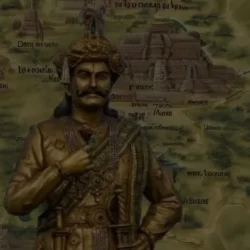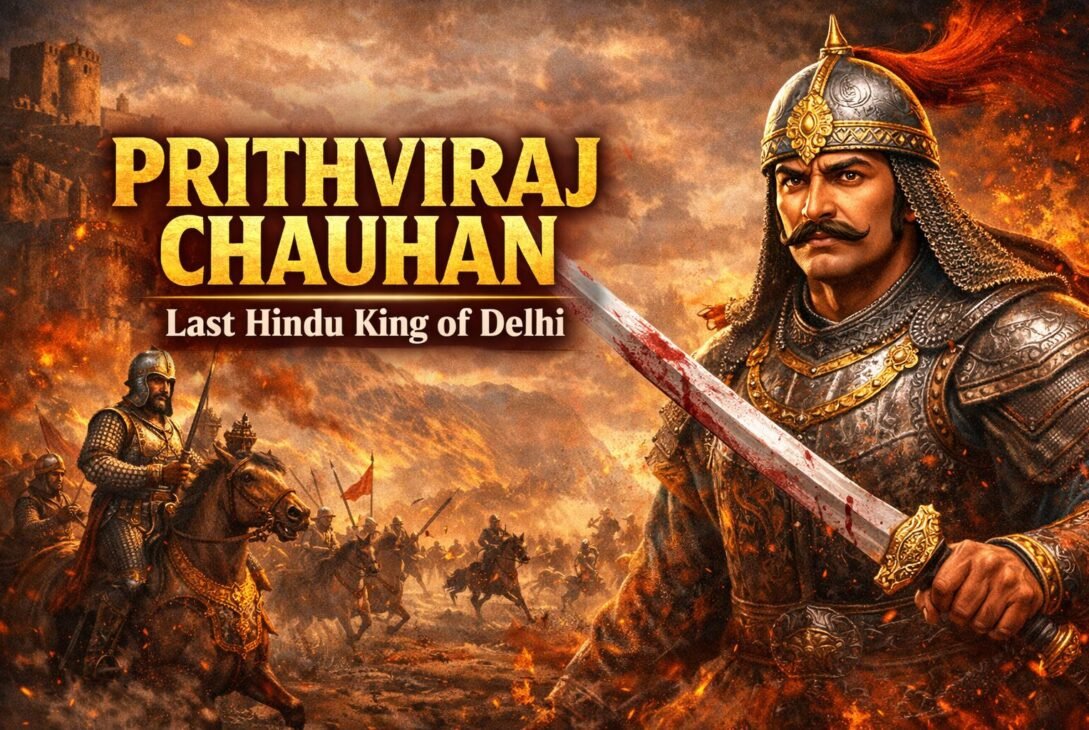
India’s history echoes with tales of valor that refuse to fade. Among these legends stands Emperor Prithviraj Chauhan, whose name still resonates across centuries. Historical records confirm his reign over Ajmer and Delhi during the 12th century. His legacy represents courage, skill, and the complex political landscape of medieval India.
Prithviraj Chauhan was more than a skilled swordsman. He mastered multiple languages, mathematics, and philosophy. His most extraordinary ability was Shabd Bhedi Baan—hitting targets by sound alone without seeing them. This Rajput warrior’s story intertwines military brilliance with political intrigue and ultimately shaped India’s future.
The Chauhan dynasty faced its greatest challenge when Muhammad Ghori invaded from the west. The Battle of Tarain became the turning point in Indian history. This Prithviraj Chauhan biography examines his rise, victories, and the decisions that altered the course of medieval Indian history forever.

The Chauhan Dynasty: Foundations of Power
The Chauhan dynasty’s roots are traced back to Sambhar and Amber, near present-day Jaipur. King Ajay Raj founded Ajmer city, which became the power center of this warrior clan. According to government historical documentation, Vasudeva Chauhan established the dynasty in the 6th century.
Someshwar Chauhan emerged as a formidable ruler in the 11th century. He expanded his empire through numerous military campaigns. When Rathore forces attacked Delhi’s King Anangpal Tomar, Someshwar provided crucial support. His military assistance helped Anangpal Tomar secure victory.
This alliance transformed into kinship. Anangpal married his daughter Karpuri Devi to Someshwar Chauhan. Anangpal’s other daughter, Roop Sundari, married King Vijaypal of Kannauj. Their son would later become Jaichand, a name destined for controversy.
Birth of a Legendary Warrior
In 1166, Someshwar Chauhan and Karpuri Devi welcomed a son. Court astrologers predicted greatness for this child. They declared he would rule vast territories and become an exceptional leader. His parents named him Prithviraj, meaning “king of the earth.”
He was actually Prithviraj III, as two earlier Chauhan rulers shared this name. People also knew him as Rai Pithora. Historical scholarship demonstrates that his birth marked the beginning of an era that would dramatically impact North India’s political structure.
Early Life and Extraordinary Skills
Prithviraj Chauhan’s childhood revealed exceptional talent from the start. Ancient texts suggest he mastered multiple subjects beyond typical royal education. He gained deep knowledge of several languages, history, mathematics, medicine, military strategy, science, and philosophy.
His most unique skill was Shabd Bhedi Baan. This technique allowed him to strike targets blindfolded using only sound. Contemporary accounts verify that this extraordinary archery ability stunned even experienced warriors. He also excelled with swords and spears, displaying remarkable combat proficiency.
One incident from his youth demonstrated his fearless nature. During a hunting expedition with friends, a fierce lion attacked their group. While his companions retreated in panic, young Prithviraj stood firm without weapons. As the lion lunged, he seized its neck with lightning speed. His immense strength broke the lion’s jaw, killing it instantly.
This event wasn’t merely about hunting prowess. It proved that Prithviraj Chauhan possessed exceptional courage, power, and strategic thinking from childhood. These qualities would define his reign and military campaigns.
Ascending the Throne at Age Eleven
Fate tested Prithviraj early. At just eleven years old, his father passed away. Suddenly, the entire kingdom’s responsibility fell on this young prince’s shoulders. He inherited Ajmer’s throne as Someshwar Chauhan’s successor during an extremely vulnerable period.
His youth invited challenges from within. Feudal lords and regional chieftains began rebelling, attempting to seize portions of his kingdom. During this crisis, his mother Queen Karpuri Devi assumed control as regent. She stabilized the kingdom with trusted ministers like Kandabvasa.
Some historical accounts suggest an alternative narrative. The epic Hammira Mahakavya indicates Someshwar didn’t die then. Instead, he voluntarily abdicated the throne to Prithviraj and retreated to the forests as a renunciant. Regardless of which version holds, young Prithviraj faced immense pressure.
Under his mother’s guidance, Prithviraj learned governance intricacies. He quickly mastered administrative skills that impressed court officials and subjects alike. In 1180, at just fourteen years old, he assumed full independent authority as ruler. This marked the beginning of his legendary journey.
Consolidating Power Through Military Campaigns
When Prithviraj took power, internal threats proved more dangerous than external enemies. His own relatives exploited his youth to rebel and claim territories. This pattern revealed how unstable India’s feudal system was in the 12th century. Without a strong central authority, local lords prioritized personal interests over loyalty.
Three years after his coronation, Prithviraj emerged from his mother’s protection. He began establishing himself as a formidable emperor. His first critical task was crushing Nagarjuna’s rebellion, who was his uncle Vigraharaja IV’s son.
Nagarjuna exploited Prithviraj’s young age to claim the throne. He seized the Gunapura fort, known today as Gurugram. This wasn’t merely rebellion but a direct power struggle within the Chauhan dynasty. Prithviraj assembled a massive army with infantry, cavalry, camels, and elephants.
Victory Over Internal Threats
He besieged Gunapura and defeated Nagarjuna in battle. The fort and surrounding territories returned to his control. According to the Prithviraj Vijaya epic, he captured many of Nagarjuna’s soldiers. He executed them and displayed their severed heads on the Ajmer fort walls.
Though Nagarjuna escaped, this victory sent a clear message. Challenging the young king’s authority meant certain defeat. After this success, Prithviraj didn’t merely protect his kingdom. He began expanding his empire significantly.
In 1182, he eliminated the Bhadanakas rebellion. Their territory spread across modern Haryana’s Bhiwani and Rewari districts to Rajasthan’s Alwar region. This victory proved strategically important because the Bhadanaka territory blocked the route to Delhi.
Delhi already belonged to his empire. His uncle Vigraharaja IV had conquered it between 1150 and 1164. When Prithviraj assumed power, Delhi was already under Chauhan control. Delhi served as a major trade and strategic center.
After this victory, Prithviraj made Delhi his second capital. This decision significantly strengthened his position in North India. He constructed Qila Rai Pithora in Delhi, which became an important stronghold. These early victories demonstrated his growing military and political prowess.
Expanding the Chauhan Empire
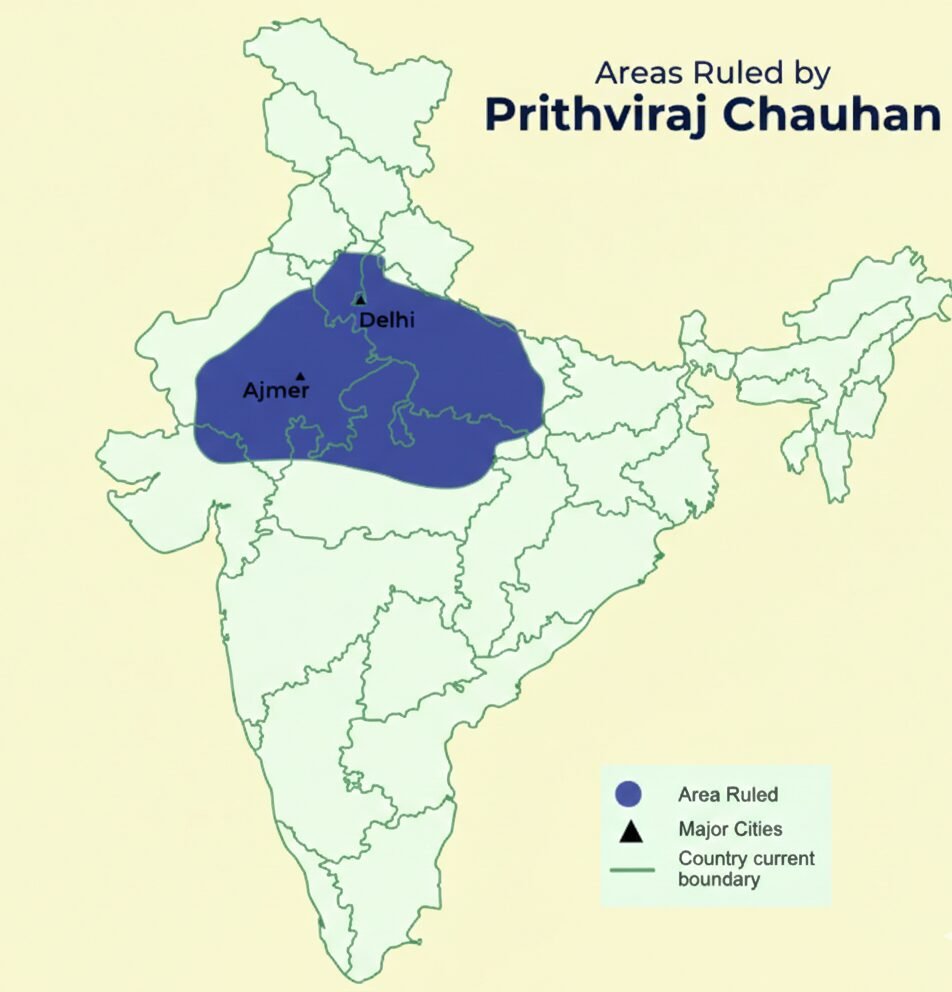
Following initial successes, Prithviraj Chauhan’s army launched conquest campaigns in multiple directions. His empire expanded rapidly across vast territories. Soon, it included most of Rajasthan, western Uttar Pradesh, northern Madhya Pradesh, and southern Punjab.
This vast empire spread its reputation far and wide. He became the most powerful Indian ruler of his time. His military campaigns included one particularly famous and bloody conflict. In 1182, he fought Chandela King Paramardi Dev at Mahoba.
The conflict erupted because Chandela soldiers attacked some of Prithviraj’s wounded and exhausted troops. They had camped in Chandela territory without permission. Enraged by this incident, Prithviraj launched a massive assault on Mahoba with his full army.
The Battle of Mahoba and Growing Rivalries
This battle became immortalized in Indian folklore for the extraordinary valor of two Chandela generals. Brothers Alha and Udal fought fiercely, defending their homeland against the Chauhan forces. According to traditional accounts, Udal died in battle. His enraged brother Alha launched a devastating counterattack.
Alha killed everyone who came before him with full force. However, the Chandelas ultimately lost this battle. Prithviraj achieved victory over Mahoba while Paramardi Dev fled. This represented a major expansion success, though victory came at a high cost.
Historical documentation reveals that Prithviraj’s army also suffered heavy casualties. Many brave soldiers died in this fierce engagement. During this period, his political enmity with another powerful dynasty became openly apparent. This rivalry was with King Jaichand of Kannauj’s Gahadavala dynasty.
Both rulers wanted to expand their empires across distant territories. Competition naturally bred rivalry between them. Some historians believe Jaichand claimed rights to Delhi’s throne because his grandfather, Anangpal Tomar, once ruled there. The Chauhans had seized it from his family.
The Legendary Love Story
According to Prithviraj Raso, this conflict became intensely personal when Jaichand’s daughter Sanyogita entered the story. Tales describe how Sanyogita fell in love with Prithviraj after hearing stories of his bravery and valor. She decided she would marry only him.
When Jaichand learned this, he became furious. He harbored old enmity toward Prithviraj and could never accept this relationship. Jaichand viewed his daughter’s love as an insult to himself and his kingdom. To exact revenge for this perceived humiliation, he devised a cunning plan.
He organized a grand Swayamvara ceremony. This ancient Indian tradition allowed a princess to choose her husband from assembled suitors. Jaichand invited all major Indian kings and princes but deliberately excluded his greatest enemy, Prithviraj.
He further insulted Prithviraj by creating a statue of him. He placed this statue at the main gate as a doorkeeper. Somehow, Prithviraj learned about this arrangement. When the Swayamvara day arrived, all the kings took their positions.
Sanyogita rejected everyone present. She walked past all assembled royals straight to Prithviraj’s statue. She placed her garland around the statue’s neck. At that precise moment, Prithviraj appeared with some soldiers who had secretly infiltrated the ceremony.
Before everyone’s eyes, he lifted Sanyogita onto his horse. They rode from Kannauj toward Delhi. Jaichand’s army pursued them, but Prithviraj successfully brought Sanyogita safely to Delhi. He married her there.
Many historians consider this romantic tale fictional. This love story appears only in Prithviraj Raso, and several scholars doubt its historical accuracy. However, one fact remains certain: Prithviraj and Jaichand’s relationship was never cordial.
This conflict ran so deep that even when foreign invaders threatened India, these two kings refused to support each other. After winning the Battle of Mahoba, Prithviraj made a powerful neighbor his permanent enemy. This mutual animosity prevented the formation of a strong alliance that might have stopped foreign powers from entering Indian territory.
The Rising Threat: Muhammad Ghori
While Emperor Prithviraj Chauhan expanded his empire eastward, a new and dangerous enemy emerged from the west. This was the ambitious and ruthless invader Muizz al-Din Muhammad ibn Sam, known in India as Muhammad Ghori.
Muhammad Ghori ruled the Ghurid Dynasty, whose empire spread across modern Afghanistan. His objective wasn’t merely to plunder India. He wanted to establish permanent control over Indian territories. Pursuing this goal, Ghori launched a major attack on Gujarat’s Chalukya ruler Bhima II in 1178.
There, he faced powerful resistance led by Bhima II’s mother, Rani Naikidevi. She defeated Ghori’s army so severely that he barely escaped the battlefield with his life. This represented a major setback that forced him to change his strategy.
He realized that entering India through southern routes proved extremely difficult. He shifted focus northward instead. This policy succeeded, and he soon conquered Sindh, Peshawar, and Sialkot. In 1186, he defeated Lahore’s ruler Khusrau Shah Malik and seized that city too.
Ghori’s Invasion of Chauhan Territory
After these continuous victories, Ghori wasn’t stopping. His next target became the Chauhan empire. In 1191, he suddenly attacked and captured the Tabarhind fort, known today as Bhatinda. He left it under his general Ziauddin’s control with 1,200 cavalry.
This move directly confronted two powerful empires. Muhammad Ghori’s capture of Bhatinda represented a direct challenge that Prithviraj couldn’t ignore. He assembled a massive army and marched toward Ghori. In 1191, their armies faced each other on Tarain’s plains in Haryana.
Both armies brought distinct strengths to this confrontation. Ghori’s forces included mounted archers famous for their speed. Prithviraj Chauhan’s army consisted mainly of infantry. However, they possessed elephants’ power and excelled at close-range combat.
The First Battle of Tarain: Prithviraj’s Victory
The battle began with Muhammad Ghori’s forces deploying their greatest strength. His mounted archers rained arrows on Prithviraj Chauhan’s infantry from a distance. This represented a tactical approach where they attacked and quickly retreated to avoid confrontation.
In contrast, Rajput warriors believed in face-to-face combat. They wanted to confront enemies directly with swords and spears. Prithviraj Chauhan’s army immediately charged forward with a strong frontal assault. This sudden attack shocked Ghori’s forces.
Prithviraj Chauhan’s massive war elephants also devastated the enemy army. They broke through enemy lines, causing panic and chaos. The Rajput soldiers’ fierce frontal fighting and elephants’ strength completely shattered the Ghori soldiers’ morale. They began fleeing the battlefield.
During the battle, Muhammad Ghori himself entered the field trying to rally his troops. He encountered Govind Rai, the Rajput army commander and Delhi’s governor. Ghori attacked with his lance, but Govind Rai blocked it and counterattacked, wounding Ghori severely.
A Fatal Act of Mercy
Ghori fell nearly unconscious. Somehow, one of his soldiers rescued him from the battlefield, saving his life. Seeing their commander retreat, Ghori’s army’s morale collapsed completely. Remaining soldiers fled the field. Prithviraj’s forces recaptured Tabarhind Fort.
After this victory, Prithviraj made a strategic mistake that would cost him and all of India dearly. He didn’t pursue the fleeing enemy and spared Muhammad Ghori’s life. Traditional accounts suggest Emperor Prithviraj Chauhan defeated Muhammad Ghori not once but 16-17 times, releasing him each time.
This represented Rajput war ethics and generosity. They didn’t strike fleeing enemies. Modern historians call this the “Prithviraj Syndrome.” The habit of showing mercy gave enemies opportunities to rebuild strength. This very generosity would prove suicidal later.
Muhammad Ghori’s Revenge
After repeated defeats by Prithviraj Chauhan, Muhammad Ghori returned to Ghazni humiliated. There, he publicly dishonored captains and commanders who showed cowardice in battle. Ghori vowed not to return to his luxurious lifestyle until he avenged his defeat.
With this determination, he reorganized his army. This time, he emphasized discipline, mobility, and deception heavily. After thorough preparation, in 1192, he recaptured Bhatinda. The Chauhans had only regained it one month earlier.
This news filled Prithviraj Chauhan with rage. He assembled his army and marched toward Tarain again to face Ghori. However, this time his army was weaker. Many of his commanders were engaged in different campaigns during the previous months.
Once again, both armies confronted each other on Tarain. Prithviraj sent a message offering Ghori safe passage if he withdrew without fighting. Otherwise, he threatened to destroy him completely this time. Ghori laid a trap here.
The Deception That Changed History
He pretended to accept the terms, saying he would consult his brother before deciding. Actually, Ghori was preparing his army while observing the Chauhan forces. This deception misled Prithviraj. His army relaxed and lost vigilance. This proved to be their biggest mistake.
Ghori knew Rajputs were extremely powerful in direct combat. He divided his army into small units. He instructed them to attack from a distance and retreat immediately when Rajput forces counterattacked. Ghori’s plan worked perfectly.
When his forces attacked the Rajputs from a distance, Prithviraj Chauhan’s army chased them. But this was a trap. Continuous pursuit exhausted Rajput elephants, horses, and infantry. They didn’t get rest through the night.
The next morning, when the Rajput army was busy with daily routines and disorganized, Ghori’s forces launched a sudden, decisive attack. Against this treachery and strategic cunning, the Rajput army couldn’t hold. Emperor Prithviraj Chauhan was defeated and captured.
The Second Battle of Tarain: A Turning Point
Thus, the Second Battle of Tarain ended with Ghori’s decisive victory. This defeat didn’t result from Prithviraj Chauhan’s lack of valor. It happened due to his strategic miscalculation and underestimating his enemy. His method of sparing even fleeing enemies proved ineffective against ruthless invaders like Ghori.
Ghori’s sole objective was to achieve victory by any means. This defeat opened the path for Muslim rule in India. It permanently changed Indian history’s direction. Some accounts suggest King Jaichand of Kannauj secretly supported Muhammad Ghori in this battle.
This is why later folklore made Jaichand’s name synonymous with traitor. However, many historians consider this story false. According to them, Jaichand may not have supported Prithviraj, but he didn’t support Ghori either. Eventually, Muhammad Ghori defeated Jaichand too and killed him.
The Mystery of Prithviraj’s Death
How Emperor Prithviraj Chauhan died after the Second Battle of Tarain remains debated among historians today. Multiple contradictory views exist on this subject. Some historical sources claim Prithviraj died on the battlefield itself.
Other accounts suggest he was captured and taken to Ajmer. There, Muhammad Ghori attempted to reinstate him as a subordinate ruler. Later, he was executed on conspiracy charges. The most popular story about Prithviraj’s death appears in the epic Prithviraj Raso.
According to this story, after Tarain’s defeat, Ghori took Prithviraj prisoner to Ghazni. There, he tortured him severely. Even after torture, when Emperor Prithviraj Chauhan’s eyes didn’t bow before Ghori, Muhammad Ghori ordered his eyes be removed.
His command was executed. Hot iron rods were thrust into shackled and defenseless Prithviraj Chauhan’s eyes, blinding him. Emperor Prithviraj accepted sacrificing his eyes but refused to bow to them. During this time, Prithviraj’s court poet Chandrabardai somehow reached Ghazni.
He saw Ghori planning to publicly humiliate and execute Prithviraj before the entire city. Chandrabardai devised a clever plan. He told Ghori that the person he was sentencing to death was no ordinary king. He was Emperor Prithviraj Chauhan, who had defeated him dozens of times on battlefields.
The Legend of Final Revenge
Ghori mocked Prithviraj, saying this blind man was now useless. Chandrabardai told Muhammad Ghori he didn’t know the truth. Their emperor was skilled in Shabd Bhedi Baan. He could strike targets just by hearing sounds.
Ghori also mocked this claim and said that if true, the entire city would witness this spectacle. A public assembly was organized, and huge crowds gathered. Prithviraj’s shackles were removed, and bow and arrows were placed in his hands.
Ghori set a condition before Chandrabardai. If Prithviraj couldn’t demonstrate Shabd Bhedi Baan, his head would also be severed. Chandrabardai smiled and replied that it wouldn’t be necessary. Then the demonstration began, and Chandrabardai recited a couplet.
This verse gave Prithviraj Ghori’s exact position, who sat on a high throne. He aimed his arrow at his bow. The arrow struck directly into Ghori’s chest, and he collapsed there. As Ghori’s soldiers rushed to kill Chandrabardai and Prithviraj, they stabbed each other with daggers.
They chose death so that even their deaths bore their names, not their enemies’. This story has been told for generations as a symbol of bravery and revenge. However, historically, it isn’t considered accurate.
Historical Truth and Legacy
Even Prithviraj Raso’s credibility raises many questions. Most scholars believe Prithviraj Raso was written nearly 400 years after Prithviraj Chauhan’s time in the 16th century. Additionally, according to historical evidence, Muhammad Ghori’s assassination occurred in 1206, while Prithviraj died in 1192.
For this reason, many historians consider this story about Prithviraj Chauhan’s end fictional. After Prithviraj’s death, his empire, including Ajmer, Delhi, and parts of Rajasthan, fell under Ghori’s army’s control.
Delhi came under the control of Muhammad Ghori’s general Qutbuddin Aibak. Delhi still has the Qutub Minar named after him. In Ajmer, Ghori made Prithviraj’s minor son Govindraja IV a puppet ruler who paid taxes to Ghori.
Prithviraj’s brother Hariraja refused to accept this. He removed Govind Raj IV and seized control of Ajmer. This rebellion increased instability in the region. Exploiting this, Muhammad Ghori’s general Qutbuddin Aibak attacked Ajmer and defeated Hariraja.
This completed the remaining conquest. Ajmer, once the pride of Rajputs, now become part of the Delhi Sultanate. Other empire portions, like Mahoba, were either split among local dynasties or were conquered by Muhammad Ghori.
The Enduring Impact
Thus, after Prithviraj Chauhan’s death, the Muslim invasion of India increased significantly. This laid the foundation for Muslim rule that continued for centuries. However, Emperor Prithviraj Chauhan’s stories of valor, courage, and bravery became immortal in history.
His story inspired coming generations and made him a symbol of national pride. His legacy reminds us that even if battles are lost, stories of valor, honor, and courage never die. They echo through time, teaching lessons about both triumph and tragedy.
Prithviraj Chauhan’s biography represents more than one man’s life. It captures an entire era’s spirit when honor sometimes conflicted with survival. His choices, both brilliant and flawed, shaped the course of medieval Indian history forever.
Conclusion
The story of Prithviraj Chauhan remains one of medieval Indian history’s most compelling narratives. This Rajput warrior demonstrated exceptional skill, courage, and leadership from childhood. He mastered the rare art of Shabd Bhedi Baan and ruled vast territories across North India.
His victories in the First Battle of Tarain proved his military genius. However, his decision to spare Muhammad Ghori repeatedly showed how traditional warrior codes sometimes clash with harsh political realities. The Second Battle of Tarain became a watershed moment that altered India’s trajectory.
Whether he died on the battlefield or through the legendary arrow that struck Ghori, Prithviraj Chauhan’s legacy endures. His life exemplifies both the glory and vulnerability of the Chauhan dynasty. Future generations continue drawing inspiration from his unwavering courage and commitment to honor.