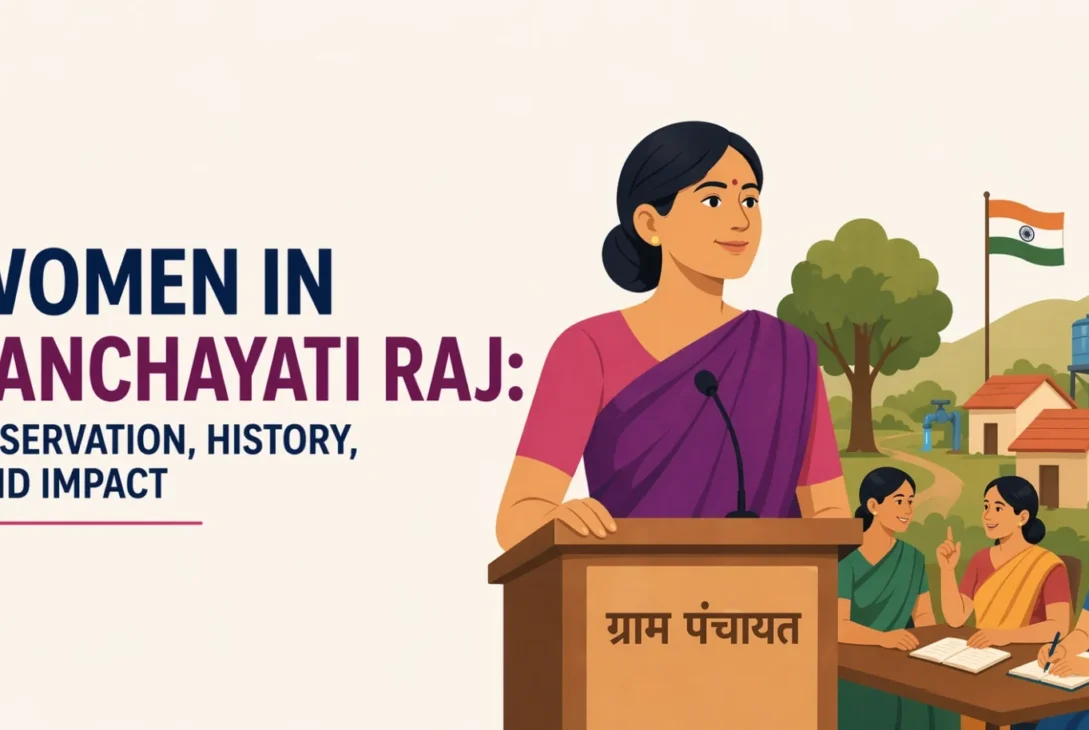
India stands apart: nearly 14.5 lakh women hold elected local office—about 46% of all Panchayati Raj representatives nationwide. The Ministry of Women and Child Development calls this “unparalleled anywhere else in the world.” [SOURCE: PIB Press Release, Ministry of Women and Child Development, March 19, 2025]
The same country has 74 women in a 543-seat Parliament. Around 14%.
That gap — between what happened at the village level and what has yet to happen at the national level — is the story this article tells. It begins with a constitutional amendment in 1992, runs through thirty years of quiet transformation in rural India, and lands directly in the middle of the current debate about Nari Shakti Vandan Adhiniyam and when women’s reservation in Parliament will actually begin.
What Panchayati Raj Is — and Why It Matters Here
Panchayati Raj is India’s system of rural local self-government. It operates through a three-tier structure: Gram Panchayats at the village level, Panchayat Samitis at the block level, and Zila Parishads at the district level. [SOURCE: Encyclopaedia Britannica, “Panchayati raj”]
Each Gram Panchayat is led by a directly elected Sarpanch and ward members. The block and district tiers include both elected representatives and ex officio officials. Elections are held every five years under the supervision of the State Election Commissions. As of 2025, all Indian states and Union Territories except Nagaland, Meghalaya, Mizoram, and Delhi have active rural Panchayati Raj Institutions.
These are not advisory bodies. Panchayati Raj Institutions are constitutional bodies with defined powers — including some degree of taxation, local planning, and oversight of welfare schemes. When women lead them, the decisions they make affect drinking water, sanitation, local roads, schools, and health facilities for hundreds of millions of people.
The Constitutional Mandate: What the 73rd Amendment Actually Said
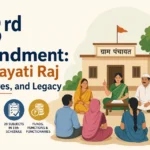
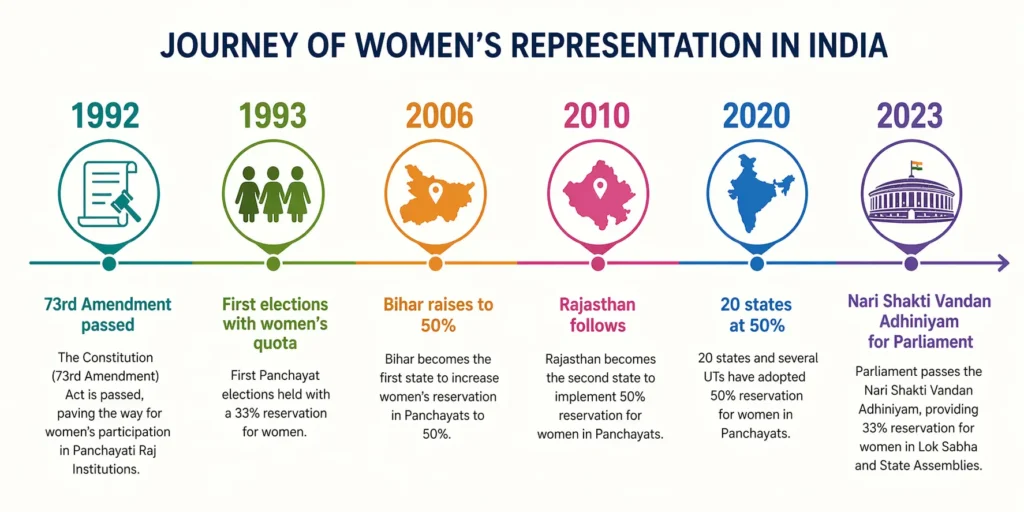
The 73rd Constitutional Amendment Act (1992), which came into force in 1993, did two things that permanently changed women’s participation in local government.
First, it gave Panchayati Raj Institutions constitutional status — making them part of the Constitution’s fundamental architecture rather than creatures of ordinary state legislation. Second, Article 243D(3) mandated that not less than one-third of the total seats in every Panchayat — at every tier — must be reserved for women. It also required that at least one-third of Sarpanch positions be reserved for women. [SOURCE: Encyclopaedia Britannica, “Panchayati raj”; PRS Legislative Research, Women’s Reservation Bill 2023 analysis]
The 74th Amendment did the same for urban local bodies — municipalities and town councils.
One-third was the constitutional floor. States could go higher. And many did.
The most important thing to understand about this legal structure is what it did not do. The 73rd and 74th Amendments created reservations in local bodies only. They made no provision for women’s representation in Parliament or State Legislative Assemblies. Those remained untouched until the Constitution (One Hundred and Sixth Amendment) Act, 2023 — Nari Shakti Vandan Adhiniyam, three decades later. [SOURCE: PRS Legislative Research, Women’s Reservation Bill 2023 analysis]
These are two separate legal frameworks. Confusing them is the single most common error in public discourse on this topic.
From 33% to 50%: How States Went Beyond the Constitutional Minimum
The first elections under the new framework were held in 1993–95. States revised their Panchayati Raj Acts to implement the one-third quota, and women began entering local elected office at a scale India had never seen.
But several states did not stop at one-third.
Bihar became the first state to raise women’s Panchayat reservation to 50% in 2006. [SOURCE: The Caravan, “Why Nitish’s 2006 reservation policy remains his strongest political asset”, November 2025] Rajasthan followed in 2010. Chhattisgarh moved to 50% in 2008. [SOURCE: PIB, English Releases archive] Uttarakhand adopted 50% from its formation.
By 2020, twenty states had raised their legal quota to 50%. By 2024, this had extended to 21 states and 2 Union Territories — including Andhra Pradesh, Assam, Bihar, Chhattisgarh, Gujarat, Himachal Pradesh, Jharkhand, Karnataka, Kerala, Madhya Pradesh, Maharashtra, Odisha, Punjab, Rajasthan, Sikkim, Tamil Nadu, Telangana, Tripura, Uttarakhand, and West Bengal. [SOURCE: PIB Press Release, Ministry of Panchayati Raj, February 2024; PIB Press Release, Ministry of Women and Child Development, March 2025]
This happened through ordinary state legislation — no constitutional amendment was needed, because the Constitution set a minimum, not a maximum. It is a rare example of India’s federal structure working in the direction of expanding rights rather than limiting them.
The Numbers Today
The result of three decades of this system is the 14.5 lakh figure cited at the start. To put it in a fuller context:
India has approximately 31 lakh total elected local government representatives across all Panchayati Raj tiers. Of these, roughly 14.5 lakh — 46% — are women.
In 18 states, women now hold more than 50% of PRI seats. [SOURCE: IndiaSpend DataViz, “Reservation has increased women’s presence in local bodies”, April 13, 2026]
These numbers reflect both the legal mandate and a secondary effect: in states with 50% reservation, women contesting unreserved seats have also increased. Reservation created familiarity, networks, and political capital that extended beyond the reserved seats themselves.
The Ministry of Panchayati Raj does not centrally maintain granular data on specific positions like total women Sarpanches nationwide — a data gap the government has acknowledged. State election commissions hold more detailed figures. The 14.5 lakh total is the most reliable nationally sourced number available.
The Proxy Debate: What the Evidence Actually Shows
No discussion of women in Panchayati Raj is honest without addressing the proxy representative concern — the “pradhanpati” phenomenon, where a male family member effectively runs the show while the elected woman holds the formal title.
High-profile incidents have kept this concern alive. In March 2025, six men took oath in place of newly elected women representatives in Chhattisgarh.
The Supreme Court addressed this directly in July 2023. Its position was clear: the constitutional amendment has placed women in these seats, and the Court cannot bar women from contesting simply because proxy behavior sometimes occurs. The responsibility for addressing proxy behavior lies with the executive, not with restricting women’s eligibility. [SOURCE: Hindustan Times, “Can’t bar women from fighting panchayat polls even if proxy is followed: SC”, July 7, 2023]
The government has responded. The Ministry of Panchayati Raj convened an advisory committee specifically to address proxy representation, whose recommendations were accepted. Under the Rashtriya Gram Swaraj Abhiyan (RGSA) scheme, approximately 2.86 million women elected representatives were trained between 2022 and December 2025. The “Sashakt Panchayat Netri Abhiyan” was also launched specifically for the capacity building of women leaders. [SOURCE: PIB Press Release, Ministry of Panchayati Raj, February 11, 2026]
Academic evidence offers important context. Research on women’s proxy representation in Panchayats consistently finds that the phenomenon is most pronounced in the first one to two years of a term. Women gradually become more independent as they gain experience, build networks, and develop confidence in their roles. Many women leaders, particularly educated ones, begin advocating for local needs within months of taking office. [SOURCE: Johansson Nygren, academic thesis via CLACSO digital library]
The honest picture: proxy behavior exists and matters. It is not, however, universal — and it is declining. The more accurate framing is that proxy representation is a transitional problem in a long-term structural change, not evidence that the policy has failed.
What Changes When Women Lead
The effectiveness question goes beyond proxy concerns. What actually changes in local governance when women hold Panchayat leadership positions?
Research and field reporting point consistently in one direction. Women EWRs (Elected Women Representatives) tend to prioritize issues that affect daily household and community life — drinking water access, health facilities, sanitation infrastructure, schools, and anganwadis.
IndiaSpend reporting on Tamil Nadu Panchayats found evidence of significantly improved outcomes in communities where women led local councils, including anti-alcohol drives and improvements in school and anganwadi infrastructure. A study referenced by IndiaSpend found a correlation between constituencies electing more women and higher annual growth in economic activity. [SOURCE: IndiaSpend DataViz, April 13, 2026]
This is not to say women lead uniformly better — the conditions vary enormously by state, caste, education level, and local political culture. But the pattern across evidence is consistent: women’s presence in Panchayats shifts what local government spends attention and resources on.
The broader implication matters: India now has thirty years of evidence from its own grassroots that reservation produces measurable representation and measurable change. That evidence base did not exist when the 73rd Amendment was passed in 1992.
The Gap That Explains Everything: 46% vs 14%
The 18th Lok Sabha, constituted in June 2024, has 74 women MPs — approximately 13.8% of the House. [SOURCE: Times of India, “74 women MPs in 18th Lok Sabha”, April 19, 2026]
India ranks 147th globally in women’s parliamentary representation. The country that has more women in local elected office than anywhere else on earth sits near the bottom of the global ranking for national legislative representation.
This is not a contradiction. It is the direct, predictable result of having a reservation at one level and not at the other. Panchayat seats have been reserved for women since 1993. Parliamentary seats had no reservation until the 2023 constitutional amendment — and that amendment has not yet come into force.
The 46% vs 14% comparison is India’s own controlled experiment. Reservation produced 46%. Its absence produced 14%. The comparison is not theoretical.
A 2025 government communication made the causal link explicit, noting that the Nari Shakti Vandan Adhiniyam (106th Amendment, 2023) is built on the foundation of three decades of local reservation experience.
What Local Reservation Proves — and What It Does Not
The Panchayati Raj experience establishes three things relevant to the national debate.
First, reservation works at scale. Getting women into elected positions is not the problem — the 14.5 lakh figure proves the mechanism functions. The barrier to women’s parliamentary representation is the absence of a similar mechanism at the national level, not the absence of capable women.
Second, the benefits extend over time. Early proxy behavior fades. Women who enter politics through reserved seats build experience, legitimacy, and in some cases, careers that outlast the reservation itself.
Third, a reservation alone is not sufficient for full empowerment. IndiaSpend and ALIGN (2026) note that reservations have increased women’s physical presence in office without always translating into full decision-making authority — bureaucratic discretion, household dynamics, and social norms remain constraints. The government’s own advisory committee acknowledged this when it convened in 2025 to address proxy representation.
What local reservation does not prove is that the same outcomes are automatically guaranteed at the parliamentary level. The political economy of Lok Sabha elections — party ticket allocation, campaign finance, media visibility — differs substantially from Gram Panchayat elections. The Panchayat evidence is an argument for trying national reservation, not a guarantee of identical results.
What Is True as of April 2026
| Question | Answer |
| What does the 73rd Amendment mandate? | At least one-third of Panchayat seats reserved for women under Article 243D |
| How many states have raised this to 50%? | 21 states and 2 Union Territories (as of 2024) |
| How many women are in Panchayati Raj today? | Approximately 14.5 lakh — about 46% of all local representatives (as of March 2025) |
| Does this cover Parliament or State Assemblies? | No — the 73rd/74th Amendments apply only to local bodies |
| What covers Parliament? | The Constitution (106th Amendment) Act, 2023 — Nari Shakti Vandan Adhiniyam — separately |
| Has that national reservation started? | No — it requires a delimitation exercise after Census 2027 |
| Is proxy representation a real problem? | Yes — but it diminishes over time and is being addressed through training and government oversight |
Frequently Asked Questions
What is women’s reservation in Panchayati Raj?
It is a constitutional mandate under Article 243D of the 73rd Amendment Act (1992) that reserves not less than one-third of seats in every Panchayati Raj Institution — at village, block, and district levels — for women. At least one-third of Sarpanch positions must also be reserved. Over two-thirds of states have gone further, raising their quota to 50%.
When did women’s reservation in Panchayats start?
The 73rd Amendment was enacted in 1992 and came into force in 1993. The first Panchayat elections under the new framework were held between 1993 and 1995. Bihar became the first state to raise its quota to 50% in 2006.
How many women are currently in Panchayati Raj?
Approximately 14.5 lakh women — about 46% of all elected local representatives — serve in Panchayati Raj Institutions across India, as of March 2025. This is the highest proportion of women in local elected office of any country in the world.
Which states have 50% women’s reservation in Panchayats?
As of 2024, 21 states and 2 Union Territories have legally raised the quota to 50%, including Bihar, Rajasthan, Chhattisgarh, Madhya Pradesh, Uttarakhand, Odisha, Kerala, Tamil Nadu, Karnataka, West Bengal, and others.
Is the 73rd Amendment the same as Nari Shakti Vandan Adhiniyam?
No. These are entirely separate laws. The 73rd Amendment (1992) reserves seats in Panchayati Raj Institutions — local rural bodies. Nari Shakti Vandan Adhiniyam (Constitution 106th Amendment, 2023) reserves seats in the Lok Sabha and State Legislative Assemblies. The 2023 law has not yet come into force — it requires a delimitation exercise after Census 2027.
Why are there more women in Panchayats than in Parliament?
Because Panchayat seats have had mandatory reservation since 1993. Parliamentary seats had no reservation until the 2023 amendment — and that amendment has not yet been implemented. The 46% vs 14% contrast is a direct consequence of where reservation exists and where it does not.
What is the proxy representative problem in Panchayats?
Some women elected to Panchayat seats have had male family members exercise decision-making authority on their behalf — a pattern sometimes called “pradhanpati.” Research shows this is most common in the first one to two years of a term and tends to decline as women gain experience. The Supreme Court has held that women cannot be barred from contesting because of this concern. The government has responded with training programmes and an advisory committee.