The Indian Constitution is the supreme law of the Republic of India. Every election, every court judgment, every Act of Parliament, every right you exercise as a citizen, all of it rests on this single document. It defines what the Indian state is, what it can and cannot do, and what every person living in India is entitled to demand from it.
It is also, without exaggeration, one of the most ambitious constitutional documents ever written. When the Constituent Assembly completed its work on 26 November 1949, it had produced a text that simultaneously tried to dismantle centuries of social hierarchy, build a functioning democracy from scratch, hold together an extraordinarily diverse union of states, and protect individual rights against a state that had only just gained the power to act. That the document has survived, amended over a hundred times, tested by emergency, challenged in the highest courts, is itself a constitutional achievement.
This guide covers the Indian Constitution in full: how it was made, how it is organised, what rights it guarantees, how it distributes power between the Union and the States, how it can be changed, and what the Supreme Court has said about its limits. Whether you are preparing for UPSC, studying for Class 11 or 12, or simply trying to understand how Indian democracy actually works, this is your starting point.
Indian Constitution at a Glance
| Detail | Facts |
| Adopted | 26 November 1949 |
| In force | 26 January 1950 |
| Signed | 24 January 1950 (by 284 members) |
| Drafting duration | 2 years, 11 months, 17 days |
| Constituent Assembly sittings | 11 sessions, 165 days total (114 days on the Draft Constitution) |
| Original structure | 395 Articles, 22 Parts, 8 Schedules |
| Current structure (official NCERT count) | 448 Articles, 25 Parts, 12 Schedules |
| Chairman, Drafting Committee | Dr B. R. Ambedkar |
| President, Constituent Assembly | Dr Rajendra Prasad |
| Latest amendment | Constitution (One Hundred and Sixth Amendment) Act, 2023 |
| Current states and UTs | 28 States and 8 Union Territories |
[SOURCE: Constituent Assembly records, Lok Sabha Secretariat — sansad.in; NCERT Constitution Day Module — ncert.nic.in; Ministry of Legislative Affairs official constitutional text — legislative.gov.in]
Why the Indian Constitution Matters Today
A constitution is not a historical relic. It is an active instrument. In India, it operates every single day.
When a government order is struck down in court, the Constitution is the reason. When a law reserving seats for women in Parliament is passed or delayed, the Constitution sets both the permission and the constraint. When a state government is dismissed under President’s Rule, or when the Supreme Court holds that Parliament cannot alter the Constitution’s fundamental identity, that too comes from this document.
The issues driving current constitutional debate are not abstract: delimitation and women’s reservation, the scope of judicial review, the balance between Centre and States on taxation and policing, the reach of privacy rights in a digital age, and the limits of emergency power. Every one of these connects directly to provisions in the Constitution and to the court judgments interpreting them.
For UPSC aspirants, the Constitution is the most important single subject in General Studies Paper II. For students of Class 11 and 12, it forms the backbone of Political Science. For any citizen who wants to understand why India works the way it does or why, sometimes, it does not, the Constitution is the essential text.
How the Indian Constitution Was Written
The Constituent Assembly
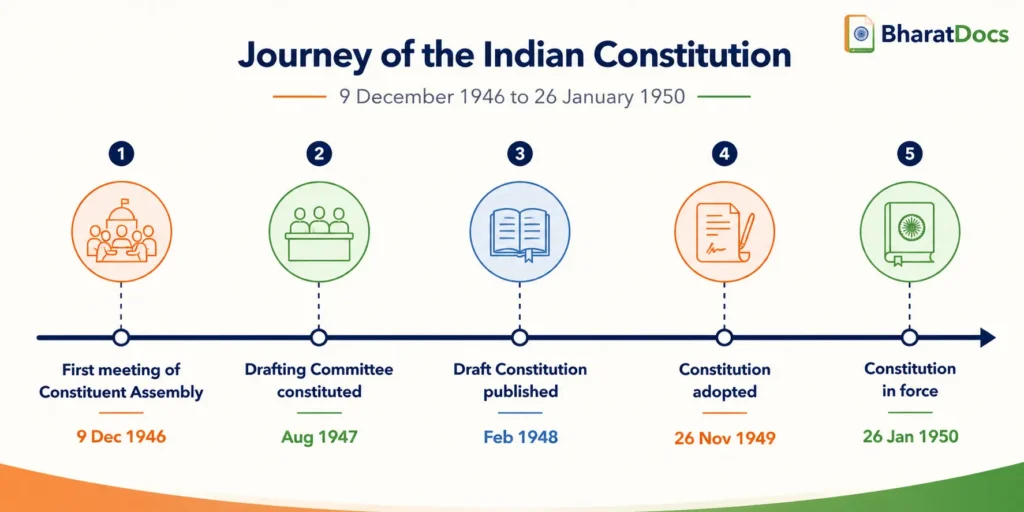
The Constitution was not written by one person. It was produced by the Constituent Assembly of India, a body that first met on 9 December 1946. Members were elected indirectly by the provincial legislative assemblies under the framework proposed by the British Cabinet Mission Plan. The Assembly was not directly elected by universal suffrage — that would come only after the Constitution was in force, but it drew from the elected representatives of the provinces and included some of the most formidable legal, political, and intellectual figures of the independence era.
The Assembly held 11 sessions over 165 days. Of these, 114 days were spent specifically deliberating on the Draft Constitution. [SOURCE: Lok Sabha Secretariat, Constituent Assembly records — sansad.in]
The Assembly’s working method was systematic. Multiple committees examined specific aspects of the constitutional design — the Union powers, fundamental rights, provincial constitutions, minorities, and the centre-state financial relationship. Their reports fed into the Drafting Committee’s work.
The Drafting Committee and B. R. Ambedkar
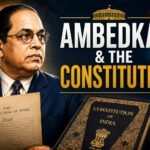
The Drafting Committee, constituted in August 1947, was chaired by Dr B. R. Ambedkar. Also prominent in the drafting process were constitutional adviser B. N. Rau, who produced an early draft that was circulated for comment, and members including Alladi Krishnaswami Ayyar and K. M. Munshi. Dr Rajendra Prasad served as the President of the Constituent Assembly throughout.
The common claim that Ambedkar “single-handedly wrote” the Constitution is an oversimplification — and he himself pushed back against it. The document was the product of extensive committee work, hundreds of amendments, and genuine debate in the Assembly. What Ambedkar did was chair the Drafting Committee with exceptional precision and legal rigour, synthesise the committee outputs into a coherent draft, and defend that draft with remarkable command through 11 sessions of close scrutiny.
→ Read more: Ambedkar’s Contribution to the Indian Constitution
Key dates
- 9 December 1946 — First sitting of the Constituent Assembly [SOURCE: sansad.in]
- 26 November 1949 — Constitution adopted by the Assembly [SOURCE: sansad.in]
- 24 January 1950 — Constitution signed by 284 members [SOURCE: NCERT Constitution Day Module — ncert.nic.in]
- 26 January 1950 — Constitution comes into force; India becomes a Republic
→ Read more: Constituent Assembly of India: How the Constitution Was Written
Structure of the Indian Constitution: Parts, Articles, and Schedules
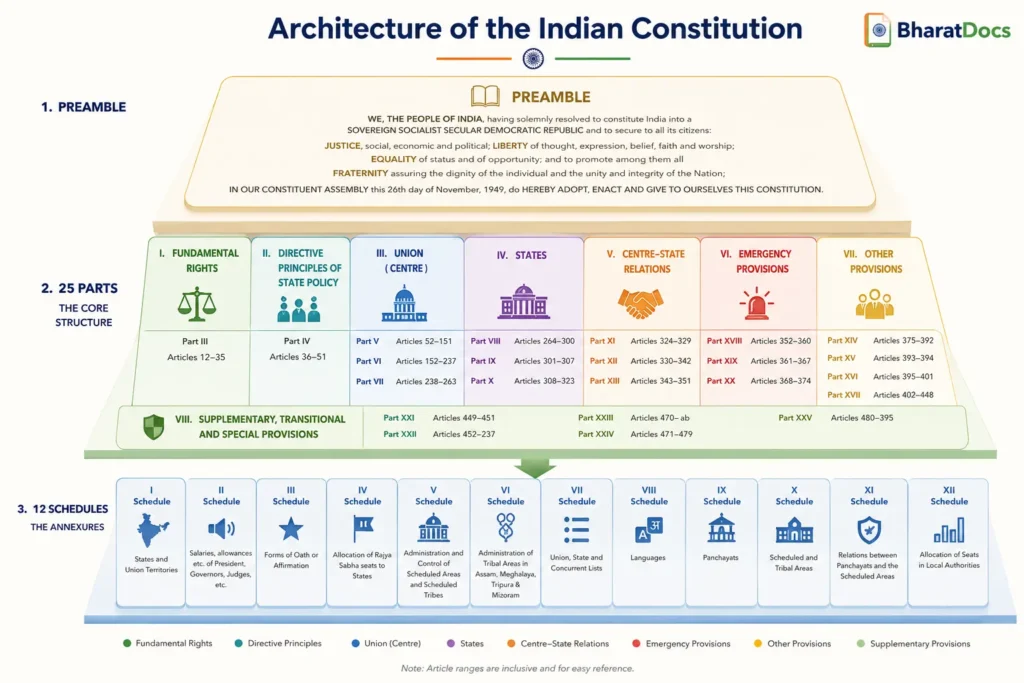
The Indian Constitution is organised into Parts, each covering a distinct domain of constitutional law. Articles are the numbered provisions within those Parts. Schedules contain supplementary material — lists, oaths, allocations of subjects — that support the main text.
Official NCERT educational material describes the Constitution as having 448 Articles in 25 Parts and 12 Schedules. The original Constitution, as adopted in 1949, had 395 Articles in 22 Parts and 8 Schedules. The difference reflects insertions, omissions, and renumbering through over a hundred amendments. [SOURCE: NCERT Constitution Day Module — ncert.nic.in]
Key Parts of the Indian Constitution
| Part | Articles | Subject |
| Part I | 1–4 | The Union and its Territory |
| Part II | 5–11 | Citizenship |
| Part III | 12–35 | Fundamental Rights |
| Part IV | 36–51 | Directive Principles of State Policy |
| Part IVA | 51A | Fundamental Duties |
| Part V | 52–151 | The Union (President, Parliament, Supreme Court) |
| Part VI | 152–237 | The States |
| Part XI | 245–263 | Relations between the Union and the States |
| Part XII | 264–300A | Finance, Property, Contracts |
| Part XVIII | 352–360 | Emergency Provisions |
| Part XX | 368 | Amendment of the Constitution |
[SOURCE: Official constitutional text — legislative.gov.in]
The Schedules
The 12 Schedules carry critical supplementary detail. The First Schedule lists the States and Union Territories. The Seventh Schedule contains the Union List, State List, and Concurrent List — the three-tier distribution of legislative powers between Parliament and the State Legislatures that is central to understanding Indian federalism. The Tenth Schedule governs anti-defection. The Eleventh and Twelfth Schedules list subjects to be devolved to Panchayati Raj institutions and urban local bodies, respectively, under the 73rd and 74th Amendments.
The Seventh Schedule contains three lists that distribute law-making power between Parliament and the State Legislatures:
| List | Who can normally make laws? | What it covers |
|---|---|---|
| Union List | Parliament | Subjects of national importance such as defence, foreign affairs, railways, banking, currency, and atomic energy |
| State List | State Legislatures | Subjects such as public order, police, public health, agriculture, markets, and local government |
| Concurrent List | Both Parliament and State Legislatures | Shared subjects such as criminal law, education, forests, marriage, adoption, labour welfare, and electricity |
Article 246 explains this distribution: Parliament has exclusive power over the Union List, States normally legislate on the State List, and both can legislate on the Concurrent List, subject to constitutional rules on conflict. [SOURCE: Constitution of India, Article 246 and Seventh Schedule — Legislative Department, Ministry of Law and Justice]
Preamble, Fundamental Rights, DPSP, and Fundamental Duties
The Preamble
The Preamble opens with the words “We, the People of India” — establishing immediately that the Constitution’s authority comes from the citizens, not from any external power or from the state itself. It declares India to be a Sovereign Socialist Secular Democratic Republic, and sets out the constitutional objectives: Justice (social, economic, and political), Liberty (of thought, expression, belief, faith, and worship), Equality (of status and opportunity), and Fraternity (ensuring the dignity of the individual and the unity and integrity of the Nation).
The words “Socialist,” “Secular,” and “Integrity” were not in the original Preamble. They were inserted by the Constitution (Forty-Second Amendment) Act, 1976. [SOURCE: Official constitutional text — legislative.gov.in]
The Preamble’s status in constitutional interpretation has been settled by the Supreme Court: it is not enforceable like an Article, but it is an authoritative guide to the Constitution’s purpose and values, and courts use it to resolve interpretive ambiguity.
→ Read more: Preamble of the Indian Constitution
Fundamental Rights
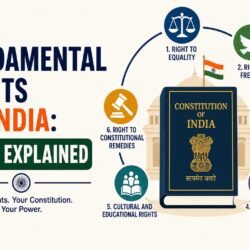
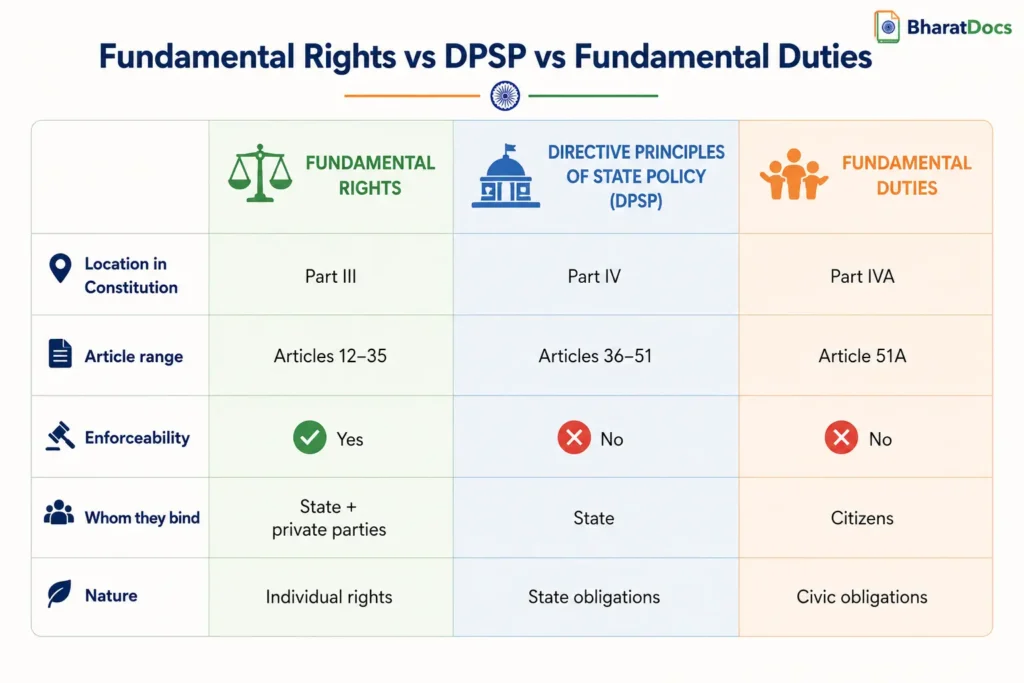
Part III of the Constitution, covering Articles 12 to 35, guarantees the Fundamental Rights. These are enforceable rights — meaning a citizen can approach the Supreme Court under Article 32, or a High Court under Article 226, if any of them are violated. Article 32 itself is a Fundamental Right: the right to constitutional remedies.
The six clusters of Fundamental Rights are:
- Right to Equality (Articles 14–18) — equality before law, prohibition of discrimination on grounds of religion, race, caste, sex or place of birth, equality of opportunity in public employment, abolition of untouchability, abolition of titles.
- Right to Freedom (Articles 19–22) — freedom of speech and expression, assembly, association, movement, residence, profession; protection against arbitrary arrest and detention; protection against double jeopardy and self-incrimination.
- Right against Exploitation (Articles 23–24) — prohibition of traffic in human beings, forced labour, and employment of children in factories and hazardous occupations.
- Right to Freedom of Religion (Articles 25–28) — freedom of conscience, free profession and practice of religion.
- Cultural and Educational Rights (Articles 29–30) — right of minorities to conserve their language, script, and culture; right to establish and administer educational institutions.
- Right to Constitutional Remedies (Article 32) — the right to move the Supreme Court for enforcement of Fundamental Rights, through writs of habeas corpus, mandamus, prohibition, quo warranto, and certiorari.
Article 13 is the enforcement mechanism: it invalidates any law, to the extent it is inconsistent with or takes away the Fundamental Rights. [SOURCE: Official constitutional text, Part III — legislative.gov.in]
One important note on Right to Property: The Right to Property was originally a Fundamental Right under Article 19(1)(f) and Article 31. The Constitution (Forty-Fourth Amendment) Act, 1978, removed it from Part III. Article 31 was omitted. The right to property now appears as a constitutional right — but not a Fundamental Right — under Article 300A, which says no person shall be deprived of property save by authority of law. This is a common point of confusion in exams and general understanding alike. [SOURCE: Official constitutional text — legislative.gov.in]
→ Read more: Fundamental Rights of India: All 6 Explained
Directive Principles of State Policy
Part IV, Articles 36 to 51, contains the Directive Principles of State Policy (DPSP). These are principles that the state is required to apply in governance. Article 37 states explicitly that the DPSP “shall not be enforceable by any court” — but it also says they are “fundamental in the governance of the country” and that it shall be the duty of the state to apply them in making laws. [SOURCE: Official constitutional text, Article 37 — legislative.gov.in]
Non-justiciable does not mean unimportant. DPSP includes welfare-state goals: equal pay for equal work, free legal aid, promotion of equal justice, organisation of village panchayats, protection of public health, protection of the environment, and promotion of international peace. Courts invoke the DPSP frequently when interpreting the scope of rights and the validity of welfare legislation. The Supreme Court has held that harmony between Fundamental Rights and DPSP is itself part of the Constitution’s basic structure.
→ Read more: DPSP vs Fundamental Rights: Which Prevails and Why
Fundamental Duties
Part IVA, containing only Article 51A, lists the Fundamental Duties of citizens. Fundamental Duties were not in the original Constitution. They were added by the Constitution (Forty-Second Amendment) Act, 1976. A further duty — to provide opportunities for education to children between the ages of six and fourteen — was added by the Constitution (Eighty-Sixth Amendment) Act, 2002. The present text of Article 51A contains 11 Fundamental Duties. [SOURCE: Official constitutional text, Article 51A — legislative.gov.in]
The duties include obligations to abide by the Constitution, to cherish and follow the noble ideals of the freedom struggle, to uphold and protect the sovereignty and integrity of India, to defend the country, to promote harmony across religious and linguistic groups, to protect the natural environment, to develop the scientific temper, to safeguard public property, and to strive towards excellence in individual and collective activity.
Unlike Fundamental Rights, these duties are not directly enforceable as rights claims. They matter in constitutional reasoning and civic education, and courts occasionally reference them when interpreting the scope of state action.
Note on a common error: Many older textbooks and coaching materials state that there are 10 Fundamental Duties. The correct current count is 11, following the 86th Amendment. [SOURCE: Official constitutional text, Article 51A — legislative.gov.in]
Union-State Relations, Amendments, and Emergency Powers
Indian Federalism: How Power Is Distributed
India is constitutionally described as a “Union of States.” This phrasing is deliberate: unlike a federation formed by agreement between sovereign units, the Indian Union is indissoluble. No state can secede. But within this indissoluble union, the Constitution distributes powers between Parliament and the State Legislatures across three lists in the Seventh Schedule: the Union List (subjects on which only Parliament can legislate), the State List (subjects on which State Legislatures ordinarily legislate), and the Concurrent List (subjects on which both may legislate, with parliamentary law prevailing in case of conflict). Parliament has residuary power over subjects not in any list, under Article 248. [SOURCE: Official constitutional text, Articles 245–248 — legislative.gov.in]
The financial relationship between the Centre and the States is governed by Part XII and includes the Finance Commission under Article 280, a constitutional body that periodically determines how tax revenues are shared between the Union and the States. The Constitution (One Hundred and First Amendment) Act, 2016, restructured the indirect tax system through Articles 246A and 279A, which established the GST Council and allowed both Parliament and State Legislatures to legislate on goods and services tax. [SOURCE: Official constitutional text — legislative.gov.in]
S.R. Bommai v. Union of India (1994) is the landmark case governing the use of Article 356 (President’s Rule). The Supreme Court held that the dissolution of a State Assembly must meet constitutional requirements, and that the floor of the House — not the Governor’s report alone — is the proper test of a government’s majority. [SOURCE: S.R. Bommai v. Union of India, Supreme Court of India — api.sci.gov.in]
→ Read more: States vs Union Territories
Amending the Indian Constitution
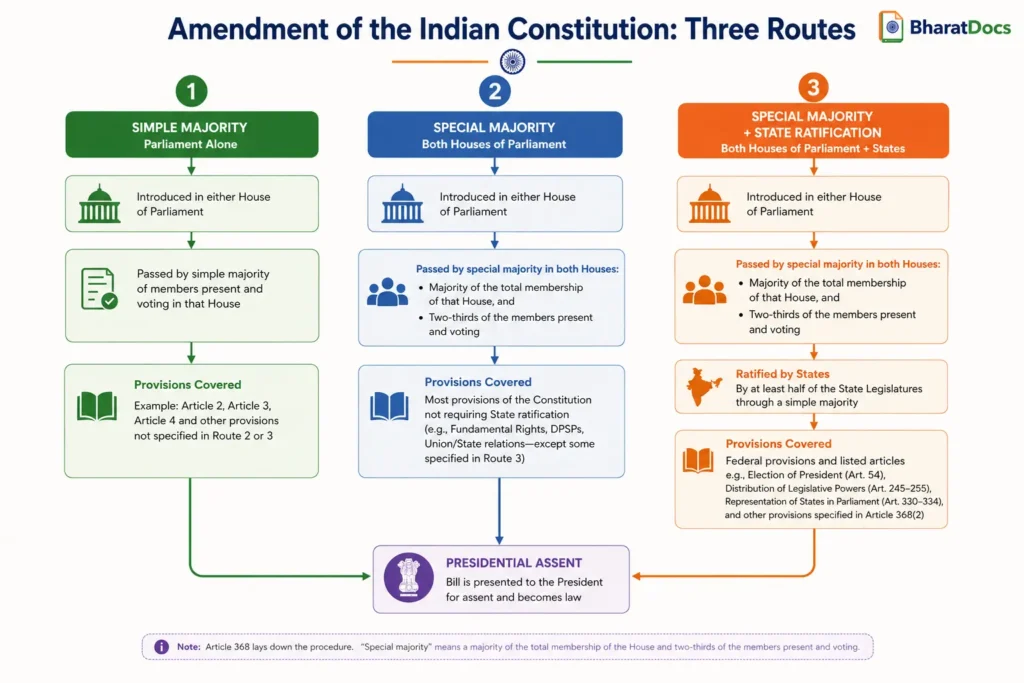
The Constitution is neither wholly rigid nor wholly flexible. NCERT’s Political Science curriculum describes three routes of amendment:
- Simple majority — Some provisions can be changed by an ordinary law passed by a simple majority in Parliament. The addition of new states and changes to state boundaries (Articles 2 and 3) fall in this category.
- Special majority — Most amendments use the procedure in Article 368. An amendment bill must be passed by each House of Parliament by a majority of the total membership of that House, and by a two-thirds majority of the members present and voting. The President must give assent.
- Special majority plus State ratification — Certain provisions that affect the federal structure — including the election of the President, the distribution of legislative powers, representation of States in Parliament, and the amendment procedure itself — additionally require ratification by not less than one-half of the State Legislatures before the President gives assent.
[SOURCE: Article 368, official constitutional text — legislative.gov.in; NCERT Political Science textbook, Class 11 — ncert.nic.in]
There is no provision for a referendum in the Indian amendment process. Amendments are initiated and passed entirely within Parliament (and the State Legislatures for ratification cases). This is important for UPSC: several countries require popular referendums for constitutional changes; India does not.
Emergency Provisions
Part XVIII of the Constitution provides for three distinct constitutional emergencies. These are frequently confused, and distinguishing between them is essential for any serious study of the Constitution.
| Emergency type | Article | Trigger | Effect |
| National Emergency | 352 | War, external aggression, or armed rebellion | Fundamental Rights under Article 19 may be suspended; Centre gains power over State subjects |
| President’s Rule (State Emergency) | 356 | Failure of constitutional governance in a State | State government dismissed; State Legislature dissolved or suspended; Parliament governs the state |
| Financial Emergency | 360 | Threat to financial stability or credit of India or any part thereof | Centre may give directions to States on financial matters; salaries of constitutional officials may be reduced |
The Constitution (Forty-Fourth Amendment) Act, 1978, made significant changes to emergency law following the 1975–77 Emergency. The phrase “internal disturbance” in Article 352 was replaced by “armed rebellion,” a higher threshold. Article 359 was amended to protect Articles 20 and 21 — the right against arbitrary conviction and the right to life and personal liberty — from suspension even during a National Emergency. [SOURCE: Official constitutional text, Articles 352–360; 44th Amendment — legislative.gov.in]
Landmark Cases That Shaped the Indian Constitution
The Indian Constitution is not just what Parliament enacts. It is also what the Supreme Court interprets. Over seven decades, the Court has built a constitutional jurisprudence that has defined, limited, and sometimes expanded what the document means. These are the cases every student of the Constitution needs to know.
Golaknath v. State of Punjab (1967): The Supreme Court held that Parliament could not amend Fundamental Rights. This created immediate constitutional tension — if Parliament cannot amend Part III, several socially important laws (including land reforms) were vulnerable. Parliament responded with constitutional amendments that directly challenged this ruling. [SOURCE: Golaknath v. State of Punjab, Supreme Court of India — api.sci.gov.in]
Kesavananda Bharati v. State of Kerala (1973): In a landmark thirteen-judge bench ruling, the Supreme Court held that while Parliament has wide power to amend the Constitution under Article 368, that power does not extend to altering or destroying the Constitution’s “basic structure.” This is the most important case in Indian constitutional law. It has never been overruled. [SOURCE: Kesavananda Bharati v. State of Kerala — api.sci.gov.in]
Maneka Gandhi v. Union of India (1978): The Court held that the right to life and personal liberty under Article 21 requires not merely that a procedure prescribed by law must exist, but that the procedure must be fair, just, and reasonable. This expanded the scope of Article 21 dramatically and laid the foundation for the Court’s later human rights jurisprudence. [SOURCE: Maneka Gandhi v. Union of India, Supreme Court of India — api.sci.gov.in]
Minerva Mills Ltd. v. Union of India (1980): Struck down parts of the Constitution (Forty-Second Amendment) Act, 1976, which had attempted to place the DPSP above Fundamental Rights. The Court held that harmony and balance between Fundamental Rights and DPSP is itself part of the Constitution’s basic structure — and Parliament cannot destroy that harmony by amendment. The official text of Article 368 carries a footnote acknowledging that certain clauses of the 42nd Amendment were declared invalid in this case. [SOURCE: Official constitutional text, Article 368 footnote — legislative.gov.in; recent Supreme Court judgment reaffirming Minerva Mills — api.sci.gov.in, 2026]
S.R. Bommai v. Union of India (1994): Established that the imposition of President’s Rule under Article 356 is subject to judicial review, and that the proper test of a state government’s majority is the floor of the Assembly, not the Governor’s subjective satisfaction. This case fundamentally changed the political use of Article 356. [SOURCE: S.R. Bommai v. Union of India — api.sci.gov.in]
I.R. Coelho v. State of Tamil Nadu (2007): Held that laws placed in the Ninth Schedule after 24 April 1973 (the date of Kesavananda Bharati) can be challenged if they violate the basic structure of the Constitution, including Fundamental Rights that form part of that structure. [SOURCE: I.R. Coelho v. State of Tamil Nadu, Supreme Court of India — api.sci.gov.in]
Justice K.S. Puttaswamy v. Union of India (2017): A nine-judge Constitution bench unanimously held that the right to privacy is a constitutionally protected value and a fundamental right under Part III. This decision has shaped ongoing debates about data protection, surveillance, and biometric identity systems in India. [SOURCE: Justice K.S. Puttaswamy v. Union of India — api.sci.gov.in]
The Basic Structure Doctrine
The basic structure doctrine — the principle that certain essential features of the Constitution cannot be amended even by a constitutional majority — emerged from Kesavananda Bharati and has been developed by successive cases. The Court has not published a closed, exhaustive list of what constitutes “basic structure.” Features identified across cases include: the supremacy of the Constitution, the republican and democratic form of government, the secular character of the Constitution, the separation of powers, judicial review, Fundamental Rights, free and fair elections, federalism, and the harmony between Fundamental Rights and DPSP.
The doctrine is judicially created — it does not appear as a textual provision anywhere in the Constitution. [SOURCE: Kesavananda Bharati; Minerva Mills; I.R. Coelho — api.sci.gov.in]
Common Misconceptions About the Indian Constitution
Q: Did Ambedkar write the Indian Constitution alone?
No. The Constitution was the product of the Constituent Assembly, multiple committees, and nearly three years of collective deliberation. Ambedkar chaired the Drafting Committee and led the drafting process with exceptional skill, but he did not write the document alone. Figures including B. N. Rau, Alladi Krishnaswami Ayyar, K. M. Munshi, and Jawaharlal Nehru all contributed substantially.
Q: Is the Right to Property a Fundamental Right?
No longer. Article 19(1)(f) and Article 31, which guaranteed the Right to Property as a Fundamental Right, were omitted by the Constitution (Forty-Fourth Amendment) Act, 1978. Property is now a constitutional right under Article 300A — meaning it can be taken away by law, but only by authority of law. It is not enforceable through the Supreme Court as a Fundamental Right.
Q: Are Directive Principles enforceable in court?
No. Article 37 explicitly states that DPSPs are not enforceable by any court. However, the same Article says they are “fundamental in the governance of the country.” Courts regularly use DPSP to interpret the scope of rights and to assess the validity of social welfare legislation. Non-justiciable does not mean irrelevant.
Q: Do all constitutional amendments require the consent of State Legislatures?
No. Most amendments under Article 368 require only a special majority in Parliament. State ratification — by at least half the State Legislatures — is required only for specific provisions that affect the federal structure, such as the election of the President, legislative powers distribution, or the amendment procedure itself. There is no referendum requirement for any amendment.
Q: Does “Emergency” in the Indian Constitution mean only Article 352?
No. The Constitution provides for three distinct emergencies: National Emergency under Article 352 (war, external aggression, or armed rebellion), President’s Rule under Article 356 (breakdown of constitutional governance in a State), and Financial Emergency under Article 360. They have different triggers, different effects, and different constitutional safeguards.
Q: How many articles does the Constitution have?
Official NCERT educational material describes the Constitution as currently having 448 Articles in 25 Parts and 12 Schedules. The original text had 395 Articles. The difference reflects insertions and omissions over time. Because some articles have been omitted and others inserted with compound numbering (e.g., Article 21A), the “article count” and the “highest article number” are not the same thing.
Key Figures in the Making of the Constitution
| Person | Role |
| Dr B. R. Ambedkar | Chairman, Drafting Committee; primary architect of the constitutional text |
| Dr Rajendra Prasad | President of the Constituent Assembly |
| Jawaharlal Nehru | Moved the Objectives Resolution, which shaped the Preamble |
| B. N. Rau | Constitutional Adviser; prepared the initial draft |
| Alladi Krishnaswami Ayyar | Member, Drafting Committee; prominent constitutional lawyer |
| K. M. Munshi | Member, Drafting Committee; contributed extensively on Fundamental Rights |
| Sachchidananda Sinha | Interim President of the Constituent Assembly at its first sitting |
[SOURCE: Constituent Assembly records — sansad.in; NCERT Constitution Day Module — ncert.nic.in]
Conclusion: Why the Constitution Still Defines India
The Indian Constitution is 75 years old. It has been amended over a hundred times. It has survived an Emergency, multiple attempts to place it beyond judicial review, and recurring debates about whether it is federal enough, secular enough, or strong enough to hold a country of India’s diversity and complexity together.
What it has done, consistently, is provide a framework within which those arguments — about rights, about power, about the shape of the Indian state — can be conducted. That is not a small thing. Constitutions fail when they cannot contain conflict. The Indian Constitution has, mostly, contained it: channelled it into legislatures, into courts, into elections.
For students and aspirants, the Constitution is the single most important text in Indian public life. For citizens, it is the document that says what you are owed and what you owe in return. Understanding it is not an academic exercise — it is the foundation for understanding how India works.
Key takeaways
- The Indian Constitution was adopted on 26 November 1949 and came into force on 26 January 1950, after nearly three years of drafting by the Constituent Assembly.
- Official NCERT educational material describes the current Constitution as having 448 Articles in 25 Parts and 12 Schedules.
- Fundamental Rights (Part III) are enforceable; DPSP (Part IV) are not — but both matter to how the Constitution operates.
- The amendment procedure has three routes: simple majority, special majority under Article 368, and special majority with State ratification.
- The Supreme Court’s basic structure doctrine — established in Kesavananda Bharati (1973) — holds that Parliament’s amending power has constitutional limits.
- Three types of constitutional emergency exist: National Emergency (Article 352), President’s Rule (Article 356), and Financial Emergency (Article 360).